

Dr. Joseph Mikhael:
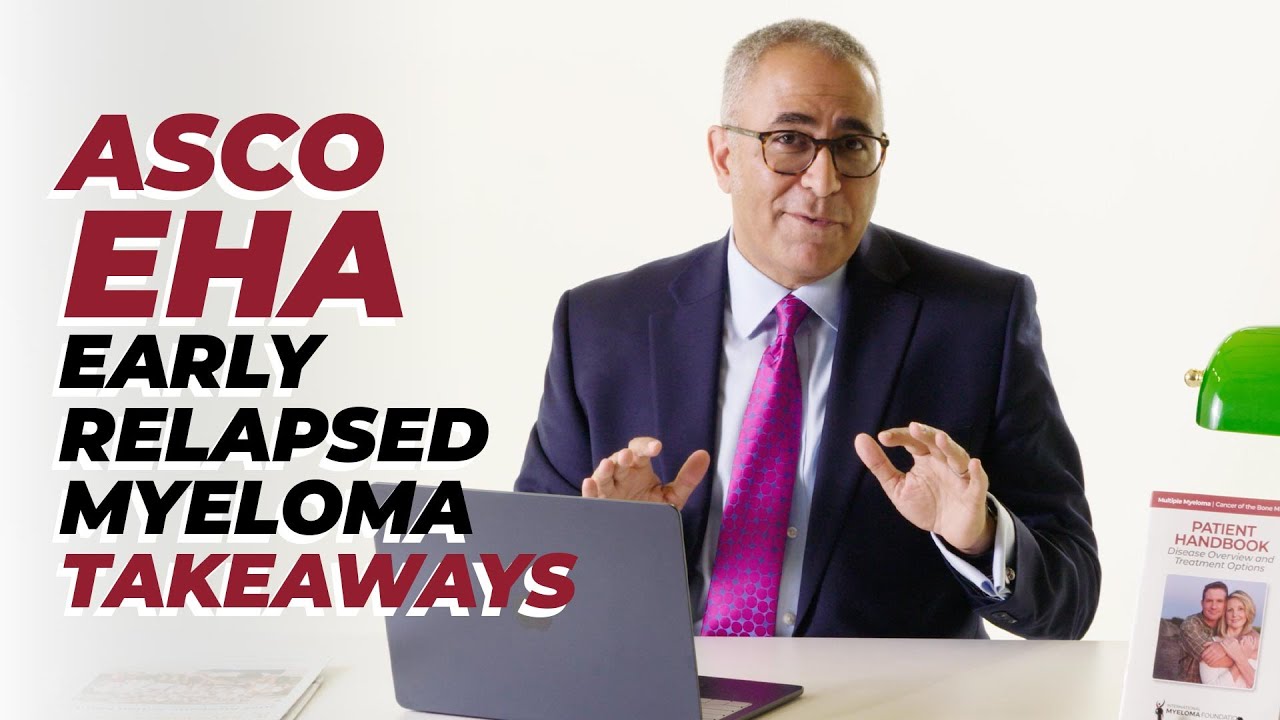
In my overview of the top 10 developments in myeloma research from ASCO and EHA, I had divided them into three categories. We looked at newly diagnosed multiple myeloma, early relapsed myeloma patients who have had one to three prior lines of therapy, and late relapse patients who've had at least four prior lines of therapy. Today I'm going to dive into that second section, early relapse patients who have had one to three prior lines of therapy so that you know what's new, but also more importantly, how it impacts the way we're treating our patients. And please subscribe to our YouTube channel, so you can see the next video in this series where I dive deep into late relapse as there are some very exciting things happening in that category of multiple myeloma.
Hi everyone. Dr. Joseph Mikhael here, Chief Medical Officer of the International Myeloma Foundation, a not-for-profit organization dedicated to improving the quality of life of myeloma patients as we seek prevention and a cure.
Although we have great therapies for newly diagnosed multiple myeloma, and hopefully you've watched the prior video to know about the great developments in newly diagnosed multiple myeloma. The sad reality is unfortunately, the vast majority of patients will relapse, the word we use for meaning the disease will come back. So what do we do at relapse? Well, typically we divide relapse into early relapse and late relapse. I'm going to be focusing now in early relapse, meaning patients who've had only one to three prior lines of treatment. We define a line of treatment as a treatment that's given until the disease relapses again. Well, this is actually a very exciting area in multiple myeloma. We've seen great strides in newly diagnosed and late relapse, but recently remarkable number of research projects and clinical trials in early relapse multiple myeloma. And today I'm going to talk about three different areas with you.
The first of these areas is the reintroduction of belantamab mafodotin, sometimes called Bela, or the trade name is Blenrep. This was a drug that was approved, but unfortunately a few years ago it was withdrawn from the market because of a negative clinical trial. And we all feel it'll be coming back very soon on the basis of two very important clinical trials known as DREAMM-7 and DREAMM-8. In these clinical trials, we compared three drugs to three drugs, belantamab added to bortezomib and dexamethasone or belantamab added to pomalidomide and dexamethasone versus standard triplet therapies. And in both of these trials, we saw a dramatic improvement of adding belantamab to either bortezomib and dexamethasone or to pomalidomide and dexamethasone. That we knew, but what we've seen in the updates of these trials is the ongoing benefit of this triplet combination and particular the benefit in giving this to patients who have high-risk multiple myeloma, which is often a challenging area of multiple myeloma to treat.
Now, to remind ourselves, belantamab is what we call an antibody-drug conjugate. It just means it's a drug. It's an antibody that hooks onto something on the myeloma cell called BCMA or B-cell maturation antigen. But the drug conjugate part means that it has what I sometimes think of as a backpack, a toxin that is very damaging to the cell. And so when it hooks onto the cell, it drops this backpack into it to help destroy the cell. That's why the drug has two names, belantamab mafodotin. The mafidotin is that toxic substance that gets inserted into the cell. Now, one of the challenges with this drug is that it's actually really quite easy to administer, but patients can have some eye-related side effects. It can cause some blurriness of vision. But we've learned a lot about this drug over the last few years and we've learned if we give it much less frequently, the likelihood of those eye-related side effects is much less.
I think this is very exciting because I believe that there are many patients who can really benefit from the belantamab drug, in particular, patients who may not be eligible for CAR T-cell therapy or patients who want a less frequent treatment because this drug is likely to be given every eight or even every 12 weeks. So seeing these DREAMM-7 and DREAMM-8 trials come to fruition, we really believe that we will have belantamab back in the clinic very soon. The second area I want to talk to you about is a different way of giving a drug that we already give, the drug isatuximab or Sarclisa. It's a CD38 antibody, not dissimilar to daratumumab or Darzalex, and we use now isatuximab in front-line therapy and indeed in relapse therapy. And historically we've given this drug intravenously, but they've developed a new subcutaneous or into the skin version of the drug known as an OBI or on on-body injector.
So it's not even actually the standard subcutaneous injection that a nurse may give. It's a little device that sticks to the skin that has a tiny needle inside of it that pushes into the skin and injects the drug. Over about 12 to 15 minutes is the average for the majority of patients receiving this. What was fascinating about this is not only can it avoid us giving an IV, but it's a very easily administered drug. Patients were very satisfied with the way it was given. We didn't see a lot of side effects from it. And looking to the future, this might be a way even for us to treat patients outside of our classic clinics and infusion centers and hospitals and possibly even at home. So more to come on that, it's not yet approved, but we anticipate in the near future that we will likely have this new subcutaneous formulation or on-body injector device for isatuximab.
The third and final area I want to think with you about are bispecific antibodies. So right now, bispecific antibodies, and of course they're called bispecific because they have two arms. One arm hooks onto the myeloma, another arm hooks onto a T-cell to engage it or activate it to destroy the multiple myeloma. They're currently being used in late relapse, in patients who've had at least four prior lines of therapy. But there was a whole series of a research studies and clinical trials presented in us now bringing these bispecific antibodies, drugs like teclistamab, talquetamab, elranatamab, even a new one that is likely to be FDA approved very soon, linvoseltamab, and using them early on and often using them in combination. And I'm excited about this for several reasons. One, we know these drugs work very well in late relapse, which means they're almost definitely going to work even better in early relapse.
But not only so, we can see that we can combine them with other drugs to even further boost their effect. This is going to yet give us even more options for our patients in the early relapse setting. And that really is perhaps the summary of what is happening in early relapse, is more and more options being developed, whether it is going to be an antibody drug conjugate in different forms of triplets, whether it's going to be a bispecific antibody of different types used with different combinations or even the way we administer it subcutaneously instead of intravenously. This is going to provide our patients rich options of choice in addition to the choices that we have now, which include CAR T-cell therapy and other triplet combinations that we use more regularly.
Thanks so much for watching. If you found this video helpful, please subscribe to the IMF's YouTube channel so you'll never miss updates in myeloma research, in education and in support. In fact, if you want to learn more, here are a couple of videos you might be interested in.