

Dr. Joseph Mikhael:
In my overview of the top 10 developments in myeloma research from ASCO and EHA, we looked at three different categories of multiple myeloma, newly diagnosed multiple myeloma, early relapse, or patients who have had one to three prior lines of therapy, and late relapse, patients who've had at least four prior lines of therapy.
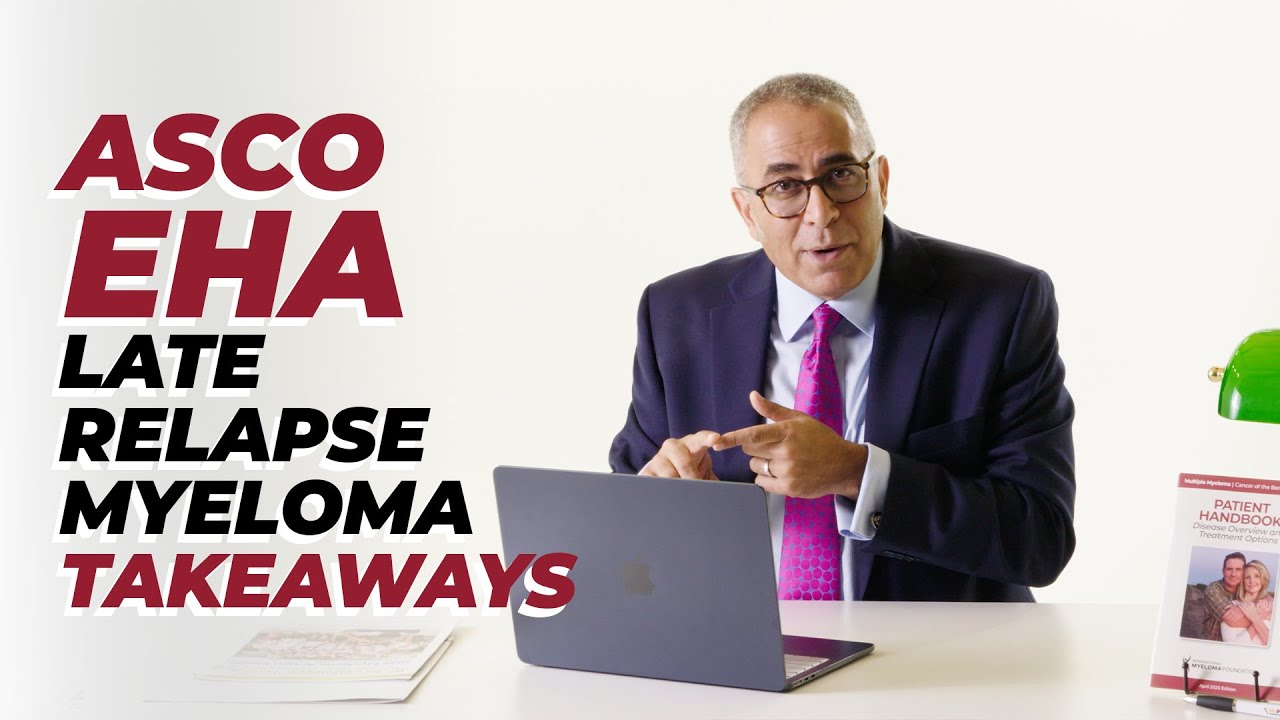
Well, today I'm going to dive deeper into that third category of late relapse, patients who have had at least four prior lines of therapy. This is important, because you can learn what's new, and more importantly, what's changing practice in multiple myeloma, and this is an area that I'm particularly excited to share with you.
Hopefully you've already subscribed to our YouTube channel, as you've seen the prior episodes of newly diagnosed and early relapse, and now we've come to the third set in this series. Hi everybody, Dr. Joseph Mikhael here, Chief Medical Officer of the International Myeloma Foundation, where we are committed to improving the quality of life of patients as we seek prevention and a cure.
When we think of late relapse in multiple myeloma, which we typically define as patients who have had at least four prior lines of therapy, we realize that this is a challenging area of myeloma to treat. However, there is tremendous research going on in this area and we're seeing patients do better than ever before with a lot of these new therapies.
As we think about the great research that was presented at ASCO and EHA, I want to talk to you today about four different abstracts in late relapse multiple myeloma. I'm going to start with the first one that I would argue if I could only talk about one abstract from ASCO and EHA, it would be this abstract, because it really has had an impact in our community and was even featured in The New York Times. This was the long-term follow-up of the CARTITUDE-1 trial, so these are patients that had multiple lines of therapy before who were treated with cilta-cel or CARVYKTI as a one-time CAR-T cell infusion. The key finding of this study was that one-third of patients, or 33% of patients at five years were still completely disease-free.
Now, we need to understand these are patients based on the number of treatments they'd had previously who typically unfortunately would only live about a year, and were likely to be treated with something that might keep them in remission for up to six months, so to see a third of these patients five years later still completely disease-free was very exciting for us. In fact, it triggered a bit of a conversation around how we define cure in multiple myeloma and how do we think of cure in multiple myeloma. I'm not saying that those patients are cured, but those patients are now not getting ongoing myeloma therapy and have no active evidence of that disease.
So I think this is very exciting for us, not only because of its use in late relapse, but now we're bringing CAR T-cell therapy earlier in myeloma care into early relapse and even doing clinical trials in frontline therapy in newly diagnosed multiple myeloma, and we hope that the impact could be even greater as we bring it sooner.
The second study that was particularly important, really two studies together was the use of what we call trispecific antibodies. So right now we have bispecific antibodies, which meaning two arms, one arm hooks onto the myeloma cell based on a target that we know exists on the myeloma cell, and the other hooks onto a T-cell to engage it or to activate it to destroy the myeloma. Well, to get more precise binding to the myeloma cell, we've developed trispecifics and there were two particular that we saw presented. One hooks onto to the CD38 and the BCMA target on the myeloma cell, the other one hooked onto to the BCMA target and the GPRC5D target. We know that these are different targets that we can leverage in grabbing onto the myeloma cell.
What I found very interesting about these two studies was that that more precise, or if you will, comprehensive binding of the myeloma cell really led to outstanding results in terms of the response rates, but also reduced amounts of the side effects that we often see if we try to combine two drugs together to leverage those two different targets on the myeloma cell. So, can we hit that sweet spot where we get just as much efficacy with even more safety is something that we need time to determine, but it was very exciting to see that that kind of technology, which in many ways kind of blows my mind how we can develop this technology, but it's wonderful to see how we could potentially leverage two targets at the same time in the myeloma cell. Not only so lastly, it often led to the drugs being given less frequently. For the J&J trispecific where we bound BCMA and GPRC5D, now this drug is given once monthly, which is even less frequent than when we give it as a bispecific.
The third area and the third abstract I really want to focus in on is a new CAR T-cell therapy called anito-cel. We heard a little bit about it last year at the American Society of Hematology annual meeting, but we got some updates in this. One of the reasons why I think this drug is particularly important is it has a little bit of a different design than some of the prior CAR T-cell therapies. It still binds BCMA, but it binds it in such a way that we anticipate that not only will we have a very effective therapy, and now they're demonstrating continued over 90% response rate, but what's also interesting is that we've seen less of certain side effects, in particular the neurological side effects.
This has been a bit of a challenge for us in CAR T-cell therapy where some patients develop neurological effects. Sometimes they're short-lived and early on, but some of them can be quite severe later, and it doesn't appear that we're seeing that yet with anito-cel. So, that may offer us an opportunity to still leverage the great efficacy or the great response rate that we see with CAR T-cell therapy, but with less of the side effects. So, more of that to come. It's not yet approved for use, but it is continuing on in clinical trials.
Then lastly, the fourth area and the fourth abstract I want to focus in on was the RedirecTT-1 trial in particular that focused in a very challenging area of multiple myeloma. This is a trial that combines two bispecific drugs that we give together, teclistamab and talquetamab, but they wanted to study that potent combination in patients in whom historically it's been very hard to treat their myeloma, because they have something called EMD or extra medullary disease.
The medulla's sort of an old word that we use in myeloma for the bone marrow, and typically myeloma lives in the bone marrow. We talk about it as being a cancer of the plasma cells that live in the bone marrow, but sometimes it can escape the bone marrow and live in different parts of the body, what we call the soft tissues, the non-bony parts of our body, that we define as extra medullary disease. As I've mentioned before, historically it's been very hard to treat extra medullary disease. Patients don't respond as well, their disease comes back more aggressively. But exciting was this trial where they combined these two drugs, gave it to patients with extra medullary disease, and we saw literally a doubling of the typical response rate that we've seen with other therapies at nearly 80% of patients responding to this combination.
So this I think is very important, 'cause it gives us hope in one of the most challenging areas of multiple myeloma in that extra medullary space, and I think is going to give greater options for our patients in the future who have this aggressive form of multiple myeloma. So, a lot going on in late relapse. We're seeing the long-term benefits of CAR T-cell therapy. We have new technologies coming with trispecific antibodies and even new forms of CAR T-cell therapy, and even ways of leveraging the bispecifics we already have of using them in combination for those patients with the most aggressive disease.
These are really exciting times in multiple myeloma, and we trust that this is helpful to you as you think through myeloma and as you're cared for multiple myeloma, knowing that if you understand these things better, it is going to improve your outcomes in the long-term. Well, thanks much for joining me in this four-part series as we have looked together at the exciting research that's been presented at ASCO, the American Society of Clinical Oncology, and EHA, the European Hematology Association.
Thanks so much for watching. If you found this video helpful, please subscribe to the IMF's YouTube channel so you'll never miss updates in myeloma research, in education and in support. In fact, if you want to learn more, here are a couple of videos you might be interested in.