


Dr. Joseph Mikhael:
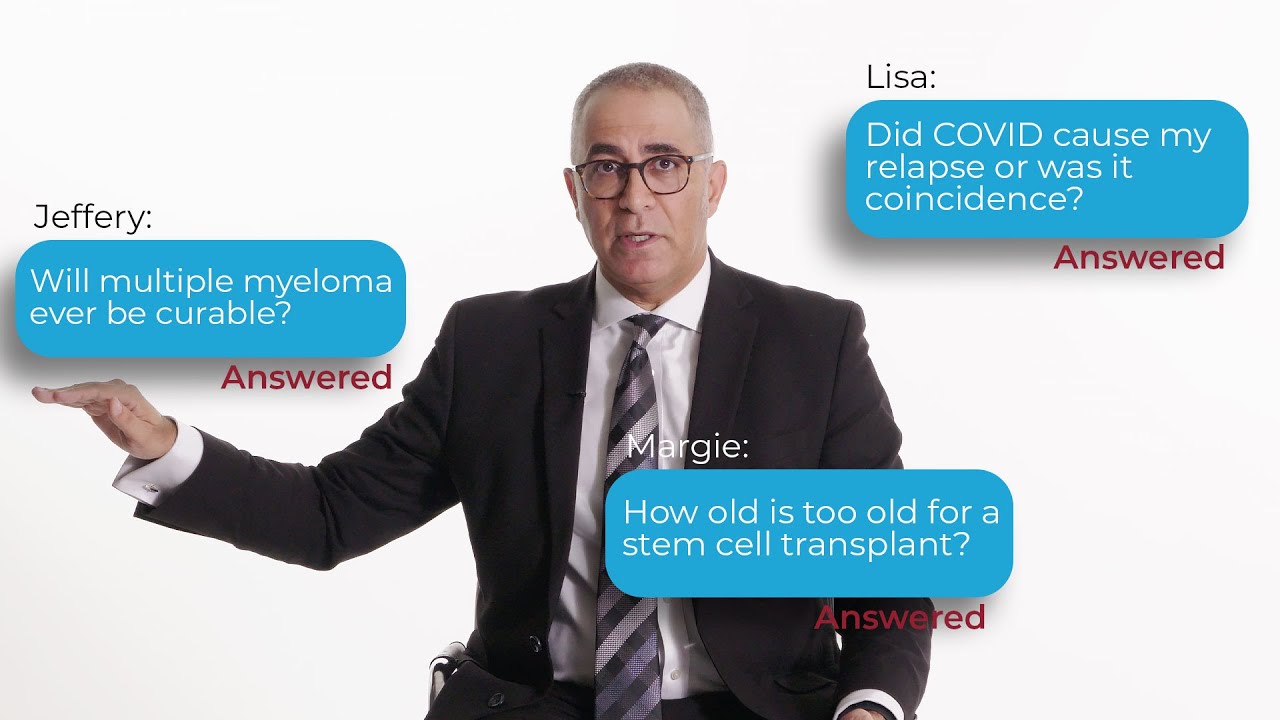
Will myeloma ever be curable? My CAR T-cell therapy worked, but can my disease come back because of surgery? Did COVID cause my relapse, or was it just a coincidence? Hi, everybody. Dr. Joseph Mikhael here, Chief Medical Officer of the International Myeloma Foundation. On a regular basis, I host a Q&A on Facebook through one of our Facebook Live events. At the time, I can never get through all of the questions, so I'm going to spend some time today going through many of the questions that have been submitted to us. Always encourage you to submit questions to the IMF, whether it's on Facebook or on X or on Instagram or any of our social media outlets.
Just before I get into the questions, I want to invite you to our next Facebook Live because this is a special one. Every year in December, we have the annual meeting of the American Society of Hematology. This is where 30,000 people gather to talk about the latest and greatest in hematology and, of course, multiple myeloma. At that Facebook Live, I'm going to be joined by support group leaders who have been through the meeting, and we're going to be talking about what the results of all this great research were and what it means for patients. You're not going to want to miss it.
All right, let's dive into our first question. Jeffrey writes to us, "Dr. Joe, will multiple myeloma ever be curable? How close are we?" Jeffrey, I love this question because when I started in multiple myeloma 25 years ago, we never used the word cure, and I'm not going to say we're at the verge of a cure or that we're super close, but let me put it this way. We are so much closer now than we've ever been before. There have always been a fraction of patients who, when given just a little bit of treatment, go into a very long remission. That fraction when I started in myeloma was maybe 3% or 4% of patients. Now, that's more like 30 or 40% of patients. That is how we move closer and closer to a cure, where larger fraction of patients are able to be treated with a defined amount of treatment and then go into remission for a long time.
There are a lot of diseases we still haven't cured, like high blood pressure and diabetes, but we've made huge strides forward in multiple myeloma, and I really hope that we will be close to a cure by the next time we do a Q&A. Thanks, Jeffrey, for your great question.
Here's a question from Leslie. "My CAR T-cell therapy worked, and my myeloma is gone," and I'm really happy to hear that, Leslie, "but can it come back after surgery or getting sick?" It's a great question, and the short answer is no. We don't really see myeloma reawakening because of other things like being sick from another illness or from having surgery, so don't be afraid to have surgery if it's indicated, or don't be afraid that if you get a cold or an illness that it's necessarily going to trigger the myeloma to come back. We don't fully know and understand why myeloma comes back. We know a lot of it has to do with the fact that we haven't fully gotten rid of it the first time around, but I would not be afraid of those things causing a relapse.
Next question comes from Lisa. "Can COVID cause a myeloma relapse after remission, or was it coincidence that my husband relapsed a few months later?" Well, again, I think, here, this is a coincidence. Sadly, we learned a lot of lessons during the pandemic that in some ways we wish we never had to learn. We learned, of course, that myeloma patients are at an increased risk of having COVID because their immune systems are affected by the disease and by the treatment that they're on. But we also did learn that it was really not COVID that would cause a relapse in someone's disease. Sometimes when people have either an infection or even a vaccination for an infection, we can see measures of their immune system go up, and sometimes that can be interpreted as their myeloma going up, but it's not a continuous thing. It does not lead to a genuine relapse of multiple myeloma.
Let's move on to Sharon who starts her question by saying oops. "Oops, another fracture. Does multiple myeloma cause or contribute to fractures?" And unfortunately the answer here is yes. The sort of classic, as we used to call it, CRAB criteria, C-R-A-B, stand for the four key things we often see with multiple myeloma. Calcium elevation, renal or kidney disease, anemia or a low red blood cell count, or bone disease. And bone disease can be as simple as a little thinning of the bone or as severe as a fracture. Unfortunately, myeloma can contribute to the thinning of the bone and even ultimately a fracture. This should be looked at in the context of the whole of someone's multiple myeloma so that further fractures can be prevented.
Let's look to another question from Margie. "How old is too old for a stem cell transplant?" Well, that's a great question. And as I get older, my perspective on this tends to change. We've learned that it's not about a defined age that determines if someone is eligible or ineligible for an autologous stem cell transplant. It has a lot more to do with what we call their frailty or their fitness level, and so we don't try to choose an exact age and say, "At this age, we do transplant, and at this age we don't do transplant." It's important for us, as transplanters, that we carefully assess our patients and determine if this is going to be risky for them or less risky for them based on their, what we call, comorbidities or other illnesses they may have, their cardiovascular and pulmonary, or their heart and lung, function to make that determination. It's really not about a specific age.
Here's another great question. "If I'm in remission and feel great," ... By the way, if you're feeling great, I'm feeling great about you feeling great. "After skipping a stem cell transplant, do I still need treatment?" Well, of course, it's hard to comment on the specifics of your case without knowing all of the details, but there are some patients who, when they've received their initial therapy, often we call it induction therapy to induce a remission, we then may give them a stem cell transplant to further deepen that remission.
Some patients opt not to have a stem cell transplant and just, if you will, save that option for later, and that's a very reasonable approach depending on the situation. But typically when that happens, we do keep people on maintenance therapy, as we call it, or continuous therapy, to reduce the risk of the disease coming back because we've learned, if we just stop therapy right then, the disease is more likely to come back sooner. Although you're feeling great, and I'm happy about that, we want to make sure that we keep the disease down for longer, so typically people will remain on some form of treatment.
Next question from Judith. "Can you be too old for CAR T or bispecifics?" Well, again, we don't choose a specific age to say someone's eligible or not eligible, but let me note that, for CAR T in particular, we do have patients who are not eligible for a stem cell transplant but are still eligible for CAR T. in the first large CAR T clinical trial, there was a patient on that study at the age of 84. We typically don't try to exclude patients based on their age, but we do an assessment of their general health. And in fact, for bispecific antibodies, we can even use those in patients who are older and are more frail who may not be eligible for CAR T. This is worthy of a good discussion with the team because you might be surprised how we can do CAR T-cell therapy and bispecific antibody therapy in patients in their 80s and even into their 90s.
Here's another great question from Mindy who says, "Besides Zometa," which is also called zoledronic acid, "what else can patients do to strengthen their bones?" I love this question, Mindy, because when we think of how myeloma affects the body, we know that one of the areas that can be affected are the bones. They can be thin. One of the reasons why, when we treat the myeloma, we also give people a drug called Zometa, or there is another, a drug, called denosumab, or Xgeva, which helps strengthen the bones. The first step is to be able to take one of those two therapies. But in addition, we know that other things contribute to good bone health in general, and this includes exercise, calcium supplementation through the orders of your physician, and it may indeed include some dietary factors including a calcium intake because I have learned when patients also take ownership of their disease, not just by the treatment that they're given, but through their own lifestyle, they feel like greater partners in conquering their disease, and it can contribute to their wellness.
Well, that's about all I can get to today, but do you still have more questions for me? Please add them in the comments below or through any of our social media channels. Use the hashtag, #asktheIMF, and I'll do my very best to answer them either in a Facebook Live or through a video or through any other means that we communicate with the myeloma community. If your question is of a more personal nature, feel free to reach out to our info line so you can talk to someone about that question. Also, make sure that you come to myeloma.org and learn about all the resources available to you, including our upcoming seminars and webinars, so you can learn more about multiple myeloma.
Thanks so much for watching. If you found this video helpful, please subscribe to the IMF's YouTube channel so you'll never miss updates in myeloma research, in education, and in support. In fact, if you want to learn more, here are a couple of videos you might be interested in.

