


Shaji Kumar:
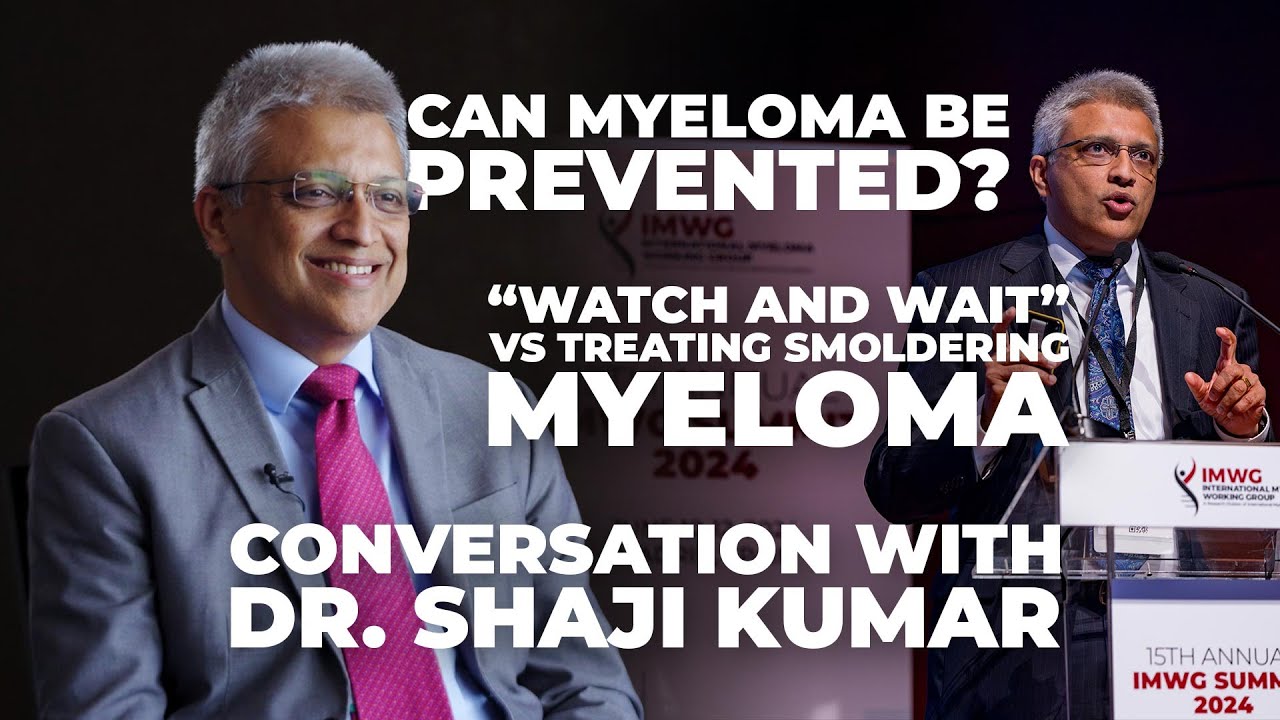
For the longest time we said patients with smoldering myeloma should be just watched because there is a real danger that we could be hurting them by giving them treatments with side effects without necessarily improving their outcomes. We actually have clinical trials that have proven that early intervention is actually important or beneficial for patients with smoldering myeloma. We can actually delay the progression to active myeloma. In many cancers we are able to intervene and prevent the cancer from ever happening. So that is one of the goals of research to see if we can actually make the myeloma go away.
My name is Shaji Kumar. I am a hematologist at the Mayo Clinic in Rochester, Minnesota. I got interested in myeloma because of Professor Robert Kyle, who is considered to be father of myeloma.
We have been involved with research both in the clinical trial area as well as trying to understand the biology of the plasma cell disorders. A lot of what I have done has been trying to understand the risk of progression to active myeloma, how we can treat myeloma, how myeloma becomes resistant to some of the therapies that we use currently, and also doing clinical trials, trying to introduce new therapies in the field.
When patients are given the diagnosis of multiple myeloma, they often feel that their whole life has been taken up by the disease. Yes we have a diagnosis that at least today may be incurable, but treatments are available for managing that very well. And our goal here is not only just getting myeloma into remission, but also making sure that you actually need a full life. We want them to live with myeloma, not just make life around myeloma.
My name is Shaji Kumar. I am a hematologist at the Mayo Clinic in Rochester, Minnesota. I did my initial medical training in India in New Delhi at the All India Institute of Medical Sciences where I got my medical degree. I did a residency in internal medicine, and then came to Mayo Clinic to do my internal medicine residency, followed by my hematology oncology fellowship. I got interested in myeloma because of an individual whom everybody in the field knows very well, that is Professor Robert Kyle, who is considered to be father of myeloma. He along with many other people in the division of hematology and the large myeloma group, and the research that we had ongoing at that time in myeloma at Mayo Clinic attracted me to this field. And I started doing research and started seeing patients with myeloma. I have been at Mayo Clinic since then as part of the myeloma group in the division of hematology.
During this past 20 plus years that I have been there taking care of patients with myeloma, I have been involved with research both in the clinical trial area as well as trying to understand the biology of the plasma cell disorders. And many of the research that I have been involved with has been quite broad, not just focused on multiple myeloma, but also trying to the precursor conditions of myeloma like monoclonal gammopathy of undetermined significance, and also smoldering myeloma, and also some other related conditions like light chain amyloidosis, which is also a related condition that can be quite deadly.
So over this time, a lot of what I have done has been trying to understand the risk of progression to active myeloma, how we can treat myeloma, how myeloma becomes resistant to some of the therapies that we use currently, and also doing clinical trials, trying to introduce new therapies in the field.
Speaker 2:
And how did you become familiar with the International Myeloma Foundation and after with IMF also with the International Myeloma Working Group?
Shaji Kumar:
The International Myeloma Foundation has been around for a long time helping patients with multiple myeloma. So it's only natural that I came across its activities, and also the fact that Dr. Kyle played a major role as have many other people at Mayo Clinic, including Dr. Vincent Rajkumar, who introduced me to the activities of International Myeloma Foundation. And I have been a member of the International Myeloma Working Group, which is obviously the scientific arm of the International Myeloma Foundation and has been responsible for developing some of the guidelines and also many of the disease definitions, response criteria, and many, many important aspects of how we take care of myeloma patients have been outlined and developed by the International Myeloma Working Group and its membership.
And this is an organization that has played a major role in how myeloma is taken care of today. And its membership have grown over the past two decades that I have been part of it, from under a hundred members to over several hundred members at this point in time. And it's a wonderful community to be part of because it's not only that we are doing all this wonderful work driving the research and the field forward, but it also gives us the opportunity to interact with each other, mix with each other, and get to know about all the others who are working in the field.
Speaker 2:
On the new definition of high-risk multiple myeloma, how do you feel that this new set of guidelines, does it immediately address the unmet needs of high-risk smoldering myeloma patients? And moving forward, how will the new consensus definition of HRMM help improve outcomes for patients with high-risk disease?
Shaji Kumar:
So as with all the guidelines that we do for the International Myeloma Working Group, this one was also in the making for a long time. And we make it a point that we don't come up with guidelines very often, but we wait until something is really changed in the field so that we can actually make guidelines that are meaningful addition to what we are doing in the field.
So the high-risk multiple myeloma has been a challenging area for a long period of time. And one of the challenges in addition to the fact that we don't necessarily always have the best treatment for patients with high-risk myeloma, has been the way we define high-risk myeloma. There has been a lot of disparity in terms of who is the true patient with high-risk myeloma. What is the right definition? So the field now has a lot of data from all the recent clinical trials and the new therapies, and also better understanding of the biology.
So this was a very opportune moment for the International Myeloma Working Group and the International Myeloma Society, and again, a very overlapping group of individuals because all of us who are part of IMWG are also part of the International Myeloma Society. So we came together to actually look at the data very carefully and then develop a risk stratification system that is clearly based on the best available data, the most current data, including data that was not published yet in order to come up with a uniform definition.
Now one would ask why you go through the exercise of developing yet one more definition? The main reason was we needed to have one definition that the community accepts that'll allow us to, again, one design clinical trials that are specifically targeted to patients with high-risk myeloma, which is an unmet need in the field. Because as I said, patients with high-risk myeloma are not doing as the rest of the patients with myeloma with survival that is often half or less than those of the patients with standard risk.
So we need to develop new therapies. For that you need to do trials that are enrolling these high-risk patients in a uniform fashion. So tomorrow if we have a clinical trial in the U.S. looking at a particular regimen for high-risk and something that's happening in Europe looking at a different regimen, we are now enrolling exactly the identical types of patients so that we can actually compare the results.
The second thing is also reflecting the advances in the field. So a lot of the things that we had thought about as high-risk in the past are no longer high-risk because the treatments have improved. And so we don't want people to think they have high-risk myeloma when the current treatments pretty much mitigate some of the risks that came with that definition based on our previous understanding.
So all in all, I think this whole effort was to have a uniform set of guidelines that everybody follows in terms of enrolling patients on clinical trials, comparing the results from different clinical trials, and also going forward, defining the outcomes of patients with high-risk multiple myeloma.
And I think we also wanted to focus on things which are very objective, which is genomics. So if you look at the new risk stratification system is primarily based on genetics of myeloma, which we have known for a long time is the primary driver of the differences that we see in the outcomes in patients with myeloma.
Speaker 2:
So as a standing co-chair of the IMWG working committee on smoldering multiple myeloma along with Professor Maria Mateos, what are your views on active monitoring versus daratumumab for high-risk smoldering, and the recent ODAC decision favoring 6-2 vote recommending daratumumab as a treatment for high-risk SMM?
Shaji Kumar:
It's been really fascinating to see how this field of smoldering myeloma and how our approach to this particular intervening stage has evolved over the past few years. For the longest time, we said patients with smoldering myeloma should be just watched because there is a real danger that we could be hurting them by giving them treatments with side effects without necessarily improving their outcomes. Now we have actually better treatments, treatments which are highly effective with low toxicity or less side effects than what we had in the past. We also have a way to identify the patients who are likely to progress from smoldering myeloma to active myeloma, thanks to the IMWG risk score that was developed as part of an IMF initiative a few years ago. And finally, we actually have clinical trials that have proven that early intervention is actually important or beneficial for patients with smoldering myeloma.
So I think we have checked all three boxes in terms of being able to identify the right patient having a potential treatment which has shown benefit. And it's not just daratumumab as you've mentioned, they have been a couple of the trials in the past that have looked at lenalidomide with or without dexamethasone and both those trials, and in fact the very first trial was done by Dr. Mateos my co-chair on the committee, which showed that we can actually delay the progression to active myeloma by treating patients early with lenalidomide.
And the most recent trial with the daratumumab was even more convincing because here we saw that not only did the myeloma come back later in those patients who got daratumumab, patients who got daratumumab also lived longer. So clearly now we have proof that we need to do something for those patients who are at a high-risk of transitioning to active myeloma.
I think there's still an open debate as to what is the right approach. I think there's more consensus that something needs to be done and more consensus about who needs that kind of intervention. But there is still debate as to what that intervention needs to be. So there are ongoing trials that are looking at some of the myeloma type therapies to see if we can actually improve upon the results that we saw from the AQUILA trial that looked at daratumumab.
But also it raises an important concept of early intervention, which is can we potentially cure this before it becomes a full-blown malignancy. In many cancers, we are able to intervene and prevent the cancer from ever happening. So that is one of the goals of research, and that is, again, spearheaded by the Black Swan Project. Through the International Myeloma Foundation, we had the ASCENT trial that looked at a very intense therapy but given for a very short period of time to see if we can actually make the myeloma go away. We still don't know the long-term results of some of that trial, but we are already thinking about what is the next trial that we can do that can leverage some of the newer treatments like the immunotherapies, again, given it for a short period of time, but potentially maybe eradicate the tumor cells in some patients at least.
Speaker 2:
What new contributions in research does the newly formed IMF Scientific Advisory Board have in store for the myeloma community?
Shaji Kumar:
I'm again, honored to be part of the Scientific Advisory Board of the IMF. I think it's again going to play a very important role in setting the stage of future research that the IMF, the IMWG will be doing. Again, we have different organizations but we all working towards the same goal of making myeloma not a problem anymore and making sure our patients are living their full life. And I think the major goal for the Scientific Advisory Board is to set the agenda, identify the priority problems that we need to focus on, and also identifying which among those should be the focus of the IMF activities.
Obviously there are lots of different things that need to be addressed and we don't need to be addressing every one of them. There are different organizations that are trying to address different problems. And so we can, again, focus on where we are the best at addressing and which problems, and identify those, and then decide what is the strategy to address the problem.
So is it a clinical trial like the ASCENT trial we talked about? Is it a screening study like the iStopMM study that was done as part of the Black Swan Project? Or is it trying to understand why some patients with myeloma live long-term with very minimal treatment, some of those exceptional responders to the initial therapy?
Understanding the biology of that might give us some clues as to how we may be able to cure this in a more reliable fashion for some of those patients. So I think it's a key goal. The key mandate is identifying the priority problems, identifying which ones we need to address, how we need to address them.
Speaker 2:
I understand. What do people ask you the most?
Shaji Kumar:
The single most common question that patients ask is why did it happen? Unfortunately, we don't have a good answer to it. Cancer is what I often think about as a perfect storm. It's often a confluence of multiple different things. Some things we have no control over. Some things we may have control over, but we don't necessarily realize it. So the genetic factors do play a role in myeloma as it does with other cancers. We know that first degree family relatives have an increased risk suggesting that there's a genetic component to it. We have identified some genetic variations of polymorphisms that can increase the risk of someone getting myeloma related disorders. So that's the genetic component of it.
The second is the environmental impact. We know that individuals growing up in farming communities, agricultural communities where they exposed to pesticides have a higher risk. We know that individuals who were first responders in 9/11, for example, have an increased risk. So clearly there is an environmental component. It could be chemicals, it could be radiation, it could be a variety of different things that could be contributing to it.
And there may be other lifestyle factors. We know that obesity is associated with an increased risk of progression from MGUS to myeloma. So there are probably elements in the environment as well as genetic that not only increases the risk of somebody actually getting that early lesion of monoclonal gammopathy, and there's also environment and genetic components that accelerate the process of transitioning from that early stage to advanced myeloma.
I think we are starting to understand more and more about it. Some of these large population-based studies, like the one Dr. Kyle did, clearly told us what is the natural history of this disease. Now we have data from the iStopMM that also tells us how often this happen, but also the opportunity to see this actually evolving in a large patient population or normal population so that we can actually get a better understanding of the factors that drive the progression.
Now we know these things happen very early in the life because we have done studies in young individuals as well where we are screened for monoclonal gammopathies, and we start seeing some of those earliest evidence of a monoclonal protein in the second decade of life. So 10 to 20 years. And from then on, the prevalence gradually increases. So it is very clear that the lesions or the initial insult at least happens very early on.
Now I think it may be hard for us to prevent some of those things because at happens such an early time point, but I think we can focus our attention on trying to understand why it evolves in some people and it descends in some people and other ways which are not very toxic, that we can potentially nip it in the bud, and identify early and intervene early. I really enjoy being part of the International Myeloma Foundation and participating in its activities.
In particular I think the International Myeloma Working Group does a very important job in terms of advancing the field and moving things forward. In addition to the guidelines that are being used by everyone treating patients with myeloma globally, it also brings together all the researchers in the field where we can actually talk about the problems that we face, talk about the challenges that we need to consider when we are designing our research, but also debating the pros and cons of various things that we do. Also asking each other very incisive questions so that we can bring out the best in each other and move the field forward.
So it's a really tight-knit community. We all respect each other. We respect each other's opinion. We may not agree all the time, but we respectfully disagree at times. But I think it's important for science to be always asking very important and pointed questions.
Now obviously what the IMF does outside of the IMWG activities, particularly with respect to the patients, is very, very important. Patients when they're diagnosed with myeloma is probably one of the most devastating news that they've probably ever had received in their life. And at that juncture, they often are clueless as to what to do next. And the immense resources that the IMF as other organizations do bring to bear is playing a major role in educating the patients, connecting them with the right providers, and essentially providing them with their guiding light at a time when they really need it.
So when patients are given the diagnosis of multiple myeloma, they often feel that their whole life has been taken up by the disease and there's nothing else left to do other than just the treatments in and out. And I think one of the things I've always try to tell patients, and as all my colleagues do, is that yes we have a diagnosis that at least today may be incurable, but treatments are available for managing that very well.
And our goal here is not only just getting myeloma into remission, but also making sure that you actually lead a full life, that you continue to do everything that you love to do in your life and not just focus on myeloma.
One of the things I always love talking to my patients about is their travel, and you do talk about it a lot more as patients survive the disease for longer periods of time. And I have many patients who right now, they don't wait for me to ask. They will tell me where all they have been to since they came and visited me last. So I think it's, again, travel is one thing. But I think it's always important for us to also understand what are the things they enjoy in life so that we make a real effort to try and make sure that they continue to do what is most important for them. We want them to not let myeloma take over their life. We want them to live with myeloma, not just make life around myeloma.
