



Dr. Joseph Mikhael:
What are the current treatment options for low-risk smoldering multiple myeloma? How fast does ultra-high-risk or double-hit myeloma progress compared to standard-risk myeloma? Can I take vitamin D supplements when being treated for multiple myeloma?
Hi everybody, Dr. Joseph Mikhael here, Chief Medical Officer of the International Myeloma Foundation. I have the privilege of hosting a live Q&A on facebook.com/myeloma, where I try to answer in real-time questions from our patients and from their care partners. Of course, I can never get to all of them, so here's a chance for me to try and catch up and answer some of these questions. Furthermore, people can submit questions through all of our social media channels using the hashtag #asktheIMF, whether it's X or Facebook or Instagram or LinkedIn, we want to be here to answer your questions. All right, let's dive into these great questions that have come to us today.
"What are the current treatment options for low-risk smoldering multiple myeloma?" Well, thanks for this great question. The short answer is we typically don't treat low-risk smoldering multiple myeloma, and let me explain why. As we always say, there's a huge spectrum of myeloma. At one end of the spectrum, there's MGUS, monoclonal gammopathy of undetermined significance, when people just have this little bit of a protein, but it's not damaging anything. At the other end of the spectrum is true active myeloma, where people absolutely need to be treated. In the middle is smoldering myeloma, and even within smoldering, we've made a division now to so-called high-risk smoldering myeloma, where we know that patients typically, within about two years, have a 50% chance of developing active myeloma, and then the lower risk smoldering myeloma, where patients have a lower risk of developing active myeloma in those two years or many more years.
And one of the reasons why we don't treat typically low-risk smoldering myeloma is that a large percentage of those patients will actually never develop myeloma, so we don't want to expose them to treatment that may not be necessary until they've reached a point where their disease is getting closer to becoming active. That being said, there's a lot of research and work in the area better trying to understand how best we define low-risk versus high-risk smoldering multiple myeloma so that we can be as astute as possible to predict, because we've all been humble that there are times when we can't really predict what's going to happen in the future with a smoldering myeloma patient. So short answer, we're not treating it now, but we're trying to define it better to determine who needs that treatment.
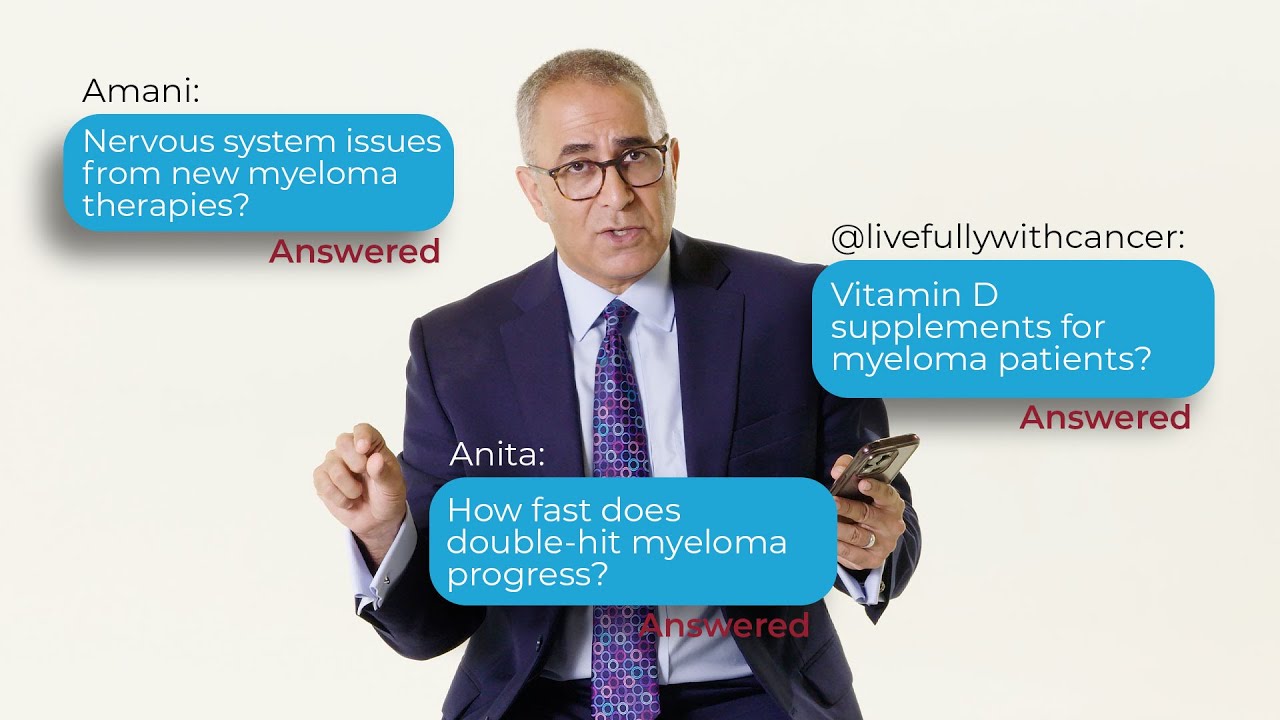
Here's another great question from Anita, "How fast does ultra-high risk," or sometimes called double-hit myeloma, "Progress compared to standard or even high-risk cases?" Well, Anita, you're highlighting something pretty complicated in myeloma and something that actually we've just come out with a brand new description of high-risk smoldering multiple myeloma, we call it risk stratification. This was a big joint effort between the International Myeloma Working Group and the International Myeloma Society to best define high-risk myeloma.
But your point is well-taken, which is that we find some patients have so-called ultra-high-risk myeloma, or they have more than one high-risk feature, sometimes, as you noted, calling it double-hit. It's hard to give you an exact number of precisely how much faster it tends to relapse than standard risk, or even, if you will, regular high-risk myeloma, but we know that it tends to happen considerably quickly, often in half the time that we would expect with standard risk myeloma. And this is one of the reasons why it's important for patients to know their risk status, because it can determine the frequency of testing, sometimes it can determine the intensity of the treatment that we receive, and in particular, how we really want to seek after MRD negativity or as little disease as possible, because even if there's just a little bit left, because it has a preponderance to grow quickly, it can end up coming back more quickly. Great question again.
"MGUS supposedly doesn't cause symptoms, or does it? I'm at the very early stage and already had a bone marrow biopsy. I think I feel MGUS symptoms. Can you speak to this?" Well, I think this is an important question, because it speaks to the importance of having that conversation with your healthcare team. The reality is MGUS is incredibly common, we see it in about 5% of people over the age of 40, and sometimes we can associate a symptom with it that may not actually be associated with it, because by definition, really, with MGUS, with a few exceptions, like an unusual neurological syndrome, we typically don't think of the MGUS by itself causing symptoms.
When symptoms happen, we typically associate that with true active multiple myeloma, the fatigue, the pain, that we can now connect to the myeloma. But that doesn't mean that an MGUS patient can't have fatigue for other reasons, they can't have pain for other reasons. So this is important to have a conversation with your provider to understand better what are the symptoms I'm having and could it really be from MGUS, and if so, is it really MGUS, or could they be from another cause?
Here's a great question that says, "I have multiple myeloma, but I also have severe rheumatoid disease with low vitamin D. Should I be taking vitamin D supplements or avoid them?" This is a particularly important question, because vitamin D is an issue in multiple myeloma. We know that, although it's more complicated than that, one of the things we can see with the vitamin D is it helps push calcium into the bones, and sometimes we know that myeloma can cause high calcium levels if the bones are being eroded. As we give people bone strength in our drugs, we typically actually supplement them with a little bit of calcium and a little bit of vitamin D.
In this situation that you've described, where you have a low vitamin D level, that should indeed be replaced under the supervision of your rheumatologist or whoever's taking care of your rheumatoid disease. But it should also be discussed with your oncologist or your myeloma provider, because we want to make sure that we give you enough, but not too much of that vitamin D. Typically, we don't give too much vitamin D very often, but we want to make sure that we don't get those supraphysiological doses that sometimes people want to take, thinking it's going to make it a lot better. But we know that many of us have vitamin D deficiency, either genetically or because of other diseases or either because of our lack of exposure to daylight, that we often need vitamin D supplementation.
Here's another great question from Holly, "Will getting an iron infusion affect tests results for multiple myeloma?" The quick answer here is it really should not interfere. We typically give iron to individuals who are iron deficient, often because either they're losing iron or they don't metabolize iron the way that they should or need to, and it usually should not affect in a negative way our myeloma tests. If anything, if the iron deficiency is contributing to anemia or a low red blood cell count, which we can often see also with myeloma, replacing the iron can improve that hemoglobin. I know there have been cases in my clinic over the years where we thought, oh, maybe this person's anemia is because of their myeloma, but it turned out actually just to be iron deficiency anemia, so we need to look for the cause of it and replace that iron. So in general, it should not be adversely affecting the testing.
All right, let's come to our last question, which is, "Is anyone else experiencing nervous system issues from the newer myeloma treatments?" Well, the quick answer is yes, unfortunately. Historically, we haven't always understood it, but there is a bit of a, can I call it, mysterious connection between myeloma and the nervous system. We don't always understand exactly how it happens, but very often, patients even before they're treated, for example, may have neuropathy. We know that some of the treatments that we give can worsen the nerves. We know that a lot of the newer treatments we're giving, like CAR T-cell therapy and bispecific antibodies, can cause neurological effects. Sometimes they're short-term, very limited things. Sometimes, in the long-term, they can be severe, even as severe as things like Parkinson's. So this is an active area of work and research, and one that we're trying to understand better so that we can reduce those toxicities.
We've learned that a few important principles are very helpful to us. As always, we need to talk to our patients very carefully about what symptoms they have, and you need to share with your doctor what symptoms you're having, if it's numbness, if it's burning, if it's tingling, visual changes, just about anything that you can think is neurologically, talk to your doctor about it. Two, we've learned that some of our treatments can cause neuropathy, things like bortezomib, and in the older days, thalidomide, and we can make dose adjustments or even discontinue some of those treatments to help improve the neurological outcomes. And more recently, with things like CAR T-cell therapy, we've learned that if we can reduce the burden of the myeloma before we give the T-cells back, we may be able to prevent some of those neurological effects, or later, give certain kinds of treatments to reduce those neurological symptoms once they've developed.
Well, that's all I have time for today, but thank you for these amazing questions, and please don't hesitate to reach out to us. Follow us on Facebook, when I do our Facebook lives where we answer questions, through any of our social media channels using the hashtag #asktheIMF, or just call us on the info line, or if you want in the middle of the night to have an answer to your question, try Milo, our AI chatbot, that's available to you at myeloma.org.

