


- Smoldering myeloma and bone marrow failure, can they coexist? Are there patients with myeloma who just don't have enough T-cells for T-cell therapy? Hi everybody. Dr. Joseph Mikhael here, Chief Medical Officer of the International Myeloma Foundation. I host on a regular basis a Facebook Live where we answer questions for patients. And sometimes we can't answer them all. So I'm gonna spend some time answering them today. But please remember, reach out to us with your questions. Any of our social media channels, use the hashtag #AskTheIMF, or call us directly in the info line. We're always happy to serve you at myeloma.org.
So let's dive into these questions that have been sent to me. Here's a great question from Irene. I have myeloma with amyloid or amyloidosis and it is affecting my kidneys. The nephrologist wants me to start peritoneal dialysis. I'm concerned about how much my body can take starting Kyprolis or carfilzomib. Well, we know that there are a fraction of myeloma patients who have also coexisting amyloidosis. This is where the light chains that are in the blood go through a bit of a confirmational change and deposit in the kidney. And so AL or amyloid light chain amyloidosis can actually be a completely separate condition from myeloma or it can coexist. And when they coexist, we look for the one that is, if you will, more dominant to be able to treat. But nonetheless here, when a patient does have to go onto dialysis, it does make it more complicated. I'm not gonna deny that it can be very challenging. Peritoneal dialysis sometimes is easier than hemo or blood dialysis because it can be controlled by the patient themselves and they do it on their own. So there are less frequent visits to the dialysis unit. And we know a lot of our myeloma treatments can be given while on dialysis because a third of myeloma patients have kidney dysfunction, and about 10% of them have true kidney failure. So we can do this, and that drug that was mentioned, carfilzomib or Kyprolis, can be given when someone is on dialysis. We trust that this will go well for you.
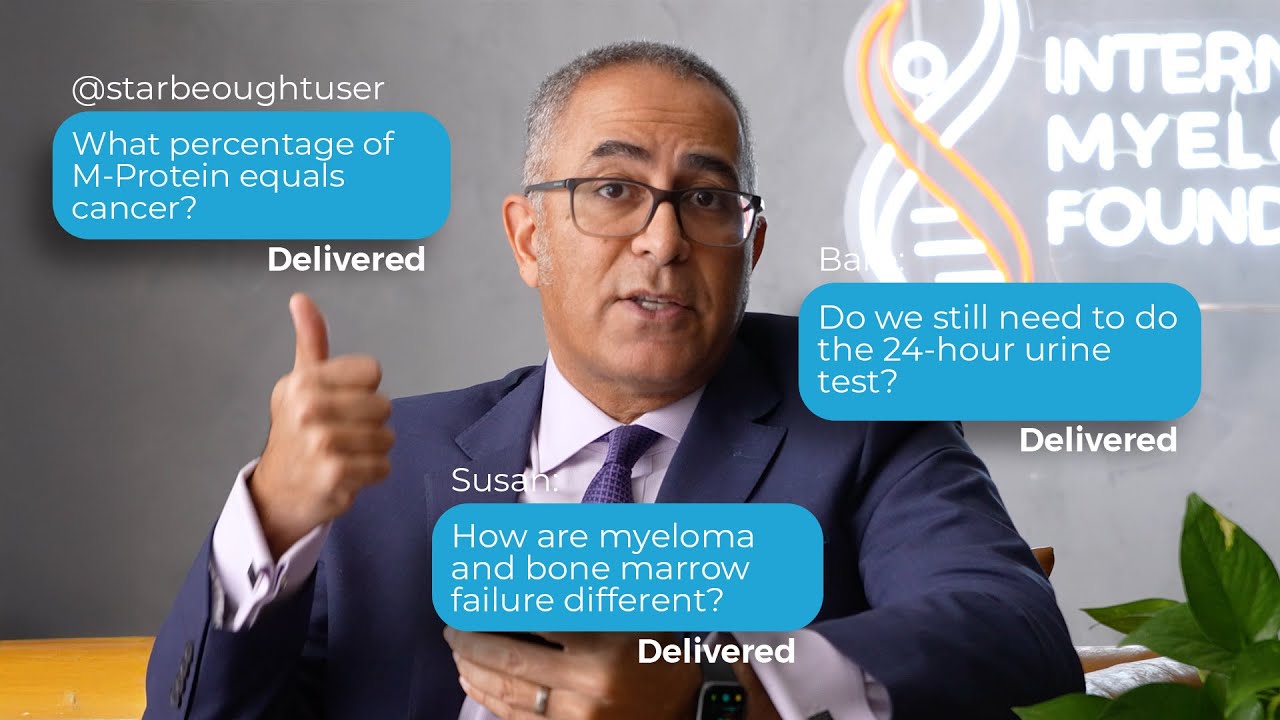
We have a second question here from Susan who's asking about her son who was diagnosed with both bone marrow failure and smoldering myeloma by their physician. How are they different? Can they coexist? And the patient himself, Susan's son, is only 25. So similar to our first question, we know that sometimes, even though multiple myeloma is a cancer of the part of the bone marrow called the plasma cell, which we think of an area called the lymphoid side. The other side of the marrow as it were is the myeloid side that typically gives rise to other cells, that sadly sometimes we can see issues on both sides. Bone marrow failure is an interesting condition where part of the factory of our blood, which is our bone marrow, is just not producing enough cells. We don't often see these two things coexisting, but it can happen. And we often, like in the previous question, we can look at treatments that could potentially affect both of them. If the myeloma is truly smoldering, we may not have to intervene with that and focus primarily on the bone marrow failure.
A question from Joanne. There are some of us who may be allergic to dexamethasone, but it seems that all clinical trials include dexamethasone. Is there a way to use something else like prednisone? Well thankfully, true Dex allergy is really quite rare. But there are some patients that are so-called intolerant to it and there are some of course who are truly allergic to it. And thankfully, we actually have multiple types of steroids. It's all part of the family of steroids. Prednisolone, solumedrol, prednisone as was mentioned. And this can be discussed with your physicians and healthcare team as to what other options exist, because although we tend to favor dexamethasone because it has such an immediate impact on the myeloma cell, we know that we can use prednisone and many of our studies do use alternate forms of steroid.
Here's a great question from Linda, my friend, Linda Huguelet, hi Linda. Thank you for this great question. She asks if teclistamab gets used at induction or in maintenance, and clearly Linda attended the Facebook live because I commented on some of the research where we're using this drug, teclistamab, which is a bispecific antibody FDA approved when someone has had at least four lines of therapy, but it's being tested in earlier lines. She's asking if it gets used in those earlier lines, how does that affect future CAR T-cell therapy? You ask a fantastic question, Linda, that is difficult to answer because we're still learning about this. But we have learned that we can go from CAR T-cell therapy to bispecific, we can go from bispecific to CAR T, and we can even, with the reintroduction of belantamab, use that in a sequencing process as well. Chances are if someone is on teclistamab and their disease is growing, we won't immediately go to a CAR T-cell therapy because we want to give their T-cells a little bit of a rest because these bispecifics are constantly engaging them, we give them a little bit of a rest, but it doesn't mean that we can't proceed with CAR T-cell therapy. And we're gaining more information about that. And I think that's really important. When you think of all these great options in myeloma, we don't want to ever close the door to a future option by giving it earlier on.
Here's a great question from Jill, who is one of our amazing Myeloma Voices support group leaders. So thanks Jill for what you did in being a virtual attendee of ASH as a Myeloma Voice with all of the blogging and the tweeting and the activity that our Myeloma Voices were doing that really echoed across the whole of the planet. And she asks a very scientific question, being a great scientist that you are, Jill, can you explain what the tumor microenvironment is and what we still need to learn about it to help address relapse after immunotherapies? Well Jill, I could spend hours boring everybody about this, but let me make it simple. Myeloma is not just about myeloma. Myeloma is about the environment it lives in, what we sometimes call the tumor microenvironment, that part of the bone marrow where those plasma cells that have become cancerous live. It's important because those plasma cells have a very unique relationship with their environment, and often can control that environment. And so a lot of the treatments that we have are not just designated to hit the myeloma, but to hit the environment that they're in. And that is really important because we wanna marshal that environment, which is really a part of the immune system to help take down myeloma. So your question is what is the tumor microenvironment and what do we still need to learn? Oh, there's still a lot to learn. We've learned a lot about T-cells and we now can engage them. We've learned a lot about B-cells, but there is still lots of areas of the microenvironment that we need to learn. And that's why myeloma research is so important. The IMF is committed to curing myeloma, and to cure myeloma, we need to understand myeloma, and to understand myeloma, we have to study it. And so the studying across the world and the research that's going on across the world to better understand the tumor microenvironment is absolutely fundamental to our future.
Here's a great question from Rebecca. Grateful to see high percentages of high-risk patients included in so many studies at ASH, rather than exclusions in general, around 20 to 30% of several participants had high-risk cytogenetics. I feel like this is a change from previous years. What do you attribute that change to? Very insightful, Rebecca, that you've detected that. We know that very often, we can divide myeloma into high-risk and standard risk myeloma with somewhere around a quarter of patients, at least initially in diagnosis, having high-risk disease. One of the reasons why we're seeing this more clearly identified is that we're gaining more consensus on how to identify high-risk disease, how to test for it. The testing has become more common and more prolific throughout not only academic centers, but in the community. And we've also come to learn that although we've made great progress in myeloma, high-risk myeloma can sometimes be very difficult to control. So we really want to make sure we don't exclude those patients with high-risk myeloma as we develop clinical trials.
Another great question comes in that says what percentage of M protein equals cancer? It would also be helpful to know when to be alarmed if that percentage goes up and at what rate it goes up. This is a fantastic question because we know that myeloma is a cancer of the plasma cells that makes that M protein or what we call monoclonal protein because it's an identical protein. That's really what cancer is in its essence is identical growth. Whether it's a breast lump or a lung tumor or a colon tumor, we know that it's a piece of tissue that grows out of control, that's, if you will, identical. We see that with myeloma, but we don't necessarily call it cancer every time we find a little bit of M protein because we know that 5% of all people over the age of 40 have a little bit of an M protein. That's what we call MGUS or Monoclonal Gammopathy of Undetermined Significance. And we know that that's so common, but a small percentage of those patients go on to develop smoldering myeloma and then go on to develop active myeloma. So what we do monitor, as you've noted in the question, is what is the size of the protein and how fast is it growing if it is growing? And we do try to draw some specific lines, but it's complicated, it isn't just an absolute number that says, "Oh, as soon as the M spike goes over 1.5 or two or three or four, is it active?" We look at the whole of the context of the rest of the patient, how they're feeling, what their other blood tests show, like the light chains, their hemoglobin, their kidney function, these other tumor markers. We have to look at them all together to determine when. And that's why we follow patients closely to make sure that we can see if there's any change in their numbers.
Karen asks a good question. Induction therapy with DRD or Darzalex, Revlimid, dexamethasone. Now on maintenance of Revlimid and Darzalex. Is Darzalex alone okay for maintenance therapy? I'm getting neuropathy from Revlimid. So this combination of Darzalex, Revlimid, and dexamethasone for many years has been the standard of care in patients who are not going to a stem cell transplant with myeloma. We have learned that if we give those two drugs, the Darzalex and the Revlimid continuously, that patients can do very well. Inevitably, there are patients that experience side effects, and typically, about a third of patients actually have to come off Revlimid for different side effects that may include neuropathy as you've described here. So in that context, of course you have to discuss it with your healthcare team, but it would not be unusual for us to discontinue the Revlimid and just continue the Darzalex until the disease wakes up again, where we would then think of a new regimen.
Heidi asks, are there myeloma patients who just don't have enough or can't develop enough T-cells for bispecifics or CAR T-cell therapy to be effective? Heidi, you ask a really fascinating question. We have been pretty obsessed of late as myeloma doctors about T-cell therapy because we know that these are healthy, strong soldier cells in the body that we can engage to attack myeloma. But we do know that over time, both the myeloma and the treatments that people have can weaken their T-cells, and we don't have a perfect measure of T-cell health. It's something that we're trying to develop. So there can be unfortunately circumstances where when we try for CAR T-cell therapy, we don't collect enough T-cells or when we give someone a bispecific antibody, remember this is a drug that engages or hooks onto a T-cell and to the myeloma at the same time and brings them together to help beat the myeloma, that sometimes the patient's T-cells are just not functional enough. As we use some of these therapies earlier on in the disease course, I think we'll see less of this T-cell failure because T-cells tend to be more vigorous early on in the disease course.
Here's a great question that says does the UPEP, and UPEP stands for Urine Protein Electrophoresis, research mean that most of us, or sorry, those of us who don't have significant protein in the urine, can gently suggest to our docs that we not do the 24 hour urine anymore. I like, Barb, how you've said the word gently. We do like to ask questions gently of our doctors, but I want to be cautious in answering this because I believe that we are going in that direction, but we really want to set the exact parameters of when we should be doing urine testing and how frequently we should be doing it. So we're almost there. We've just done a review as the International Myeloma Working Group of these kinds of studies and had a consensus discussion, and in 2025, we'll have a more clear answer of who needs the 24 hour urine test and how frequently we need to do it.
Okay, let's come to our last question here where Vicky asks a great question. Are clinical trials available in countries like the Philippines? Clinical trials are so important in multiple myeloma, not only because it moves the whole field forward, but it gives patients in the short term access to things that they otherwise would not have access. When you participate in a trial, it's not just that you're trying to help the greater good, you're trying to help yourself, and we know that patients so benefit from it. In fact, the IMF is so committed to helping patients find clinical trials that we've partnered with Spark Cures here in the United States on our website at myeloma.org, where any patient can find clinical trials that are open based on their geography or their type of disease, or just want to know what clinical trials are available here in the United States. Thankfully, there are clinical trials all over the world, and the IMF is very much involved with many in Asia and in Latin America, and even in Europe. There are limited trials available in the Philippines, but there has been greater work in trying to make those more available. And you can find out more, Vicky, if you reach out to us at the IMF at myeloma.org or through the info line, we can try and provide more information to you and help you find a trial if there's one that's being looked for specifically in the Philippines.
Well thanks for joining me for these questions. I'm always impressed at the depth and breadth of these questions that are provided. I tried my best to get through as many as possible, so please feel free to reach out to us. You can reach out to us through any of our social media channels with the hashtag #AskTheIMF, or just contact us directly at myeloma.org or through the info line because we want to provide practical answers to your great questions.

