

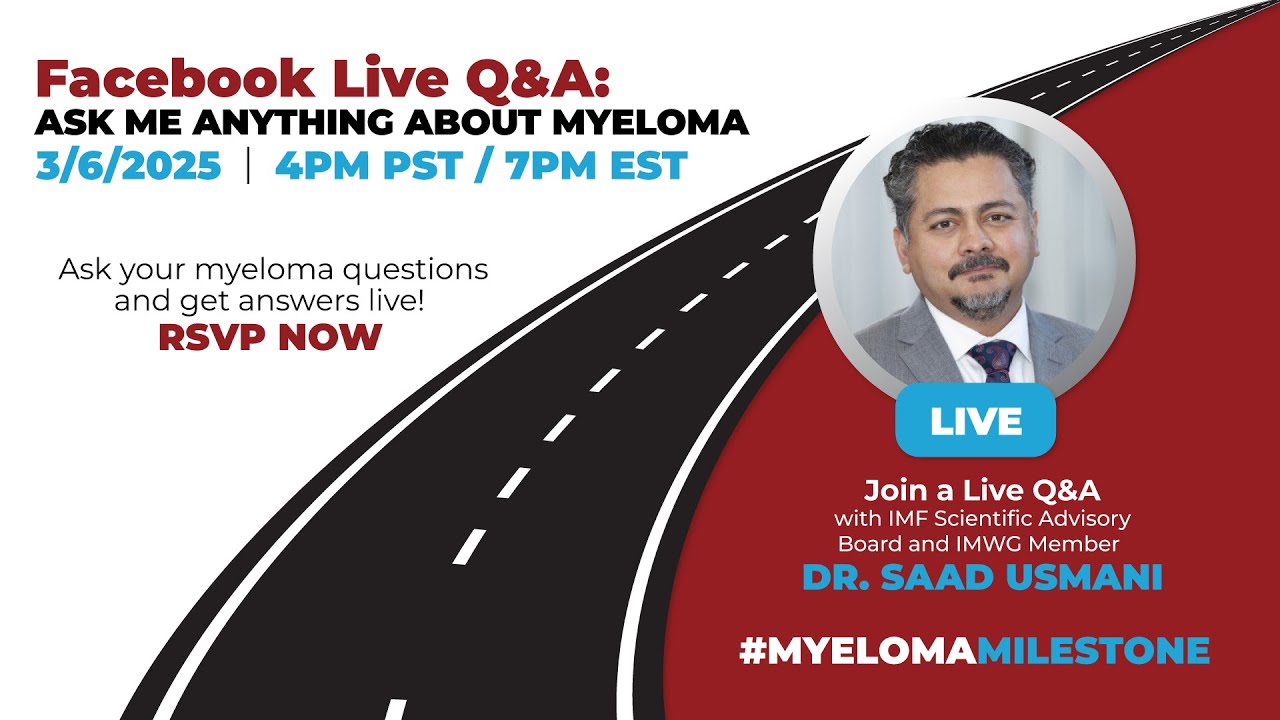
All right. Hello, everyone. I'm Dr. Saad Usmani, and I'm thrilled to welcome you to this special Facebook Live event as part of the Myeloma Action Month. Myeloma Action Month is a global social awareness campaign that takes place every March to raise awareness for multiple myeloma.
Every March, we urge you to champion Myeloma Action Month to make an impact on those living with myeloma. And throughout this month, we're shedding light on multiple myeloma and empowering patients and care partners with valuable information. Whether you're a patient care partner or simply curious about multiple myeloma, this Q&A session is for you.
So a little bit about me. I am a cancer doctor and specialist in hematology and medical oncology. I take care of myeloma patients as well as do clinical research in furthering the mission to cure this disease. I oversee a team of 14 investigators here at Memorial Sloan Kettering Cancer Center in New York where I serve as the chief of the program. And we are totally committed to the cause and try to do collaborative research with folks around the world. Please feel free to ask questions in the comment section and I'll do my best to address as many as possible as we get further along into this session.
All right, so again, don't be shy. Feel free to comment and or ask questions as it relates to multiple myeloma. If you want to get more involved with the Myeloma Action Month, you can actually go to the website www.myelomaactionmonth.org to get more information and find out how best to get involved.
All right, so while we are waiting for people to ask questions, let me just share with you what multiple myeloma is. Multiple myeloma is a... So multiple myeloma is the second most common blood cancer that occurs. It is a disorder of white blood cells called plasma cells. And let me just before I continue, let me just see if I can take some of these questions and maybe I can incorporate some of my responses here. I've suddenly started to see a bunch of questions trickle in, so instead of giving you my spiel, I'm going to try to get to these questions the best that I can.
All right. All right. So we have a question about the use of steroids in myeloma treatment. I'm just going to try to provide a general answer here. So dexamethasone is a corticosteroid. It is an important part of myeloma treatment, not does it only have and direct activity against myeloma cells, it can also help the other drugs that we utilize to treat myeloma more tolerable for patients. So a little bit of steroids can go a long way in making patients feel better as they're getting treatment.
However, the steroids can also cause other side effects, sleep problems, especially the day that patients take steroids, you feel like Superman or Superwoman or Wonder Woman. And then the next two or three days it's like a steroid crash feeling where you're fatigued and tired and that's just one of the initial side effects. But people can get heartburn, people can have some anxiety or personality-related changes. And then long-term use of steroids can also cause other issues, including bone loss.
So in general, what our more recent approach has been is to try to dial down on the dose of dexamethasone after initial therapy with it. So whether it's in the newly diagnosed setting, whether it's when the myeloma comes back or in the relapse setting, when we utilize dexamethasone as a steroid, we start off at the usual dose which is age appropriate, and then we try to dial it back down as patients start feeling better, as they start having a response to treatment.
And now after a few months of treatment, if the patients have had a response plateau where the myeloma levels are as low as they can go, we can even consider peeling off dexamethasone or steroids altogether as well. So I think that's kind of my response to this question about dexamethasone.
And then hello to Sherry. Hello to Litsa. Laura Snell from Charleston, South Carolina. Hello to you as well. Irma from Saginaw, Michigan. Hello. Hello.
All right, so then Carol Spencer has a question here about bispecific safety. I'm not sure what the question is. Is it about the general safety of bispecific antibodies or how they work? I can give a general answer here as well. Bispecific antibodies are an awesome new tool in our toolbox as myeloma doctors. The concept is very simple. This antibody has two proteins that it can identify. One protein is on the surface of the myeloma cell and the other protein is expressed on the surface of immune cells called T-cells. And so this antibody, when it's given to patients, it tags the cancer cell and brings the immune cell to the cancer cell and the immune cell then gobbles the myeloma cell up or that's the intended mechanism of action.
So the kind of protein that the bispecific targets on the myeloma cell is different. There are different types. The two proteins that we are targeting right now, the drugs that are approved for use by the FDA target a protein called BCMA and the other one is GPRC5D. And I promise you there will not be a quiz after this live program, so you don't have to remember that. But these two different ones, there are some common side effects that can happen. There are some other unique side effects that are different for GPRC5D.
So for BCMA, the things that we watch out for, blood count issues, we watch out for infection risk with long-term use of this antibody. With GPRC5D, yes there is an infection risk, but this GPRC5D protein is also present in the skin, in the nails, in the salivary glands. So they can potentially cause appetite issues or issues with dryness of the mouth, with taste changes or sometimes skin and nail changes, and the extent of these symptoms can vary from very mild to actually having some skin peeling, but every patient is different and one can hold the medication, reduce the dose, and the schedule of the medication as well. So these are some unique issues with both and they're kind of more long-term as patients continue treatment.
Cytokine release syndrome is a side effect that tends to happen within the first two or three doses of getting any of these bispecific antibodies. And it's just a way of how the white cells, the immune cells, when they're activated to go after the myeloma cells, it's like you're activating these guys so they can secrete certain chemicals that make you feel like as if you have an infection. So it's almost like that kind of feeling. So fever, maybe low blood pressure can happen. That kind of side effect can happen in maybe a little over half of the patients. It's typically very mild and we manage it very effectively and that's why when patients are getting initial doses or what we call step-up doses, you watch patients carefully if they're having that side effect, we can give some steroids or Tocilizumab, things like that.
But once you start the bispecific, it's working. Many of us in the clinic start also dialing down the schedule for these treatments. You may start with once weekly dosing. As you're responding, we might go to every two weeks or even once a month with the bispecifics, but they're quite effective treatments even in folks who have had the myeloma come back two or three times. If we were to give this bispecific antibody kind of treatment to say a hundred people, we would expect 60 or 70 out of a hundred people to have a very good response, which is a pretty high number. So that's kind of like the broader explanation about the bispecifics.
All right, let me move down the list of questions. I see a lot more questions coming to me. So, all right, let's see here. So we have a question about, "When do you think it is appropriate to receive MMR vaccine after having an autologous stem cell transplant?" So typically, we have to wait a little bit longer to receive live attenuated vaccines after patients have had an autologous stem cell transplant. And the practice varies from one transplant center to the other. Typically, we would start that series at least nine to 12 months after you've recovered from an autologous stem cell transplant. But every center is different. So there are some minor differences between one versus the other center. So just follow the advice of your local team that's taking care of you and just follow one protocol. At the end of the day, the objective of each of these protocols is to deliver these vaccines in a sequential fashion in trying to replenish your immune response to each of these vaccines.
All right. And then Daria has a question, "Has the standard of care for frontline therapy changed recently?" The answer is yes. So we have gone from using three drugs as frontline treatment for both transplant eligible as well as ineligible patients now to four drug combinations, which we call quadruplet induction regiments. And there have been Phase III trials where we've looked at four versus three drugs for both transplant eligible patients as well as those patients who are not getting a transplant. And in both those situations what we found in the trials is that the four-drug combination gives a better depth of response, higher response, depth of response, higher MRT negativity rates, and better progression-free survival compared to the three-drug combination. So patients go into a deeper response and stay in a remission response longer than they would have if they got a three-drug combination. And so that is something that is becoming standard of care.
The only caveat is patients who are not eligible for transplant and older. For those patients we still utilize three-drug combinations like DRD. So that is an appropriate choice for patients. So there's nothing wrong with three drugs. If you're getting three drugs, that's totally appropriate. But then the standard of care, especially in the last year, year and a half, has started to move towards the four-drug combinations because we are getting all of these clinical trials that are coming down the pike and they're maturing and they're showing us all this exciting data.
All right, so just to let you know, the objective of this Facebook Live is to provide you general ideas about your questions and explain things. And I'm going to try to avoid giving specific medical advice. That's not the objective of this session. So I do see some folks writing specific questions about their own scenario or health and I would advise you to just seek advice from your care team because they know your care best and your medical history best.
All right, I see a question here about bispecific safety for frail patients. Typically, what we've seen with bispecifics is once the patients are through the step-up dosing, it's pretty safe to give in the outpatient setting. What my practice is for frail patients, if I need to give them bispecifics as step-up dosing, I would admit them to the hospital to make sure that they're okay during that phase. I would monitor for cytokine release syndrome and treat it right away even when it's low grade. And then once they get into the outpatient setting, we can give the bispecific less frequently. We don't have to give it weekly from the get-go. We can give it every other week, even every fourth week, or once a month because the objective isn't to get a response superfast, you have to balance the good effects and the side effects at the same time.
We don't mind if we get the best possible response in four months rather than two months. The idea is to get to a recipe that would work for that frail patient. So it depends on case to case basis. I just saw someone last week for step-up dosing as an example, they started to have a really nice response and they're frail and they're in their mid-eighties and they tolerated the bispecific combination fine and then they were transitioned to the outpatient setting and they're going to be receiving treatment every four weeks. So you can make these clinical judgment kind of decisions after discussing with your patient and come up with a more personalized kind of plan for them.
All right, let's try to go to a good question. So we have Steve Weinstein who's asked the question, "Do you suggest clinical trials at each stage of treatment?" The answer is yes. That is something that I do encourage and talk to my patients about if they have a clinical trial that they'd be eligible for. It's important to have those discussions. And the analogy that I give to patients is all the treatments that we've developed in myeloma, it's because of patients like you who went on those clinical trials to prove that these work. And then just like the example I gave of four versus three drugs kind of clinical trials, there were patients who actually went on those studies to prove the point that four drugs may give better depth of response and survival outcomes. And that's why it becomes a standard of care and it's a way of paying things forward.
So there were patients who went on studies that enabled you to get the treatments that you are getting and it might be a little bit altruistic from that standpoint. And who knows? Who will be the first patients who ever get cured with myeloma? They'll be the patients who go on trials first. It'll be probably a trial where patients get a new treatment approach that may cure them. Who knows? I mean that's what we are looking for right now. So it could be a little bit self-serving too. If you go on the clinical trial and get a treatment approach that could potentially be a future cure.
So there are many different reasons, but it is a nuanced discussion. You have to weigh the pros and cons. The decision is always yours. And one thing that I have to also share when patients go on a clinical trial, it's not that they've signed up and then you cannot withdraw consent. Once you sign up, and if for any reason you're feeling that you can no longer participate in a clinical trial, it's okay to have that discussion. And if it is a significant health issue that's already going on for you, your treating doctors will actually tell you that it's okay. Just come off of trial and we'll try something else. So it's not a black and white thing, the clinical trials are for you guys, not the other way around. So we are always welcome to having our patients participate, but we do it for you guys to benefit from it.
All right, so let's go down the list. Wow, we have a lot of people participating from all over the country. That is amazing. All right.
Oh, there's another dexamethasone question. So, "When does dexamethasone become a bone loss issue?" It takes months to years. So it doesn't happen after just a few months of treatment. If you keep on taking it for a year or two year or three years, when you take it chronically, that becomes an issue. It's more common when you're taking it more frequently. In myeloma, most of the regimens you're taking dexamethasone only once a week, maybe three out of four weeks. So there's a little bit more leeway, it's not the same kind of dexamethasone dosing that would get you bone loss quickly, but long-term, there was a time when we used to give dexamethasone to patients along with lenalidomide or with bortezomib for as long as it's working because we didn't have any options. So it was a different era. Now we have more effective treatments so we can back off of the dexamethasone.
All right, so then I have another question here, which is... Yeah, so Steve is asking, "Please explain the relationship between 17P and TP53." Okay, yeah. So that is a more complicated question. The way that I can explain this to you is there are 23 chromosome pairs in every human cell. So we have 46 chromosomes and there are 23 pairs. So we get one copy of each chromosome from mom and dad, and that's how we get 46 chromosomes.
So on chromosome number 17, the chromosomes have a short part or short arm and a long arm. And the short arm is called P, and the long arm is called Q. So chromosome 17 contains different genes. One of those genes is P53, and P53 gene makes a protein called TP53 and this protein is supposed to be what we call tumor suppressor. So it helps in controlling the way that the cells divide in a normal fashion.
And this gene is present on the P, or the small arm of chromosome 17. So if a myeloma cell loses one part of that 17 chromosome, the short arm, it actually loses that P53 gene. And when it loses it, the cells divide faster. And that's how that kind of myeloma is considered high risk because it can divide fast and patients whose myeloma has that abnormality can relapse early even after getting all the right treatments. So you have to tweak their maintenance treatment and other approaches in a different way.
So the other way of losing TP53 is having an abnormality in the sequence of that gene. When that happens, it's called a mutation. There are different types of mutations, but if the myeloma cell develops an abnormality in how the gene sequence is present or it becomes mutated, that P53, TP53 protein won't do its job.
So essentially, the same phenomenon happens as if the small arm of chromosome P is lost, that you have a non-functioning P53. So again, the myeloma cells will divide faster and that too is considered a high risk feature. So that's my spiel about that. And for those patients who have either of those abnormalities, we try to give them two-drug maintenance treatment so that we can keep the myeloma under check after they've had their initial induction treatment with or without a stem cell transplant.
All right, we have West Coast colleagues in the house as well. We've got Vijay from California, Joyce from Ventura here. Thank you for joining, hope whatever answers I'm giving you are going to be helpful to you guys. All right. All right. So we have a very important question from Todd and I'm going to take that question and it's amazing how time flies and how quickly this time is really going.
So let me take this question. So Todd's question is, "Is myeloma curable and what is your definition of cure? What is your prediction for the prospect of more patients being cured?" So we know that there is a subset of myeloma patients who when treated have been cured or can be cured. We have known this over the past two decades, but the proportion of patients was very low. It's like single digits. And what is our aspirational goal? We want majority of our patients to be cured, where we treat patients, they're off of treatment and the stuff never comes back.
The way that we are thinking about this now, we have all these wonderful treatments, we have the four-drug induction treatments, we have immunotherapies, we have bispecific antibodies, CAR T-cell therapies, and we are working on the right sequence of these treatments in clinical trials. We want our patients to go into a deep response, which is called MRD negativity.
We want our patients to stay there in MRD negativity for an extended period of time. After being in MRD negativity for maybe two or three years where we are comfortable that "Hey, this is real, this is happening. There is nothing on PET scans, there is nothing that we can detect in the blood, the bone marrow biopsy and MRD negativity testing looks fine. Let's take patients off of treatment and then continue to do the MRD testing for a few years." And many of us feel that once patients have achieved MRD negativity in that fashion and we discontinue treatment and patients stay in a remission, very deep response for at least five years, if not more, then we'd be comfortable in saying, "Hey, myeloma is likely cured in this situation."
We are just beginning to delve these definitions for myeloma because myeloma generally happens later in life, although we have young myeloma patients as well. But to define curability in myeloma, we are going to have to draw a line somewhere. And that's what we are thinking about at the moment.
All right, so let me see. I think our time is coming to an end. I'm going to try to take one more question and then try to wrap things up here. I see some familiar names. Thank you for joining. Lynn, Lisa, Scott, Joan is there. There are a lot of other people joining in from the Midwest as well.
All right, so I am going to try to wrap things up here. The International Myeloma Foundation would like me to take a moment to thank their Myeloma Action Month sponsors. It's Amgen, Binding Site, Bristol-Myers Squibb, GSK, Johnson & Johnson, Karyopharm Therapeutics, Arcellx, Pfizer, Regeneron, and Sanofi. And thank you to everyone who has come to spend 30 minutes with me to get some answers to their questions.
And before you log off social media for the evening on your tablet or on your phone or on your computer, I want to give you a challenge. I want to challenge you to go on to your most used favorite social media platform. It could be X, it could be Insta, whatever you want, and share a post about an important time in your Myeloma journey. Share with the hashtag Myeloma Milestone. Do this for me, do this for you. Do it for the Myeloma community. Raise awareness and thank you so much for your kind attention.