This week's "Ask Dr. Durie" comes from a patient who's been on a clinical trial. And the doctor said that he had to stop the clinical trial because there was an indication of relapse. However, the doctor didn't want to start any new treatment right away. So this was very confusing for this patient. Apparently, he had relapsed, but there was no recommendation for treatment.
And so this is a very reasonable concern. And the key thing to know and to understand is that within a clinical trial, there is something called biochemical relapse. And so what this means is that the level of the myeloma protein has gone up by at least 25% and by an amount of at least half a gram per deciliter.
And if that happens, that means that there is an indication that the treatment and the clinical trial is not working. But it actually doesn't mean necessarily that the patient has had a full relapse with new bone lesions or anemia or some other kinds of problems. And so many times a patient will come out of a clinical trial because of biochemical relapse.
And at that point, it's important to kind of reevaluate and see how things look. If the patient has what we call high-risk features, which would be abnormal chromosomes like 17p- or +1q or a number of other high-risk chromosome features or other indicators of high-risk disease with disease that maybe has been outside the bone marrow or even in the bloodstream.
So in that situation, it may be that there is a need to move forward promptly with new treatment.
But the BOTTOM LINE here is that if you fall into this situation of biochemical relapse, where there's a change or an increase in the protein level, that's where you need to talk carefully with your doctor and have what we called shared decision-making.
Let's figure out is it okay to monitor your myeloma for a while? Do you need to have extra testing to make sure, if any of the CRAB features are emerging? Do you need to really think carefully about getting started on some treatment quickly? If you have high-risk disease to make sure nothing emerges in a bad way related to active myeloma?
So some very, very important details and mostly important. this is a situation to talk it over carefully with your doctor.




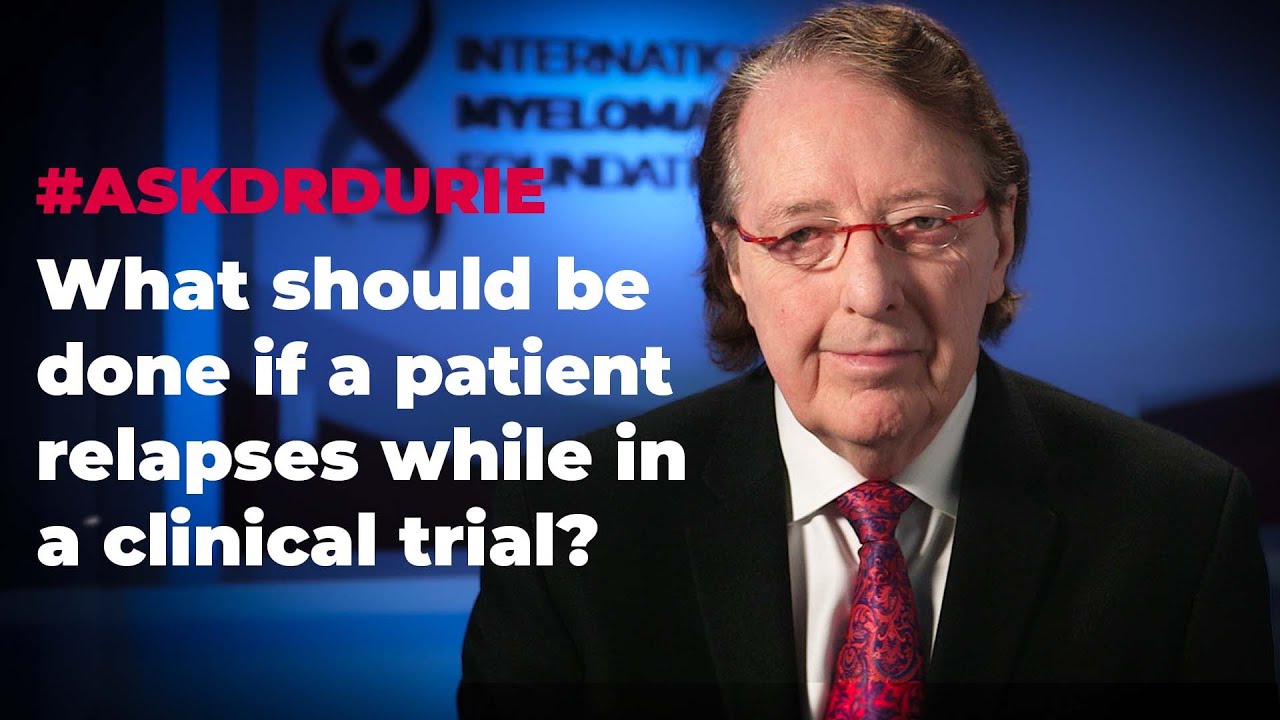
 Dr. Brian G.M. Durie (1942-2025) was the co-founder of the IMF. He was a Professor of Medicine, Hematologist/Oncologist, and Honoree MD at the University of Brussels.
