Myeloma Risk Factors By Race and Ethnicity
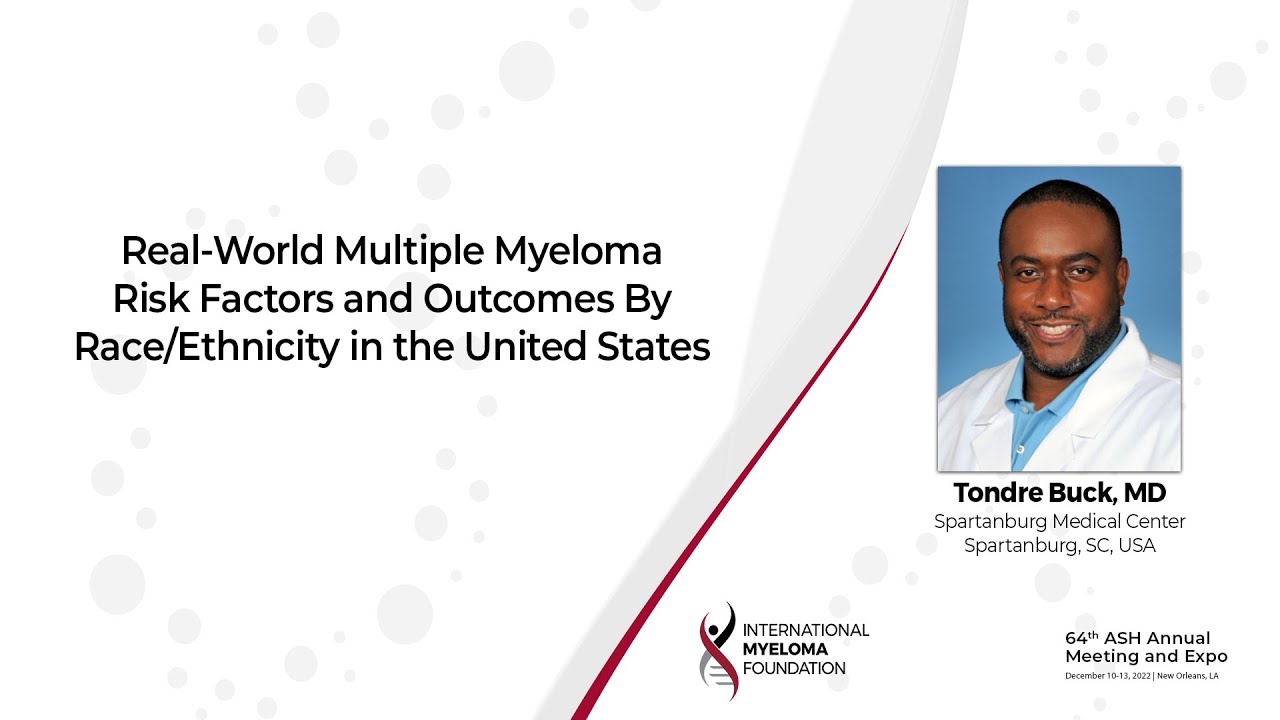
Dr. Tondre Buck presents an abstract on real-world multiple myeloma risk factors and outcomes by race/ethnicity in the United States.
Abstract title:
Real-World Multiple Myeloma Risk Factors and Outcomes By Race/Ethnicity in the United States
Purpose of the trial:
Age-adjusted incidence and mortality rates for multiple myeloma (MM) have been higher among Blacks/African Americans (AAs) than Whites in the United States. Yet several prospective and real-world retrospective studies have suggested similar, or even improved, outcomes among Blacks/AAs, particularly when there is equal access to care. Real-world (RW) evidence can provide important insight into factors that impact patient (pt) outcomes in everyday practice. This retrospective, observational cohort study sought to describe associations between pt, disease, and treatment characteristics and survival outcomes by race/ethnicity.
Video summary:
This study used the nationwide Flatiron Health electronic health record-derived, de-identified database of MM pts treated in the United States. During the study period of January 1, 2016, to January 31, 2022, pts whose first-line treatment was initiated after the study start date and whose race/ethnicity was categorized as either non-Hispanic (NH) White or NH Black/AA were included. Pts with evidence of treatment >14 days prior to their diagnosis date were excluded. We examined pt, disease, and treatment characteristics by race/ethnicity. We also examined RW progression free-survival (rwPFS) and overall survival (rwOS), indexed to first line of therapy (LOT). rwPFS was defined as the time from start of first LOT to the date of first progression event (informed by International Myeloma Working Group criteria and incorporating both abstracted M spike values and structured free light chain values) or death. rwOS was defined as the time from start of first LOT to the date of death. Differences in rwPFS and rwOS were assessed using the Kaplan-Meier method. Multivariable (MV) Cox proportional hazards models were used to examine associations between pt, disease, and treatment characteristics and outcomes by race/ethnicity.
Conclusions:
Among RW pts with MM from the Flatiron Health database, unadjusted rwPFS and rwOS were similar between NH Black/AA pts and NH White pts, as previously reported. In general, associations between risk factors for rwPFS and rwOS were consistent between races/ethnicities. Findings from this study compliment knowledge gained from earlier prospective and RW retrospective studies, helping to inform clinicians about the impact of race/ethnicity on disease characteristics and treatment patterns in the United States as well as MM outcomes within diverse populations.
Trial information:
ASH 2022: Abstract #2285
Authors:
Tondre T. Buck, MD, Taylor Salinardi, PhD and Megan S. Rice, ScD, MPH
Doctor Bio:
Dr. Tondre Buck received his medical degree from University of Mississippi at Jackson. He completed a residency at University of Mississippi Medical Center in Internal Medicine. Dr. Buck also completed a fellowship at University of Mississippi Medical Center in Internal Medicine. He is board certified in Hematology/Oncology.