

Joseph Mikhael:
Hi everybody. Dr. Joseph Mikhael here, Chief Medical Officer of the International Myeloma Foundation. On a regular basis, I host a live Q&A at facebook.com/myeloma to answer the questions of the myeloma community. Unfortunately, we can't get to all the questions during the live Q&A, so I have the privilege of answering some of them with you today. Please feel free to reach out to us. Use the hashtag, #asktheIMF through any of our channels, be it Facebook, be it Instagram, be it X, to bring your questions to us and I'll do my very best to answer them.
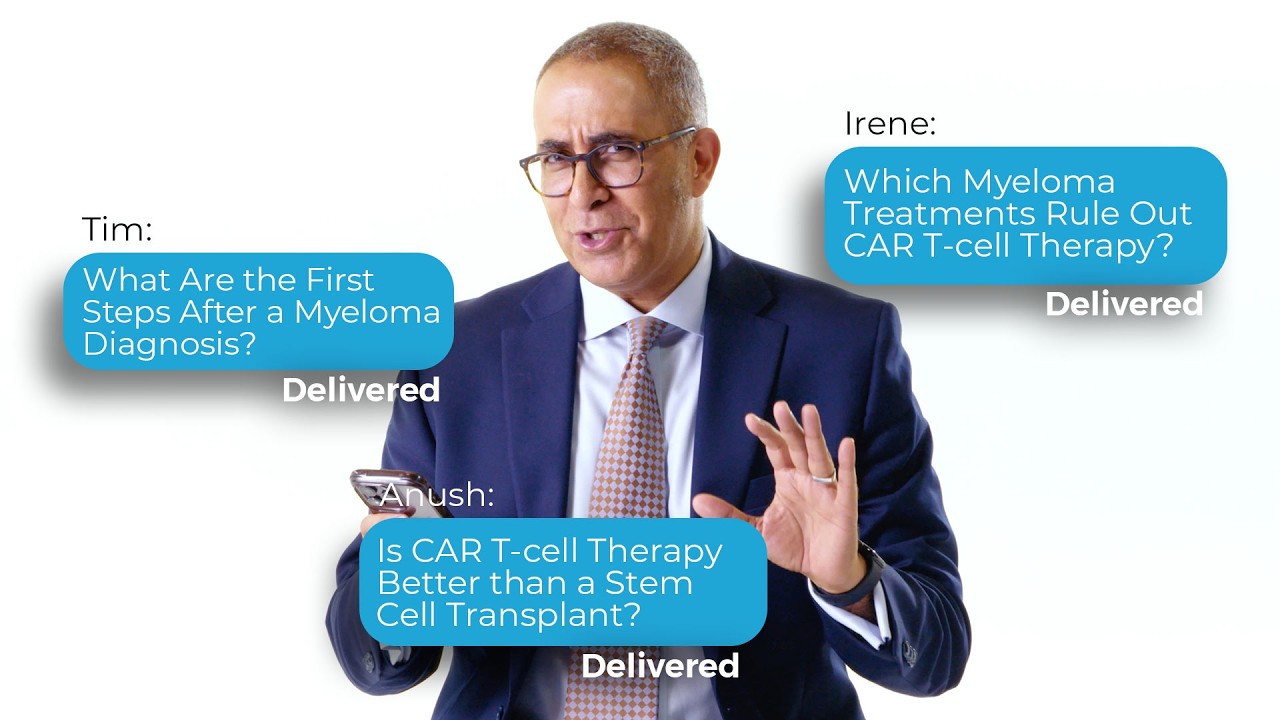
Well, we've got a lot of great questions today, so let's get to it. Irene asks this question, I'm wondering if any myeloma treatments would make me ineligible to receive CAR T-cell therapy. Well, CAR T-cell therapy has changed the way we treat multiple myeloma. We have not seen any treatment as effective as CAR T-cell therapy, to control people's disease and to keep it in control over long periods of time. Surely we would not want anyone to receive a treatment that would make them ineligible. In general, there really isn't a so-called ineligible category, but there are some things that we would not want to treat people with immediately before trying to collect their T-cells, to go through the CAR T-cell process. This is primarily the more historical kinds of chemotherapy like melphalan, like cyclophosphamide, like bendamustine, these more historical drugs that we use at times in myeloma, but we know they can be tough on T-cells and therefore make it more difficult to receive. This is particularly important as we now move CAR T-cell therapy earlier line in the course of multiple myeloma.
Here's a question from Kim, very up to date. When will we know if the FDA will approve the daratumumab treatment for smoldering multiple myeloma? Well, Kim, you're obviously aware of the AQUILA Trial or this clinical trial that evaluated giving single agent daratumumab in patients with high risk smoldering myeloma, and comparing it to what we typically do, which is just to monitor patients closely. That trial showed that it delayed the diagnosis of multiple myeloma considerably, when patients were given daratumumab, and even improved their overall survival.
The FDA is reviewing this. I have no crystal ball to know exactly when it's going to happen, but we anticipate in the near future that this will be an option that we can provide to our patients. It reminds us of the importance of that shared decision-making model with the team, because it's not for everyone, but some patients may indeed benefit from daratumumab monotherapy with high risk smoldering myeloma.
All right, let's get to our next question. Special question to me because it comes from my home country originally of Canada. Sandy says, "We live in Canada. How can we access the new myeloma drugs? Is there a person who can provide guidance?" I always say the I in IMF of course, is the International Myeloma Foundation. We're committed to all patients across the world, which includes of course, Canada. And Sandy, my first quick answer to you is, you have a tremendous resource in Myeloma Canada.
Myeloma Canada is very closely connected to the IMF and we work together on many initiatives. And they can help you understand what's available to you in Canada. What are the resources that they provide to you to carry you through your journey. Because indeed, many of the very same things that we use here in the U.S., are absolutely available in Canada. And sometimes we even have situations where we can advocate for something that may not yet be available in Canada, to be made available. Please do contact the individuals at Myeloma Canada. They're a fantastic group.
Here's another question. I'm high risk. I have heart failure and I've had multiple myeloma since 2019. I just had a bone marrow biopsy that showed it is steady, but my numbers are climbing. What should my next treatment step be? Well, it's hard to know the details of this, and it's difficult for me to give specific medical advice about your situation, but you're pointing out a very important theme that I would love our audience to understand. Is that myeloma has multiple ways of being measured. Sometimes I say, myeloma is kind of like a crime scene. There isn't one piece of evidence that tells you the whole story. We need to look at multiple pieces of evidence. Like the bone marrow, like the blood tests, like the x-rays. And based on that we can determine, is the disease stable as it appears from your marrow or is the disease growing, as you're saying with the blood test? Often we start to see the changes in the blood tests, before we see anything else. I would review this more carefully with your healthcare team, to determine if more treatment is needed.
Here's a great question from Rob. I took the first therapeutic dose of Talvey, also known as talquetamab, and my light chains jumped. Does this mean that Talvey does not work? Is it possible that only the second dose could work? It's a great question because, myeloma is not always predictable when we measure, in particular the light chains, as we treat someone. Sometimes we start treatment and we can see the numbers jump up a little bit. It could indeed mean that the disease is growing and the treatment's not working at all. Sometimes we just see a blip and sometimes that blip, of course, is followed by a nice drop. That's typically why we don't give up on a myeloma treatment with just one or two doses, we typically want to give patients two full cycles, which is typically approximately two months of therapy before we make that determination. I would discuss this with your healthcare team, but we need to understand that the dynamics of myeloma is that sometimes it goes up a little bit, before it then comes down later.
Here's a question from Tim, and I really like the way he's partially answered his own question. What are the first things you should and shouldn't do when you receive your myeloma diagnosis? I'll start with a shouldn't. Don't Google it. Well, thanks Tim for guiding us a little bit. Not that there's anything wrong with Googling it, because chances are if you Google myeloma, it'll take you to the IMF Myeloma website, at myeloma.org. But I would recommend a few things. First of all, connect with the IMF. Call us in the info line, go to our website, interact with our chatbot. Find out when the next live webinar or virtual webinar exists, so that we can communicate with you and help you through your journey. We want to be with you.
Secondly, take an opportunity to have an open and honest conversation with your healthcare team. If your physician is comfortable treating myeloma, that's great. If it's a disease that they're not very familiar with, we advocate for the opportunity to get an expert opinion. It doesn't mean the first opinion was incorrect. It's not cheating on your current doctor, but it's getting expert in opinion. In a disease like myeloma, that is relatively rare and is very complex, getting an expert opinion can help guide both you and your treating team for the best care possible.
And lastly, perhaps don't panic. Of course, it's a natural reaction when you hear a word like myeloma, which is why we want to help you through this diagnosis. But thankfully, myeloma is a disease that we can treat. Myeloma is a disease where the vast majority of patients will go into a deep response and a durable response and long periods of remission.
Here's a great question from Shanna, which says, "Can the new immunotherapies be used without using chemo first?" Well, you're looking ahead to the future, and I think many of us believe that is going to happen if not already happening. Where we're using less and less of the traditional chemotherapy and using these newer immunotherapies. For example, CAR T-cell therapy was first approved in patients who had at least four prior lines of therapy. Now we can use it as early as the second line of therapy. Bi-specific antibodies are now still only used after four lines of therapy, but we're doing the clinical trials to see if we can use it sooner. And most of us believe indeed, we will be using many of these therapies, including CAR T-cell therapy and BI-specific antibodies, even in first line therapy in multiple myeloma.
Here's a great question about exercise. How much weight lifting is advisable? My husband is a former athlete diagnosed with multiple myeloma. Well, first of all, I'm very happy that he wants to exercise. I often say that body was designed to move and exercise in general is very good. Weight lifting though, does raise a bit of a concern. It's not that it's impossible, but this absolutely has to be reviewed with the healthcare team, because based on someone's myeloma and how it's affected their bones, it may or may not be advisable to do certain kinds of weight lifting. Especially, heavy weights or jerking movements that can put a lot of stress onto the spine. But typically lighter weights, walking, swimming, other forms of exercise are strongly encouraged, because we know when you're generally healthy, it'll be easier to treat your myeloma and your outcomes will be better.
Here's a great question from Terry. One of our support group leaders. Is the current climate of potential governmental cuts in science and research, affecting research for multiple myeloma? Well, first of all, let me say, Terry, as a myeloma researcher, thank you for asking this question, for being concerned. We don't have a crystal ball. We can't predict what's coming in the future, but we are all of course concerned about myeloma research. Research is fundamental to moving the needle forward, to giving patients a greater quantity and quality of life. Research in the lab and research in the clinic. We encourage our patients to be aware of what's happening, speak to their representative, advocate for greater funding, and indeed follow us on the IMF. We'll keep you updated as to how things are changing, as we are so committed to this issue and so committed to our patients.
All right, we're almost done, but here comes the last question. Is CAR T-cell therapy better than a stem cell transplant? Can you live long without it? You ask one of the toughest questions that we have in myeloma today is, what is better? Is it a stem cell transplant or is it car T? Well, right now, they both have a role in multiple myeloma. And until we demonstrate that CAR T is superior to a transplant, it clearly still has a role in frontline therapy with multiple myeloma. But let me reassure you, we are doing those clinical trials, even at my center, we're doing a clinical trial that is comparing head-to-head, a CAR T cell therapy versus an autologous stem cell transplant and frontline therapy. And we hope to have some of those answers soon. Because we want to give our patients the best therapy available.
As I often say, we don't save the best for last in multiple myeloma. If we know something is most effective, it's going to be the most effective when given earlier on in the treatment course. And so we should have answers about CAR T-cell therapy and frontline therapy in the near future.
Well, that's all I have time for today. But thank you so much for these fantastic questions. And please remember to reach out to the IMF. We want to answer your questions in any way we can. Use the hashtag, #asktheIMF on any of our social media channels or call us directly at the info line. We want to help you.