

Dr. Joseph Mikhael:
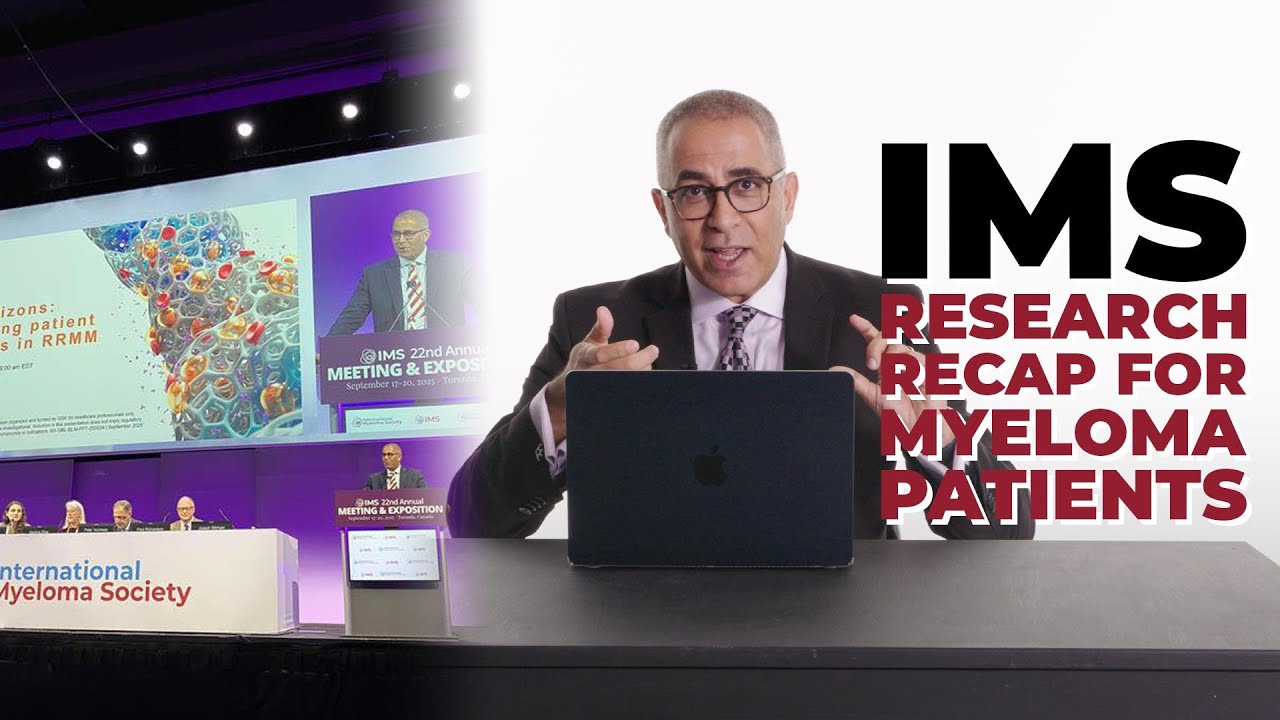
The International Myeloma Society meeting was held in September of this year with over 3,000 participants from the myeloma community from over 70 countries. Today, I'm going to give you the highlights of the impactful research from that meeting that affects you or your loved one with multiple myeloma. I'm going to focus in four areas, frontline therapy, or the first treatment someone gets, high-risk multiple myeloma, or the aggressive form of multiple myeloma, immune therapy updates, or how we can make best use of our immune treatments, and then lastly, a little picture into the future of multiple myeloma, what's coming in multiple myeloma. Today will just be the highlights of these four areas, but if you want to learn more, subscribe to our YouTube channel, where I'll dive deeper into each of these four areas. You're not going to want to miss.
Hi everyone, Dr. Joseph Mikhael here, Chief Medical Officer of the International Myeloma Foundation, a not-for-profit organization dedicated to improving the quality of life of patients while we seek prevention and a cure. The International Myeloma Society annual meeting is a wonderful opportunity for the myeloma community to come together, share the latest research, and really think through this disease together. So many areas were discussed and covered, but I'm going to focus in four areas today to just give you a taste of what's happening in multiple myeloma today.
Number one is frontline therapy. We have made tremendous progress in frontline therapy of late, you might wonder, how can it actually get better? Well, it is getting better. We saw so many clinical trials bringing forward bispecific antibodies, CAR T-cell therapy into frontline therapy, and even into high-risk smoldering multiple myeloma. I think this is telling us that we can get better at treating myeloma at the very start, because what we do at the start has an implication in the long-term. We're seeing response rates of 100%. We're seeing the majority of these patients get into a very deep and durable response. So, much more to come in frontline therapy.
Number two is high-risk disease. This refers to about 20% of patients that have a form of myeloma that tends to be more aggressive. It tends to come back more quickly. We need to understand this area better, and we had a lot of discussion and research in trying to understand how can we define high-risk myeloma, knowing that it really isn't just one group of patients, that there's a spectrum of high-risk myeloma? When patients have two high-risk features, for example, we saw that that is really ultra high-risk myeloma. And more importantly, we learned of ways that we can reduce that risk, as it were, where we can give patients a better outcome by seeking a deep response and keeping people on therapy when they have high-risk multiple myeloma. We saw some of the best outcomes we've ever seen with high-risk disease when we continue therapy in this group of patients.
Number three, we came to learn how to use our immune therapies better. So many lessons here. Three quick lessons that I learned. Number one, give your T-cells a rest. We use a lot of T-cell therapy in myeloma now. These are our soldier cells that can fight off myeloma, but they need a break. If we're going to go from one T-cell therapy to another, it's best to give the patient a break in between. Number two, don't overuse a target. We attack the targets on the outside of the myeloma cell, but if we keep using the same one over and over again, it can be challenging and it can actually develop resistance, so it may be important to give it a break. And thirdly, when we can, change the target. Now that we've discovered new targets, let's go from BCMA to GPRC5D and some of these other complex targets that we've learned.
And then lastly, looking at the future of multiple myeloma. I was very excited to see new ways of treating myeloma. We even saw an abstract that gave two CAR T-cell therapies together. Can you drive two cars at the same time? Well, you can in this study, and we saw patients do very well because of it. Or another study where we gave CAR T-cell therapy followed by bispecific antibodies. These are the kinds of things that are really going to change the future of multiple myeloma. There's so much going on in the world of myeloma. I'd love to tell you more. Make sure you subscribe to our YouTube channel, where I'll dive deeper into these four areas so that you can understand more about the disease. And always feel free to reach out to us at the IMF. We're here for you. And come specifically to myeloma.org, where you will find innumerable resources that can help you in your journey with multiple myeloma.
Thanks so much for watching. If you found this video helpful, please subscribe to the IMF's YouTube channel so you'll never miss updates in myeloma research, in education, and in support. In fact, if you want to learn more, here are a couple of videos you might be interested in.