


Dr. Joseph Mikhael:
In my highlights of the International Myeloma Society meeting, I covered four key areas: frontline therapy, high-risk multiple myeloma, optimizing immune therapies in myeloma, and the future of multiple myeloma. Here's my chance to dive a little bit deeper into each of these four areas with you. But not just to learn about research, but to understand what does it really mean for the myeloma community and more importantly, what does it mean for you or your loved one with multiple myeloma?
All right, let's get started. Hi everyone. Dr. Joseph Mikhaelhere, Chief Medical Officer of the International Myeloma Foundation, a not-for-profit organization committed to improving the lives of multiple myeloma patients while we seek prevention and a cure. The International Myeloma Society is an annual meeting that brings together the myeloma community to talk about the latest and the greatest in multiple myeloma and how we can do better for our patients.
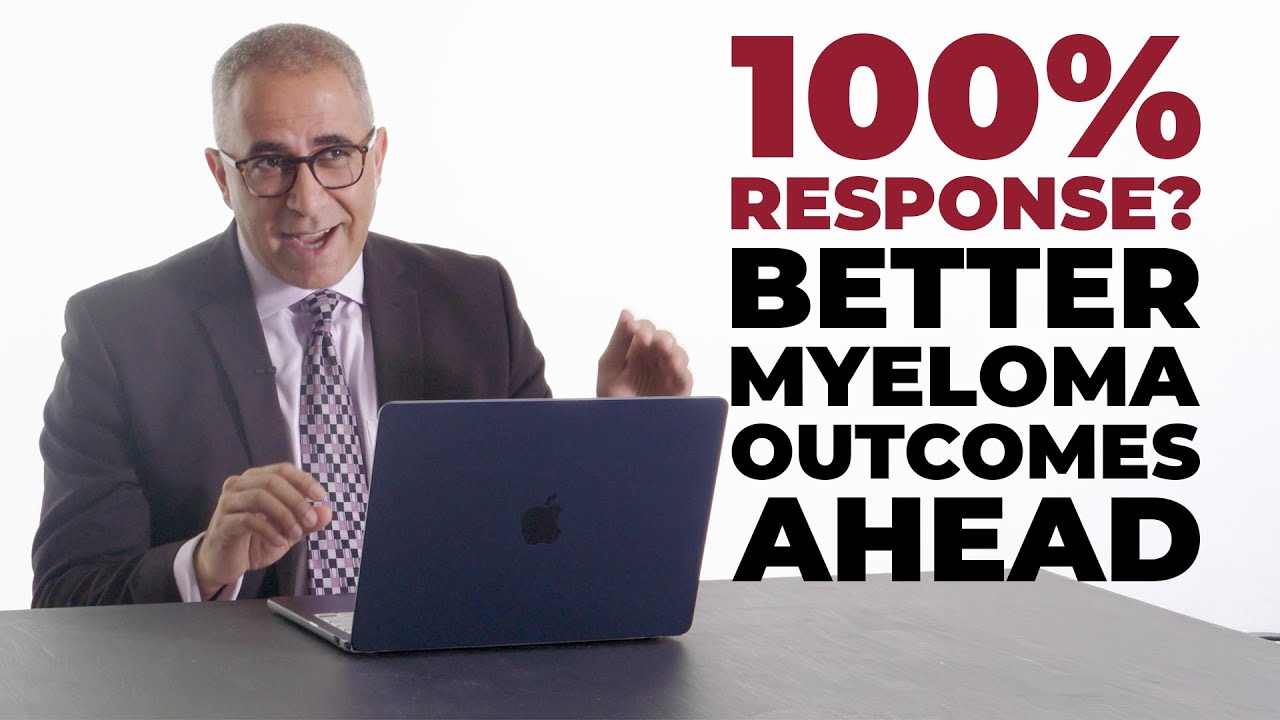
This year was extraordinary. Three thousand people, over 70 countries represented, and of course it happened in my homeland of Canada. So much was learned through this meeting, I could never cover it all. But I'm going to cover four areas with you today. Topic number one is frontline therapy for multiple myeloma. This was an exciting conference because we saw nearly 100% of patients responding to treatment in these clinical trials in the frontline setting. Well, how was that achieved? It was achieved when we took therapies that we would typically use in the relapse setting and bring them to the frontline space.
Let's talk through what are those therapies that we brought to the frontline setting. One of them was in smoldering multiple myeloma where we're still not sure how to treat high-risk smoldering myeloma, and it brought a bispecific antibody, specifically Linvoseltamab, the most recently approved bispecific antibody to give those patients who have high-risk smoldering myeloma a treatment that could potentially prevent them from ever developing multiple myeloma. It's still early, but the response rate was 100%.
On the subject of 100% response rate, another study demonstrated bringing Teclistamab, another bispecific antibody, into frontline therapy, adding it to the treatments we're using now before a stem cell transplant could also produce a very deep and durable remission. Again, 100% of patients in this study had a response to the therapy. It's too early to say how long that remission will last, but this is very impressive for frontline therapy.
And lastly, there's a whole new class of drugs coming, something called CELMoDs. These are a group of drugs that are similar to the IMiD drugs that we use, but really quite unique. And one of them is called Iberdomide. And we saw a study that introduced Iberdomide into frontline therapy, those patients that were not going to stem cell transplant, and remarkable 95% response rate. Two-thirds of these patients got into MRD negativity, which we know predicts a much longer response. So I'm very excited about what's coming in frontline therapy and what this means for patients and for their care partners is that we can actually get more patients into a deep and a durable response as we bring these new therapies to the frontline.
The second area to talk about is high-risk multiple myeloma. This affects about 20% of myeloma patients who have a form of the disease that tends to be more difficult to control and that it tends to relapse more quickly. We learned, for example, that even within high-risk disease, there's a spectrum. There are patients that have ultra high-risk disease, when they have more than one risk factor that that can significantly impact their outcomes. But we also learned that we can start to overcome high-risk disease when we use continuous treatments for longer.
Very often when we treat myeloma, we start with a combination and we taper down the drugs we're using. But we saw some studies that continue that intensity of therapy and we saw the best outcomes we've ever seen in high-risk patients. So what this means is for patients who have high-risk multiple myeloma, we should really be thinking about giving more continuous therapy not only to get the disease down, but to keep the disease down for the long term.
Let's talk about area number three, immune therapies and how we can make them even better. Myeloma has been revolutionized over the last several years as we use CAR T-cell therapy and bispecific antibodies, but of course now as we start to use the more and more we want to get the greatest benefit from them. And we've learned lots of lessons about how to use these practically in the clinic. One lesson is that we need to give our T-cells rest. What does that mean? We engage T-cells, or our soldier cells, when we use CAR T-cell therapy or bispecific antibodies. And now that we're using them more, we often go from one to another, but we've learned if we go immediately from one to another and we haven't given the T-cells a rest, that treatment may not be as beneficial to the patient. So it's important to give our T-cells a break in between.
We've also learned that it's often very helpful to change the target that we're seeking to catch on the outside of the myeloma cell. As we discover new targets in myeloma, we've come to learn that instead of using the same target over and over again, we should switch, go from BCMA to GPRC5D or the other way around. We've also learned, importantly, that sometimes if we are attacking a particular target, it may be reasonable, once a patient has gotten a depth of response, to back off treatment, not only is it good for patients to come off treatment, but when we're not ongoingly attacking a target, we can sometimes go back to that target later. And so it gives us a chance to give a break to the patient for their treatment, but also gives us the opportunity to reuse that target again later.
Lastly, area number four, the future of multiple myeloma. Let me be a Dr. Joe Prophet for just a minute and try to look into the future. Here, we've now developed all these great therapies for myeloma. But can we do better? While according to the research that's going on, we absolutely can. I was fascinated to see a study that actually used two CAR T-cell therapies together. Can you drive two cars at the same time? Well, you can in this study, and it showed that we were able to get patients into a very deep response and overcome resistance from the previous treatments they have had. Another strategy, gives a CAR T-cell therapy and then immediately after a bispecific antibody, so that we can get that disease down and hopefully keep it down for the long term.
These are very exciting times in multiple myeloma. So what does all this mean? It means we're using the tools we have even more effectively and we're still developing newer tools that I believe will bring us closer to the cure of multiple myeloma. After hearing about all this research, maybe you want to participate in a clinical trial. We've made it easy for you, by developing a clinical trial matching engine in partnership with SparkCures, so you can find clinical trials that are available to you, even close to you geographically that you would be eligible to participate in. Check it out at myeloma.org/SparkCures, and you'll be able to learn about the clinical trials available to you.
And of course, reach out to us at the IMF. We are here to help you through every step of your journey. Whether you use our AI chatbot, whether you call the info line, whether you come to the website or visit us at many of our in-person and virtual meetings, we're here for you and we want to support you through your journey. Thanks so much for watching. If you found this video helpful, please subscribe to the IMF's YouTube channel so you'll never miss updates in myeloma research, in education, and in support. In fact, if you want to learn more, here are a couple of videos you might be interested in.

