


Ide-Cel Versus Standard Regimens: Updated Insights for Triple-Class-Exposed RRMM Patients – Findings from KarMMa-3 Study
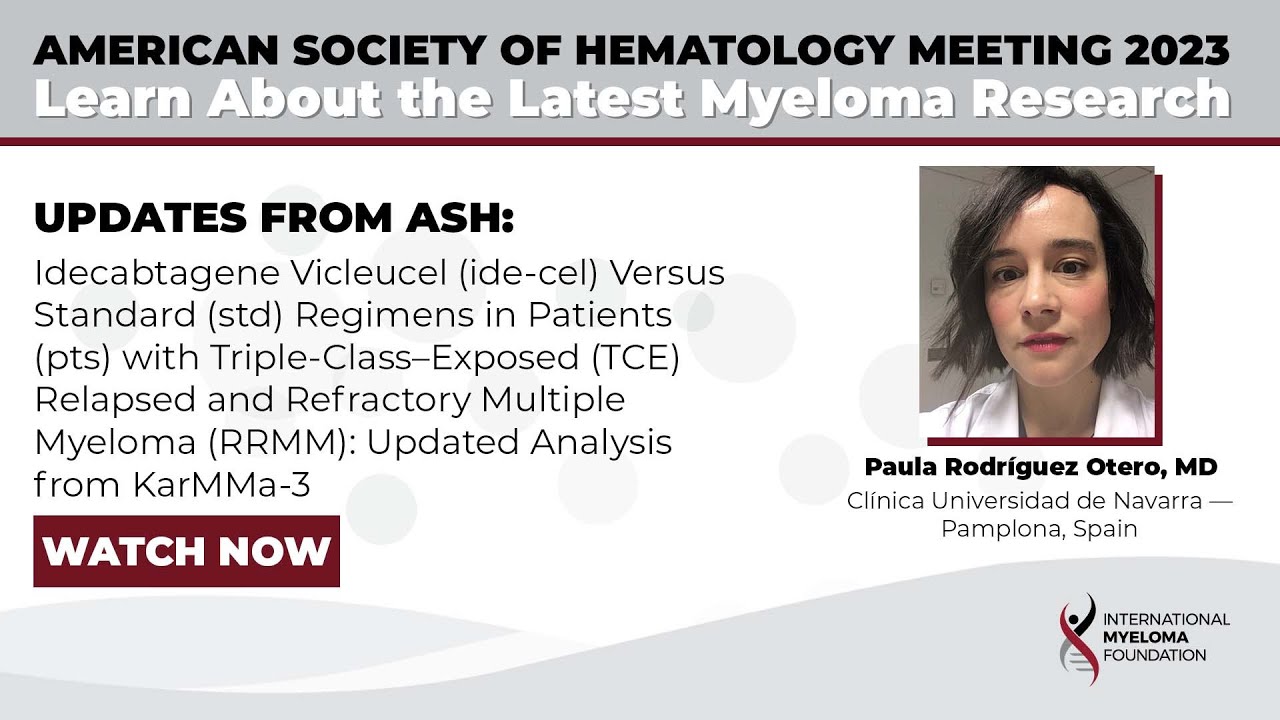
Dr. Rodríguez discusses the KarMMa-3 study, and how ide-cel compares to other regimens in the treatment of heavily pre-treated relapsed/refractory multiple myeloma patients.
Abstract Title:
Idecabtagene Vicleucel (ide-cel) Versus Standard (std) Regimens in Patients (pts) with Triple-Class–Exposed (TCE) Relapsed and Refractory Multiple Myeloma (RRMM): Updated Analysis from KarMMa-3 Presented at ASH 2023
What is the purpose of this trial?
In this study, researchers aimed to understand how a single ide-cel infusion compares to standard regimens in treating heavily treated Triple-Class-Exposed Relapsed and Refractory Multiple Myeloma (TCE RRMM) patients. The goal was to evaluate the progression-free survival (PFS) of ide-cel against standard treatments. Early results showed that ide-cel led to significantly longer median PFS (13.3 months) compared to standard regimens (4.4 months). The study focused on patients who had been through a lot of prior treatments for their condition. The safety data from this study was similar to what was seen before in other research. Ide-cel benefits were seen consistently across patients in high-risk subgroups and those who had undergone 2–4 prior lines of therapy. We wanted to see if ide-cel could offer deep and lasting responses for these patients. Now, with additional follow-up data, the results of the final analysis are presented to provide a comprehensive understanding of ide-cel's effectiveness and safety in the long term.
In this video:
Paula Rodríguez Otero, MD, (University of Navarra — Pamplona, Spain) discusses how a single ide-cel infusion compares to standard regimens in treating heavily pre-treated Triple-Class-Exposed Relapsed and Refractory Multiple Myeloma (TCE RRMM) patients.
Conclusion:
In their final analysis of the KarMMa-3 trial, researchers found that ide-cel maintained significantly longer progression-free survival (PFS) compared to standard regimens. The risk of disease progression or death was reduced by 51%, and responses to ide-cel were not only deeper but also more lasting when compared to standard treatments. An increase in the rate of complete responses with ide-cel was observed since the interim analysis, suggesting a further improvement in the treatment response. No change was seen with standard regimens. Interestingly, a single infusion of ide-cel showed a longer median time to next treatment (TTNT) and second progression-free survival (PFS2) compared to continuous treatment with standard regimens, indicating better long-term control of the disease.
Importantly, the safety profile of ide-cel remained consistent with what was seen before, and there were no reports of Parkinson’s disease or Guillain–Barré syndrome. These findings provide continued support for the use of ide-cel in patients dealing with Triple-Class-Exposed Relapsed and Refractory Multiple Myeloma. The data suggest that ide-cel not only maintains prolonged disease control but also offers a favorable safety profile, making it a valuable option for those in need of effective and well-tolerated treatments.
Trial Information: Abstract #1028
Doctor Bio:
Paula Rodríguez Otero, MD, is Associate Clinical Professor of the University of Navarra, teaching the subject of Preclinical and Hematology seminars.
Deputy Director of the Expert Degree in Immuno-Oncology of the School of Medicine of the University of Navarra. As a researcher, she has participated in about 20 scientific publications in journals of impact in the field of hematology. She has also presented scientific papers in different national and international congresses.

