

Joe:
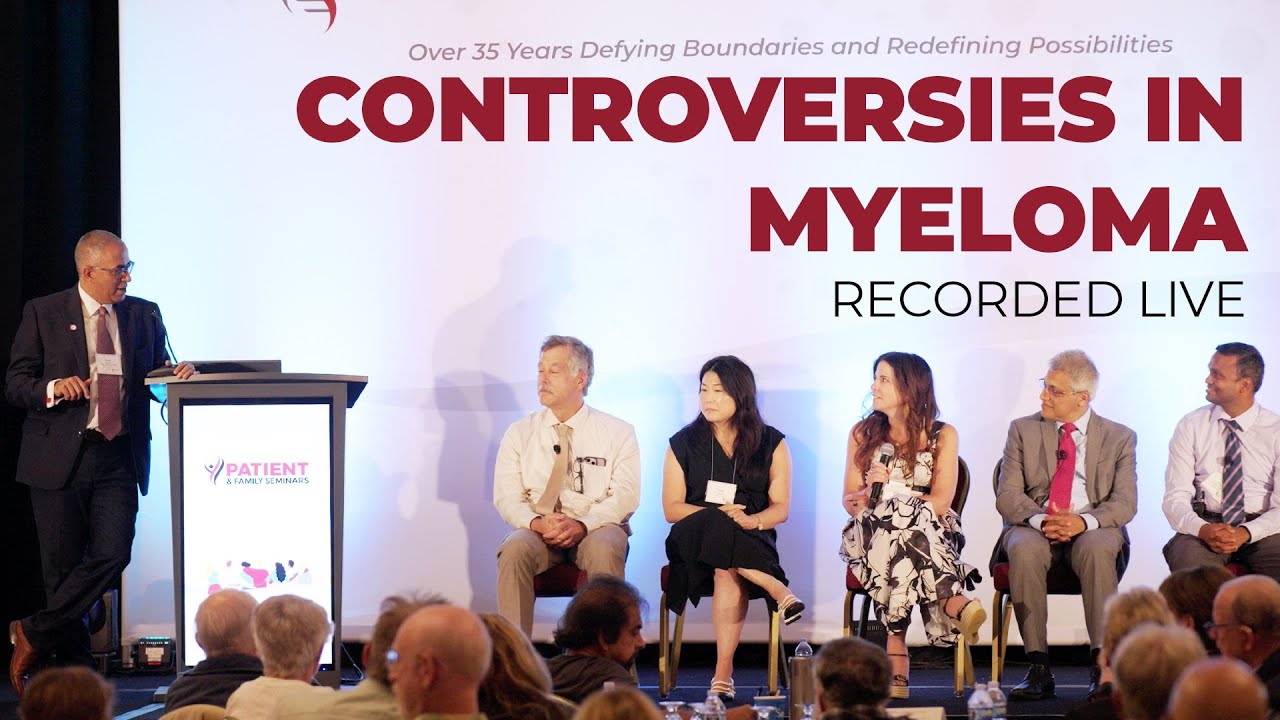
Well, thanks everybody for coming back and for being the faithful to make it to the end of our session. We're actually going to merge our final two sessions together in controversies with Dr. Kumar and Dr. Vescio. But as well, we've asked Donna Catamero to join us, Dr. Sarah Lee and Dr. Murali Janakiram who will join us shortly. I just thought it'd be easier to go right into a session where we can talk a little bit about controversies, but then also open it up for even more questions because I know that that is something that is always on the minds and hearts of everyone in this room, is to ask our expert faculty questions.
For those who did not meet Dr. Robert Vescio, Bob Vescio, of course, is at Cedar Sinai. He needs no introduction in this crowd because he's a legend in the Los Angeles area. And to his left is Dr. [inaudible 00:00:53]
And to his left, for those of you who are not in the newly diagnosed session is Dr. Sarah Lee, who also has roots in LA, but then transiently disappeared to Seattle for a little while. But then we were able to recruit her back, and she's at City of Hope here in Los Angeles as well. So welcome Dr. Lee.
And, of course, we met Donna and Shaji earlier in our session. So the point of this part of our agenda is to recognize that although we work very closely together as a myeloma community and as myeloma physicians, we have the privilege of working together, collaborating on research of different things.
But whenever you put a few experts in a room, I put five myeloma doctors in a room, and I have 12 opinions. So there are things that are a little bit controversial. And those are typically areas where we want to do more research because we don't really know the answer.
And that is really something that sometimes patients get a little bit nervous when we talk about controversies. But that is actually the essence of science. Science is designed to answer questions that are up in the air, things that we don't know. We have a fancy scientific term for it where we call it equipoise, meaning it's not clear, "Do we do this or do we not do this?"
And often, we need clinical trials to answer those kinds of questions. So I'm going to choose a couple of topics that we know tend to be somewhat controversial, and I'm going to ask the opinion of our faculty. Some of them, we hinted at a little bit with Dr. Kumar during the fireside chat this morning, but others, we're going to introduce as we discussed things a bit further.
Going right to the earlier phases of myeloma, we talked about screening with Dr. Kumar. So we won't come back to that, but I did mention at the time that there was a rather dramatic clinical trial that influenced the myeloma community called the AQUILA Study in patients with smoldering multiple myeloma.
So you've heard all weekend the spectrum myeloma, MGUS or monoclonal gammopathy of undetermined significance, smoldering myeloma and active myeloma. And historically, we didn't treat smoldering nor active myeloma... Sorry, nor MGUS. We would only treat active myeloma. But this study looked at what can we do for patients that are really at the further end of smoldering myeloma based on the analogy that I gave yesterday. If I'm running towards a cliff, you want to catch me before I fall off that cliff.
Those are the smolders that are getting very close to that edge. They've not really gotten quite to myeloma yet. But they're getting very close. And so this clinical trial was done. I won't bore you with every detail. The short version is half of the patients got what we typically do for smoldering myeloma, which is just active monitoring where they were watched closely. Come join us, Murali, thank you.
And the other half of patients were given single agent Darzalex or daratumumab. In the typical way, we would give it weekly for eight weeks every other week for 16 weeks and then once a month or once every four weeks for roughly a three-year period. And then it was stopped. And patients were followed.
And the results were quite impressive, in fact, that having the single agent daratumumab significantly prevented larger percentage of patients going on to multiple myeloma. And there was even early indication that there was a difference in overall survival.
Now, I'm being a bit vague about the numbers because I don't want to get into every last detail,. But one of the controversies in myeloma right now is should we be treating patients with high-risk smoldering myeloma either by the definition that they had in the trial or other forms of the definition like I explained yesterday, the 220 M-spike over two free light chain ratio over 20% or plasma cells over 20%.
If you have two or three of those, you're considered high-risk. So let me start with Professor Vescio here to my left. So Bob, when you see the results of the AQUILA trial, do you now say pretty much every high-risk smoldering patient should take this treatment, or are you still unconvinced?
Robert Vescio:
I think it was a very helpful study to have because it confirmed probably the suspicion we all had, that if we use a drug that people can tolerate and we give it to people early in their course that you can ultimately affect their long-term outcome.
I do think that there were other studies that weren't maybe as conclusive. But they also suggested treating people early with Revlimid and dexamethasone improved survival. But the standard, the people that were watched maybe weren't followed as well as they should have.
But I think it did give me anyway comfort knowing that it may be the best thing to do for many patients. But I still think, as you mentioned earlier, you do have to individualize things because there's age, is involved and, like you mentioned earlier, people's work and how that's going to affect them.
And then the question is whether single agent daratumumab given other drugs that we've used is the right thing to do for all or whether we should combine things and do something more. So I think it requires a lot of individualization and watching the patient. And one advantage that we all have is that if we're not sure, you can think about it, and you can see how the myeloma is evolving or not evolving and make a decision later down the road if somebody's unsure what to do.
Joe:
Excellent. Sarah, what do you think about this? Do you think that this is legit or we should just wait until people have active myeloma before we treat them? I'm trying to be the crossfire controversial student.
Sarah Lee:
I think it highlights probably what Beth was talking about yesterday in terms of shared decision making. I think also smoldering myeloma, the way I see, even if you have high risk, part of it's the pace maybe at which things are changing. So let's say you went to your doctor. You had an elevated total protein, they were worried. They checked this, and they did all the workup and your categorized as this high risk smoldering, and you check your labs in three months or in six months and nine months.And the numbers really aren't changing at all, and you're working and have all these other things.
The pace at which it's changing or not may influence kind of whether or not we want to do treatment. I think it's still... The data is very promising. It does look that it's going to delay the onset potentially. And maybe, there's a survival benefit, but I think it's a decision of you're asymptomatic, you don't technically have this disease yet. Do you want to potentially introduce a factor that may disrupt your life, your lifestyle, introduce infections, side effects?
I think the other thing that we don't know of still is what is a response and what is a relapse? So we know that with active myeloma, we're keeping a very close eye on your numbers. We're trying to get things down to normal. We have this response criteria that if even things are starting to come back just by numbers alone, we're going to change treatment potentially because we don't want a recurrence of the anemia, the bone disease, the kidney problems that first got you started on all this in the beginning.
But in smoldering, we don't have that. We're just going by lab values, and we don't know at what point is do we call it a relapse if it's just based on these numbers alone, and then what are we going to do to change treatment? We don't have that yet. So I think there's still a lot that we have to understand about the treatment. But also as physicians, what we're going to look at as a response, what is the goal? What are we going to say is a relapse from smoldering?
Joe:
Well. It's good that we have someone on the stage who actually wrote the response criteria. So Shaji coming to you, what do you think about this concept that Sarah has introduced of saying, "Well, when someone has active myeloma and we treat them, we've got very clear criteria for response and for relapse." But for smoldering patients to develop active myeloma, what's the IMWG doing about this? Do we really have an appropriate definition? Of course, I'm saying it a little tongue in cheek, but you tell us what you think.
Shaji:
I think it's an important question, but I think in terms of the response criteria itself, the different thresholds that we have developed to call somebody partial response or complete response terminology that I'm sure you would've heard in the past remains the same. But the question is, "What do you do about that particular level of response or progression?"
So I think if you're doing a clinical trial in patients with smoldering myeloma, we would still call a 50% decrease in that M-spike as a partial response or if it's completely gone, you might call it a complete response or you have MRD negativity.
So all those criteria remains the same for the smoldering patients. And those are often used as endpoints or the goal for particular clinical trials. Where it gets challenging is the progression aspect. So if somebody's M-spike, say, went from three to one and then went back up to two, technically yes, this is progression by what we call biochemical progression.
Do we do anything about it in a smoldering patient? It's unclear whether we need to do anything about it because these are patients who otherwise, if we had not treated them in the first place, a change in the M-spike to that level might not have led us to do anything different.
So that's where I think some of the challenges now is at what point in that progression in a smoldering patient who is getting treated in one of these trials, do we do something different? Like the AQUILA trial that Joe talked about, that used a definition of active myeloma but using what we call the SLiM-CRAB criteria where the free light chain ratio [inaudible 00:11:29] is a definite threshold.
So majority of the patients didn't get bone disease or any of the other things that we worry about in myeloma. Majority of the patients who are called us progressing was because the free light chains went up and the ratio flipped and so on and so forth.
But I think what we are all trying to figure out is that a relevant end. If our whole goal is to prevent myeloma from happening, I think it's reasonable. But at the same time, there's still some patients who are getting bone disease, which in the first place we never wanted to happen. We treated patients with small rings so that the bone disease never happens.
So we cannot really let patients go to that point where they're developing bone disease. So we are working now to see can we develop some early markers so that we can actually intervene before those bad things happen. So I think that's the ongoing effort trying to do that.
Joe:
So clear as mud to everybody now because, see, why it's a controversy, right? We're at the point with each of these topics, there's no simple answer. But I think in the interim, the consensus I think that I'm feeling from everybody is that we have to have a conversation with our patients.
Now, we're still waiting for formal FDA approval for the use of daratumumab in this way, although because we see it on NCCN guidelines, and it's a good thing we have the chair of the NCCN guidelines here, Dr. Kumar.
I actually think Shaji has cloned himself. I think that's the only way that one person can do as much as he does. But that's another discussion for another day. But that discussion becomes really important because I look at it very positively that we now have another option. And Bob graciously noted how I had said before that it's going to be different for different people.
I can have the exact same description of the study to one patient who'll say, "I hear what you're saying, Dr. Joe. And I think I'd rather wait." Another patient says, "No. Sign me up. Give me the Darzalex afternoon." And so I think that's reasonable.
All right. That was just like a warmup. Let's get into something a bit more controversial. So Murali, we should just stop doing transplants. Seriously, why would we want to bombard people with this [inaudible 00:13:43]-like chemotherapy? And we know that it makes them sick. We know that it puts them at risk for other cancers later. We have all these new therapies in myeloma like CAR T-cell therapy and bispecific antibodies and all these other things. Isn't it about time to just get rid of this old school brick phone and move into a modern day technology and just stop doing transplants?
Murali Janakiram:
Joe, you sound like my clinic 35 times every... I get asked this question. Why are you-
Joe:
I see people have come to you from someone else in Los Angeles. Yeah. Okay. Sorry.
Murali Janakiram:
Yeah. I think that's a great question. Why put people through transplant and all the side effects and then get them better? I really wish I had a time machine where I could go 10 years down into the future and look at whether CAR T and other therapies are equivalent to transplant.
Right now , I do not have those results. So I have to still go with the time-tested approaches and say that if I prescribe X regimen with a transplant with two other drugs, that is the best right now I have the results for. If I have to look into the future, as Joe said, I will slowly wind down the transplants. And we are winding it down, especially for patients who have a great response to induction where the myeloma is nearly MRT negative and for standard risk where we have a choice. Should we do the transplant now, or should we just collect the stem cells wait and watch and the future is going to be bright and let's rely on the future, versus someone else might say, "If this is the best you got for me right now doc, just do it so that I don't have to be with the myeloma or deal with the myeloma for the next five to seven years and go on with it."
So the statement is true, which is, yes, I'm going to wind down the transplants. But now at this time, the data which I have is with the transplant. We have trials which are comparing transplants to CAR-T that is completed accruing. But everything in science, we really have to wait for the results and the results we are expecting somewhere in the next five years or so. So yes, there is a future without transplants.
Joe:
So if I could get you the plutonium and Marty McFly, we could send you into the future, and you could come back and tell us. But Donna, I hear what Dr. Janakiram is saying. I mean, I get it, but honestly, in your clinic and maybe influenced by the former head of the myeloma program at MSK, who I teased at one of our recent meetings that his name was Ola, I hate Transplant language, although he said you made it very clear that was not his middle name. We're very close friends, just so you know, that really the best evidence we have for transplant are people under the age of 65.
And now with regimens like DRD and now even with quadruplets like Isa-VRd and Dara-VRD in older patients, at least over the age of 65 or those who we know potentially could go to transplant, but they're going to do really well with these others, shouldn't we just at least abandon transplant in that group of people?
Donna Catamero :
Still want the data.
Murali Janakiram:
She's on my side.
Joe:
You guys are so evidence-based.
Murali Janakiram:
I still want the data because transplants still tried and true, but I do think CAR-T and offering it earlier on, we see attrition rates from one line to the next. So giving our best drugs, our best therapies up front I'm a fan of, but I want to see the data. So that's how we're still practicing at Mount Sinai.
Joe:
See, this is the problem, right? We're just complete nerds up here. We have to follow the data. And I pushed it to make the point is that there are differing opinions when it comes to transplant, no doubt. But there's also no doubt that transplant has had a huge impact on providing longer and better lives for patients with myeloma.
And it goes back to what we've repeatedly said all weekend. We have to have that discussion with our patients. Although I also agree with you, Murali. Looking forward, as I think I said at the earlier session today, I'm not buying transplant stock right now, meaning I'm not sure that it is going to retain its prominence.
And that being said, the I in the IMF is the International Myeloma Foundation. There are many places across this planet where it is going to take a very long time before they have access even to quadruplets, let alone things like CAR T and bispecific antibodies where transplant still plays a prominent role.
All right. Well, coming to CAR T then, because you heard a little bit from Dr. Kumar about this morning when we had our fireside chat, Bob, we have data now from two big clinical trials, one with cilta-cel , one with ide-cel that shows that CAR T is considerably better than the triplets that we typically use in early relapse, whether it's after one line of therapy or after two line of therapy. So we just be lining up everybody to get a CAR T when they first relapse with myeloma.
Robert Vescio:
Yeah. All right. That's a good one.
Joe:
That's what we bring here, Bob.
Robert Vescio:
Yeah. Wow. I think occasionally it is. I think, for some people, it is very important to move quickly to a CAR T. People that show their disease is behaving in a way that's aggressive. Ad so you have to treat it aggressively because you may not have another chance. But somebody who's been doing well for seven years and now their disease is relapsing the first time, they haven't had a proteasome inhibitor for seven years.
I have a hard time jumping straight into a CAR T for those patients without trying a regimen that I'm comfortable with, I feel has modest or minimal risk and still knowing in a patient like that that I could still transition to a CAR T.
So I think while again averages help guide and tell you what's better, one regimen's better than the other, I think somebody who's progressing six months after a stem cell transplant isn't the same as somebody who's progressing seven years after one. So, again, it's again patient-oriented. You have to go through those things. But, yeah, that would be-
Joe:
I think you highlight such an important point, and I hope we brought through this weekend. I sometimes say multiple myeloma is multiple for a reason. There's a huge spectrum of the biology of the disease, and we can't treat everybody in the same way. We have some forms that are, as you say, very aggressive, others that are very slow-growing.
So when you come to a meeting like this and you're interacting with other patients, we want you to chat with each other and to gain support and help for each other. But you don't sort of look and say, "Hey, what's your M-spike? Let's compare it to my M-spike," And see is this the same? Why would you treated this way versus me being treated that way?
It depends individually. But Sarah, let me ask you, do you buy that? I heard just a minute ago from someone who happens to be sitting next to you that we're guided by the data. Don't we have data that show that when you give cilta-cel versus the typical triplets that we give, that you're going to be tripling the period of time and remission, maybe even impacting overall survival. Isn't it just CAR-T cell therapy or [inaudible 00:22:16]?
I'm trying here. I'm trying. I'm channeling my inner Jerry Springer here. I'm trying to get something.
Sarah Lee:
I'll be honest, I think, and this includes kind of transplant. For me, the way I see all these treatments and you harkened to it a little bit earlier in the day of, it's not about if. It's all about when. So I think I have access to all these treatments including transplant, including CAR-T bispecific. It's not do I do one or the other and then I'm never going to even think about transplant.
It's when do I use it and when can I potentially have to use everything that I have in my tool belt? So the data, the way it stands now, if you're transplant eligible, you're young, fit, we're thinking about a quad, we're thinking about transplant, we're thinking about maintenance. And then it's a matter of when do I use CAR T? When do I use transplant and not if I do it or if I don't do it, I think.
So same with CAR-T. I agree. I think in second line, not all second lines are equal. So if you got Dara-RVd and you're progressing without just on the quad alone, your myeloma is something that's quite aggressive. It's not responding to the quad that we think we might have to go a novel approach and do CAR-T.
If you got a quad and you got transplant, you're on maintenance, or maybe this was even when you got a triplet from years ago and you've just been on Revlimid maintenance after transplant, it's been five years and your number's just starting to slowly come up. Maybe, you don't want to do a treatment that's going to require you to be at a center for a month, not be able to drive for several weeks, need your caregiver to take off time from work, miss events with your family.
Maybe, that's not something you want to do. And you're comfortable with coming in once a week getting these newer treatments like daratumumab or things that have since come out of the market that you didn't have access to before. So I think, again, it really depends on the patient, depends on the disease. And I don't want to take lightly the side effects that can come from CAR T, especially the neurotoxicity, the early and the late-onset neurotoxicities.
And so that's something to really take into consideration as well. If you're young, you may get a long time with it, but are you going to trade one thing for something else, and you think that's a very serious thing to consider?
Joe:
See why she's such a great doctor. Well said. Absolutely well said. Okay. Donna, I've got one for you. As we wrote in an article a couple of months ago, the nurse practitioner I have the privilege of working with, we wrote an article called Down with Dex. The alternative option was Let's Talk About Dex, Baby. But that was felt to be maybe slightly racy.
So the principle of what we wrote was in relation to one of Sarah's former colleagues who did an analysis of patients who were treated on two large clinical trials. One that was led by our former chair of the board and one of our founders of the IMF, Dr. Brian Durie and a different ECOG study where patients had been treated with frontline therapy that included dexamethasone.
And the dexamethasone was meant to be continued throughout the whole of the treatment. And so they looked back at these two clinical trials, and they evaluated the patients that had had their dexamethasone reduced because the protocols allowed a dex reduction if people had some side effects from it. And they wanted to see if you had your dex reduced, did you do inferiorly when compared to those who stayed on the dex?
And it turned out that the two groups were the same. So maybe, we really don't need all that dexamethasone. Hence, the article we wrote called Down With Dex. Now, I know that every myeloma patient in this room loves dexamethasone and wants to stay on it at full dose for as long as possible. Obviously, I'm being super sarcastic here. But we all know, as I say, it's the drug we love and we hate.
We love it because it actually boosts the effect of every other drug. It has anti-nausea property. It has anti-pain property, and it even helps reduce the potential reactions we can get from drugs. But really all of those effects are probably not that valuable after the first month or two. So shouldn't we just all start going down with dex? Shouldn't we just everybody say you get your first month or two and then we dial it down and by five or six months later, we should just stop or should we put our license plate as dex forever? What's your take here, Donna?
Donna Catamero :
I heart dex.
Joe:
I heart dex.
Donna Catamero :
My favorite article is The Devil is in the Dex because-
Joe:
The Devil Was in the Dex.
Donna Catamero :
The Devil Was in the Dex. I think it's important for debulking. So early on, yes, and then I can titrate patients off, but the disease is going to dictate how I'm going to... And I would always joke with patients like, "Well, if you didn't walk in here with diabetes, you're going to be walking out with diabetes," because we gave so much dex, but I think we're learning we don't need so much dex and we can definitely dial it back.
Joe:
And Shaji, what's your take on this because I know you've been a participant in the trials before when Dr. Vincent Rajkumar who's actually the chair of our board at the IMF currently led really a sentinel study in dexamethasone. And we always want to note that it was a patient who said to the committee, the ECOG committee said, "Can you not do a clinical trial with less dexamethasone?"
So for all of you who've been on high dose dexamethasone as sometimes it's called or the dexamethasone we give now is 40 milligrams every week, we used to give 40 milligrams 12 out of 28 days in the month. So you would get four days on, four days off, four days on, four days off, four days on, and then the rest of the 28 days off.
And so people got literally three times as much dex as they're getting now. And he did that study that compared that amount to just getting it once a week. And remarkably, the lower dose of Dexamethasone patients did better and actually had a better survival. So I know you've been involved with some of this work in studies. As Donna's indicating, is it time to finally go down with dex? Our French colleagues are already doing clinical trials where they stop the dex after two months anyway. Is this really the way we're going or do we still need to continue this love affair with dexamethasone?
Shaji:
No, I think we need... Dex is an example of less is bit more. And I think there are trials even there's a large trial that did in Italy where they proactively discontinued dexamethasone after nine cycle, and people actually did much better where the doses of the Revlimid was reduced and the dexamethasone was discontinued.
We did a study which had a quadruplet where we discontinued the dexamethasone after one cycle and compared two different cohorts and there was no difference in terms of their outcomes. So I think especially with all the really effective treatments we have, really, there's minimal reason to continue the dexamethasone beyond the first couple of cycles.
Joe:
And I don't have a pure anti-dex agenda here. I don't have some childhood reason to tell you that I hate dexamethasone, or something like that. But I've just seen so many of our patients suffer with this. And so I'm not commissioning any of you to do anything. But if you are struggling with dexamethasone, and as you know, the signs and symptoms of dexamethasone can be very typically it can keep you up at night, it can make you irritable. And if you don't think you're irritable, just ask your spouse or partner or friend or pet, and they may be able to tell you it can increase blood pressure, it can increase blood sugar, it can make your skin such that it bruises a little bit more easily, and the list goes on.
So I do encourage our patients to have a conversation with their healthcare team about their dosing of dexamethasone. In my practice where I see a lot of individuals I mentioned earlier as an expert opinion, more often than not, I'm saying, "You know what? I think you can actually start to taper down your dexamethasone."
So I know we want to be respectful of a dexamethasone and the impact it's had in myeloma over many years, but I think it's time to think about dialing it down.
Okay. A couple more controversial questions, and then we're going to open up for Q&A. So here's one, and I'll start with you, Shaji, which is we have emerging evidence now that maintenance therapy doesn't necessarily have to be given forever as we initially thought. So often after a stem cell transplant, patients are put onto typically Revlimid, lenalidomide and are told, "Well, the French did it for two years, but the Americans did it for longer. God bless [inaudible 00:31:17]. We'll do it for longer because it seems to be better than just two years."
But is that changing? Do we now have parameters by which we can talk to patients? And this is independent of whether or not a patient is suffering. I think if a patient is having significant side effects from Revlimid, we know that almost roughly between a quarter and a third of patients can't stay on Revlimid because of the diarrhea or severe cramping or other things that I think that kind of goes without saying we need to taper them down and potentially even discontinue it.
But in terms of just actively planning, have we reached a point that we can give more patients? I joked in yesterday said, "My favorite drug is nada, nothing." Can we take them off the Revlimid and just write prescriptions for nothing?
Shaji:
Joe, I think it's important question. I think with the Revlimid with a single drug maintenance, I think there is probably a role for a little bit longer. And again, there was a really nice analysis that the UK group did looking at their clinical trial data, and they showed that there's decreasing benefit as you go keep them on dexamethasone for long time.
So at two years, there's benefit. If you keep it for three years, it's better than continue beyond. But beyond four or five years, they really didn't see a lot more added benefit. So I think if you're using Revlimid alone, I often try to give at least two years. But beyond two years, it's a balance between the side effect and how deeper response the patients have reached. So if somebody's having side effects, and they're MRD negative, I'm very happy stopping at two years.
But if somebody's having no side effects or if they still have some disease left behind, I often try to go with lower doses maybe if needed, but at least three or four years for as long as they can tolerate it. But I think the whole thing has changed because now, we are using two drugs for maintenance in many of these, especially with the quadripletes transplant, two-drug maintenance.
In that scenario, I think now we are able to discontinue in a lot more patients because more patients are getting to be MRD negative after two years. And that's what a lot of the trials are designed going forward as we talked about it this morning. And if you're MRD negative and if you stay in MRD negative for 12 plus months, there's a very good chance that we can stop it and not necessarily compromise the long-term outcomes.
Joe:
Murali, is that how you're approaching it in your clinic? Are you planning to give people two to four years of Revlimid alone, and do you use MRD to guide you a little bit in that?
Murali Janakiram:
Yes, Joe. I think my boss, Dr. Krishnan, said, "The best one is to stop all the drugs," and time-limited therapy is the key. I completely agree with Shaji that around the two-year mark, now MRD is coming up. And if there is MRD negativity, I really have a discussion with the patient. If the myeloma is standard risk, then I say that is very minimal to no benefit in continuing the Revlimid.
We should probably stop it. If the myeloma is high risk, then maybe for the third year, I would continue the maintenance. If the myeloma is still MRD positive at the end of two years, I tend to continue maintenance. But if there is no evidence of cancer at two years with standard risk, I tend to stop it.
Joe:
So MRD positivity and high risk will make you continue it. But in general, you're trying to look at stopping. Bob, are you stopping at that early too?
Robert Vescio:
I tend to be continuing it more just because I'm less of a, for an individual, a believer that MRD should totally sway what you do. That's just kind of my feeling about it. I think studies is tremendously important, a tool to compare one regimen to another.
But for the individual, until we are seeing lots of people cured and coming in here 20 years out from their disease, we assume for many that the disease is still there. And if we do a test that shows it's not, the assumption is it's still there. And if something that you're taking puts you into remission and they're tolerating it, then I have a hesitancy to stop a treatment that got you there.
But it definitely depends on their tolerability, and we have so many other choices that no one needs to suffer in any way from Revlimid lenalidomide when there's so many other options.
Joe:
And I think that's a great take home message to the group here because I think there are times when people have heard, "Oh, staying on maintenance is better. So I'm going to keep taking it no matter what." And some patients really, I can think of a patient not long ago, whose husband looked at me and said, "Please, have this conversation with her." She tells you she's fine, but she never leaves the house anymore because she's worried about some of the side effects like the diarrhea and other things you may be experiencing.
So that becomes very important that we do have other approaches and other options. But at the same time, I think I land somewhere between you all where I feel like that the data from the UK really pushes me to go out to three years. I actually have a Greek study that looked at going three years. And then if they're MRD negative, thinking about stopping them.
But you can tell obviously there's a little bit of controversy here. Our last question before we open it up, our last controversy before we open it up for Q&A has to do with bispecific antibodies.
Murali, I start with you because I know you've been leading and doing a lot of these studies. We now have four different bispecific antibodies. So we have teclistamab, which is BCMA-directed. We have talquetamab which is GPRC5D connected. We have elranatamab and and, now most recently, as we commented yesterday, linvoseltamab. So four drugs. There's a lot of similarities and some differences between them.
Is it okay if someone is progressing on one bispecific antibody to then just switch to another? Do you really want to ensure that you're going to a different target if they're on teclistamab, you're going to go to talquetamab or vice versa? Or are you comfortable saying these drugs are different enough, the three BCMA-directed drugs that you would just go from one to another or do you need to have a break in between?
Murali Janakiram:
Great question, Joe. So I think of the three BCMA antibodies as sort of triplet babies, so choosing between them is pretty much, and all of them are equally effective. So the first bispecific antibody between teclistamab, elranatamab or talquetamab, I think all of them have nearly same efficacy and same side effects. So I don't mind which were one is started.
Now, when the myeloma progresses on one of these three, I tend to either, if possible, give a break because, as we said, these antibodies ask your immune system to bind to the myeloma and attack the myeloma.
Now, when the myeloma is relapsing, sometimes, the immune system is tired. So we might have to give a break between bispecific antibodies to just let the immune system recover so that it can catch its breath. And then try a different bispecific antibody. Usually, change the target to talquetamab or TALVEY. If I cannot give a break at all to the immune system, then I go to a different target which is the TALVEY. In general, I don't try and choose between the triplet babies and go one after the other.
Joe:
So you're of the mind that the T cells need a little bit of a vacation. And, hopefully, and just an area of work and research and not to get into too much detail still early, we are doing a lot of work to try and understand T cells and what makes them tired and how tired are they and what spa can we send them to be rejuvenated.
There's even some talk about some of the newer drugs looking into the future cell mods and others that may even have the capacity to sort of rejuvenate your T cell. One of our scientific advisory board members called it the cappuccino to your T cells in some of these newer therapies.
Sarah, are you following that same modality? And maybe, particular, can you comment for just a moment on if you're looking at a patient who's eligible for both CAR T and bispecific, are you going to favor one over the other in terms of the sequencing of the two?
Sarah Lee:
Yeah. So I think, in general, if you have the time to get to CAR T, I think we're still favoring CAR T over bispecific because it is a potential therapy where you get it. you get into a very good response and you may not need treatment for few years afterwards when it's effective, and that's really meaningful time back.
But as we saw earlier through Donna's slides too, CAR T is a process. You need to be able to get to a center. You need to have time to collect the cells, can take four to six weeks to get the cells made and then you get into the hospital or an outpatient to get it. And in between that time, if your myeloma is progressing too quickly, we don't have time to get through that. We need something really quick. That's oftentimes, when I'll think about using a bispecific versus a CAR T. I think, otherwise, yeah, I still try to prioritize CAR T.
I think one of the things we doing at City Hope with partnership with TGen is looking after a bispecific, for example, especially at BCMA, now that we have these triplets, like Dr. Janakiram said is one of the problems of why one might stop working is , one, the immune system might get tired. But the other is you stop expressing that BCMA antigen. You might not have the signal anymore so that even though the drugs around trying to look, it has nowhere to bind to.
And so we're starting to look to see, "Well, what is that? Are you losing that expression? Do you still have that expression maybe then another BCMA treatment could be effective or have you lost that?" And we need to wait until that gets re-expressed again later. So these are all things that we're looking at.
Joe:
Fantastic. Okay. We could go on all day with different controversies. But let's open it up for you for our final Q&A of the day. I'm sure you have questions after all that information that we brought to you. We have a little under half an hour left, and we'll wrap up in time for everybody to enjoy some Los Angeles traffic at 5:00 o'clock. So maybe, we'll start right up here. Question number one.
Speaker 7:
Thank you. I have a question. Have you noticed or has there been any studies that have come through comparing Revlimid with lenalidomide? Has anybody had any problems? I know it's the generic. But we just had a discussion earlier where some people said they have had some effects from lenalidomide where they didn't with Revlimid.
Joe:
Right. So to clarify, in case people are confused coz we often use those terms interchangeably, so every drug of course has its generic name. It's sort of if [inaudible 00:42:56] more scientific name and then it's trade name, right? So lenalidomide, pomalidomide, thalidomide are the generic names. The trade names Revlimid, POMALYST.
But now, we have different forms of lenalidomide in terms of different generics and maybe, I don't know who feels comfortable answering that. Shaji, I've had some experience, but I don't want to answer everything. Do you want to comment a little bit about the potential difference in generics?
Shaji:
In terms of the efficacy wise, I haven't really seen much of a difference. Again, the experience has been limited because it's capped in terms of how much of the generics available. So many patients end up starting the generics in the beginning of the year, and they end up switching back to the Revlimid because they can no longer get it after a few cycles.
So there are patients have been going back and forth, and they have not really seen too much of differences in terms of side effect profile or the toxicity or the efficacy of the medication.
Joe:
And I think that reflects most of the experience talking to people across the country. I think that reflects most of the experience we've had in the US with the generics that are available in the US. So again, this is a massive international issue. But here in the US, the concept is if a generic is made, it's typically a little bit cheaper. But there's some laws around that and some things that's actually not that much cheaper.
But some insurance companies will mandate and say, "Do you really need the trade name ,Revlimid?" Maybe we'll give you the generic. It's 85% of the cost of the real. And even that 15% difference when you're talking about drugs that are over $20,000 a month, right? Imagine the mortgage you'd have, the house you'd have with a mortgage of 20K month.
But it can make a difference. That being said, there have been some individuals. I know we've reported. I saw miss here a few minutes ago. We've seen people call into the info line about this that they felt different on it, that there have been different side effect profiles. I don't think it's been as dramatic an issue as when I talk to my colleagues in Brazil and my colleagues in India and in other parts of Asia where there have been more generics produced, some of which don't have the same, let's say, restrictions and standards that we may have here where people have felt vastly different when they've gone on to different generics.
So my general guidance here in the US is we've helped some patients who've tried to say and write letters to their insurance company saying, "Can you please just keep me on Revlimid?" It's kept me in remission this far. I'm tolerating it well. Let's continue it, and I support that. But if someone's in a situation where they've had to switch to the generic for other reason, I don't want them to think that it's a disaster. For the vast majority of patients, they've been able to do this with the same efficacy and without a change in the tolerability.
That being said, if someone is experiencing something different, we'd like to hear about it. We want to help you with it and find ways to overcome that. Dr. Kennedy.
Dr. Kennedy:
Donna shared a sobering statistic on her slide on prevention on infection and said that infection's the leading cause of death in myeloma patients, and you gave us some helpful tools on personal hygiene, thoughts on vaccines, and things like that.
But I wanted to drill down on two points on that slide. And one is it's coming up on flu season soon. And practical tips for all of us on is it one dose, is it multiple doses? I know Dr. Hofmeister presented some stuff at ASH last year that suggested multiple doses of a flu vaccine might be helpful for myeloma patients. The second part you shared was on IVIG, and the guidelines on that has seemed to shift a little bit. Is it at 400 with recurrence life-threatening infections? Is it at below 400? Is it if you're on a bite, everybody gets IVIG> what are your thoughts on those two topics?
Donna Catamero :
So in our institution, flu vaccine, we do multiple doses for our older patients, for IVIG, especially in the winter months for our bispecific standard patients because that healthy IgG level is going to drop because of the target.
So everyone is on IVIG. And then those patients who aren't on bispecifics or post CAR T, the winter months can be difficult for patients with infections. So some patients we will give IVIG throughout the winter months to provide that extra protection.
Joe:
I just want to see if any of the other panel members want to comment on this.
Shaji:
I think the main thing is the change, I think, you're alluding to is the shift from the previously we said people have to have low IgG and also have to had infection before they can get IVIG. I think that paradigm has changed in the context of the bispecific antibodies and CAR-T no longer relate as much on the levels or rely on the fact they have had previous infection before starting IVIG.
Sarah Lee:
I'll just add-
Joe:
I'm sorry. Go ahead, Sarah.
Sarah Lee:
I'll just add, unfortunately it becomes sometimes insurance-driven. That's a really big piece of things is that a lot of times, even if your IgG level is less than 400, they may not give authorization unless there's been a documented history of recurrent infections. I think, in general, for post CAR-T and post bispecifics, there's enough justification that we can usually get authorized for. But if you're on a daratumumab-based treatment frontline and your IgG's low, sometimes, they may still deny and that becomes an issue.
Joe:
Yeah. The only thing I'd add to that one is that I think that insurance issue, in general, I'm actually finding is getting a little bit easier. I think insurance companies are recognizing it's better to prevent an infection than to treat an infection. And the second, and it's not to disagree at all with what's been said, but I'm also very conscious when we have a meeting like this that everybody leaves thinking like, "I'm going to dive an infection."
And there is a balance between taking precautions and not going as it were overboard. But it has to be what you're comfortable with. We learned some unfortunate lessons during COVID, for example. We learned that, in fact, myeloma patients, although we always think of myeloma patients being at significant risk of infection, there were periods in the, if you will, life cycle of a myeloma patient where they were at particular risk when their disease was active either at frontline therapy or relapse, if they were post transplant or post CAR T.
We didn't have as many bispecifics at the time. So there are times in your myeloma life where infections are going to be a greater concern. But there are also times now with our treatments as people get into remission and their disease remains stable, that we have to balance that risk with the life you want to live.
And I have to say, after the pandemic, I've interacted with a lot of patients who are like, "I'm never going to get on a plane again. I'm never going to a concert. I'm not going to touch my grandchildren. I'm not going to get into an elevator." I understand as my daughter likes to say, "You do you." If that's what you want to do, that's your prerogative.
But at the same time, I find myself often in clinic giving permission for patients to travel, giving permission for patients to go and celebrate their anniversary out at dinner. As I commented earlier, everything in life is a risk-benefit analysis. And you have to find that balance.
And I think that goes back to having that conversation with your healthcare team. What do you safe with? What is your IgG level? What is the state of your myeloma? What is your history of having or not having infections? Because I don't think, and this is why we respect everybody who wants to take certain precautions, but we want to also give people that freedom to say, "You're not the bubble person that needs to live in the bubble and wear a mask in the shower and never have an opportunity to interact with the rest of the world."
Next question. I remember, there's also, someone asked me earlier a question about high-risk myeloma that I want to come to before we conclude, but let's take this question at point three.
Speaker 9:
Yeah, I wanted to just add one more piece-
Joe:
Sorry, can you speak up just a little bit more?
Speaker 9:
Yeah. I just wanted to add one more piece of anecdotal evidence to that debate over whether dex is necessary. I'm in my ninth year of myeloma, third line of treatment. In about two and a half years ago, I started into [inaudible 00:51:23], VENCLEXTA and a half dose of dex.
And I'd have come Mondays, I go 24, 36 hours with no sleep and have a miserable day on Tuesday. Christ. Two days out of a week, we're just gone. My AMP protein dropped to zero within a short time after starting the new treatment. So about a year and a half ago, I told my doctors, "I want to stop dex. Period."
And they're okay with it. So I went cold Turkey on it. That was a year and a half ago, and I have seven days a week now. Just wonderful. The AMP protein hasn't gone up or anything at all. So it's just been wonderful. So whatever it takes, I mean that's just-
Joe:
Welcome to the Down with Dex movement.
Speaker 9:
I know.
Joe:
Well said. Thank you for sharing that with us. Thank you. I'm sorry that you had to experience those sleepless nights though.
Speaker 10:
I want to ask about something that's come up several times this weekend, and that's the problem of delayed diagnosis. So several people on the faculty have said that what we need to do is better educate the primary care physicians.
But I want to ask if you can expand on that and say, "Well, what exactly do you tell them?" Because, well, I never went to medical school. So I don't know what it's like to be a primary care physician, but I have to imagine that if a patient presents with symptoms or complaints which have multiple possibilities of the cause, how do you deal with that?
I imagine that there's a protocol for a panel of tests that you order to try to narrow down what it is. And so instead of asking the physicians, just think more about myeloma, what about adding things to the standard panel of tests so they don't actually have to think in detail about every single possibility they run those tests and see what comes out? Does that make sense?
Joe:
So fantastic question. It's complicated because on the one hand, we don't want to over test, we don't want to under test, right? So we can't do the testing on every single person in the country with back pain or fatigue because all of you would be tested every week. It's amazing how much we have that.
So what is it we're teaching the primary care doctors? What we're teaching them is two sort of basic things. One, here are the classic signs and symptoms of myeloma, especially as we put it in the context that typically myeloma has a delay diagnosis. Not to make them feel guilty or bad about it, but this is an ongoing problem. And here are the things to think about and, in particular, to think about it in higher risk populations. In patients who are now over the age of 50, patients of African descent patients, Latino Americans. We do try to highlight this is where your radar has to be even a little bit higher.
And then number two, which is here's how you do the testing. Now, one of the things we've done, we did a small pilot in Atlanta, and we're hoping to do it in other places where we had what I call the easy button. So because myeloma is complicated, do we order the serum protein electrophoresis and do we order light chain tests? Is it the light chains in the serum, or is it the urine? Is it the quantitative immunoglobulins? If you looked as a primary care doctor in the tests that you can order that are related to immunoglobulin, the list is this long, and it's really complicated.
So we created this what we call a cluster or an order set that just ordered the key ones together. So they didn't have to say, "I do this test and this test and this test." I think the person might have myeloma, click.
And I think that's a big part of our future. I think of simplifying the way in which we make that diagnosis because you're very right. More and more primary care and other specialties are guided by these algorithmic-like approaches. And this is frankly, even AI is helping us because some of our medical systems are being able to say, "They detect that this patient had this and had that." All the patient actually had a total protein that was high and a creatinine that was a little bit high.
And it sends an alert to the doctor saying, "Have you considered myeloma?" Amazing, isn't it, because we as physicians, we can't learn at all. It's impossible. No one human brain can wrap around what we have in medicine. So I do think it's a mix of the things that you've just said.
Before we jump to the next question, I'm just going to ask the group, because someone earlier had asked that we bring this to us. Shaji, I'll start quickly with you, and I know this can be complicated. But we want to try and simplify things a little bit. I mentioned yesterday that we had this joint effort between the International Myeloma Working Group, which you're a member of, and the International Myeloma Society, which he's also going to be the president of the IMS before too long. So Shaji does everything. And we jointly came together to create a new definition of high-risk myeloma. Can you just talk us through the basics of that and, in particular, how now it might mean doing more sophisticated testing than we've historically done?
Shaji:
Yeah. No. I think the reason why we wanted to readjust because now who really has high-risk myeloma is because many of those markers that we have identified over the years have no longer carry same prognostic value or the same adverse impact as it had because the treatments have improved.
So again, we know that there's about a quarter of the patients who don't get the same degree of benefit from the current treatments that we have, even though they're very effective as the rest of the three-quarters of the patients. So we wanted to identify those group of people who didn't do as well so that we can actually design clinical trials specifically for that group in order to improve the outcomes.
Now, to define those groups uniformly, we have to have come up with a criteria that is universally applicable and is based on data. So the combined effort was based on a lot of the data that has already come through from the recent clinical trials, including some of the unpublished data.
And what we found was, and it's a testament to the power of the therapies. So we had, let's say, 414 translocation in the past was a high-risk marker. But we know with the new therapies that has the impact has gone down. And what we found was that having just one abnormality may not be as bad as it was in the past. So we need to have at least two abnormalities, especially if you're talking about translocation 414 or 1Q gain.
So having two at a time is really the marker of high-risk behavior with the current therapies. The only exception being somebody with a 17p deletion, even you have one of them gone, it usually has a profound impact on the outcomes.
So that is the reason behind developing a new set of criteria. One, uniformity. Everybody sticks to that same criteria. All of us do clinical trials based on that criteria so that if you have five different trials going on in different parts of the world. Using the same criteria, but four different therapies or five different therapies, at the end of the day, we can compare them and say which one may have been the best in terms of the treatment of high-risk.
So that is the reason behind doing it. And as you mentioned, it's purely genomic. It's mostly based on the characteristics of the information that you currently get from FISH, with the exception of a mutation that we have included in there that requires sequencing. So that is going to be a challenge in that transition, but I would predict that in the next three to five years, we will stop doing FISH, and we'll be doing sequencing or DNA sequencing on every sample so that we can get the complete set of information.
Joe:
Beautifully said. So what that means in the interim is that it's a bit of a shifting criteria. And the last thing I always want to remind people about high-risk disease is these models aren't perfect, right? I sometimes give the analogy that high-risk disease is like having a high-powered sports car, right?
It has that capacity to grow more quickly. What defines high-risk typically is that patients even paradoxically may respond really well. But their disease comes back very quickly. So it has that horsepower, and it has that ability to come back. But just like sometimes on the highway, you see that Prius passing the Porsche, there are patients who have standard-risk myeloma whose disease can be more aggressive, or patients with high-risk myeloma who don't, if you will, behave aggressively. So it's not a death sentence, right? It's not a final statement. There is some caveat to that. All right. Michael two.
Michael:
Okay. Yeah. You touched a little bit on what my question actually was. A couple of months ago, I attended a HealthTree Roundtable in San Diego where Dr. Scott Goldsmith of City of Hope was very, very excited about whole genome sequencing.
And at the time, he was expecting IMS and IMWG to be recommending it soon over FISH testing. And my notes here, clinical WGS in 48 hours is in the works expected this summer is what I wrote down at the time. Where are we with that?
Shaji:
So right now, again, we don't necessarily need to be whole genome sequencing. I think increasingly the approach is trying to look at a panel so we know which genes we need to look at. So a panel of 100, 140 genes will give us the complete set of information that we really need for risks stratification.
Is it available? There are a couple of tests that are already out there that is available. Most of them have not been fully validated, cannot be used in, say, clinical trials or have not really started being used in the clinical practice uniformly. But I think, as Joe said, it's a transition phase. Yeah. I would say the next three to five years, it'll be completely shift over to that. It's going to be a lot less expensive than the FISH testing is.
Joe:
So if you're a support group leader here today and someone sends you an email saying, "We have this rapid amazing test, we're going to do your genome sequencing," just take it with a grain of salt because there are 50 companies right now that are trying to do this, right? I work at a genomics institute, and this is what we do in the lab, and it's very complicated.
But the optimistic answer too to your question is that I think we're going that way in the future. Just like Dr. Kumar said, in the future, we're probably going to be dropping FISH testing. Just like in the old days, we used to do conventional side genetics. Remember, those table up?
We've gone literally from the brick phone to the Blackberry, sorry, Diane. Now, we've moved on to the iPhone. And so I think I know some of you're Samsung people, I get it, whatever. But we move in that direction. I think in the future, it's all going to be about sequencing because it doesn't just tell you about these major changes to genes. We get down to the tiniest changes, the tiniest mutations.
We also capture, of course, those translocations or those other things, all the different things that could happen to genes in that when we hear the word sequencing, you're looking at it really fine print. It's one thing to get the summary of the book. It's another thing to read the whole of the war and peace novel. And that's what we're doing with sequencing. We're getting the whole of the novel every letter, and so we can make those distinctions. I think we have time for a few more questions before I ask Robin to come up and close us off.
Speaker 12:
Hi. I just wanted to know what is considered early relapse, because I've heard it sounds like it would be within a year, but is three years early relapse? Is it five years?
Joe:
How we define early relapse?
Speaker 12:
Yes. How long? Can you give me a period of time like years?
Joe:
Bob, this has been a changing definition in some ways. So what do you, in your mind, consider someone to have relapsed quickly? So let me just clarify very first before I ask Bob that question.
It's unfortunate we sometimes use that phrase, early relapse, can confuse people. So there's two different concepts. There's the concept of how many lines of therapy have you had, meaning I've had one prior line of therapy no matter how long that lasted. And then I get my second line. Then I get my third line. And we've often said, early relapse is those first few lines of therapy and late relapse are the, I've already had four prior lines. I've already had five prior lines. So that's one concept.
The second concept is how long were you in remission before you relapsed? And we sometimes call early relapse, which unfortunately, it's almost the same phrase we use. But we're saying you've almost should be rapid relapse as opposed to early relapse, meaning that typically, in the old days before we used maintenance therapy, the average time to relapse was about two years.
Now, with maintenance therapy, it's really more four years. So we think of people relapsing more quickly, how do you define that in your mind, Bob? When do you think to yourself, "Oh, I'm concerned that this person is relapsing more quickly than I wanted them to." Everyone relapsed more quickly than we want to, but what do you think of as a few more rapid relapse?
Robert Vescio:
I don't have an absolute line in the sand, but I would agree two years would be early, in my mind, something that they were on therapy and within two years that the disease is progressing especially, and we often talk about it after a transplant. So when decisions are being made and to do a CAR T as we were talking about versus something or delaying the CAR T after something else. But it also depends on the rate, the rate of relapse, how fast is the disease progressing? But yeah, two years, I would say.
Joe:
The good news is that overall, that average time to first relapse keeps getting pushed out with the latest PERSEUS trial where we give the quadruplet of D-VRd and a transplant and some consolidation and maintenance. We have some models now that are predicting that the patients on average are going to go a decade before they're going to relapse.
And, obviously, averages only mean average. So when we say the median progression-free survival of drug X is three years, what does that mean? That basically means that at the three-year mark, half of the patients have already progressed. Half haven't. But there's a huge spectrum. Some people progress at three months. Some people are going to progress at eight years. But it's that spectrum. Michael.
Michael 2:
Yeah. Going off of the disparities discussion earlier, as a Latino who got this relatively younger, I'm curious about what we see about rates in Latinos in the US versus, say, the broader Latin America area. Just thinking about that concept, trying to figure out is this something specific or is it environmental, or what kinds of things might cause a higher incidence, especially at, I guess in my case, an earlier stage?
Joe:
Great question. I can try to answer very quickly is that, and thank you for raising the importance of that, much like we saw with African Americans who have a higher incidence of myeloma, a lot of that work also was done in Africa. Actually, there have been multiple countries in which the incidence of myeloma has been looked at, and that has also been very high.
And then some great work has been done to try and understand the genetics of that and trying to understand is the genetic pattern related to where people originated in the country? I give myself as example is that I'm from Egypt. So if you looked at me, you didn't think I was Black, but I'm African American because my genes are much more like the rest of that region that have the greater incidence. So in Egypt, when I go back and visit family and go do lectures and so on, we see that higher incidence of myeloma.
Similarly within the Latin American population, and again, it's been hard because with the disparity of access to care in Latin America, we don't know the true incidence and the true average age of myeloma diagnosis.
When I speak to, and we've created now a Latin American myeloma network, which we're doing, I think, some great work in, I speak to Latin American doctors there regularly. I go there regularly, and they're seeing that they are seeing younger than average what they would expect patients with myeloma.
Now, is that because younger patients have greater access to healthcare and older patients are not going to be seen at these clinics and, therefore, it's a bias by virtue of their referral, or is it the true biology? This is part of the work that the IMF wants to do there to get good data, to do true incident studies, to get registries across countries. They'll help us understand that more. But it is felt to be more, if you will, genetic-related than environmentally exposure per se related. It is unfortunately the end of our time together for the panel. Let me take a moment to thank each of you for being amazing people. You are relieved of your duties.