

Brian McMahon:
They found a CAR T trial that they didn't know was at their home center, right? So they were able to call, get the appointment, get over there. We heard from them six months after they had gone on. She said, "It was the first time I was ever able to tell my mom that I was in remission." This is what clinical trials, this is what new treatments bring to myeloma patients and their families.
Dr. Joe:
You got me excited about the show and I'm the one hosting the show.
Brian McMahon:
There he is.
Dr. Joe:
Brian, it is always good to see you, my friend. I hope all is well with you and welcome to the program.
Brian McMahon:
Thank you for having me. It's always great to see you.
Dr. Joe:
You and I have had the privilege of working in this field over a long period of time and we know that clinical trials are really an important part of what we do, not only in cancer but very specifically in multiple myeloma. And I wonder if you can summarize for us in a few minutes why this is so important and what we're going to obviously be speaking about over the next 15 minutes or so together.
Brian McMahon:
When we think about clinical trials, a lot of patients don't actually participate, which is a challenge. So we're going to talk about why trials are so important. Like any problem that's really complex and big, there's not one factor that stops patients from participating. But I think three big things that we're going to talk about today is awareness, trust, and access. Because what I'm going to show here is patients may not even be aware that clinical trials exist. You and I are really familiar that the majority of patients receive care in the community setting, but most trials are at large academic centers. So if patients don't know they exist and they don't have a trusted resource, it's going to be really hard to get them access to these trials to go in there. And if you think about something like clinicaltrials.gov or a hospital website, it's really difficult when you see 2000 options or sometimes zero options, right? What do you do? You're going to throw your hands up in frustration on either one of these.
So the really beautiful thing about the partnership and what we're doing with the IMF and what the IMF is doing with us is we're really merging these things together. How do we raise awareness? How do we build upon the trust and the beautiful relationships that you guys have built over 30 years with patients? And how do we make these things more accessible? We want patients to make better decisions, better informed decisions, which could mean not going on a clinical trial in the first place, but we want to help them understand what that looks like.
Dr. Joe:
When patients are facing such a complex and difficult disease, we want them to have every bit of information possible available to them. We want them to understand the disease. We want them to ensure that they have an expert opinion. We want to make sure that they're surrounded with others who are supporting them through this journey. And we want to, if I can put it this way, normalize clinical trials and have everyone see this is a part of regular care and sometimes a trial will be available and sometimes a trial's right, and sometimes it's not. So I'm really looking forward to this discussion, Brian. Before we dive in though to that, I know this is not just professional for you, this is personal and I wonder if you can take a couple of minutes and share with me a little bit why this is so important to you, my friend.
Brian McMahon:
What led me into here, this is a photo of my mom. My mom was diagnosed with multiple myeloma back in 2004 and Dr. Joe, when we think about this, when did you start practicing in myeloma?
Dr. Joe:
Do I really have to disclose that?
Brian McMahon:
You were there in those early days though. So the way that we talk about multiple myeloma treatment and care today is very different than it was in the early 2000s, right? My mom was diagnosed before Revlimid was even approved, right? Revlimid, which everybody gets is standard of care and frontline setting. And the difference is when my mom was first diagnosed, I was 21. I had no idea what clinical trials were. I had no idea what multiple myeloma was. I didn't know any of these things. And the doctor said basically, "Get your affairs in order." They caught it really late and she had high-risk disease. So in an instant, in a moment, our lives were turned upside down. Now the difference is when the doctor said, "Go home and get your affairs in order," what my mom ended up doing was going home and trying to find a clinical trial because my mom wasn't your typical patient.
My mom had been an oncology nurse for over 30 years. So she had been working in hematology, she was involved with the Leukemia Lymphoma Society. She was treating patients that had all these different types of blood cancers, like multiple myeloma. So she really had the clinical experience of understanding that. But she was also working at one of the largest biopharma pseudocoel companies at the time. So she had what we like to say, the Rolodex that she could pick up the phone and call anybody from anywhere and really get a quick answer. And those two things combined within three weeks, within two weeks, we were connected at a clinical trial down at the University of Arkansas. Within three weeks she was enrolled. And I mean that's a thousand miles away. Dr. Joe.
I mean our lives are turned upside down. My mom has myeloma, we're living a thousand miles away, but we got into a clinical trial right now. This is a photo of my mom as a patient, but what this clinical trial gave to us and gave to my mom was time. She was working, we were going on vacations, we were doing Sunday book clubs and having picnics. Now that's not to take away. We had rough spots. There was nights my mom could barely eat dinner right times that she couldn't even open up a pill bottle because of the peripheral neuropathy. But this is what we got. We got two years with my mom when we thought we were going to get 30 days, that's pretty incredible. It's an amazing thing, this gift that we got through clinical research.
So I think that the thing is we want to let people know this is what it looks like. This is how we get better treatments and better therapies out to the masses, out to all patients in all families. And there was a time too, just as a quick aside is, in a ten-year period, I was a cancer caregiver four different times. My mom was the only one to ever get onto a clinical trial. So we really started Spark, here's with the premise that you shouldn't have to be a decades-long oncology nurse or know Dr. Joe or know Yelak, or know people at the IMF in order to navigate your clinical trial options. We think that's a really important piece.
Dr. Joe:
That's fantastic, Brian. And I appreciate your passion. I've seen this photo so many times. It gets me every time I see it. And before we get into the details of how people can access the tool that we now share together on our website at myeloma.org, let's dive a little bit deeper into clinical trials and specifically into multiple myeloma. Because I know sometimes people think of clinical trials as sort of this really boutique difficult thing that is only available when someone has had every other treatment that has ever been given to them. It's always kind of a last-ditch Ale-Mary-like situation. But I want us and our crowd to understand that the clinical trials really has made a massive difference in what we do in multiple myeloma, and I know you're very passionate about this. So share with us a little bit about that if you could please, Brian.
Brian McMahon:
Yeah, it's a great lead-in and all credit goes, Dr. Sborov from Huntsman is the first person I ever saw do this. But what we want to do is if you were diagnosed 150 years ago with myeloma, there was really no treatment options for you and the longevity, the time you would survived was very short, unfortunately. But if we look from the 1950s and onward, what I want to do here is just share the treatments that we now have available. And it's important because these are drugs that are FDA approved for use in multiple myeloma. And you can see what happens in the 2000s. All of a sudden there's four drugs approved and then six drugs approved. And we're what, four years into the 2020s here? And look at what we have, the CAR-Ts, bispecifics, all these drugs and therapies. And you can see this really beautiful upward trend.
And this is one piece, so access to treatment. But at the end of the day, what does that give patients and what does that give their families? Well, when we look at the five-year relative survival in the 1970s, up until about the year 2000 where we want to show this, we're hovering around 26 upward to 33%, meaning that basically one out of three myeloma patients was still going to be alive five years after diagnosis. But in those 2000s with all these FDA approvals, this line just starts going up. And the data I'm showing here is eight years, nine years out of data as we're all aware based on the government data bit. Dr. Rajkumar was at a recent event that we were all at, and he had shared that the overall survival at four years for transplant eligible patients is around 90% right now.
This is what clinical trials, this is what new treatments bring to myeloma patients and their families. But maybe even to bring an even better point onto it, the only way these drugs get approved by the FDA is they first have to go through clinical trials. So without clinical trials, we don't have these drugs. And I want to share with you, when we look here in the year 2000, the number of clinical trials, 125, but in the 2010s, that goes up by over a 500% increase, right? We're seeing over 600 clinical trials and then we're seeing 800 clinical trials. And again, we're four years into the 2020s and we're already at 430 clinical trials that have been started just here in the U.S. for myeloma patients. So you can see how incredibly important it is when we look at these clinical trials being initiated and being run and patients going in them to help us figure out are there better ways to treat myeloma?
Dr. Joe:
That's amazing. Just looking at these numbers are staggering. And I've often said is, I think you've maybe heard me say before, when I look at how that survival curve has improved so much, and of course every patient's unique and is different, but when we see that survival curve, it has been the function of these new therapies. Sometimes I always call them the 4Ts. Triplets or three drug combinations, which are now turning into four drug combinations, transplants or autologous stem cell transplantation, clinical trials, and now CAR-T cell therapy. And those four things have really moved the field forward, and I just really appreciate that you've explained it that way. I want to in just a moment get into those three areas that you focused on when you made reference to the fact that we want to increase awareness that it's based on trust and that we want to obviously facilitate access to trials.
But even before that, I want to clarify something with you, Brian, because very often when we have a conversation about clinical trials, people think that, well, I go onto a clinical trial and it may benefit someone else down the line. I'm sort of altruistically giving my body to science, and although there may be some downstream benefit, really I want my patient on a trial because it's going to benefit them right now. And I know that you described this beautifully, those patients that have been on a trial and how they've carved a path for us, but they've also benefited from that like your beautiful mother who had that opportunity to have two more years with her family, that was likely impossible, other means. I wonder if you could just share with us a little bit about that.
Brian McMahon:
Yeah, it's a really important point and it's why we actually call the company SparkCures because we don't know what clinical trial, what treatment is going to be that cure for myeloma patients, but our goal is to create as many sparks as we can along that pathway to get there. And I think there's a really great quote, and it goes like this, it's, "Hope is like a road in the country. There was never a road, but when many people walked on it, the road comes into existence." I want to pause on that for a second. I thought it's the best way I've ever heard clinical trials described. Because if we think of something like daratumumab, daratumumab was approved in 2015 for multi myeloma as a monotherapy. And the trials that got that approved, there was two of them and it was about 220 some patients all told.
So you can see how the few, how they benefit during this trial, but then also how those few went on to benefit all of myeloma patients. I mean, daratumumab is a backbone of myeloma treatment going back to your triplets to quad. Well, that quad addition is the daratumumab in the upfront, newly diagnosed setting. So I think it's really important, and you did a really nice job of explaining this on a recent podcast where the goal is to help you and to help other people. It's this really beautiful, you can call it selfish, fine, but there is altruism as well. But how do we help somebody right here and now and how do we help them in time and how do we help just the myeloma community as a whole in time I think is a really important piece of clinical trials.
Dr. Joe:
That's awesome, Brian. No, I appreciate it. I love the quote and I love the picture. It kind of looks a little bit like my home state of Arizona maybe there, I'm not sure.
Brian McMahon:
You've probably run down to this road at some point.
Dr. Joe:
Yeah, perhaps I have. But as we think about this, I mean hopefully we've made the case that the trials are important and obviously this beautiful partnership between the IMF and SparkCures comes down to those three things you've talked about, awareness, trust, and access. Let's think about that for a few minutes before we close off. So awareness, I mean, we have something as great as a clinical trial, but if someone's not aware of it's not going to help them. We sometimes almost jokingly say, "If you don't take a temperature, the patient doesn't have a fever." I mean, you've got to be able to know about it. And then talk to us a little bit about the importance of awareness of trials.
Brian McMahon:
I think it can't be understated. If no one is talking to a patient about a clinical trial, then it's up to their own devices. So the first step, the goal and the hope is that your treating clinician is talking to you about clinical trials, but we all know a 15 minute, 20 minute appointment window. A lot of times these clinical trials, they might be out there, but they're not at the center where you're receiving care. In which case the doctors, they may not be aware of it or they might not have the time to walk you through what that looks like. And I think the nice thing is how do we start raising awareness across the board, right? Through all the efforts that IMF is doing, through efforts that we do. And if we look at this video here right now, the awareness is that there are clinical trials across a patient's entire journey.
So whether it's a precursor condition such as MGUS or smoldering or when we actually get into newly diagnosed myeloma, there are clinical trials before you receive care. There are clinical trials when you're in maintenance coming out of a stem cell transplant, and there's clinical trials in the relapse refractory stage. You know as well as I do that, the toughest thing about clinical trials is this landscape is constantly shifting. As soon as you receive a treatment, some clinical trials are going to go away forever. Some become available for the very first time and trying to navigate and keep that straight, it could be a full-time job. So part of what I think is really great about our partnership and what we're doing is we're not asking people to become experts on clinical trials. We're helping to provide a tool to make them a better informed patient and help them to make better informed decisions and have better informed conversations with their doctors, which is a win for everybody when we get to that point.
Dr. Joe:
Yeah, that's fantastic, Brian. I mean, I couldn't agree with you more. I'm in a privileged position where I work in a center where I have a lot of trials and I can have that conversation, but without that conversation, people aren't going to have a trial. The other barrier, of course, is trust. And we know that trust within the healthcare system is a big challenge. And you know me and the work that I do in health disparities and our Empower Program at the IMF. We discuss this very much. And sadly, this is built on a history of unfortunate clinical trials in the past that were not properly regulated, that really abused essentially the patients that were there.
And often certain populations like the African-American population where in myeloma, one in five patients in this country like myself, are of African descent. And yet we look at the history of trials and most trials have maybe 2, 3, 4, 5-ish percent representation of African-American on trials. So there's a lot of trust to build here for people to see what clinical trials are, that they're not a Guinea pig, that this is definitely designed for their benefits. And I just think that aspect that you've shared with us is so important, and I want to emphasize that to our listeners and in the midst of this discussion, that that trust and rapport, we know the relationship that someone has with the healthcare system in general and specifically with their treating doctor and even specifically with their oncologist, has an impact on their outcome.
Brian McMahon:
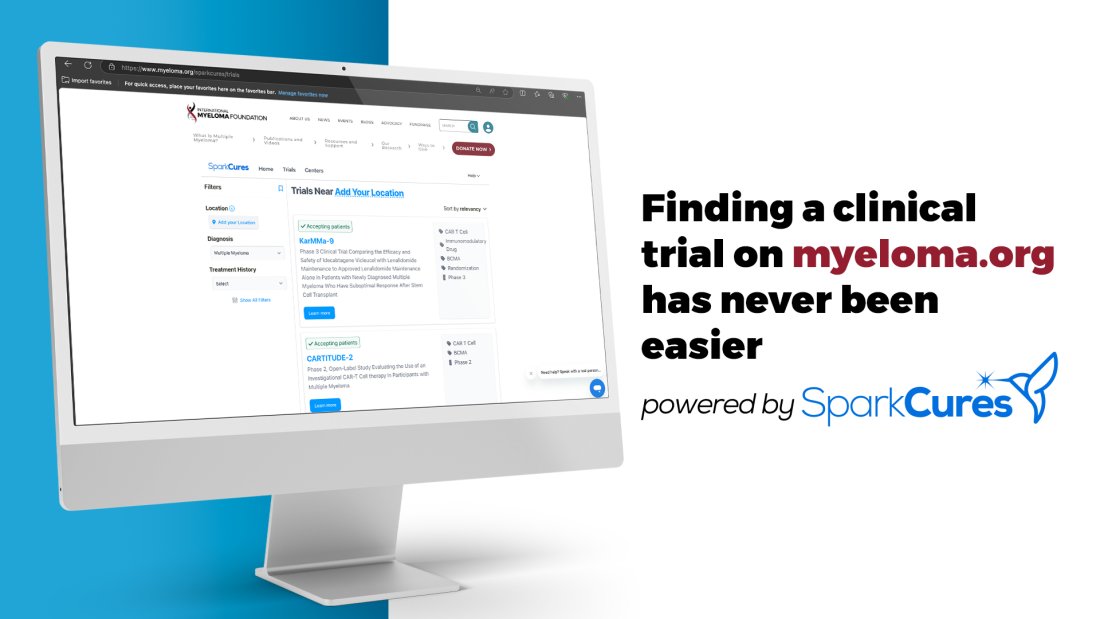
And the work you guys are doing on that side is just really incredible and just so incredibly needed. And when we think about how do we do that, and I think that gets into the partnership here where we know, you had this great quote the other day, and I didn't write it down, so I hope I don't butcher it, but someone had said, "How do you develop trust?" And you have to be genuine and it takes time. So when we think about this, that's why when we look at this partnership, we're not asking for seven years worth of lab history and data and all these different things. We've created this very specifically so that you can go on there and never give us any personally identifiable information. You can go to the IMF's website at myeloma.org, you can browse through, you can look through everything, every clinical trial across the U.S., every center that's running clinical trials, you can go through this and never provide any data back.
Now, there are some benefits to doing that, and we want to make that clear, but we're not here to say, create an account and give us data or else we're not going to give you any information or help you. If you're able to go on, and I'll tell you one of the most beautiful messages we had ever received was there was a patient, this is a couple of years ago, who was on a Dex kick. It was like three o'clock in the morning. They couldn't call us. So they started going through and just searching by themselves, and they found a CAR-T trial that they didn't know was at their home center. So they were able to call, get the appointment, get over there. We heard from them six months after they had gone on. And I'll tell you Dr. Joe, and I know you have more stories of these than you could ever share in a whole day's worth of podcasts, but she said, it was the first time I was ever able to tell my mom that I was in remission.
And it's like, we don't want to be the roadblock. We want to make sure that you're equipped if you have a great relationship with your doctor, and we can augment that through the technology, great. If you need help in navigating it, we are here. You can call us, you can call the info line, you can create an account. But I think that's the part where we're just here. We have patients we've been working with for almost a decade now, some that have never gone on to a clinical trial and some that are on their fourth or fifth clinical trial at this point, because these things just take time and you have to show up, and you have to be there, and you have to show that you really care and you're here for the long run. And I think that's a really important piece of this and why working with the IMF makes so much sense. I mean, who's been around longer than the IMF at this point, right?
Dr. Joe:
Yeah. Well, and that's very kind of you to say and so important. And as we come to wrap up here, Brian, the last major area we discussed was access. And you've already beautifully talked about it, and you have the webpage up here. I just want to remind people, you go to myeloma.org and there's clear instructions there that it's a \SparkCures, and you can start navigating this process. And walk us through it just really quickly if you could, Brian, to help people see what's going to be at their fingertips and so that they don't just go do as you said, clinicaltrials.gov, where they might get a search that comes up with 3000 trials that obviously they can't walk through.
Brian McMahon:
Well, doing these demos in real time is not always the most fun thing for people to watch. So I think really simply, we've worked very closely with the team at the IMF, with the info line with you, with the entire team across the board. And really when you go there, you can go to myeloma.org/sparkcures and you can start browsing and you can just try to understand or start to poke around at some level of comfort. Our phone number is on every page. Your phone number is on every page, right? We are here to support you. But if you create an IMF account, which is really easy to do, but as you're creating an account, you can just say, "Yes, I want to get clinical trial updates and alerts as well." And by doing that, you're going to be part of the SparkCures IMF system, and we're here and we're going to give you a big warm hug. And we're here along the entire journey to say, "Here's what your options look like and here's how they're changing is your needs, wants, and understanding changes."
Dr. Joe:
Well, thanks so much, Brian. I just always enjoyed time with you, brother. I appreciate you. What you and your wife and your whole team work so hard to make this happen. I'm so thankful that we have this partnership now that people can go to myeloma.org and be able to find a clinical trial, whether it's close to them or somewhere else in the country if they're able to travel. We want to be able to provide every resource possible. And of course, as you noted already, that if they have questions, call the info line. We're here. We want to be accessible to you 24/7. Use our new chatbot, Myelo. We want so many different ways for people to connect with us. So thanks again, Brian, for joining me today. Always good to see you, my friend. Appreciate you so much.
Brian McMahon:
Always good. Thank you. Really appreciate it. Thank you.
Dr. Joe:
And thank you for joining us today, and I hope this has been helpful to you, for yourself as a patient or as a care partner or someone that you know that has multiple myeloma. We want to be able to support you through your journey and make sure that you keep on your notifications here so that you can know of future community conversations like I've had today with Brian so that you can follow us at the International Myeloma Foundation and so we can help you and your loved ones through the journey with multiple myeloma.