

Dr. Joe Mikhael:
What is the best imaging modality for multiple myeloma? Hi everyone, this is Dr. Joe here, Chief Medical Officer of the International Myeloma Foundation. We host Facebook Lives and provide the opportunity for people to ask questions. And sometimes we have so many questions we haven't the opportunity to answer them all. So today, I'm going to take time to answer some of those questions. Whenever you want to ask a question through any of our channels, please use the hashtag #asktheimf, whether it's Facebook or X or Instagram, and we want to help answer your questions. Of course, if your question is more personal, feel free to direct it to us through the info line that you can reach by phone and by email, and always find us at myeloma.org.
Okay, here's a great question from Jase which says, "How much should people share with their nurse and doctor when it comes to side effects?" I think this speaks to the critical importance of open honesty with your healthcare team. One, it builds the relationship of trust with your healthcare team. Two, it alerts the team to signs and symptoms that you have that may actually indicate something that's happening with myeloma or an infection or something else. So the simple way to answer this is be fully transparent and open. Sharing that is very important. We've actually shown over the years that when you develop a close and comfortable and honest relationship with your healthcare team, you actually do better. You live longer with cancer than when that relationship isn't established. So please be as honest as you can be.
Annie asks, "Does it matter when your stem cells are harvested? Should you wait or have less disease for a longer remission?" So generally speaking when we think about this, Annie, we give patients the induction or the initial treatment for around four cycles before we collect stem cells. And the reason for that is twofold. One, because we do want to get the disease down. It's easier to collect stem cells when there's less disease. But also, if we give a lot of treatment for much longer, it can sometimes make it a little bit more difficult to collect stem cells. So typically, we do it four to six cycles after someone has initially been treated for their multiple myeloma. But of course, this can be discussed in more detail with the healthcare provider.
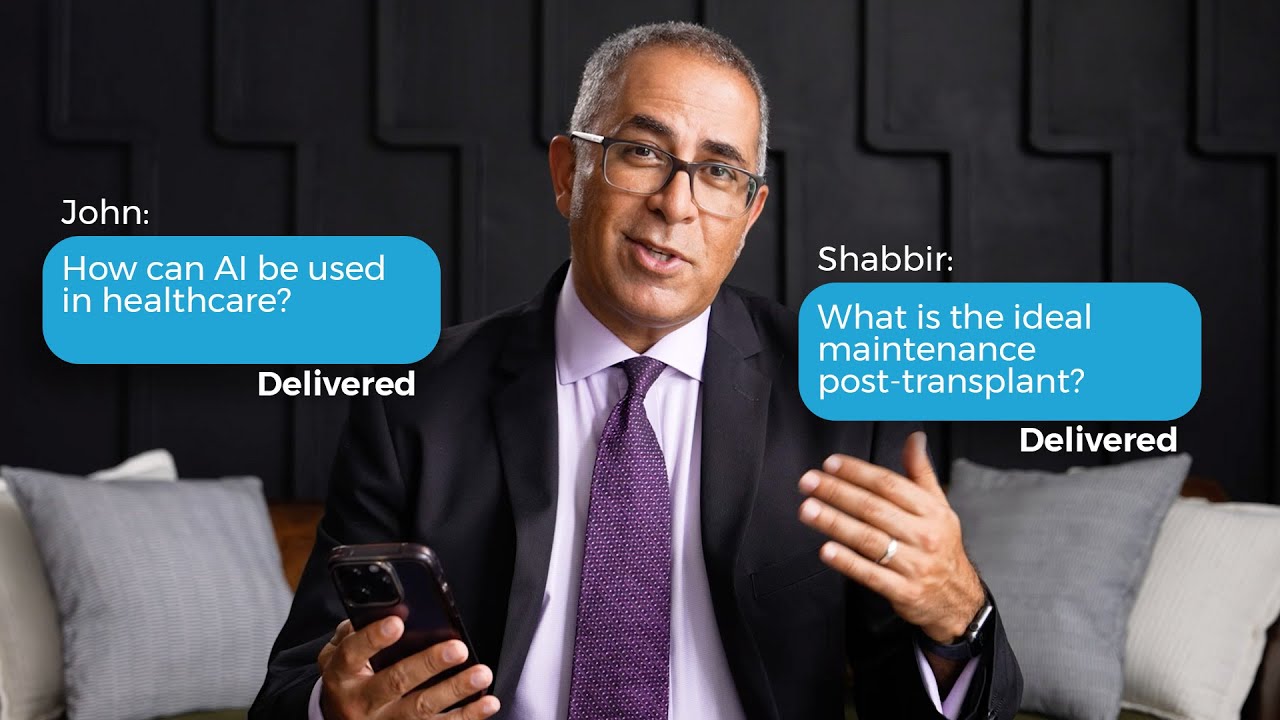
John asks a really good question that I wish I could answer simply, but, "How can AI be used in healthcare?" Maybe being sarcastic, how can AI not be used in healthcare? I mean, AI is influencing so many areas of our life in information technology, in our understanding of information, in the processes of so many things that we do. But joking aside, we want to leverage the power of AI in healthcare. And we're doing it at a global sort of high level in the healthcare system way, but also individually within the patient.
And this is a good chance for me to give a commercial out for our AI chatbot that we've introduced at myeloma.org, and his or her name is Myelo. And you can go to myeloma.org and just start asking Myelo questions and hopefully provide answers to you. So we want to leverage AI. We know that sometimes AI can scare people a little bit. There may be aspects to it that seem a little invasive, but it's harnessing all of that information to answer questions that otherwise would be difficult to answer.
Here's a question from Shabbir. "What is the ideal maintenance post-transplant?" Well, there really isn't one perfect ideal maintenance. I would say that the general standard of care, because we know that it improves people's time and remission and even survival, is Revlimid maintenance by itself. That's pretty much what we use in the vast majority of patients. Obviously, if someone can't tolerate or has already had disease that's grown on Revlimid, we switch to something else. But also, if someone has higher-risk myeloma, we may opt to add something to Revlimid. And often that is a proteasome inhibitor, like Velcade or Kyprolis, or potentially Darzalex as well. So that can be explored based on the risk status of the patient.
All right. We've got a few more great questions and I'll wrap up. Daniel says, "Some health professionals have been recommending the Mediterranean diet in recent years. Do you recommend this for myeloma?" Do you like Mediterranean food? Well, most of us do. I mean, I think that we want patients to have a balanced diet. And the Mediterranean diet has been focused on in medicine because it really provides a greater balance than the typical North American diet, which is very heavy in meats and in carbohydrates, and we don't see as much fruits and vegetables and fibers that we need in our diet.
The connection between myeloma and diet is still not entirely clear. It's being studied. Our friends at Memorial Sloan Kettering Cancer Center are doing a great study trying to see if diet can actually influence myeloma. What we do know that obesity is a risk factor for myeloma. So we're typically trying to encourage our patients to watch their weight, but also to have a balanced diet, but also not to be, of course, diet obsessed in the sense that we want to make sure that, as we seek patients' quality of life, that they enjoy the life and the food that they want to have while living with this disease.
Matthew asks, "Do I freeze my cells versus a bone marrow transplant?" And I think what's being asked here is, in the old days before we had more sophisticated ways of collecting people's stem cells through their blood, we used to have to collect it in their bone marrows. I remember back in the day when I was a myeloma fellow I learned to do those very intense bone marrow draws in the operating room where we would suck out a lot of bone marrow from patients to use as a bone marrow transplant.
But now, we typically call it a stem cell transplant because we can get those concentrated stem cells that we want from the bone marrow, but instead of collecting them directly from the bone marrow, we give patients some drugs in advance to tell some of those stem cells to leave the bone marrow and circulate in the blood. And then we just collect them from the blood. And that's typically the way we do it. There are some patients who may not be able to collect through that stem cell process through the blood and may have to have it collected from the bone marrow.
Maria asks, "The new four drug approvals, how available is this combination of drugs? Who qualifies for it?" Well, great question, Maria. Very recently, we've seen approvals for four drug combinations, both for patients eligible for transplant in the form of DVRD, or Darzalex, Velcade, Revlimid, and Dexamethasone, but also for patients not eligible for transplant, Sarclisa, or also known as Isotuximab, plus VRD, Velcade, Revlimid, and Dexamethasone. So this is now FDA approved. This is now listed in the NCCN guidelines. It should be approved by insurance companies when it's requested by the oncologist. And if someone is deemed to be so-called quad eligible, meaning that their health and their other conditions that they may have is not preventing them from receiving it, we are using these. The data in the clinical trial is cut off at the age of 80, but the FDA approval doesn't limit that. So it depends on someone's well-being otherwise and their health otherwise, but most patients would be eligible for that quadruple therapy.
Marita asks, "Does IMF do patient and family seminars in Europe?" Absolutely, we do, typically between eight and 12 meetings a year throughout various parts of Europe. And you can go to myeloma.org to learn more about those meetings. Peggy asks, "What is the preferred imaging for monitoring multiple myeloma?" And maybe the easiest way to answer is it kind of depends on what was first discovered. So when we first do imaging in myeloma, we used to do it with plain x-rays and we call it a skeletal survey. We really don't do that anymore because it's not a very sensitive test, meaning someone has to have a lot of bone damage before it shows an abnormality. So we typically do it through a CT scan or a MRI scan. And sometimes when we do a CT, we do what's called a PET-CT. And if someone has identified myeloma through that modality, they should have that same modality used over time to monitor for their disease.
And we come to the last question. "I'm on KCD, or [inaudible 00:08:53], should I still be getting flu and COVID shots?" The answer is absolutely yes. We know that, although myeloma patients may not have quite the same response to a vaccination, meaning they may not get as robust a response, they still get a response. And as we move into the season where we anticipate that we're going to see more flu, that we're going to see more COVID, we really do believe that this should be the standard across myeloma patients. Now, obviously there are some exceptions to this. Individuals have had certain reactions to vaccinations before. But in general, this is really important and one of the multiple ways that we can reduce the risk of infections in our patients with multiple myeloma.
The questions keep pouring in, and I'm happy to see that because we want to answer your questions for you. As I noted earlier, please don't hesitate to reach out to us, whether it's through Facebook, through Instagram, through X, directly through our info line or at myeloma.org. Use the hashtag #AsktheIMF, and we're more than happy to try and answer your questions. We trust this has been helpful to you in your journey with multiple myeloma.