



Dr. Joseph Mikhael:
Bispecific antibodies have truly changed the way we treat relapsed and refractory multiple myeloma, but the unique way they're given makes it a bit of a challenge and there's a need to coordinate care as a patient is treated with these new drugs. How does that happen? Let's dive in and talk about it.
Hi, everybody. Dr. Joseph Mikhael here, Chief Medical Officer of the International Myeloma Foundation. Welcome to our myeloma made simple series, where we take the complicated world of multiple myeloma and make it more straightforward. Before I dive into today's episode, let me remind you that the IMF is here for you. We want to help you through this complicated journey. You can call us on the info line. You can visit us at myeloma.org. You can even use our chat bot Milo to answer questions 24/7. And of course, we want you to employ this myeloma made simple video series, where we take complicated topics and ideas and make them straightforward for patients and their partners so they can understand their treatments and understand their journey in myeloma.
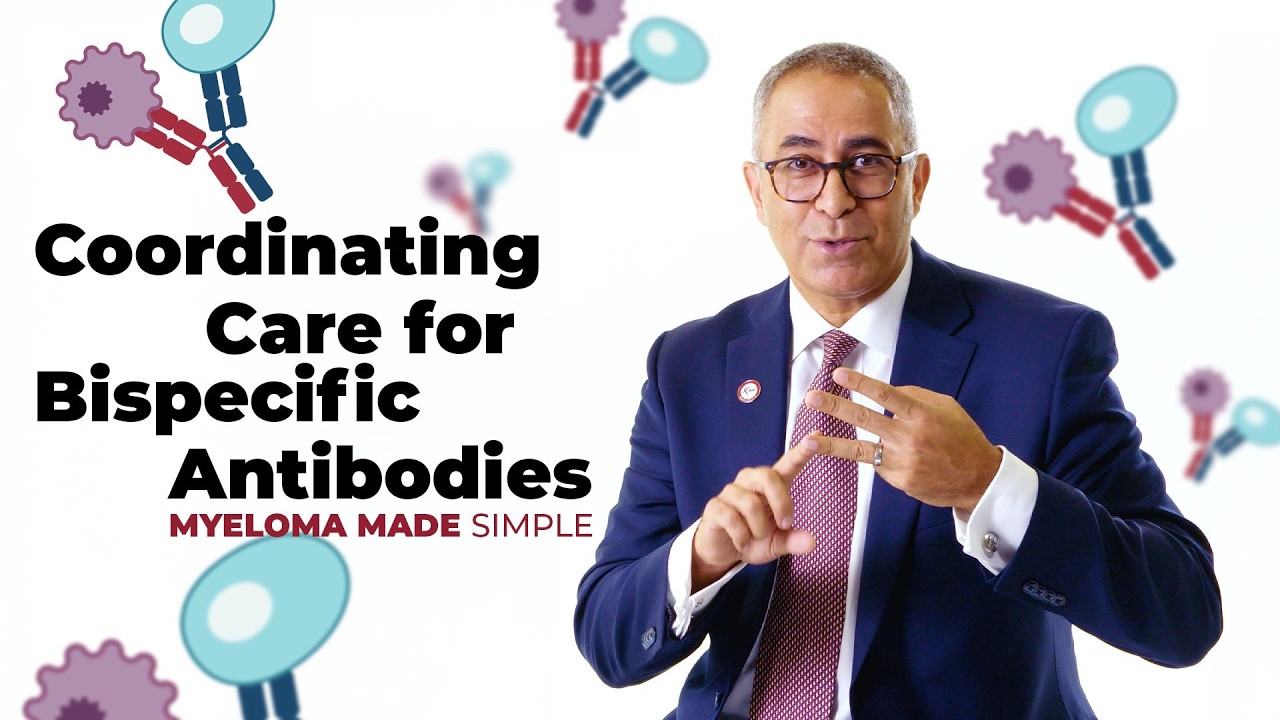
Today's episode is on coordinating care for bispecific antibodies. Bispecific antibodies are fantastic drugs that have really improved the way we care for patients with relapsed multiple myeloma, but they have some unique properties that require some very special coordination. Let's talk about how that happens. First of all, quick review. Bispecific antibodies are called bispecific because they have two arms. One arm hooks onto the myeloma cell, one arm hooks onto one of your own immune cells called a T cell to engage that cell to destroy the multiple myeloma. Fantastic technology, but does require some special care.
The reason for this is when we give bispecific antibodies, they have to be given in a center that is specially qualified to do it because there are certain side effects that patients can have. Coordinating this care requires the active participation of three important parties, the doctors and the team that are going to first treat the patient, the community oncologist that will later take over the patient, and of course, always most importantly, the patient themselves. So how do we make sure that everyone's in sync together? Well, it starts with the academic center or the team that is going to start treating the patient, they're the ones that typically start because of these special considerations. There are some side effects that can happen with bispecific antibodies. Two of them in particular, something called CRS or cytokine release syndrome, and number two is a special kind of neurotoxicity or effect on the nerves. And that center has to watch patients very closely to see if those happened as they initially are treated.
But once they get through that phase, then the patient can be transitioned back to their community oncologist. That requires some special coordination, making sure that everyone's communicating, making sure that we know how the patient has done over those first several weeks so that they can get back to their community oncologist to continue that drug and indeed to continue some other things that will need to be followed thereafter. I'll talk a little bit more about some of those extra things that have to be followed when I do a special video on infections with bispecific antibodies.
But now we're back with the community oncologist and they're caring for the patient now, often it means we can reduce the frequency of the dosing of that drug. All along the way, the patient is at the center, and we want to encourage patients to ensure that that coordination of care happens to get to the first team to get the treatment, to make sure the transition back to the community oncologist is smooth, and so that they're aware of what's happening every step of the way. At the IMF, we always want our patients to advocate for themselves, and even just by watching this video and learning more about this process will help you as you go through your journey with multiple myeloma.
So, quick summary. Bispecific antibodies are great drugs that help our patients with relapse multiple myeloma, but because they're given in a unique way that patients have to be monitored when they're first treated, we need to ensure that the coordination of their care is very smooth between the team that first treats them and then the team that will continue their treatment after they've gone through that first phase. Myeloma is a complicated disease, so through this myeloma made simple series, we're making it understandable so that you can face myeloma confidently with the right knowledge, knowing the IMF is with you every step of the way.

