This week's Ask Dr. Durie comes from a patient who wants to know if a four-drug combination is recommended for patients who are not transplant eligible, so more elderly patients, is a four-drug combination something reasonable to consider. The answer to that is probably yes. At the ASCO meeting in June 2024, right now, there was a presentation of data for a four-drug combination versus a three-drug combination. Isatuximab, Velcade, Revlimid, and Dex was compared in a phase III comparison with the standard of care, Velcade, Revlimid, and Dex. The outcomes were very good with the four-drug combination. The achievement of complete remission, the achievement of complete remission combined with MRD negative, 1/10 [inaudible 00:01:14] minus five, and sustained MRD negative minus five at 12 months. All of those were improved with the four-drug versus the triplet, three-drug standard of care.
The MRD sustained negative at 12 months was actually 46.8%, so really quite good. In a separate study presented at ASH, the four-drug combination was compared with the triplet Isatuximab RD, which is a triplet very similar to the Dara RD, the so-called Mya regimen, which has become a standard of care in the non-transplant setting. Again, Isatuximab RD was a superior regimen. So the bottom line is that based upon the current data, it's very reasonable to consider a four-drug quadruplet in patients in the non-transplant setting, provided they are not frail. Patients who were frail were excluded from these trials. But in the non-transplant setting, it's reasonable to consider an Isatuximab VRD combination as an important option and a potential new standard of care in this setting.




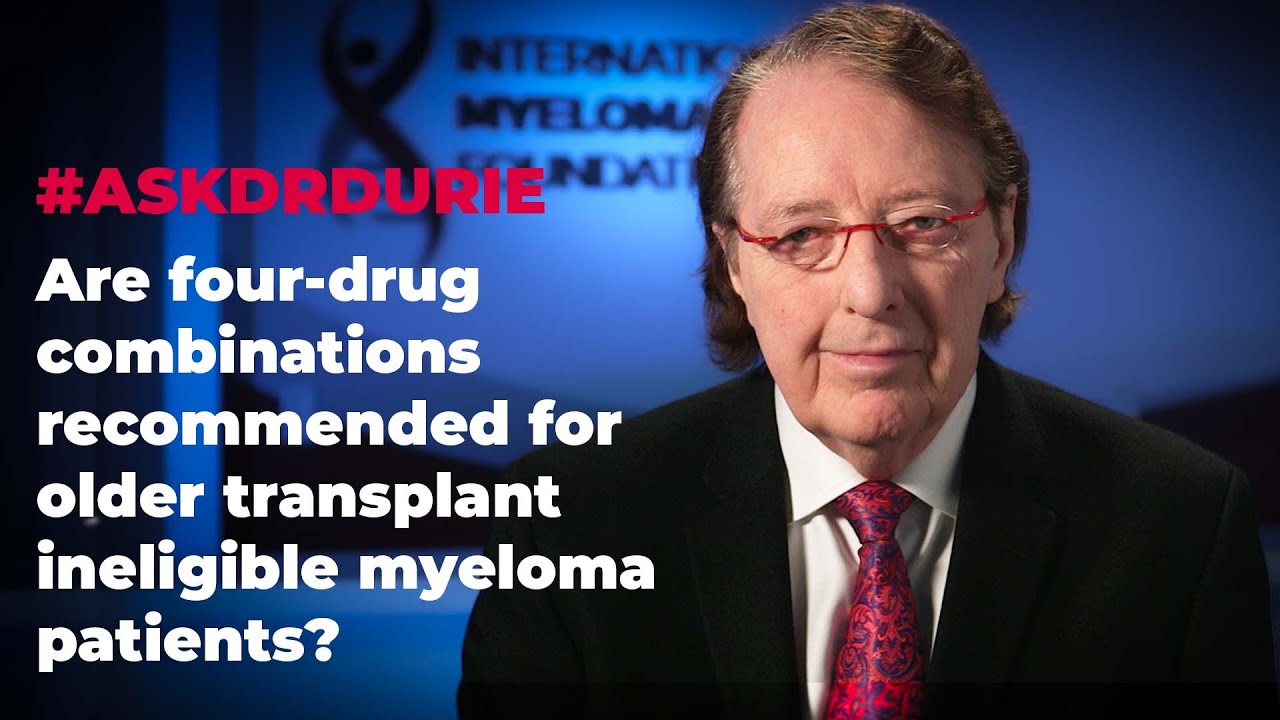
 Dr. Brian G.M. Durie (1942-2025) was the co-founder of the IMF. He was a Professor of Medicine, Hematologist/Oncologist, and Honoree MD at the University of Brussels.