

Dr. Joseph Mikhael:
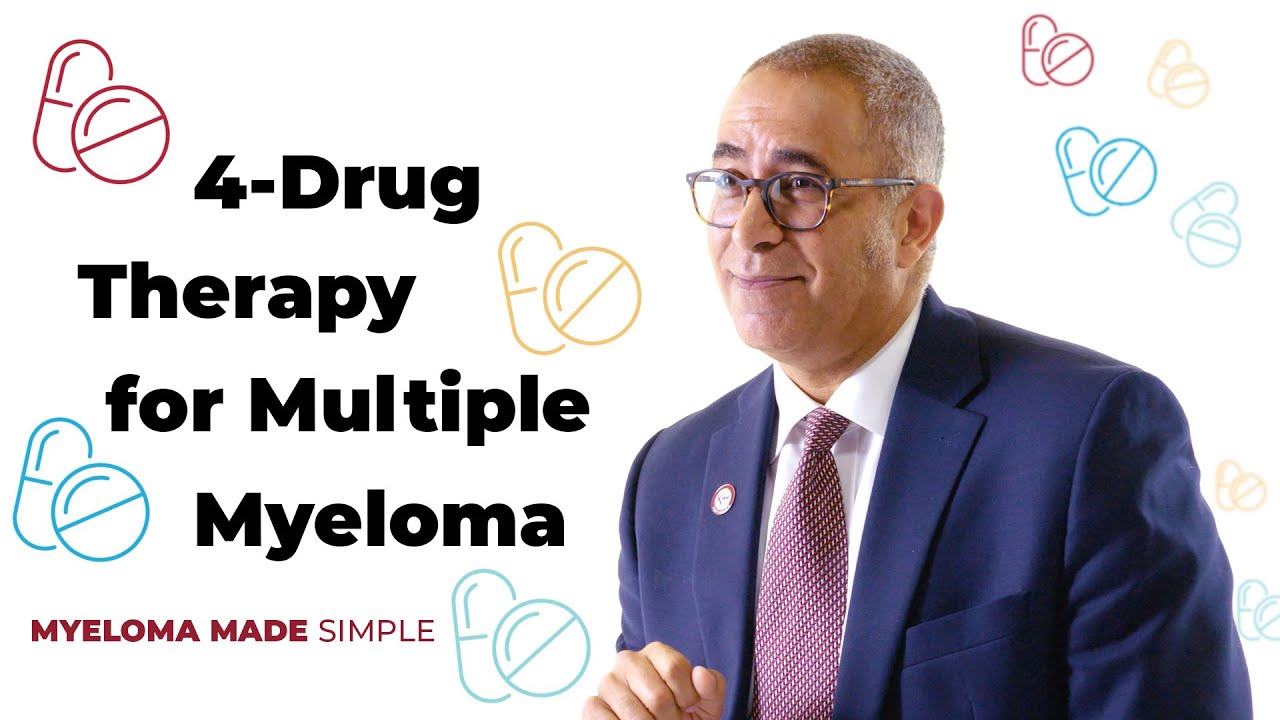
Is it two, is it three, or is it four? How many drugs does a patient really need for their first line therapy with multiple myeloma? Let's talk about quadruplets. Hi, everybody. Dr. Joseph Mikhael here, Chief Medical Officer of the International Myeloma Foundation. Welcome to our Myeloma Made Simple series, where we make the complicated world of myeloma much more comprehensible. Before I dive into today's episode, let me remind you that the IMF is here for you. We want to help you through this complicated journey. You can call us on the info line. You can visit us at myeloma.org. You can even use our chatbot, Milo, to answer questions 24/7. And of course, we want you to employ this Myeloma Made Simple video series, where we take complicated topics and ideas, and make them straightforward for patients and their partners, so they can understand their treatments and understand their journey in myeloma.
Today's episode is quadruplets in frontline therapy. What really are these quadruplets? Well, we use that word to describe four drug combinations. This is so important to us, because we've really changed the way we treat frontline therapy in this last year in multiple myeloma. Why is that? Well, it was because of a whole series of clinical trials, three very important trials in particular, that compared giving four drugs to three drugs in frontline therapy with multiple myeloma. Interestingly and importantly, these were studied both in patients who were going to have a stem cell transplant and in patients who were not going to have a stem cell transplant. And in every one of these trials, we saw the same result. The result was getting four drugs when compared to three, gave patients a deeper response and a more durable response. And of course, that's what we want in multiple myeloma.
We know that right now we're not curing the majority of our patients, but if we can get them into a deep remission and keep that remission for a long period of time, we know that their lives will be better. So we took the historical three drug combination, where we typically gave drugs called Velcade, Revlimid, and Dexamethasone, where we now added a fourth class of drugs known as monoclonal antibodies. We've actually been using these drugs in the past in relapse multiple myeloma, but now have brought them to the frontline therapy. Two key drugs in this class are Darzalex, or Daratumumab, and Sarclisa, or isatuximab. And these clinical trials demonstrating that adding either Darzalex or Sarclisa to the well-known combination of VRD, meaning going from three drugs to four, demonstrated that the four drugs were better. Now, at first, someone might say, "Is it okay to have that many drugs?"
But really, what these studies showed was that when we give them at the right dosing, it is better to have more ways to tackle myeloma than just three ways. Myeloma is a complicated disease with what we call a complicated biology, meaning it has different ways of overcoming drugs. And bringing these four together have definitely improved the way we can treat this disease. So whether it was the PERSEUS study, the CEPHEUS study, or the IMROZ study, and all these words sound complicated, but these were key important studies that led to the FDA approving these regimens for patients in their first line of therapy. We know now that the new standard of care in multiple myeloma is giving four drugs. I also want people to understand that this is important, because the way we treat myeloma up front affects them for the rest of their lives. We know that sadly, myeloma is a disease that typically does come back and comes back several times over the course of someone's life.
But what we do up front is so important, because very often that first remission is the longest remission. So we want to give our best shot at myeloma the first time we treat it. We don't save the best for last like we might see in a romantic movie. We want to use the best up front. And now the best is indeed using a four-drug combination, typically with that monoclonal antibody, either Darzalex or Sarclisa, added to the Velcade, added to the Revlimid, and added to the Dexamethasone. When given at the right doses, we've been able to find that not only can people start these drugs, but they can continue them to keep that disease down and to keep it down for many years. Well, I hope this video has been helpful to you as we've thought together about quadruplets in frontline therapy of multiple myeloma as now being the new standard of care. Don't miss the rest of our video series of Myeloma Made Simple, where we take the complicated concepts of myeloma and make them understandable to you.