

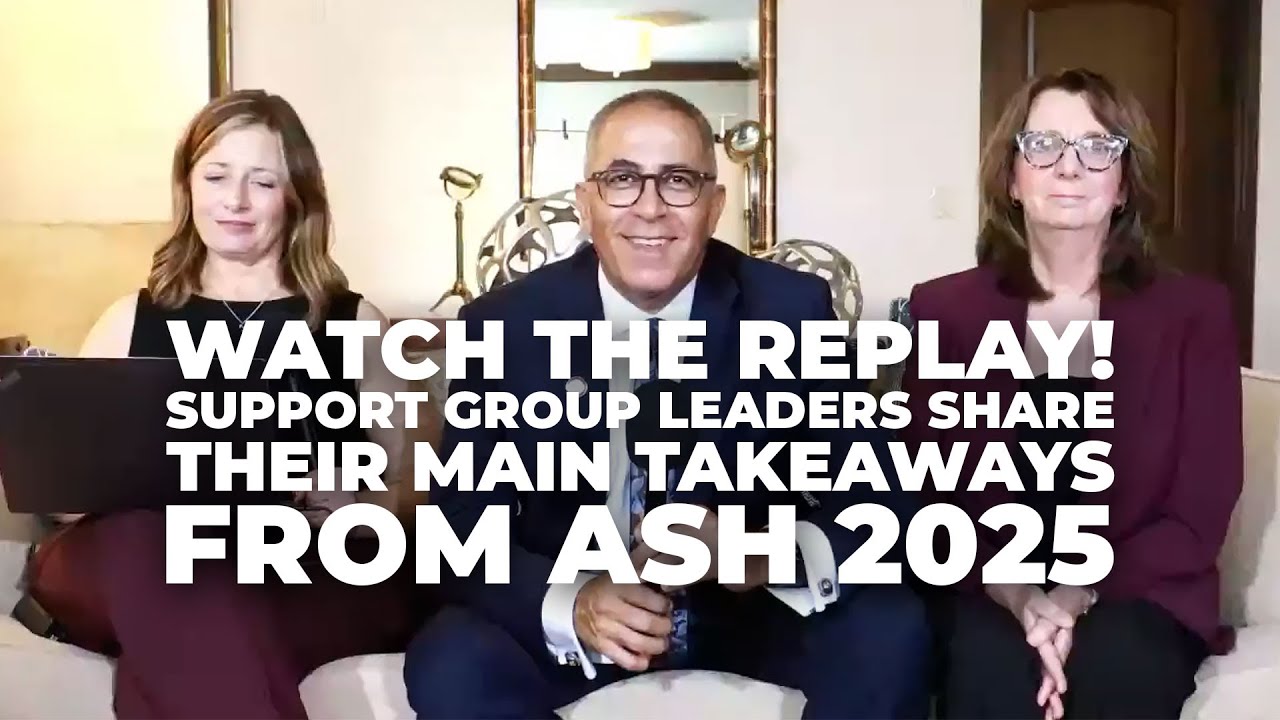
- Well, hello, everyone, and welcome to our International Myeloma Foundation Facebook Live. It's a special live event because we are literally live from Orlando, Florida, where we have had the privilege over the last several days of attending the American Society of Hematology Annual Meeting. So welcome, this is Dr. Joe here. I'm the chief medical officer of the International Myeloma Foundation, and I'm gonna serve as our host over the next 30 to 40 minutes as we quickly review some of the amazing things that have been happening at this meeting over the last several days. Now, before we get going, as people are joining, as the masses, the tens of thousands of people are joining our Facebook Live, do me a favor, in the comment section, tell me where you're from. Let us know where you're from this evening. We know that we've got folks from the East Coast, from the West Coast. Typically, we even have some individuals who have difficulty sleeping at night in Europe, for some reason seem to join us in the middle of the night. Let us know where you're coming from, and we would love to have the opportunity to interact with you. Also, if you have questions, if you have questions already, been hearing a little bit about what's going on here at ASH, we call it ASH, short form for the American Society of Hematology, send us your questions. Also, as we go through, a lotta questions are gonna be coming up. This is also a special Facebook Live 'cause I'm surrounded by some amazing people that I'm gonna introduce you to in a few moments, and they're gonna be peppering Dr. Joe with questions as well, because remember, at the IMF, we want to help answer the challenging questions we all face. So remember, whether you're on Facebook, Instagram, X, LinkedIn, TikTok, YouTube, use the hashtag #AskTheIMF, and you can ask us any question. My BFF is sitting here to my right, Becky Bosley, who works with us here at the IMF. And Becky, are we starting to get a sense of where people are coming from?
- We are, we have Maryland, North Carolina, City of Hope in Huntington Beach. We have your family in Canadia-
- Oh, we've got some Canadians, oh, yeah.
- hanging in with us. Central Mass, Sacramento, California.
- Even Boise, Idaho. Well, welcome, everybody. This is fantastic. We're delighted to have you with us. I'll quickly let you know about the agenda for our next time together. First of all, in just a moment, I'm going to ask Robin Tuohy, who is our vice president of support at the IMF, to tell us a little bit about this motley crew of people that I'm surrounded by so that we can know who these are. I'm then gonna dive in and just give the uber rapid overview of some of the major things that have happened in multiple myeloma at the ASH meeting. It is genuinely remarkable what has been shared over the last few days and what is still yet to be shared tomorrow morning. We're not quite done yet. And then what we're gonna do is work through all of these wonderful individuals that are sitting with me, and each of them are going to have an area, a topic that they found fascinating here at ASH that they're gonna share with us that we're gonna have a little dialogue with. And then lastly, we'll have the opportunity to answer your questions, and we'll take some time to do that before we wrap up. So, Robin, always great to have you with me on a Facebook Live.
- Thank you.
- Always good to have you next to me. Why don't you tell our crowd today who are all these marvelous people that are sitting with us tonight?
- Oh, not only this crowd here in the room, but all those, our virtual team, we are fammily, right? F-A-M-M-I-L-Y, and we really truly feel like that. And this is a group of support group leaders from across the country that are patients, care partners, nurses, healthcare workers, that are selfless, that are dedicated, and they're bringing the information back locally to their own groups, globally through social media. And for anyone who does not attend a support group, what you can expect to learn here is really what you would learn at a support group meeting locally, whether it's virtual, in-person, or hybrid. So we talk about side effect management, we talk about the new drugs that are out there, so everybody could have a good conversation with their doctor about their myeloma.
- Wonderful, well, I know that Robin is also supported by Becky, whom you've heard from already, also from Teresa Miceli, who's with us tonight, who has been supporting this group. And as noted, we not only have in-person family here, we have those online as well, our virtual team, including Jenn Wieworka, who also works with us at the IMF. And we're so glad for you, Jenn, and for the support that you've given the team. Now, you're gonna meet all of these patients and partners and those who are involved in what we call Patient Voices at ASH in just a few moments. But I wanna emphasize how important it is that we have that patient perspective in the research that we do. This is really such an important aspect of what we do in hematology, and specifically in multiple myeloma, that as we as doctors and nurses and scientists and others do this research, I say it all the time, I don't treat myeloma, I treat people. And having the people around me here tonight is a particular privilege for me, but to have their perspective on the research that's coming out is particularly important, and that's why at the IMF, we've created this program of the Patient Voices and why it's so valuable, and you'll see that tonight as you hear their perspective on the great work that's going on. Well, let me quickly tell you, just give you the balcony view. I will say that what I'm gonna share in the next couple of minutes, you can hear in a much longer and a deeper level with many more perspectives on it at two upcoming events that we have at the IMF. The first of which is going to be when I am accompanied by a few myeloma experts and one of our nurse leadership board on December the 17th at 3:00 PM Pacific. And you'll see, we'll be advertising it, we'll have an opportunity to really dive deep into what's happening at ASH. This will be a pretty high-level, but we really wanna understand what all the myeloma research means. But again, on January the seventh, also at 3:00 PM Pacific, I'm gonna be joined by a couple of these marvelous people around me here to again have the patient's perspective as we try to make sense of the complexity of the research and break it down into a form that will be very clearly understandable to our patients and to their partners. So don't miss these events, you'll hear much more. But I'll just give you the quick overview. So, ASH, as we've mentioned, is the American Society of Hematology. We have our annual meeting. We eclipsed just over 27,500 people in person here this week in Orlando and another 4,000 people virtually. When we come to this meeting, really the centerpiece of the meeting is to review what we call the abstracts or the research that has been performed in the area of hematology. And back in August, everybody had to submit their abstracts or the summary of their research to see if they could be presented here. This year, we had 9,000 abstracts submitted to ASH. That's 1,000 more than we've ever had before, it's remarkable. What's perhaps even more remarkable is over 1,500 of them are related to multiple myeloma. So I'm gonna spend the next 15 hours going over the 1,500 abstract. No, of course I'm not gonna do that. It would be impossible. I have read them all 'cause I'm a nerd. But it is amazing what's happening in multiple myeloma, and I'm really just gonna choose a few areas in which these abstracts have been produced so that we can understand what's changing in myeloma. To make it even more simple, I'm just gonna focus in three areas. Area number one, frontline therapy for multiple myeloma. The very first treatment we give a patient for multiple myeloma is critical because it will affect the way that their disease responds even in the very long term. Over the years, we've gone from giving one drug to two drugs to three drugs, and now we've learned that we can give a combination of four drugs, sometimes we call that quads or quadruplets, and that has really now reached a point where it's FDA-approved, whether someone's going to a transplant or not. And I would say the first major theme here we've seen in frontline therapy is that quads are still absolutely important in our treatment. We're seeing the benefit of these quads, not just in getting someone's disease down but keeping it down. I always talk about the two Ds of treatment. There's the depth of response, can we shrink down their myeloma to almost zero, if not absolutely zero, and then the duration of that response, can we keep it there over the long term? And we have a few really fascinating and important follow-ups on previous quadruplet studies that are continuing to demonstrate the benefit of giving those drugs long-term. The other area that is very exciting in frontline therapy in our first theme is bringing some of the drugs that we typically use later in myeloma earlier into the disease course. So things like CAR T-cell therapy, things like bispecific antibodies. These are the immunotherapies, as we call them, because we engage someone's own immune system to tackle their myeloma. These are the things that have really changed the face of relapsed myeloma. They're starting now to change the face, as it were, of frontline myeloma. So, we saw a fascinating study using CAR T-cell therapy up front. There was another study using various different kinds of bispecific antibodies. If you're not familiar with that phrase, you can go and look it up on "Myeloma Made Simple" and the videos that we have. But the short version is that these are drugs that are called bi 'cause they have two arms. One arm grabs onto the patient's myeloma, the other arm grabs onto one of their immune cells, called a T-cell, to attack their myeloma. These drugs we use now in people who've had at least four prior lines of treatment with myeloma, but now we're studying them in the frontline setting, and some of the results we saw here at ASH were really remarkable. Major area number two is early relapse multiple myeloma. And when I say early, I mean that after someone has only had one prior treatment with myeloma or perhaps two prior treatments, we know when the disease comes back, we have an opportunity to really get it down again and keep it down again. And what we do at that first relapse becomes particularly important. Arguably the most talked about abstract at ASH this year, if you've been napping, this is the time to wake up for a few seconds, perhaps the most talked about abstract in myeloma at ASH this year will be presented in a little over 12 hours from now at what we call the late-breaking abstract session. We don't know all the details of the study 'cause it's fully presented tomorrow, but we have seen the summary of it, the abstract of it, and this is a study that is combining a drug we often use in early relapse, daratumumab or Darzalex, and combining it with one of these bispecific antibodies, specifically teclistamab. This combination of tec-dara or dara-tec, as it's sometimes called, is part of the MajesTEC-3 study, and the preliminary results that we've seen from this is dramatic, where we've seen the vast majority of these patients respond and stay in a deep and durable remission for a long period of time. This could very much change how we treat myeloma by bringing bispecific antibodies into that early space. We've also seen some great abstracts looking at CAR T-cell therapy and other bispecific antibodies also in that early relapse space where we know now that they can have a greater effect over the long time. You know, we have a general theme in myeloma that if something works well when someone's been treated with everything else, and we're showing this with CAR T and bispecific antibodies, it will work even better if we use it earlier in the disease course 'cause we want to reduce the number of lines of therapy that a patient ever will have. My nirvana is that we treat people once, and their disease never comes back, but that we know we're not there yet, but we're getting closer and closer to that as we bring these therapies earlier on. So major theme number one, frontline therapy, keep using the quads that we have, introducing new things like CAR T and bispecifics. Major theme number two, early relapse, introducing bispecifics earlier on in combinations, and even bringing CAR T-cell therapy early on, as we now have that FDA approved. The third major theme is really some unique or, what I would call, novel ways of delivering CAR T-cell therapy. Again, if you're not familiar with CAR T-cell therapy, in simple terms, CAR T-cell therapy is where we take T-cells out of a patient. T-cells are kinda like soldier cells that our immune system has, and we manufacture them in such a way that they really want to attack a patient's multiple myeloma. We put what's called a receptor on the outside of them that's specific to someone's multiple myeloma. That's why it's called CAR T. The R in CAR, it's an acronym, chimeric antigen receptor, T-cell therapy. And then we give those T-cells back to the patient, and they go and attack their multiple myeloma. It's really a remarkable field. And CAR T-cell therapy has changed the way we treat myeloma. We have two CAR T therapies that are already available to us that are FDA-approved. But what we saw at ASH this year were other new CAR T-cell therapies coming, one of them that seems to be incredibly effective with an over 90% response rate with less of the side effects that we sometimes see with some of our current CAR T-cell therapies, and specifically, some of the neurological effects that we can see, and I know we're gonna talk more about that in just a minute. We also are seeing a CAR T-cell therapy that is truly unique, and that's yet going to be another late-breaker tomorrow morning, and that is called what we call in vivo CAR T. In vivo CAR T, what does that mean? I told you earlier that CAR T-cell therapies, they take T-cells out of a patient, manufacture them, give them back to a patient. Here, we don't even have to take the T-cells out. We give patients a drug that goes to their own T-cells and converts them into these CAR T-cells by being able to produce that receptor on the outside of the T-cell. I know it sounds like you're watching a science fiction movie, but you're just watching Dr. Joe, I promise. And it's really remarkable. And so, we're gonna see tomorrow morning a report of the first three patients treated with this unique therapy. Granted, only three patients, but we've seen from the early report that these three patients had a remarkable response to it. Well, there's so much more I could say about what's going on at ASH. As I told you, there are 1,500 other abstracts I didn't cover, but I am keen to hear from the patients that we have with us. So, I am going to pass the microphone to one of my BFFs, Sheri, and we're gonna ask you to quickly introduce yourself, Sheri.
- Yes.
- I've kinda given them your name already, but, and then ask or comment on what it is that you really learned from this ASH, and how we can educate our crowd more about things in multiple myeloma.
- Okay, thanks, Dr. Joe. I'm Sheri Baker, and I lead a support group in Boise, Idaho. And one of the things I noticed more as all the new therapies are coming out is the mention of side effects, one of those being CRS, cytokine release syndrome, all the time now, versus, you know, some of the earlier, earlier drugs, you didn't really have that. At least I wasn't aware of it. Are we getting better at managing CRS?
- That is a fantastic question, and I wouldn't expect Sheri to not ask me a brilliant question. And I think the quick answer is yes, we are getting much better at managing CRS. So CRS is not something we talked about in myeloma really until we introduced these new immune treatments, those two key treatments we talked about, CAR T-cell therapy and bispecific antibodies, because those treatments, when we first give them, it's kinda like the immune system says what's going on here? There's something that is not usual, and it can basically overreact to what those drugs are doing, and that triggers what we call cytokines, these hormones that we have in our body, and patients can get quite sick with this. And when we first started using the drugs, the vast majority of our patients got it, and for some people, it was very severe. But like with every treatment with myeloma, as we learn about it, we can get better at trying to manage the side effects. And so there's some really outstanding work at this meeting about how we need to catch CRS quicker, how we can monitor our patients more effectively, how we can often even do it as an outpatient by checking on patients every few hours, monitoring their blood pressure and their blood and their temperature, and then being able to intervene sooner with some of the treatments. So you're very right. There's been a lotta CRS talk, and thankfully, it's moving us in the direction where I think we're gonna see less CRS over time as we manage our patients more effectively.
- Thank you.
- Let's pass it on to the next.
- Hi, I'm Terry Glassman. I lead a support group for Long Island, and I also lead a high-risk support group, co-lead with Becky Bosley over there. Dr. Joe, I have to, I'm looking at my question because I like to ask you a little bit of the difficult questions. So it's very exciting that CAR T therapy is moving into earlier lines of treatment, but many patients are really still very concerned about the neurological toxicity. So there's one abstract, 96, that looked at the relationship between T-cell expansion and neurotoxicity, and it suggested that if we watch the absolute leukocyte count, which is a very easy, we all look at that every time we get our bloods drawn, that it might predict delayed toxicity. So can you talk to us and explain that in a little bit easier terms?
- Sure, yeah, it's a challenging area, but there's always been this kind of mystical relationship between myeloma and the neurological system. I've joked at some of our patient seminars, it's a little bit like Travis Kelce and Taylor Swift, as I don't quite fully get it, but it's there. And what happens when a patient receives CAR T-cell therapy primarily, but it can also happen with these bispecifics, is there can be a neurological challenge, and sometimes it's actually just a mild thing, it's transient. Some people might get a little bit of a headache. They may have a change in their vision. Some of these things can be very transient, but some of them actually can be really quite severe. Thankfully, it's not very common, but some of our patients can really experience a dramatic phenomenon, like a Parkinson-like phenomenon later. And what this research did that you quoted and others is trying to figure out why is this happening, can we predict it, and more importantly, can we do something to intervene? And that lymphocyte count that you were talking about, or the ALC as we call it, may be one of those indications that something is happening that may put someone at risk of a neurological toxicity. And one of the things we're trying to do at the IMF is we host something called the Immune Therapy Registry, where we're collecting data from multiple centers all over the world to pool our data to understand that better so that we can come up with those kinds of solutions. So, my hope with time is that with the existing therapies we have and the newer ones that are coming, and with this kind of strategy, we can really shrink down and hopefully to zero the number of patients that have that kind of neurological toxicity. Great question, Terry.
- [Terry] Good answer.
- All right, Jim, you're up to bat, my dear friend.
- Well, I don't have near the ability to ask the complicated questions, so mine's real simple. I'm gonna go back to when I was out of my stem cell transplant 17, 18 years ago, and in going through that process of having to get the immune shots again, my pediatric shots, you know, the little things that you wouldn't think about. Well, now I go to an abstract here, and leading a group of patients out of Memphis, Tennessee, I'm thinking of those that are there that are newly, you know, diagnosed and still have very limited immune system. And in this abstract, they're talking about the measles outbreak that we're seeing across the country. And when I saw the United States, and he was showing those states that are dark blue, light blue, there was not any of them, nothing there. All of the states are having a breakout with measles. Talk about that from the, and when we say the idea of infections, that can be a game changer for some people.
- Mm-hmm, you know, thank you so much, Jim. And it's really a challenge being able to not only manage the myeloma, but what can happen to the rest of the body because of multiple myeloma, as we all know, and one of those things are infections, of course. So we think of myeloma really is a cancer of part of the immune system that is designed to help protect you from infections. So when someone has myeloma, even before we treat them, 'cause we often think of the treatments put people at risk of infections, but even before we treat patients, they can be at risk of infection, and so we try to do the very best we can to reduce that, and we do that in multiple ways. Sometimes, the most important thing we can do is actually treat the myeloma, 'cause as we reduce the myeloma, the natural immune system starts to come back and puts them at a stronger immune system. Secondly, we sometimes have to give antibiotics or some kind of preventative treatment, especially with certain preventative antibiotics or antivirals when we're giving the treatment. The third area that's really important, as you sort of intimated, was immunizations, right? And we know that there have been challenges in people's thinking of vaccinations and like, and that's a bigger topic than we can cover in, you know, a two-minute answer on Facebook Live. But we know that vaccinations save lives, and we know that when people have been protected with the measles vaccine, that it's going to reduce the community burden of measles, and hopefully reduce and has proven to reduce the people that will be infected. I don't want our myeloma patients to have this sort of fear that everyone's at super high risk of measles. Thankfully, although there are outbreaks in different places, most of our patients are very well protected by virtue of the vaccinations they've had before and the control of the measles that they've had in their bodies from the vaccination and from their own immune systems. But it is something to talk to their doctors about. One of the abstracts that you make reference to as well was looking at the safety of giving that measles vaccine because sometimes we've been nervous to give it because it's what we call a live vaccine, so it actually has a little bit of measles in it, a tiny, tiny amount to trigger your immune system to respond to it. So theoretically, if someone's immune system's weak, I could actually give them measles. And what they were showing was that actually doesn't really happen, that patients actually can really get protected by this kind of vaccine, and that the historical rules of, you know, never giving a myeloma patient a live vaccine may change a little bit as we understand this a little bit better, that there may be myeloma patients who could still receive that MMR vaccine.
- [Jim] Thank you, sir.
- Thank you, all right, next up.
- All right, thank you. I'm Mindy Fast. I am a co-leader of the Richmond, Virginia support group. And Dr. Joe, I have a kind of more general question. I've learned so much while I've been here about different treatments, different combinations of drugs, different targets that we're focusing. How do I know that my doctor is gonna know what these new things are, and how will my doctor use all this information in considering my treatment?
- Hm, wow, what a fantastic question, Mindy. I love the way you think, and I appreciate you asking the question. It's hard to answer it in a simple way, but I think the best way to answer it is to say it this way, that we know that we're sitting here in this room literally at the cutting edge of myeloma history. And I'm not being hyperbolic here, and I'm not being melodramatic. It really is amazing what the last four days has shown to us. But it's not gonna be even of help if we talk about it in a room of a few hundred or a few thousand, and it doesn't actually affect patients back at home. So there is a very deliberate strategy to educate the doctors on the front line of what happened here. As doctors, we all have to have a certain amount of education time every year. We have to keep up to date to things. And there's multiple ways in which people are informed when drugs get approved, when drugs combinations are approved. A lotta times, the things that we see here are not going to immediately change practice because they're research that's early on, that's testing an idea, that's testing a hypothesis, and thankfully, the FDA takes time, the process takes time. Sometimes, we'd like it to go a bit faster. And we've worked very hard at the IMF to make sure that research can more quickly be translated into solutions for patients, and it's really been exciting to be a part of that. But that will now go back to those doctors when those approvals come through, that they hear about it through various organizations, through the kinds of things, of course, that we do, like meetings like this and the updates that we do to empower those physicians and those patients to make the decisions together. I actually believe a big part of that is educating patients. That has been one of the, if you will, greatest assets to the IMF over all these years, that our founders believed that if we can empower patients with the right education, with what's going on in research, it facilitates the conversation they're gonna have with their doctors to be able to make those decisions together. So it shouldn't be that the doctor comes into the room and says this is the drug you're gonna take. You'll take it, and you'll like it. It's much more about having a conversation, what we call shared decision-making, when those two come together. And I'm excited to see about, to think about all of the shared decision-making that's gonna come out of this ASH meeting.
- [Mindy] Thank you.
- Hi, I'm Rob Salmon. I co-lead the San Francisco Bay Area Myeloma Support Group. Dr. Joe, let's stay with that theme for a second. You just touched on cutting edge, and for sure, the last three days, there's been updates on a lotta progress being made, but the reality is it's not touching everybody. And the inequalities in healthcare, whether it be racial inequalities or geographic inequalities, they're real. So there's a fairly large population out there that they're not getting the treatments that we're talking about today, and that's leading to poor outcomes. How do we address that?
- Yeah, I'm really glad you raised that, Rob, because this is something I'm particularly personally passionate about 'cause it's personal and professional to me, but it's something that is critically important to the IMF. Being at a meeting like this really highlights it as well, Rob, because ASH, although it's the American Society of Hematology, nearly 40% of attendees here come from outside of the United States. And those disparities are great all over the planet, whether it's from Africa or the Middle East or Asia or even down the street here in Orlando. We know that there are tremendous disparities. And I can't in a super quick session like this be able to give all the solutions, but I will say that the events of the last several years have really raised the issue of health disparities more clearly, and the concept of health equity where we want everyone to be able to live to their highest level of health, that we want to ensure that these amazing new drugs and strategies we have in myeloma are accessible. How good is a therapy if it's not available, if it's not gonna be accessible? And I can tell you on the behalf of the IMF that we've taken this very seriously 'cause we think we're positioned in a very special place to help reduce these health disparities. We've created a specific program, the M-Power program, that many of you are familiar with. And if you're listening tonight, and you're not familiar with, you can go to our regular website, myeloma.org, or mpower.myeloma.org and learn about what we're doing about community outreach, about finding ways to increase access to therapies, and reduce the disparity in multiple myeloma 'cause there are disparities, as you've mentioned, Rob, on geographic basis, on a racial and ethnic basis, on several fronts. We see this on a socioeconomic basis, and it's really important for us to recognize those disparities, to recognize where they come from and how we can fix them and, indeed, to work hard on fixing them. And we are working very hard to try and reduce those disparities. And lastly, I was very impressed even here at ASH in those 1,500 abstracts I mentioned that there were many that were really focused in on finding novel solutions to the health disparity problem. All right, let's move on next. Who's up next?
- Me, I'm up next. Hi, I'm Rose, and I'm local. I'm a member of our Maitland multiple myeloma group, which is just right outside of Orlando. I don't actually have a question. I'm actually more so, like something I just wanna share. Like, coming to ASH, definitely took in a lot. I'm actually leaving out here, I didn't know what I was gonna like, you know, learn or, you know, while I was here, but definitely was a lot. But one of the things I'm, like, really truly happy for is that I'm leaving with a positive outlook. As someone who's been recently diagnosed, I've only had, I'm a patient, I've diagnosed but three years ago, just had my transplant. Like I said earlier, I was one day leading a regular life, working out, no problem, and then next day, I was diagnosed, critically ill. And being here at ASH, what I heard was a lotta positive news. I definitely saw that they're definitely working towards, well, I won't say working towards, quality of life. That was something I heard over and over and over again. They wanna make sure that the patient has a positive quality of life. And the other thing that really stuck out for me was that they don't want us to be on meds forever. 'Cause once I was diagnosed, I was told I was gonna be on maintenance meds, and when I asked for how long, I was never, you know, they never said, oh, just six months, two months, a year, or whatever. But now, they're actually saying that, you know, with the different lines of treatment, they don't want us to be on them forever. They hope that, you know, you're on for maybe two years, three years, or whatnot, depending on, you know, how it works for you. So, for me, that's like, that was the best thing, knowing that they don't actually want us to be taking meds forever because, yes, I wanna take care of myself, but I don't wanna have to take care of, you know, take these heavy drugs forever if I don't have to. So that honestly took a load off of my shoulders that I didn't even realize was there until I heard them say it, so.
- Well, that's so beautifully said. I love the way you've said that. And, you know, I think that's a reflection of the progress we've made in myeloma, that it really used to be we would say to patients, you're gonna have to just take this as long as we can, because if you come off this drug, your disease is gonna come back. But now that our drugs are even more effective, that we can find ways to truly stop treatments for people. We commented earlier about CAR T-cell therapy. It's one of the treatments that we typically give it and not have any treatment thereafterwards. So I'm happy that you're encouraged, and I'm encouraged. I've often joked and said my favorite treatment is nothing, nada. I love prescribing it. Every insurance company covers it.
- Ah.
- And I think we are moving based on the depth of response, based on this testing we call MRD, or minimal residual disease testing, we're moving more and more to have patients off treatment. Professor Tuohy, you're up next, brother.
- All right, okay. Hey, everybody, Michael Tuohy, co-founder, co-leader of the support group in Connecticut, with my wonderful wife Robin over there next to Dr. Joe. So, Dr. Joe, my question is the construct of the D-domain binder in the CAR T anito-cel, very impressive, zero delayed toxicities. Do you think that could be a way of the future for CAR T therapy?
- Yeah, no, I know that you always ask, I think you're like some kind of mechanical engineer gene in your brain works particularly well, Michael, 'cause I always, I like when you ask me questions about the way drugs are formed and structured. And I really do think that this notion of making CAR T-cell therapy even more effective is a major theme of what we've heard at ASH. And specifically, you're referring to anito-cel. So this is a new CAR T-cell therapy that has not yet been approved by the FDA, but we saw some really remarkable updates. It's in my top 10 list of abstracts at this meeting.
- Okay.
- And one of the things that we think may be contributing to the benefit of this new strategy is just as you've said, this concept of grabbing onto the myeloma cell but grabbing onto it even more effectively because we think that some of the challenges we have with CAR T-cell therapy and maybe even some of the toxicities are when some of those CAR T-cells don't bind the myeloma, and they can traffic to different areas of the body, they might be able to cause some damage here and there. But if they're really focused in and only hooking onto multiple myeloma, that's the only place that they're really gonna reside, that could be one of the reasons why we're seeing less of this. So I think time's gonna tell, but I think what it underscores more than anything else is the importance of research. You know, that we want to test drugs in a way that are gonna be not only more effective, but even safer for our patients. Awesome question.
- Absolutely. Thank you, Dr. Joe.
- All right, we're gonna take our last in-person question, then we're gonna move to three of our support group leaders who are in our virtual team before we take some questions from you. And then I have a little surprise for everybody at the end.
- Cool.
- So good evening, I'm Eric Wolf. I am a co-support group leader for a couple of groups in the Southern California, Los Angeles area. So, Dr. Joe, you stole my thunder when you opened with in vivo CAR Ts. It seems like only a couple of years ago when I thought that CARs were science fiction, and now we have science science fiction exponential. So, if you could just discuss those a little bit more and how you think they're going to be brought out to us, what that's gonna look like as patients and...
- Yeah, no, it's beautifully said. And, you know, going back to even the question that Rob asked around the health disparity, one of the challenges that we face is we can develop great therapies, but if we can't deliver them to patients or our patients don't have access to them, then they're less effective. And although CAR T-cell therapy has revolutionized what we do in myeloma, it's really only available in a small number of countries in the world. And even within the US, relatively speaking, there are a lot of places in the US where people would have to drive hours and hours to get to a CAR T-cell center, and that's one of the things that has limited our ability to use it. What particularly excites me about in vivo CAR T is that we may not require that big infrastructure of taking T-cells out of a patient, which is a very complicated process and requires a very specific set of skills and machinery and the like. For those of you, for example, who've been through a stem cell transplant, you know when you sat on that machine, and your blood went out into the machine, and it picked off your stem cells and gave your blood back, it's the same kinda deal with T-cell collection, and that requires a very specialized center. Whereas with in vivo CAR T, we might be able to just give someone a drug, and they make their own CAR Ts by themselves. And interestingly, in that study, we saw less even of the side effects that we see, the CRS that Sheri raised earlier. So, to me, it's particularly exciting because it's an opportunity to deliver something more broadly, and it's even an opportunity to potentially reduce the side effects. You take that concept one step further, we're doing now clinical trials in what's called allo-CAR T, where we actually collect T-cells from healthy individuals and create the CAR Ts and then literally just deliver them directly to patients without all the manufacturing challenge as well. So that's maybe at a future Patient Voices, but a fantastic question. Thank you for asking that. Three of our amazing support group leaders are online, and I believe that they're submitting their questions to Becky here. We've got Diane, Jill, and Jessie out in the virtual world. And who's up first, Becky?
- Jessie's up first. She's got a great question. "As a smolderer, as risk stratification models for smoldering myeloma are still evolving, what guidance would you give patients at different stages, for example, newly diagnosed, two to four years in, or five plus years, with high-risk features who are considering if the recently approved dara treatment is appropriate?"
- Well, I knew she was going to ask me the tough question. It's time to wrap up our Facebook Live. No, we still have about six or seven minutes left. So a fantastic question, of course, Jessie. I think the simplest way for me to answer is that this is a very important learning curve for us as we come to understand that literally every myeloma patient before they developed myeloma actually went through a phase of smoldering myeloma, and for some, it was a short time, for some, it was a long time. If we can catch this disease earlier, perhaps we can catch it before it causes more damage, and we may be able to save patients from the bone pain, from the kidney damage, from the nerve damage, from all the things that myeloma can do. We're doing intense research now to try and sort out what is the best approach 'cause we wanna intervene early but not too early. And so, I think the right answer to your question is that we don't have the perfect answer yet, and that it's really important to stay up to date with what we're doing and what's being recommended and to have that conversation with your healthcare provider. Because there are patients who would very much benefit from being treated with that drug, Darzalex, that was approved by the FDA for smoldering myeloma, but there may be other patients who may wanna just wait and watch, or others who say my smoldering myeloma is so close to active myeloma, it may be time to actually fully treat multiple myeloma. So it's an area that you're gonna hear a lot about over the next several years.
- And it looks like, I don't believe we have Jill or Diane's questions in quite yet, so we might be wrapping up.
- Okay, well, let me just see. Do we have any questions from the greater crowd? I know that there may be people who've been listening who this has triggered more questions. And as I noted from the start, if you weren't here with us at the start, we love questions at the IMF, so please use any of our social media channels. Just add on the hashtag #AskTheIMF, and we'll do our very best. I work with Jason and his team, who you all can't see, but he's looking very stellar behind the camera this evening, and we work to collect those questions so that we can answer them in different forms in different places. And, of course, you can always reach out to us directly. You can call the InfoLine. You can come to the website. If dexamethasone's keeping you up in the middle of the night, and you want to get an answer in the middle of the night, come meet Myelo. Myelo is our AI chatbot that you can find at myeloma.org, and Myelo will do his or her best to answer your question. So, do we have a question from the crowd we wanna cover, Becky?
- Let's see, yes, I found Jill's here. "What therapy in the pipeline are you most excited about to help patients?"
- Wow, that's really challenging.
- Mm-hmm. Loaded question.
- Well, I think we've partially answered it already. I think, in light of all the great things that are happening at ASH right now, I'm actually really quite excited about this in vivo CAR T, I have to say that, 'cause I think it speaks to us of being able to develop CAR T and being able to deliver CAR T more rapidly, more easily, and perhaps even more safely. Now, I don't wanna get too excited about something that's still relatively new and needs to be validated in a longer set, but the science of it, and maybe 'cause I'm geeking out a little bit here, but the science of it is so remarkable, because we have all seen how CAR T-cell therapy has changed the way we treat multiple myeloma that I think this concept, this idea is particularly exciting. So more of that to come. You're gonna hear a lot about in vivo CAR T throughout 2026. Well, time goes very, very quickly, but I did promise that I had a little treat for you. So before we wrap up, I would like to first of all thank the amazing people around this room for the incredible work they've done over the last several days. And it's not just the time here at ASH. They took hours and hours of preparation to prepare for Patient Voices at ASH. So thank you each and every one. But secondly, my real treat tonight is to introduce you to someone who is very special to us at the IMF, who had previously been at the IMF and is now back as our new president and CEO. It is my joy and delight to introduce you to Heather Cooper Ortner, who has just joined us. You're just about to have your month anniversary, if I'm not right, Heather. And we want to give Heather a chance to introduce herself to the crowd, then I'll wrap us up.
- Thank you, Dr. Joe. That was great. That was really, really wonderful. Thank you all for your questions. I don't know if you all got the sense of just how excited this group is in here, but I think listening to your questions and to your answers, Dr. Joe, leaves me with really one word, and that is hopeful.
- Nice.
- And I think that that's really, for me, the theme that I'm taking away from ASH today, tomorrow, this week, that there has just been such amazing progress in the science. And we can thank the researchers. We can thank the members of the IMWG, the International Myeloma Working Group. We can thank the brave clinical trial participants around the world who step forward to help advance the science to not only help themselves but to help others who may end up with myeloma in the future. And we can thank this really remarkable crowd of just amazing individuals that I have the pleasure of getting to know today and sitting with tonight. Your dedication not only to understanding the science, but then to taking back with you what you each have learned and sharing all of it with your communities, I think that that's really what the IMF is about, right, Robin?
- Absolutely.
- Yeah, this is what we do. We are a big community. Robin said fammily with two Ms in the middle. But we are really just the deepest form of family. We are a deep community. We depend on each other, we support each other, and we are there for each of you. And we're so grateful that each of you joined us in Orlando this weekend, this week, and will now go back to take that to your own communities. It is a true pleasure to come back to the IMF after just over a decade and to see the remarkable transformation that has happened in treatments. There are so many options for people today that there just weren't a decade ago, and that, again, leaves me hopeful for what's to come in the very near future. So I'm gonna thank you all, and I'm gonna thank all of the people that have been joining us online, and I'm gonna say, I guess, goodnight. Dr. Joe, you're awesome. That was fun.
- Oh, you're very kind. Well, thank you, everyone, for joining us. Thank you, Heather, for those kind words. You heard it here, hopeful, directly from the mouth-
- Yeah.
- of our president and CEO, and it's genuine hope. I've had the privilege of being a myeloma doctor for 25 years. I have never seen a year like this year in all of the things that are coming for our myeloma patients. So thank you all who have joined us on our Facebook Live. Please stay tuned. Always have that events page on myeloma.org as bookmarked so that you know when next things are coming up. Because as we said, whether you want to go to a virtual event, a live event, speak to a real person, speak to an AI chatbot, we're here for you to answer your questions in multiple myeloma, and to hopefully extend that hope that Heather was just sharing with us that we have in multiple myeloma. So thank you again for joining us, and have a wonderful night.