

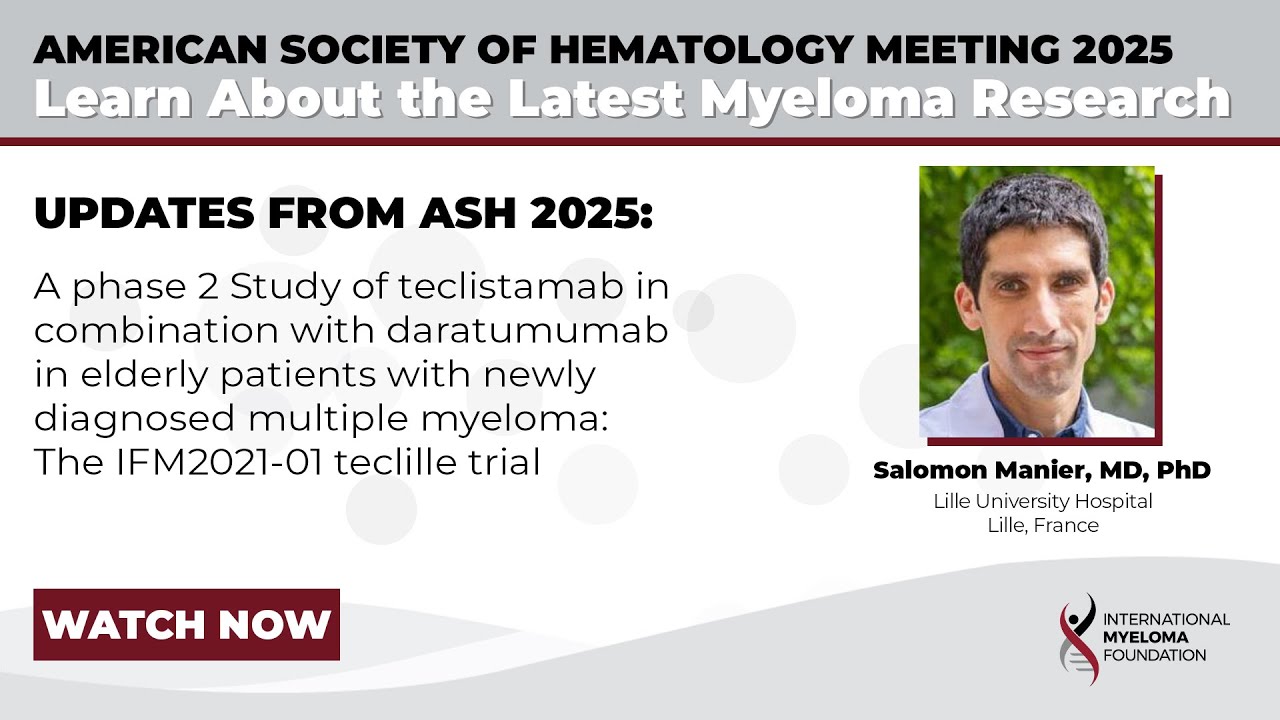
The IFM2021-01 TecLille trial (Cohort A) evaluated an "all-antibody" regimen combining teclistamab and daratumumab in 37 elderly patients (median age 73 years) with transplant non-eligible newly diagnosed multiple myeloma. With a median follow-up of 10.3 months, the combination demonstrated exceptional efficacy, achieving 100% very good partial response (VGPR) or better rates at best response, with all evaluable samples (n=27) showing MRD negativity at 10⁻⁶ by next-generation sequencing at 6 months. The safety profile was favorable, with no grade ≥3 cytokine release syndrome, no immune effector cell-associated neurotoxicity syndrome, and only 14% grade ≥3 infections despite systematic immunoglobulin prophylaxis. The study achieved 100% progression-free survival and overall survival with high dose intensity for both agents (95% for teclistamab, 96.6% for daratumumab), supporting further phase 3 evaluation of frontline BCMA/CD3 bispecific antibodies combined with anti-CD38 monoclonal antibodies.
Key Points:
- Primary Endpoint Achievement: 79% of patients achieved VGPR or better after 4 cycles, with 100% achieving VGPR or better at best response (59% complete response/stringent complete response, 32% CR, 8% sCR)
- MRD Negativity: All 27 evaluable samples demonstrated MRD negativity at 10⁻⁶ by NGS at 6 months; clonotypic mass spectrometry showed only 3 patients with clonotype <5mg/L (equivalent to MRD 10⁻⁵)
- Exceptional Survival Outcomes: With 10.3 months median follow-up, 100% PFS and 100% OS were observed with no progression or death events
- Safety Profile: Grade ≥3 adverse events occurred in 78% of patients, predominantly lymphopenia (57%) and neutropenia (43%); CRS was mild (35% grade 1, 24% grade 2) with no grade ≥3 CRS or ICANS
- Infection Management: Grade ≥3 infections occurred in only 14% of patients with 95% receiving systematic immunoglobulin supplementation; median initiation at cycle 1
- Immune Remodeling: Flow cytometry demonstrated increased terminal effector memory T cells and decreased regulatory T cells and NK cells at 6 months, alongside decreased soluble BCMA levels
- Treatment Exposure: High dose intensity maintained with median 12 cycles received (range 10-18), only 1 patient (3%) discontinued due to adverse events
- Patient Population: Representative elderly TNE NDMM cohort with 32% high-risk cytogenetics, 32% ≥75 years old, and 22% classified as frail by IMWG frailty score
Conclusion:
The IFM2021-01 TecLille trial Cohort A demonstrates that the teclistamab-daratumumab combination represents a highly effective and well-tolerated treatment option for elderly transplant non-eligible patients with newly diagnosed multiple myeloma. The unprecedented 100% VGPR or better response rate, universal MRD negativity at 10⁻⁶ among evaluable samples, and excellent safety profile with manageable infections through systematic prophylaxis establish this "all-antibody" approach as a promising alternative to current standard-of-care regimens. The favorable toxicity profile, particularly the absence of severe CRS or ICANS, combined with high dose intensity and no treatment-related deaths, supports the feasibility of this regimen in an elderly, potentially frail population. These compelling results warrant confirmation in phase 3 clinical trials evaluating frontline combinations of BCMA/CD3 bispecific antibodies with anti-CD38 monoclonal antibodies as potential paradigm-shifting therapy for elderly NDMM patients.
Authors:
S. Manier, J. Lambert, M. Macro, T. Chalopin, M. Dib, A. Rumpler, J. Gay, J.-N. Bastie, C. Jacquet, C. Sonntag, L. Vincent, A. Perrot, C. Mariette, L. Montes, S. Rigaudeau, N. Bigot, M. Doyle, D. Santra, P. Smirnov, C. Albrecht, C. Touzeau, J. Corre, P. Moreau, H. Avet-Loiseau, C. Hulin, X. Leleu, and T. Facon.
ASH Abstract: 367