Robin Tuohy (00:00:00):
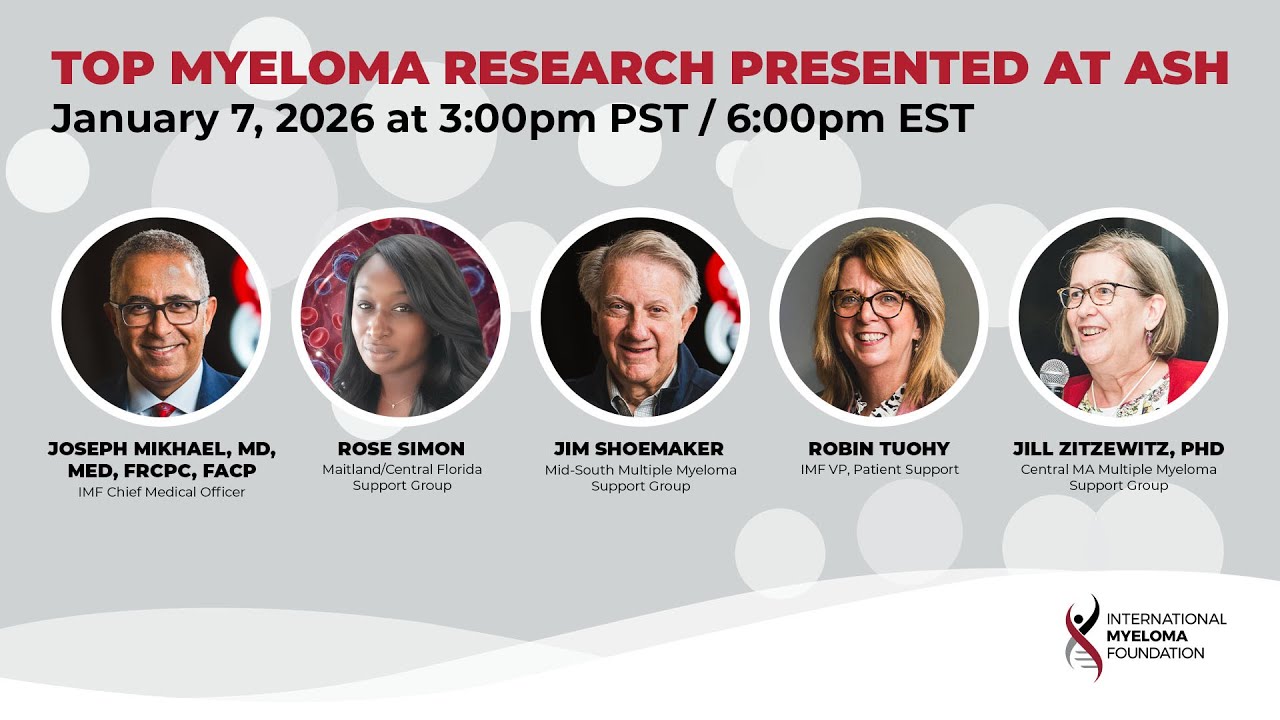
Good day. Good evening everyone. Happy new year. Happy healthy new year. Tonight, this is the International Myeloma Foundation's Living Well webinar, and tonight we're going to be focused on the top myeloma research presented at ASH, but this one is really focused on the patient perspective. And so we will be joined with Dr. Joe Mikhael hosting and moderating the conversation with Rose Simon, who is a support group leader and patient in the Maitland, Florida area. Jim Shoemaker, who is in Tennessee, myself and Jill Zitzewitz, who is everybody is a patient here. I'm a care partner, but all the rest are patients. And we feel that this patient perspective, the language we use, what's important to us and what we hear and learn at ASH, is it really important to bring forward to all of you as patients, as care partners, so that we can better understand the deep science, the hope in the science, and live well with myeloma.
(00:01:18):
So this evening, before we get started, just a few things to keep you engaged tonight. Something fairly new that the IMF has been doing is this closed captioning. And so if you're interested in closed captioning, you can see here where that show captions button is in the control bar at the bottom of the screen. And if you don't see it, just simply click on the more three dots and look for the closed captions. And we want you to be able to hear, read, see, enjoy, and learn. Now, if you want to also have some questions, we will let you know that at the end, at the very end of the presentation, we will be going through the chat box and we invite you as that question pops into your head to type it in the chat box and we will get to as many as we can.
(00:02:13):
Dr. Joe does an amazing job going through and consolidating so many questions. And if you have any tech issues, then just write to this email at [email protected]. And you can also, with any tech questions, use that little Q&A to send to the support group team who's going to help you with whatever it is to make sure that your experience here tonight is just stellar. We thank our speakers here tonight and our sponsors. And tonight, that is AbbVie, GSK, Johnson & Johnson and Sanofi.
(00:02:55):
And as always, we want to hear from you. So you will, at the end of the program, get this survey. You will also get the survey by email. Please let us know your thoughts. Was this helpful? Did we miss something? Can we do something better? Because that's the goal. We always want to improve based on your needs. After tonight, this video, this webinar will be available by replay. So you can go to the IMF website, myeloma.org. You can click on this section marked publications and videos. Go down to the Living Well section and click on it for the slides for the entire replay. And as a reminder, for any of you that are support group leaders out there, it's a fantastic thing to replay at your January meetings. All right. Now we're going to get into the nitty gritty of it. And it's my absolute honor, pleasure to introduce to you not just tonight's panelists, but the entire Myeloma Voices team that came to ASH with the IMF.
(00:04:05):
And you can see the group here of 15 patients. And some of them were with us at ASH in person. Some of them were with us at Ash virtually. So the experience was different for each and we're happy to bring you what their updates are. So in addition to what you're going to hear from Jill and Rose and Jim that are highlighted tonight, you can always go to the myelomavoices@ash webpage to look at all the social media, to see all the different blogs and things that each of these wonderful individuals took their time to do so all of us can learn and better and have better conversations with our own healthcare teams. And what else could be better now than me turning this over to Dr. Joe Mikhael, our chief medical officer, to really take it away and get into everything with you tonight. So Dr. Joe, please take over.
Dr. Joseph Mikhael (00:05:11):
Thank you, Robin. Always wonderful, always such a fantastic hostess, and it's just a privilege to be here. I have the privilege of giving many, many talks over the year. Some of you get to watch or have to watch a lot of the videos that I create. When I can do a program with patients, I am particularly happy. So to have Jill and Rose and Jim with us tonight, Robin, is just a treat, and I'm very, very thankful for that. Now you may be listening so far and you think to yourself, okay, this is a little awkward. I don't even know what ASH is. What are they talking about? Well, let me explain that ASH is our short-term acronym or short acronym for American Society of Hematology. So this is a huge meeting. We have almost 30,000 people that come to this meeting. It happened to be in Orlando this last year.
(00:06:00):
So Rose had the short ship of all of us there. But this year it was in Orlando. It changed from year to year next year in New Orleans. And we had over 3,000 people virtually attending. So over 30,000 altogether. And what we'll be discussing tonight, we use the word abstract a lot. You may not be familiar with the word. Ironically, abstract sounds vague, but abstract is actually what a scientific group or a doctor or group of individuals or an institution will submit several months earlier before the meeting as a summary of a research project that they're working on. Whether it's a clinical trial, which is most of what we're looking at tonight, but sometimes it may be a report, it may be a survey, it may be something that is done scientifically in the lab and experiment. And these are what get discussed at the annual meeting.
(00:06:55):
So thousands this year, 9,000 abstracts were submitted to ASH. Now these of course aren't all myeloma, because remember this is the American Society of Hematology, so all things blood. So blood cancers like myeloma, leukemia, lymphoma, but also other aspects of diseases like sickle cell disease and bleeding disorders, clotting disorders. So we have over 9,000 abstracts for submit this year, which was a record thousand more than the year prior. But what's amazing to us is even though myeloma is a relatively rare condition, we had over 1500 related to multiple myeloma. Myeloma continues to be the fastest growing research area within hematology that's presented at ASH. Now, nobody on this panel would be willing to sit with Dr. Joe if I reviewed all 1500 abstracts. Being a nerd that I am, I read them all, but we won't have by any means time to cover all of these abstracts.
(00:07:54):
We're going to focus on what I've often called Dr. Joe's top 10. So we're going to focus on 10 abstracts in just a minute, and I'll explain a minute what these two abstracts are that we included what we call late breaking abstracts. And the two categories for these 10 abstracts are going to be two out of the three major areas of what we sometimes call immunotherapy or immune therapy. Right now, really in many ways, a lot of the treatments we give, we can consider immune therapy. And we call it immune therapy. We just mean that we're engaging someone's own immune system to fight their cancer. And the two that we are going to focus on tonight are CAR T-cell therapy and bispecific antibodies. And I'll explain them each very briefly as we go into each section. But I should note that there is actually a third area of immunotherapy, what we call antibody drug conjugates, of which we have one that was very recently approved for use called Blenrep or Belamaf.
(00:08:54):
And this is a drug that hooks onto a myeloma cell and kind of drops, if you will, a backpack of to destroy. And we're not getting into a lot of detail about blood wrap tonight, only because one of our previous seminars, we spent a lot of time talking about its new approval, and there weren't as many abstracts on it because we had had so many in the previous year, but we expect to hear a lot more about belantamab and its use in the coming months. But tonight, just for purposes, and I'm sorry we don't get to cover everything, we're going to focus on these two areas, CAR T-cell therapy and bispecific antibodies. For CAR T-cell therapy, these are the five that we're going to talk about. I won't go in a lot of detail right here on this slide, is just to give you a sense of where we're going.
(00:09:38):
We're going to start with the first so-called late-breaking abstract or we call LBA1. And it's called that because the meeting was held in December. Abstracts get submitted in very early August, but we also know that sometimes there's more research that's going on. There's something really so- called hot off the press or late breaking. And so there is an opportunity to submit abstracts by the end of October, so very close to the meeting. Now, I got to tell you, over a hundred abstracts get submitted, but we only choose six. So there's a risk of waiting too long to submit the abstract, but these really tend to be the hottest topics. And amazingly, this year, out of the six late-breaking abstracts, two of them were related to multiple myeloma. One of them is going to be in the CAR T category. One of them is going to be in the bispecific antibody category.
(00:10:30):
So let's dive right into it and talk about this notion of in vivo CAR-T. And if you don't know what the phrase in vivo CAR-T means, please don't be embarrassed. Most of us had no clue of what it meant up until recently either. Let me just quickly remind you about the process of CAR-T. If you look at the picture on the left as you're staring at the computer here, you see what we have titled or what they have titled X vivo CAR-T. That's what we do now. X means out in, of course, means in. So X-vivo CAR-T is what we do now. So if you're not familiar with CAR T-cell therapy, let Dr. Joe make it simple for you. You have cells in your body that are like soldier cells, and we call them T-cells. They're a form of white cell. And this amazing new therapy that we have in myeloma over the last few years of CAR T-cell therapy, we take T-cells out of a patient and we, if you will, train them to fight their myeloma.
(00:11:32):
That training manufacturing is by putting a receptor on the outside of the cell. That's why it's called CAR chimeric antigen receptor. And that receptor on the outside of the cell is going to allow that T-cell when we now give it back to the patient because we do all that manufacturing outside the patient. We give these T-cells back to a patient and now these amped up soldier T-cells have a receptor and they just can't wait to find myeloma. And they go in and they grow and they find myeloma and they destroy it. That's the process of CAR T-cell therapy that we use right now. Why this was a late-breaking abstract and why this kind of blew our minds in many respects is this was the very first report in myeloma. And granted, it's only three patients that we have a lot of detail on, but the concept is so brilliant.
(00:12:25):
It is what we call in vivo CAR-T. So instead of taking T-cells out of a patient, manufacturing them, giving them back to a patient, here they just give a drug to a patient that goes to their own T-cells and converts them to CAR-Ts by putting those receptors on the outside of the T-cell, and then those T-cells can go and destroy the myeloma. So you don't have to collect T-cells in advance. You don't have to wait weeks for the manufacturing. Some of you know who've been through it, and I know Jill, I'm going to call on you in a couple of minutes to tell about your experience because Jill is a live late breaking abstract of going through CAR T-cell therapy that before we give T-cells back to patients, we give them a little bit of chemotherapy to sort of calm their own T-cells so we don't have a epic T-cell battle.
(00:13:16):
And in this case, we don't have to do that either. We just give this patient the drug, wait for these cells to be made CARS or CAR-Ts, and then they go attack the multiple myeloma. And I noted earlier, we really only have data on the first three patients and it's still early, but let me tell you, all three patients were high risk. All three patients were very heavily pretreated with myeloma and all three patients within the first month became MRD negative. So amazing, amazing concept. And we'll talk more about that concept with our team later because what I'm going to do is present all five abstracts and then we'll get some discussion from Jill and Rose and Jim as we discuss the implications of these. So that was abstract number one, the late-breaking abstract. Secondly, I want to talk about this abstract that was presented by my dear friend, Luciano Costa, who looked at the long-term follow-up and specifically what we call progression-free survival.
(00:14:21):
Now, if you're not familiar with progression-free survival, I'll explain it on a slide coming up. Don't confuse it with P and F, which is patient and family seminar, very different phenomenon. And we'll be telling you about patient family seminars later that you can come visit us with, but PFS is very different than PNF or a patient of family seminar. But they wanted to look at what happens to people in the long term who got treated with a specific CAR-T, what's called ciltacabtagene otolucil, which I know is a mouthful. So we call it cilta-cel for short or Carvykti is the trade name, if you're familiar with it. And specifically looking at patients with standard risk myeloma. We divide myeloma sometimes into high-risk and standard-risk. And we saw some early reports about high risk and some people thought, well, CAR-T is a pretty involved process.
(00:15:13):
Let's preferentially give it to high-risk. But here they wanted to say, well, let's look at the standard risk patients and see how they did with myeloma. And it was based on two studies that we had already talked about. And again, I don't need to go a lot of detail here, but one was called the CARTITUDE-4 study where basically CAR-T was compared to what we call SOC or standard of care. What we typically do, unfortunately, when someone diseases relapse, we may give them a triplet therapy. And I know there's a lot of lines here and this is really confusing. Let me make it straightforward again. PFS or progression-free survival is meant to look at how when patients get treated with whatever treatment they're getting, how many people stay in remission. In an ideal world, these curves would be flat. I'm going to show you a pretty flat curve in a couple of minutes, actually.
(00:16:03):
Typically, you think nobody wants a flat curve in medicine, but this is where we like flat curve. So if you look at where the word PFS is or the letters PFS is, you see some red and black lines there. But to keep it simple, unfortunately, every time a patient relapses or dies, unfortunately, that line starts to drop down. You can see how there's quite a bit of a drop early on because in the first few months, typically, patients with very aggressive myeloma may not respond or may relapse very quickly or sadly even die, and then the curves start to flatten out a bit. And as we look at the curves flattening out, we start to see that, wow, that standard risk group, that very highest curve, they've done the best because remember the goal is to keep the curve as high as it is, but let's give some more numbers to this.
(00:16:50):
We saw that not only with the CARTITUDE-4, which is where patients were treated who had only one to three prior lines of therapy, even those patients with very heavily pretreated myeloma were treated in what we call the CARTITUDE-1 study. Here we start to see when Dr. Joe sits down with a patient, when you sit down with your healthcare team, can we start to give average numbers or what's the likelihood that with standard risk myeloma, my CAR T-cell therapy is going to work and how long could it work? And so if you look at that dotted line up and down that what's called the 30-month PFS, so we do a cutoff at 30 months. So at two and a half years, those patients that had cilta-cel or Carvykti with one to three prior lines, over 70% of them were still in remission. For those patients that had very heavily pretreated myeloma, it was 60%.
(00:17:45):
So we do learn that giving CAR T-cell therapy earlier seems to be more effective than giving it later, but these numbers are really quite impressive. So we've put them in this column here for you where again, if we look at just PFS, we won't focus on overall survival right now. If we look at progression-free survival, I can tell a patient with standard risk myeloma that at 30 months, I actually expect 80% of those patients to still be in remission and 60% if they had several lines of therapy. These are some of the best numbers we have ever seen in relapsed myeloma. And I think it tells us that using CAR T-cell therapy even in relapse in standard risk patients can be very effective. And one of the things that's really important to us is not just that drugs work well, but that they're safe. And as some of you know, one of the things that we get particularly concerned about when we use that same CAR T-cell therapy, cilta-cel or Carvykti, is that albeit in a very small percentage of patients, there is a risk of what we call delayed neurotoxicity.
(00:18:52):
So when we look at the side effects of cilta-cel, there are things that happen early on. Some of you are familiar with things like cytokine release syndrome and even some neurological things that can happen that thankfully tend to be short-lived, tend to be well-controlled, but there are some things that are so- called delayed. And for time's sake, I'm just going to focus on the top one because that's what this abstract was about presented by Dr. Sedana from Stanford, what we call delayed neurotoxicity, where patients can develop basically a condition as if they had Parkinson's disease or some of these other neurological things. These are things that we hate to see. Thankfully, we typically see them in less than 2% of patients, but if you're in that 2% of patients, obviously this is very severe. And so what they did is they looked back at over 750 people that had had Carvykti and tried to figure out who got the neurotoxicity and who didn't.
(00:19:44):
Is there something that predicted for one person to get it versus the next? And more importantly, could we do something about it? And their conclusions here were very important. I would argue there are two things we learned really from this study. Number one, as they've highlighted and read here, because I've used their slides so that I can present it objectively, that remember how I said T-cell therapy, we take T-cells out of a patient, we do the manufacturing, we give them back to the patient. That time in between, we call any treatment we give a patient bridging treatment. What we've learned is it's important to give good bridging treatment. If we can squeeze down whatever little bit of myeloma has left, for reason we still need to understand, that can reduce risk of neurotoxicity. The second lesson was when we give those T-cells back, remember how I said the T-cells grow?
(00:20:37):
They don't grow in terms of getting bigger. They grow in terms of multiplying. The medical word we use when I give a T-cells back to a patient and they create more of them, we call that expansion. And for, again, reasons we don't fully understand, sometimes that expansion happens almost too quickly and the T-cell levels shoot up really high and we can measure this by looking at someone's lymphocyte count or absolute lymphocyte count. We sometimes call that ALC for short. And they show that in those patients that had a big jump in their ALC that that was potentially a higher risk of getting Parkinson's. And so maybe there's something we can do about reducing that expansion, reducing that jump up in lymphocytes that may be able to help us control this neurotoxicity. All right, we'll come to number four and then one more and we'll get to the group because I know you had heard enough about Dr. Joe now and you want to hear about Jill's experience with the CAR-T.
(00:21:36):
This next abstract I found fascinating for two reasons. This was one of the first CAR T-cell therapies that actually, not that it has two receptors, but it duly targets, has two targets. When I talked about the other CAR T, for example, we may be referenced to CARVYKTI, it has one receptor that goes after BCMA, which is something that on the outside of the myeloma cell. They've developed a drug here that actually has two targets. It targets not only BCMA, but also something CD called CD19 that we see on myeloma cells as well, hoping that maybe if we do it with the target, we'd be able to more precisely capture the myeloma cell and not have any so- called friendly fire that the T-cells would go and hit any other cells, because that's what we really don't want to have happen. The second reason I chose this abstract in my top 10 was that this was now used in first-line therapy.
(00:22:36):
Most of the CAR-T studies that we've seen, we've talked about, and the FDA approval now is in patients that have had prior therapy and have had relapse, but they wanted to treat patients in frontline. Now, granted, it wasn't a huge number of patients, but it was, I think, important to learn about what we can do when we use CAR-T earlier, thinking and hoping that T-cells are younger, they've seen less treatment, and maybe they could be more effective in bringing down myeloma. Now, as I noted, there was only 30 patients treated so far on this study, but all 30 responded to it and seemed to respond quite deeply to it in terms of how many of them, 97%, as you see here, achieved a stringent complete remission. And then the last abstract in this group here was another new CAR-T, still not yet FDA-approved. It's now being used in relapsed multiple myeloma, but a little bit like the previous one, the previous study had so- called a dual targeting CAR where it had two targets that it would hit the myeloma cell.
(00:23:43):
This was still one target using BCMA, but with something they called the D domain binder. And the concept and the idea here is that this may more effectively and more precisely hold onto the myeloma cell and again, not go to other cells. And again, there's so much we don't really understand about it, but sometimes we think that maybe some CARS go the wrong direction. Sorry to stretch the analogy too far, but if we're sending these CARs and you're supposed to go find myeloma, sometimes some of them go elsewhere, maybe some of them traffic to the brain even and cause the Parkinson's. But if we can make sure that the ... Again, I'm stretching analogies and the nurse practitioner I work with would say, "Enough, Dr. Joe, way too many analogies." But the GPS of some of these CAR-Ts take them in the wrong path. But here, if you've got a really sophisticated GPS, it's going to bring the CAR T-cell to the myeloma, and that's what we've seen with this drug called anetic cell in the IMAGINE study.
(00:24:49):
And what was fascinating is that they treated over a hundred patients, 96% response rate, and it seemed to last, especially in patients who were very heavily pretreated. At two years, over 60% of these patients were still in remission, which is quite remarkable for very heavily relapsed myeloma. But arguably, even more importantly, those delayed neurotoxicities we talked about earlier, they didn't see any of them in the study. So it's not to say that it can't happen, but we saw considerably less of any neurotoxicity. There was some mild, what we call ICAN, some of the earlier neurotoxicity, but none of those delayed ones like the Parkinson's or the Guillain-Barre syndrome. So if you've been napping for the last, let's see, 18 minutes or so, a quick summary, and then I'm going to turn to Jill and ask her a couple of questions about what she thinks about all of this.
(00:25:42):
Now, CAR T-cell therapy really still remains the single most effective therapy we have in myeloma. And what did we learn through these studies that we can reduce some of the side effects or toxicities when we bridge carefully and maybe monitor that expansion, potentially do something about those rising lymphocyte counts. Number two, when we look at those standard risk patients treated with Carvykti, really amazing outcomes, long-term remissions that we've really not seen before. Thirdly, we can give CAR T-cell therapy in frontline. Obviously we can't in terms of it's not yet FDA approved, but scientifically, feasibly, we can do that. And now we have these amazing new ways that are being developed to deliver CAR-T, whether it's the dual targeting, that more precise D-domain binding, or even what I think is almost miraculous to me, this whole concept of in vivo CAR-T, of being able to deliver CAR-T in such a unique way.
(00:26:41):
And so I've generated a few questions here, but we're going to go through our panel here to get their take on this. What does this mean for CAR-T patients as they think about it, whether they're standard risk or high-risk? And what are these new things going to really mean? I see a lot of great questions, Robin, already coming into the chat, and I'll come to those in a minute. But Jill, maybe I can turn to you first because you're a scientist as well as a patient, and you have a lot of experience in these meetings and these abstracts. Tell me a little bit about what this means to you. And of course, I'd love you to share a little bit about your experience having very recently gone through a CAR T-cell therapy.
Jill Zitzewitz (00:27:23):
Yeah. Thank you, Dr. Joe. As you mentioned, I am a scientist, and so I love going to ASH, and this is my fifth year going to ASH. And the thing about science is it takes a long time. It's a lot of work and a lot of studies even before we do clinical trials. And as a patient, I am beyond overwhelmed over and over every year how rapid this progress has been for myeloma. And that gives me so much hope. I mean, when I was diagnosed in 2017, I was on a triplet therapy because we didn't do quads yet. That came later. And then right at the beginning of the pandemic, I relapsed and started on a second line of triplet therapy that included a CD38 monoclonal antibody. And that's when I first attended ASH. And there were all these abstracts about CAR T and the only way to get CAR T at that point was through a clinical trial.
(00:28:14):
And if you were very relapsed and refractory. But then when you start to see results in that line and that this was working, then they can get FDA approval to bring CAR T to earlier lines. And so it was only about a year ago, roughly, that CAR T was available for an earlier line. And so I relapsed in April and I had some new sternum pain and it turned out from a PET scan, I had new lesions. And so the decision was what do we do? And as a patient, I wanted to go on no drug. And I had gone to ASH and I knew that the results were good. And so the nice thing about CAR T is you're off of everything. So you don't have that fatigue and that sort of brain fog and that exhaustion. And you can just have a nice little holiday from myeloma therapy.
(00:29:03):
And my myeloma specialist is like, "We're going to put you on bridging therapy." And I went on bridging therapy. So when I had my CAR T in October, I didn't really have any sign of myeloloma. But of course, being a scientist, I'm in the hospital and I'm asking a million questions, right? "What's in my blood work that shows this is working? How do you know it's not working too much? What do you worry about? "And they're like, " Oh, well, we worry if your absolute lymphocyte count gets too high. "And then when I was like, " Well, but how do you even know that my CAR Ts are there? "They actually showed me some slides of these absolutes of sites, which don't look like normal ones. They look like misshape and misfolded. And this is the stuff I love. And so I had a lot of confidence through the process.
(00:29:46):
But then when I went to ASH and all of this, the data comes out and you see that what people think it might be happening, there's data to support it. It gives me so much confidence that hopefully I have this nice little holiday of break where I can do other things in my life for a while besides worry about balancing my energy and-
Dr. Joseph Mikhael (00:30:07):
Absolutely.
(00:30:09):
Thank you so much for sharing that, Jill. And we know that you've just undergone some testing to reevaluate the state of your disease and our thoughts and prayers are with you as we wait the results. But it really is wonderful to hear from someone who's just been through it. I mean, she just did her CAR T-cell therapy in October. By the way, you look great. I mean, you always look great to me, but you look particularly great tonight. And so I'm really thankful that you can share that experience. And you bring something that I think is important that I want to turn to Rose and ask about because I know, Rose, when you and I are chatting a little bit about CAR T-cell therapy and so on, that one of the things that resonated with you was that this might mean, and I don't want to get too far ahead of ourselves, but this might mean that patients won't need some of the traditional chemotherapy, drugs like Melphalan and heavy chemos that can cause a lot of grief.
(00:30:59):
And you're on mute right now, Rose, but if you unmute yourself, I'd love to hear your thoughts a little bit about that.
Rose Simon (00:31:06):
Yeah, no, definitely. Honestly, going to ASH, I've had the opportunity to see what's being worked on and coming through the pipelines, which was honestly super exciting. But going to the question, I did definitely want to know about that. With Melflulen being that main chemo drug that we have after going through the whole transplant, will that be something that we still need to receive if we're able to go through this process? Because like you said, it does have some impacts, well, not some impacts. It has a lot of impacts on people, younger, older, and whatnot. So with that being said, is it possible for even to be a first-line drug, not a second-line type of treatment too? That's also a big question of mine.
Dr. Joseph Mikhael (00:32:02):
No, that's fantastic, Rose. Thank you. And this is maybe a good commercial for people to think about next year's ASH. And maybe even if my numbers are right, it might be two years from now. I know that seems like an eternity when it comes to myeloma timing, but what we showed tonight was some preliminary work of doing CAR-T and frontline therapy, but there are some large clinical trials going on right now that are comparing CAR-T to transplant. And I know Rose is going to be the first one to read the results of those trials because she's going to want to know if we can actually replace CAR-T or sorry, replace transplant with CAR-T. Jim, let me turn to you for a moment. As someone who I know has had myeloma for many years and you hear the results of these kinds of things and you see some of those progression-free survival curves going on for a long periods of time, what are your thoughts about this, my friend?
Jim Shoemaker (00:33:00):
I appreciate the question, Dr. Joe, and the reality of just what we've been talking about. When you think about 1,500 abstracts this year alone, and that was something ... I was diagnosed in 07 and I couldn't spell multiple myeloma. I mean, never heard of it. Nobody told me about it. I did the best I could and so much appreciate what's going on with the IMF and with ASH and the research. And my question to really to you is the research is just off the charts. Just going to ASH and as everybody said, you see so much and now you're talking about in vivo CAR-T and the other things. Are we looking at research that we could begin to talk about the word cure? I mean, is this the beginning of the end of myeloma? Are we close to that? That's my thoughts.
Dr. Joseph Mikhael (00:33:55):
I love that, Jim. One, because you'd be an amazing contestant on Jeopardy. You answered my question with another question, which was awesome, and I love it. And it is a great question. We met as the International Myeloma Working Group for our summit in June. And with some of the results that actually some of the results that I shared here, especially about the long-term follow-up of Carvykti, we said to ourselves, we need to start making sure we define the word cure because we are starting to see a group of patients that we believe are cured. In fact, I've been a myeloma doctor even before your diagnosis, Jim, and it's just wonderful to know that you look so well and do so well after 18 years with myeloma, but I've been a myeloma doctor for almost 25 years and it's amazing. Back then, we actually thought that maybe two or 3% of patients were getting cured because they seem to get a limited amount of treatment than just stay in remission for a very, very long time.
(00:34:58):
Now, I think we're starting to see that fraction maybe 10 times higher than that. 20 up to 30% of patients with these kinds of treatments are staying in remission for a very long time. And I mean, I think I'd love to define cure the way someone on the street would likely define cure saying, "Hey, you get a treatment, you never have to think about the disease again." We're not quite there yet, but there are definitely groups of patients that are going in that direction. And before Robin, we jump into our next section, and I want to thank again Jill, Jim, and Rose for those great thoughts. Let's just quickly answer a couple of these CAR T questions because they're so pertinent to what we've just said. I love question number one. Whoever you are, question number one, thank you for this question. It says, "What is the reality and the promise of in vivo CAR T?" Well, I think we've talked about the promise.
(00:35:47):
The promise, the idea of being able to give CAR T in a way that we don't have to go through all of the process that we have now. I do think it is more than a promise. I think it will be a reality. I think a lot of the work we do at the IMF relates to what we call health disparities or the fact that there are people that don't have access to treatments right here in the United States and all over the world. This may make it easier to deliver CAR-T in poorer countries or in other areas where people have less access to treatment. And an answer to a question further down, number five that says, "Does in vivo CAR-T still have the same adverse reactions or side effects as old CAR-T?" The short answer is yes, but less. It looks like there is less cytokine release syndrome, less of the neurotoxicities, less of the low blood counts, and that partly because of course we're being able to deliver this in the patient and not from the outside.
(00:36:45):
And someone also asked with in vivo CAR-T, does the patient need to be given any chemo as part of the infusion? And the reality is no, they're not getting that what we call lympho-depleting or T-cell depleting chemo to ensure that their current T-cells are calmed because we're not matching two separate CAR-Ts together. We're just giving a patient drugs that convert their own T-cells into CAR T-cell therapy. And I also like how someone further down asked, "Oh, first of all, let me say thank you to whoever said, I don't give too many analogies." I appreciate that. But someone asked, "Will we see CAR T-cell therapy used for smoldering myeloma?" Well, yes. We talked about this last year at last year's Ash that there was some preliminary work of looking at high-risk smoldering myeloma. And so that is being studied and it is being studied earlier line.
(00:37:38):
So for the person who asked, can it be given second-line? Yes. Carvykti is approved as early as second-line therapy and Abecma is approved as early as a third-line therapy. I'll take a couple more questions here, Robin, about this section and then we'll move on. Someone asked, what are the issues with CAR-T treatment for older patients, 80 to 85 or more? Is actual age key or is it the health of the patient? Well, I always like to say it's never really just the absolute age. We try to look at what we call frailty, what we look at comorbidities or other illnesses that people have. I don't say that you can or can't have a CAR T because you're 50, 60, 70 or 80. In the very first large CAR T trial where we used Abecma or ide-cel, there was an 84-year-old patient on that trial. And so there are patients in their 80s who can have CAR T-cell therapy.
(00:38:31):
Sometimes we may be concerned about that chemo that we have to give and the treatment may be a bit intense. And so we may decide on something like a bispecific antibody, which is a nice segue into our next section, but we do try to make decisions not really based on age alone, but based on someone's whole health status. And the last question I thought here was great was what about having maintenance of some kind after CAR T? I relapsed within a year after CAR T, and I'm very sorry for that person who has relapsed just like the other question that says, "Can you have another CAR T if you've had one?" Well, interesting, I'm going to show an abstract in a few minutes where they actually did that. They gave a little bit of maintenance right after the CAR T to try and see if they could prolong the remission of the CAR T.
(00:39:17):
So we'll learn more about that as we go through. But let's now jump into our next section, which is the bispecific antibody section where we also have five abstracts, the first of which was another late breaker as I commented earlier about late breaking abstracts. This abstract was the MAJESTIC-3 study, and this is a trial that was a randomized trial, so much larger than the previous trial we talked about as a late breaker. Instead of three patients, you're going to see here that there were hundreds of patients in this study. And what they did is they wanted to compare the usual triplets that we give when patients have one to three prior lines of therapy. Remember, a line of therapy is a treatment that you're given until your disease progresses again. So it's not just the number of drugs, it's the line of therapy. And we typically give drugs like DPD or DVD, as you see here in the gray box, or the triplets with Darzalex, pomalidomide index, or Darzalex, Velcade index to give it in comparison to a new combination of giving a bispecific antibody with Darzalex or with daratumumab.
(00:40:30):
If you're not familiar with this, remember a bispecific antibody is called bispec because it has two arms. One arm, if you will, answers ... Sorry, one arm grabs onto the myeloma, the other arm grabs onto a local T-cell. So a little bit like the in vivo concept we talked earlier, we don't have to take T-cells out of a patient. Here, we can actually just give them a drug that matches up the myeloma and a local T-cell and brings them together so the T-cell can do its magic and destroy the myeloma. And the first bispecific antibody we had approved by the FDA was teclistamab. That's why the study was called MajesTEC. Get it? Yes, they like to use cute phrases. And it was teclistamab. Tecvayli is the trait name, and it was given in combination with daratumumab. If I were only allowed to show one slide for this whole presentation, this might've been it.
(00:41:30):
Now that you're all experts in progression-free survival, let me remind you that here, unfortunately, there is still a bit of a dip at the start. It's not a very large dip, but look how almost flat that line becomes. So in patients who were given teclistamab and Darzalex together, at three years, 83% of them were still in remission. Unfortunately, the people that had the triplets had a much less likelihood of staying in remission. It was only 30% as you see there. So what strikes me here is that absolute number is so, so high, but also it's quite different than the other triplet, really speaking to the power of these two. Now, I don't like to be sour grapes by any meal means, or I don't like to lessen the impact and the beauty of this slide, but I think it's important for me to also know ... Oh, sorry.
(00:42:25):
I should notice the overall survival was also dramatic. Over 80% of people still alive at three years versus 65%. But there was a challenge with this study and it had to do with infections that unfortunately, 13 patients died early on in the study in the teclistamab/Darzalex arm because of infections. It made the committee that runs the trial, hold the trial for a minute, more than a minute, or hold the trial for a while they implemented some extra precautions like making sure people get IVIG. Many of you know where that is, what we call intravenous immunoglobulin or replacing the immunoglobulin that gets depleted when you have a bispecific antibody, being more careful with infections and giving antibiotics when need be. Thankfully, when they implemented those precautions, there was only one death after that. It's still tragic that anyone would die, but much, much less.
(00:43:22):
And so it did remind us that although this combination is extremely potent, we have to be careful with infections, but this is quite amazing now. And this combination has been sent to the FDA for review, and we anticipate and we hope that we'll be able to use this combination probably sometime in 2026.
(00:43:41):
Now, interestingly, this same combination, teclistamab and daratumumab was also used in frontline therapy. Just like we've seen CAR T-cell therapy approved in late relapse, moves to early relapse, gone to first frontline. Our colleagues from France and my very dear friend, Sadamo Menie, presented this interesting study where they said, "Let's look at trying to use this combination in frontline therapy." And interestingly, they had a study where they're in two combinations, what's in green here called cohort B, they showed to us before adding teclistamab to Revlimid or lenalidomide, but in this study, they're using teclistamab and daratumumab. And the idea here is are we eventually going to replace the way we treat frontline therapy? Maybe as Rose talked about to us earlier, maybe for patients who are eligible for transplant, we don't need transplant. Here in patients who are typically not eligible for transplant, instead of using those combinations with a monoclonal antibody and a proteasome inhibitor and like Revelcade or a immunomodulatory drug like Revlimid, maybe we can use a two-drug combination like this with teclistamab and daratumumab.
(00:45:00):
Now granted it's early, granted only 37 patients treated, but no one is unhappy when we see 100% response rate. Not only that, remember I told you I was going to show you about a flatted curve as we've ever seen in myeloma, and I know it's only 10 months into the study or 10 months of average follow-up, but in those 10 months, nobody has progressed and thankfully nobody has died out of those 37 patients. So again, I don't want to over-call something that's early on, but what a remarkable feature to see this combination. So it's very likely we're going to see this combination move its way to earlier line therapy. The next two studies I'm going to show to you, believe it or not, I'm a little less excited about the results of the study and more excited about the design of the study. What do I mean by that?
(00:45:54):
Someone might think that's strange, but what I liked in this study was several things. This was a study of looking at so-called fixed-duration bispecific antibody. And here they're using the newest bispecific antibody that we have approved by the FDA, something called linvoseltamab. And it was given to patients with newly diagnosed myeloma who had been treated, but did not yet achieve MRD negativity. So I know there's a lot going on here. Let me explain that. So for those of you who aren't familiar, we have been doing a lot of work and it's been a tremendous effort at the IMF and the tremendous passion of our dear founder who sadly recently passed away, as many of you know, Dr. Brian Dury, committed so much of the last years of his life to studying MRD or minimal residual disease. This is when we test patients that have no clear evidence of myeloma in their blood work or their urine and look for tiny amounts of myeloma in the bone marrow because we've learned if we can get someone to MRD negativity, that really is a very good indicator that they're going to stay in remission for a long time.
(00:47:09):
And that with Jim's thinking, I suspect that's going to be part of the definition of cure in the long run. So what this study did was, and I know there's a lot of complicated parts to this, but if you look, let's follow the colored boxes together, they took newly diagnosed myeloma patients who got the standard of care treatment, and they took those patients that did not achieve MRD negativity and said, "Okay, you haven't gotten quite as far as we want. What if we give you a limited duration of a bispecific antibody?" And you remember that linvoseltamab targets BCMA, just like those CAR-Ts we talked about earlier, and typically in the first treatment, we don't give drugs that target BCMA. So it's kind of like, let's come at myeloma a different way to get those last few cells. Sometimes the complex word we use in myeloma is we say that sometimes patients have several clones, and that just means that myeloma is sometimes not just one disease.
(00:48:12):
It's like if you look out into your grass, sorry, Robin, I know where you live right now, your grass is covered with hideous white stuff. I mean, beautiful snow, but if you could look out my Arizona window here, I have some of the greenest grass of the year. This is the time of year that we actually get our nicest grass. I can see Jim smiling. And anyway, if I look out to the grass and I see weeds, sometimes it may not ... I mean, I don't see any weeds in myelon, but if I were, you might see different kinds of weeds. And sometimes I think of myeloma that way, that it's not just one kind of weed, it's a few kinds of weeds. And so sometimes one treatment is really good at thinning out weed type number one, but didn't get rid of weed type number two.
(00:48:55):
And sometimes we think when someone's left with a little MRD positivity, it means that there's another kind of weed that whatever treatment was given didn't quite remove that and didn't quite take it down. And so I just love that this idea was one, let's come at myeloma in a different way. Two, let's use MRD as a guide. And three, instead of giving a bispecific antibody forever, or at least until someone progresses, which is typically how we use it now, maybe we can maximize its benefit by giving it in the short term. And to me, that is a huge area of work in myeloma. I've joked about it many times, but it's not really a joke. I love giving patients nada, nothing. RIA, nyet, whatever language you speak, I love giving nothing. It's my favorite drug. Every insurance company covers it. Everybody is fully compliant and adherent when taking it.
(00:49:53):
And if we can find ways to be able to stop treatment on patients. One person asked about the maintenance, I would love to sometime not have to give maintenance for long periods of time because people love being off therapy. I know Jill is loving being on NADA right now, and this may be one way in which we can do that. The other study that I was interested in just the design of it was this study from our friends at Penn who really were the very first ones to do CAR T-cell therapy. And in a similar way, they said, okay, let's take people that had CAR-T, whether they had ide-cel, Abecma, or cilta-cel, Carvykti. And instead of just giving them NADA, which although we love, maybe we can extend their time and remission by also giving them a short period of time on a new bispecific antibody that's actually not even FDA approved yet called cevostamab (00:50:48):
Now you remember the bispecific antibodies that so far we've talked about target BCMA, but we now have new targets. We have one of our approved bispecific antibodies called talquetamab that targets GPRC5D. And I always say, I'm sorry, they're all license plates. I didn't make up the names. But now we have cevostamab , which targets something called FCRH5. And so the idea here, a little bit like the previous study is let's wipe out myeloma as best we can with CAR-T, but maybe there's a little bit of disease we might not even be able to fully measure it, but let's give someone sevostamab for about six months and see if we can keep them in MRD negativity or get them into MRD negativity. And if they do, then we can stop. If they're still MRD positive, maybe giving them a little bit more treatment will be helpful. I like this design because one, it's not a very invasive or tough treatment that we may be able to give people after CAR-T to make CAR-T even more effective.
(00:51:53):
And then we come to ... Sorry, the slide is not quite advancing here. There we go. Hopefully it should jump now. We come to the last of the first of these five studies that we have in bispecific antibodies, which is now saying, okay, you've told me about bispecific antibodies in combination with standard drugs, the daratumumab in frontline and early relapse. You've shown me that I can use a biospecific antibody after certain treatments. What if I give two bispecific antibodies together, one that targets one license plate and the other that targets the other license plate, one that targets BCMA and one that targets GPRC5D. And this was presented by my very close friend, Sadusmani, the redirect study. Not only was it trying to prove that we can use these two drugs together, what was fascinating to me here is that they did it in arguably the toughest kind of myeloma to control, which was EMD or extramedullary disease.
(00:52:58):
Medella is an old word in medicine for the bone marrow. So we typically think of myeloloma lives in the bone and it's intra- or it's medullary. If it's extramedullary, it means people are growing myeloma outside of their bones. And we've learned over time, if we find myeloma outside of the bone, it tends to be more aggressive. And so interestingly, they gave these two drugs together to try to see if the synergy of these two could really help in a situation where sadly and historically, patients really don't do well with significant extramedullary disease. And amazingly, just short of 80% of patients responded to this, not something we typically see. And the duration of that response was longer, meaning the progression-free survival here at one year was over 50%. Now that's not the same kind of curves as you saw earlier, but with extramedullary disease, typically these patients, unfortunately, tend not to stay in remission for more than three or four months.
(00:53:58):
So to see over half of them stay in remission over a year is really quite remarkable. And this is also being evaluated by the FDA to potentially be approved. Now, you know, Dr. Joe well enough, if you know me, that I can never just give 10. It just hurts. So I got a quick bonus abstract here and it's another bispecific antibody. We've talked about three of them that we have. So we have four already approved, one that we hope to be approved in the future cevostamab , but the other one that is approved that we didn't talk about yet was called elrantamab. And I was fascinated by the study because they gave already mab with another new drug that's not been approved yet, which is called iberdomide. For those who have heard about this, it's a part of a new class of drugs called cell mods that you can read about.
(00:54:49):
One of our publications at the IMF. Robin is going to remind us at the end, we have a lot of resources for you. One of them is our booklets, and we've written a booklet on cell mods. These are drugs that are in some ways similar to the drugs we use now like Revlimid and pomalidomide, that class of drugs. They're pills. They tend to be very easy to take, and they wanted to see if they could combine the two together, and they did. And again, remarkable. Look at this. 100% of patients in that DL1, overall, 96% of patients responding to this combination. And so I think it's going to expand our thinking about bispecifics that we can combine it with other combinations with other drugs. And in this case, we can combine it with lanatimab. So in conclusion, before I come to our patients here, the combination of teclistamab and daratumumab is really remarkable.
(00:55:40):
We're seeing it used both in frontline and early relapse, although we have to be careful infections, as I noted. Number two, we're looking at novel ways to better the treatments we have, whether it's giving a fixed duration of a bispecific antibody in newly diagnosed myeloma or after CAR-T. The combination of teclistamab and talquetamab seems to be very effective in extramedullary disease and the future is going to be combining these with other agents. And then in this case, I use the example of the Celmod. So lots of questions here, and I've been talking too much, so I'm going to turn it to one of my BFFs here, Jim, and say, Jim, just like Jill was really remarkable in sharing with us that she had been on CAR-T, I know that you've been on a bispecific antibody, and maybe you could just tell us a little bit about that.
(00:56:36):
And you were actually on a clinical trial where a bicypic antibody was given in combination with another drug.
Jim Shoemaker (00:56:43):
Yeah, I was fortunate enough to be selected for the trial with talcutibab back in January of 23, and I missed talquetamab by just one person. So I was fortunate enough to be the first one to get the talquetamab with daratumumab. And having a conversation with you what we were talking about. But I was very fortunate to know that they were watching me and they weren't giving me a lot of attention to make sure that I did not get sick. I ultimately had to go on some IVIG therapy, which was important for infections. I'd never got really sick, but I did have the typical side effects of some infections that I needed to be careful with. And I was fortunate to have a great team of my team at the center for me here in Memphis did a great job of watching over me and taking care of me.
(00:57:47):
So I was very successful with that. MRD negative and I stopped a trial, still on the trial, but stopped the drug after about 18 months, and I'm not taking any type of maintenance whatsoever. So quality of life is on a scale of one to 10, a 10, and success, a 10. And so right now, I feel very comfortable with what that bispecific drug did for me.
Dr. Joseph Mikhael (00:58:13):
That's amazing, Jim. And I think you're also, based on some of the data we just showed, you're living proof that not only can these drugs work so effectively, and not every patient obviously can have the same experience you've had, but I love the fact that you're able to come off that treatment. And I think in some of these trials are showing to us that although these drugs are very, very effective, we can actually have them so effective that we can stop them for periods of time. And that's been one of our recurring themes today of being able to have limited duration of treatment. I know, Rose, that's something you and I have talked about before, and I know something you have been particularly passionate about as well, and maybe you can talk a little bit about that, this idea of having new treatments where we can actually stop the treatment.
(00:59:05):
You're on mute, Rose.
Rose Simon (00:59:10):
Sorry. I'm always a problem child.
Dr. Joseph Mikhael (00:59:12):
No, not at all.
Rose Simon (00:59:14):
No, yes, definitely. For me, when I was diagnosed, I was told ... Well, the first thing I was told was that multiple myeloma normally impacts people who are older, not younger. And so when I started my process, everyone was not sure how to deal with me. And also when it came to getting my treatments, there were questions I didn't know to ask, but I know now because of the IMF. And one of the main things is that, yes, I'm so grateful that my myeloma was found early and that I had my transplant, but now I'm on maintenance strugs, very grateful, but with the With the maintenance drugs, you have your monthly survey question that you have to answer. And also for me being on, say the younger side, the impact on fertility. So whether you're male or female. So that of course is a treacherous question that I'm always thinking about.
(01:00:22):
And it would be amazing if future patients don't have to go through that. Now, of course, I work with several doctors and they're always trying to think of new things, new processes for me and whatnot, but you're still never sure. So for me, in my age range, fertility is the biggest thing. So like I said before, first I had the melphalan and that puts your body through a rigorous process. And then to maintain to where I'm at right now to be in remission, I of course have to take my Revlimid. And that also has done certain things to my body as well. So it would be amazing, I think, personally. And I'm pretty sure other people would feel the same. I understand we do need the maintenance drugs, but if we could come off of the maintenance drugs. I mean, of course right now, I'm hearing what's going on with CAR T.
(01:01:21):
I'm excited about CAR T and I'm also jealous because I just had my transplant about a year ago. And just thankfully I am in remission, but I'm just like, ooh, I wouldn't mind CAR T right about now. But of course, that's not how it works. That's not how it works.
(01:01:39):
And I've had the privilege of being around Jim and I see how vital and funny he is. And it's just like, I want to be in gym shoes right now.
Dr. Joseph Mikhael (01:01:50):
Well, it's a good thing he's a shoemaker.
(01:01:53):
Sorry, Jim, I couldn't help but say that, brother. But I think Rose, you capture so many beautiful things the way you say that. And I really hope, as we've sort of said before, I really hope the future of myeloma has a lot to do with limited duration treatments, treatments that are less toxic. As we get treatments that focus more on the tumor and less on the patient that hit the bad cells and not have as much friendly fire on the good cells, I think we're going to have that experience. And part of the challenge, of course, of that is this risk of infection. And I know, Jill, that's something you and I have talked a bit about. And I wonder if you can comment a bit. I don't want to detract at all from this great research that we've just presented, but I think the research also reminded us that when we play with the immune system, we do have the challenge of people getting infections.
Jill Zitzewitz (01:02:43):
Yeah. I think almost every myeloma therapy has that challenge, but the immune therapies are even more so. The risk of infection is much more serious and worrisome. And right now it's flu season, so it's not a good time to be a myeloma patient. And it's great to hear all of what that came out of ASH, how IVIG is used much more standardly now. I'm fortunate that I'm able to have IVIG, which gives me some confidence. But I do think that that is a big worry. You have to sort of hibernate in your home and wear a mask if you go out and be very cautious and don't be around anyone sick. And it's hard to know. We all spread germs before we're sick. So I think the more we can do to make sure that we're not treating more than we need to and not pushing too hard on the immune system.
(01:03:36):
Because right now I don't have any of my own antibodies. I don't have any of my own T-cells. They're still recovering. So I'm relying on a thousand different people's antibodies to keep me infection free right now.
Dr. Joseph Mikhael (01:03:50):
And we're thankful for those thousand people. We should always make sure that we're grateful for those people that donate. And one of the reasons why, of course, Jill says a thousand is when people are given IVIG, it's what we call a pooled blood product from multiple donors that have been very gracious to offer that. And I see some of the questions here, Robin, in that same vein, that we have become thankfully, I think, more liberal with using IVIG. And thankfully, we've actually seen greater, or I should say lesser challenges with insurance. For a while, there were even more challenges. Insurance companies were questioning, does this person really need IVIG? But I would say almost universally, everybody who gets CAR-T or biospecifics needs IVIG for a period of time. It's not lifelong. Ultimately, people's immune systems come back and they make their own antibodies. I think we still have to figure out exactly how long that should be.
(01:04:43):
We're often guided by the immunoglobulin level when someone's not receiving it from someone else, but those are the kinds of things that will help us in the future. Well, Robin, before we go to this great list of questions, I always have to share this almost incomprehensible slide. People look at it and go, "Ugh, it's such a busy slide." When I give a talk on how to give a talk, I always tell people busy slides aren't the issue. We should be calling them lazy slides because it means that people didn't make them effectively. But I purposely make this one ugly because I love the fact that there are so many words on this page. When I started in myeloma 25 years ago, there were two or three words on this page. Now we have so many more treatments and so many more coming. I think it's really exciting.
(01:05:33):
And the last slide I want to share with us before we go to the questions is something that is literally ought off the press. It came into print yesterday. I know we've been focusing on ASH today, but there's another organization called ASCO or the American Society of Clinical Oncology. And I've had the privilege over the last two years of working with the great names of the patients that you can barely read. They're a little bit small font, but a group of experts in myeloma to write the latest guidelines with some of our colleagues from Canada for multiple myeloma for the treatment of myeloma. In that, we included two patients who worked with us. And one of them, as many you know, was just a titan of patient advocacy. And I want to be careful I don't get choked up here because I absolutely love Jack Aiello, his wonderful wife, Nell and their family.
(01:06:24):
Jack was a patient. Jack was an advocate. Jack was a support group leader. Jack was a board member at the IMF. Jack was funny. Jack was smart. Jack was just a remarkable individual. There are very few people who would've interacted with Jack and not been deeply touched by him. And because Jack sadly passed away in the creation of these guidelines, if you do read all 60 pages of them, you'll come to see at the end that we have a beautiful dedication to him. And these guidelines are dedicated to him. These are primarily for providers, primarily for doctors and nurses and others, but of course these can be found and we do have a patient-friendly version of the guidelines, but we thought it would be nice and thanks to Robin for suggesting this that I think we wanted to make sure that Jack was honored. And the last thing I'll say about Jack, Robin, I'll turn it back to you to make some comments as we go into the questions, is that one of the things that Jack loved was having other patients go to ASH like the patient voices and how passionate he was about patients learning themselves, the research and not always just being hearing it second, third, fourth hand.
(01:07:37):
And so I think it's fitting that when we review these great abstracts at ASH that we honor Jack.
Robin Tuohy (01:07:45):
Well, good job, Dr. Joe at not getting choked up over that because we, in addition to all the beautiful accolades that you just expressed, Jack was a friend, Jack was family, F-A-M-M-I-L-I. People in our community understand and appreciate that. And so as we move into the end of our meeting, we thought it would be very helpful and valuable to all of you to show you where some of these resources are. You heard Dr. Joe talk a little bit earlier about patient and family seminars, not PFS, but patient and family seminars. And so the first one that the IMF is going to be holding this year is in Boca Raton, Florida on March 13th and 14th. And you could find more information on how to register for this free in- person program on myeloma.org. And I want to now have you just look at this screen.
(01:08:47):
These are some of the key places that you can find resources on what we discussed today. I saw a question come in, someone asking about where can I find information on clinical trials. So you could see the third bullet down there. It says, "Find a clinical trial, SparkCures" If you look to the right side, these are screenshots of the IMF website. And if you are looking for a clinical trial, you can find it by clicking on this resources and support tab at the top. And then you'll see the third arrow down says, "Find a clinical trial." We've partnered with SparkCures and they have a very easy to navigate resource right on the IMF website, as well as you can contact them by phone. They're very, very patient-friendly and try to help people understand. I also, of course, want to give a little extra information because I saw questions coming in about our three amazing patient panelists today and where do you find a support group?
(01:10:02):
So you can continue to get this information. So I wanted to just let everyone know again that Jill is leader of the Central Massachusetts Myeloma Support Group. Rose is leader of the Maitland Florida Group, and Rose was a first timer at ASH this year. I think that's a very important perspective to hear when you don't even know half of these words that are flying around, but the more you hear these words, the more comfortable you become with them. And then Jim and Jill have been coming to ASH with the IMF for a number of years now, and so they have this elevated level and they mentor people like Rose so she can better understand and then explain to you. And our dear friend Jim here, he is a wonderful support group leader at the Memphis Tennessee group. There are 160-ish groups across the country as well as special interest groups.
(01:10:59):
So that first bullet there where it says, "Find a support group," you can click there and find out where they are. I did see a question where somebody asked about Rose being a younger patient. Well, we are going to be launching in February a brand new group called Myeloma in the middle. It's for those people that are in that younger mid-age area of their lives and what are the important questions for them and things to think about as Rose brought up. So as you look through here, you can see we've got IMF publications, the videos. Where do you find these videos? So on the second, on the bottom screenshot, you can see publications and videos. Under videos, you see all of these bubbles down here that help you hone into exactly where do you want to find the resources. And if you want to know more in depth, you can, on that third column over here, look at the IMWG publications.
(01:12:04):
You can look at the ASH abstract summaries. I think all of this information is crucial to us to have as patients, as care partners, so we can have those good questions with our entire healthcare team. So with that, we want to just, again, end up with the audience now because it's your time these last, let's see, we've got about 10 minutes left. Dr. Joe, this gave you a little time for you to look at that chat box and all the
Dr. Joesph Mikhael (01:12:36):
Questions that came up. Yeah, lots of great questions. And I'm going to answer some of these. And if it's okay with our panel, I'm going to include some of them as we answer these. But let's dive in. Someone asked a really important question because I made a brief mention of it that how do we differentiate high risk from standard risk? And then there's another question about high risk in a minute. So I said briefly that we as a myeloma community have always recognized that there is a fraction of myeloma patients whose disease, if you will, behaves a little bit more aggressively. It tends to come back more quickly. One of the groups included in that would be the group that I discussed earlier with patients with extramedullary disease. In addition to that, we recently have a new guideline between the IMWG and the International Myeloma Society where we defined, and I won't go through them now because it's a bit meticulous, but five different, if you will, genetic features of the myeloma that we typically detect on patients' bone marrows that indicate genetic changes that are associated with being high risk.
(01:13:44):
But there's also patients that we call so- called functional high risk, meaning we don't see evidence under the microscope that they've got aggressive myeloma, but unfortunately their disease behaves aggressively. I was speaking to a patient who sadly this week, within three months of their initial treatment, their disease relapsed. They didn't have any obvious high risk factors at the start. So high risk disease is not just defined by what we look at from a genetic standpoint, but what actually happens with patients. And that's one of the reasons why we want to be careful in making the definition so that we can provide the best treatment possible for all patients, but in particular, those patients with high-risk disease who tend to have a more aggressive course, which is one of the reasons why I thought it was interesting tonight that we would look at the difference in standard risk patients who were treated with Carvykti who did particular well with it.
(01:14:42):
One question that comes here is, what is given for bridging therapy? So bridging, which there's no perfect answer to that, but typically we want to give something for bridging. Remember, bridging is defined as what we give to patients after their T-cells are collected and before their T-cells are given back to them in the CAR T-cell process, something that we know is going to control their myeloma. So Jill, maybe you can quickly comment in your specific situation because I know yours was a little bit unique, but what was your, you're still on mute, but what was your experience with bridging?
Jill Zitzewitz (01:15:15):
Yeah. So my second line was daratumumab, which is a CD38 and Pomalyst, which is another similar to Revlimid, one of these immunomodulators and a steroid. And so what we did is we swapped out the Darzalex or the daratumumab for a different monoclonal antibody, elotuzumab, which was very ... And the reason for that is it was very well tolerated. The challenge was I had to stay on the Pomalyst and I had to up the DEX. So bridging wasn't ... Having a lot of DEX wasn't fun, but we were able to bring that down after a couple of cycles once things seemed to clear out. And the Pomalyst, for some reason, I was able to tolerate it better with the elotuzumab than I had been. So every patient is different and you never quite know. And I think that was really nice that I could have a conversation with my myeloma specialist and we were able to play with the bridging as we went to optimize it for what I could tolerate.
Dr. Joseph Mikhael (01:16:17):
And that's really the key point that we wanted to make, I think that we want to make here is that it's an individualized choice. What is the best for that patient? What is most likely to get their disease down and keep it down? While we're still on the CAR T theme, someone asked and said, "Well, if CAR T could be done earlier, wouldn't another advantage be that the patient would be healthier and more able to qualify for treatment?" And that's true. That's one of the reasons why not just the T-cells being healthier and younger, well, the whole of the patient is that. Someone asks and says, "Well, aren't you giving chemo with CAR-T? So how is CAR-T better than transplant?" Well, I know Rose could answer the question about melphalan, but the chemo that we give for transplant tends to be considerably more intense because remember, the purpose of chemo with transplant is really to devastate the bone marrow to get rid of all the myeloma that's there.
(01:17:17):
And unfortunately, there's a lot of friendly fire. So it's a much higher dose of chemo. The little bit of chemo that we give with current CAR T-cell therapy is to just, if you will, attenuate or to calm some of the patient's own T-cells so that they don't get into a battle with the T-cells that we're reinfusing. We're not trying to really heavily beat down their bone marrow like we do with stem cell transplant. Here's a sobering, but an important question. Do you consider multiple myeloma to be a terminal cancer? And Jim, I mean, how do you express it to people? I mean, obviously in some ways you're an exception to the rule. You've had myeloma for 18 years, but if someone says to you, "Jim, don't you have a terminal cancer?" How do you address that?
Jim Shoemaker (01:18:05):
I've had that question asked me several times, Dr. Joe. And the reality is if it's terminal cancer, then I understand that. And by my faith, I trust that. But the reality is if you'd have told me when I got my transplant 18 years ago, I was told two years, that's terminal cancer. But today, with all the things we've got going on, I think it's much more treatable. And I've learned that that's become a conversation. It's a cancer that's treatable. I'm not going to compare it to other diseases. I'm just going to say there's so much out there I wouldn't want to call my cancer today, multiple myeloma, terminal. That doesn't mean that I may die from multiple myeloma. I may not, I may. But the point being is when I have the optimistic mindset, I take care of myself, I trust my physician, I trust what we do at the IMF.
(01:19:02):
It's like, okay, I'll take it as a journey, and it's turned out to be an 18-year journey for me.
Dr. Joseph Mikhael (01:19:07):
Well, beautifully said, Jim. And of course, part of the reality of myeloma is there's such a spectrum. I mean, we see people, thankfully, like yourself, 18, 20, 25 years. I know Robin can speak about her wonderful husband whom we all love who's a survivor of myeloma well over 20, 25 years now. And then sadly, there are others that still succumb to the disease within the first couple of years. That's one of the reasons why that high risk discussion was so important. And so for some, sadly, it is quite terminal. For some cure is not even on their radar screen, but for others it is. And I think, as I intimated earlier, that the fraction of patients that are living longer and living better with myeloma, and that's what I've heard from all three of you. All three of you, "I want to live longer, but I also want to live better." Someone said, "What's considered a long remission?" Well, it depends.
(01:19:59):
25 years ago, six months was a long remission. Now we want remissions much longer than that, five years and more. I'll take a couple more questions here, Robin, and then I'll turn it back to you because I know we can't get them all, but allow me to make a quick commercial for asking questions of the IMF. We love questions. So whether it's here at our top myeloma research presented, whether it's one of our Facebook lives, always submit questions. You can do it through any of our social media challenges. Just use the hashtag, ask the IMF. We'll do our best to get back to you. Of course, you can always ask our chatbot. You can always call the info line as Robin, I'm sure we'll share with you before we close off, but we love questions. I'll try to get to a few more of them because I know we can't get to every single one of them.
(01:20:44):
Someone says, "Are bispecifics called BYTS?" Yes. The word BYT was actually patented by a company. That's why we tend not to use it as much, but the acronym BITE stood for bispecific T-cell engager with the T and the E capitalized because that's what it does. It engages those T-cells as we go through. Someone asked, "Hi, Dr. Mikhael. Is CAR T-cell therapy indicated for Lambda light chain myeloma?" And the quick answer is yes, we think of Lambda light chain myeloma as a form of multiple myeloma. As you may remember, myeloma is a disease of the plasma cell that makes an antibody that has that funny Y shape to it with heavy pieces in the middle and light chains or light pieces on the side. And sometimes we can measure the whole thing in myeloma, sometimes only light chains. And light chain myeloma tends to affect the kidney a little bit more, but it is another form or it is part of the definition of myeloma.
(01:21:42):
So whatever treatment we have with myeloma, we can apply to that as well. And then lastly, there were several questions that came around stopping maintenance therapy. I think they were all listening so intently to Rose and I love it. And the short answer is we're still developing the right guidelines and the right approach to it. But I would say that most myeloma specialists now are saying if someone has standard risk myeloma, if they've gotten into a very deep remission, ideally MRD negativity and they've been given, I'm just going to give you a ballpark, about three years of maintenance therapy. There are a lot of those patients that were starting to say, perhaps we can stop treatment and give them NADA. Now, obviously this has to be an individual discussion. You need to discuss this with your healthcare team. In some exceptions, we may do it when they're not even MRD negative.
(01:22:39):
Sometimes we might decide to treat for longer. We do have some evidence going even out to four years from one study, so that has to be discussed. But I think there is a very strong desire within the myeloma community to do that. Someone asked a question, "My husband was treated with stem cell transplant, has gotten into MRD negativity. Should they still get maintenance therapy?" Right now, the best evidence we have is yes. We still know that a period of maintenance therapy can help keep that disease further away as to how long that is very difficult. And then I think very lastly, someone asked about how they can get the patient-friendly version of the ASCO guidelines. They're just being prepared, but it will be at asco.org, asco.org, where you can now find, and you don't need, it's open access. You can find the full guidelines and the patient-friendly ones will be available soon thereafter.
(01:23:36):
I wish I could answer them all, Robin, but I know you have a few final slides to walk us through, so I'll turn it back to you. But I will get you to answer question number 69 here, which is, is there a recording available? I'm leading the witness here.
Robin Tuohy (01:23:51):
As always, Dr. Joe, you've gotten through these questions spectacularly, and I did see that question as well. So I am going to make sure that ... There we go. We're advancing the slides again. Just a quick reminder about that survey that you'll all be getting. Please take a minute to do that for us because ultimately it only improves our programs for you. And now back to Dr. Joe's last questions and information that we want to get. This again is you're looking at a screenshot of the IMF's website, and there were a couple of questions that came in. Dr. Joe, you just asked a question about where can we find this replay? So here, I don't know if you'll be able to see where I'm circling, but under that second column that says IMF videos, you can see if you just click right on there and then you will find all of the different videos, replays available that the IMF has had through the years.
(01:24:54):
It would be remiss of me if I didn't mention our amazing info line. They usually have an influx of calls right after our webinars. And if you don't have that number, it's 1-800-452-2873, and that's actually CURE. 2873 is CURE. And there was another question in here about support groups and where can you find them? One more time, I will let you know up here there's a tab that says resources and support. You can click on that and you can type in the box or on the map whatever state you're looking for, or you could click down to the tab that shows all of our different special interest groups. If you want more help with support groups, you know how to reach me. Just email me and I'm more than happy to help you and direct you to my amazing support group team. One more question, Dr. Joe, that I want to put out there is our friends up north, the Canadians.
(01:25:56):
They asked, where can they get this kind of information specific to Canadians because drug approvals are different in different countries. And so I would refer them to go to myeloma.ca, and that is Myeloma Canada, and they are an incredible wealth of information. So I think that led us through some of those last few burning questions from everyone. So again, we thank all our sponsors. We thank our amazing leaders here, Rose and Jim and Jill and Dr. Joe for leading us through in an understandable way. And we thank everyone here for being on the call, for taking the time to learn, and we want you to live well with my-
Jim Shoemaker (01:26:43):
Hey, Robin?
Robin Tuohy (01:26:44):
Yes, Jeff.
Jim Shoemaker (01:26:46):
I appreciate you saying thank you, but I think it's important as a patient 18 years on this journey, the time that I was invited to be a part of the Myeloma International Myeloma Foundation and leading a support group, that's been almost 13, 14 years ago. The amount of that I have learned and the fact that I can sense just an enormous amount of hope, your dedication, the team's dedication. Dr. Joe, just what we get from that, I cannot tell you, speaking for all the patients that are involved, thank you.
Robin Tuohy (01:27:21):
My goodness. I totally agree.
Jim Shoemaker (01:27:24):
Thank you for what you do for us and your dedication.
Robin Tuohy (01:27:27):
I enjoyed that.
Jim Shoemaker (01:27:28):
And we appreciate it.
Robin Tuohy (01:27:30):
Well, on behalf of the entire IMF, there's a mic drop right there. So goodnight, everyone. Thank you. Have a wonderful evening.