

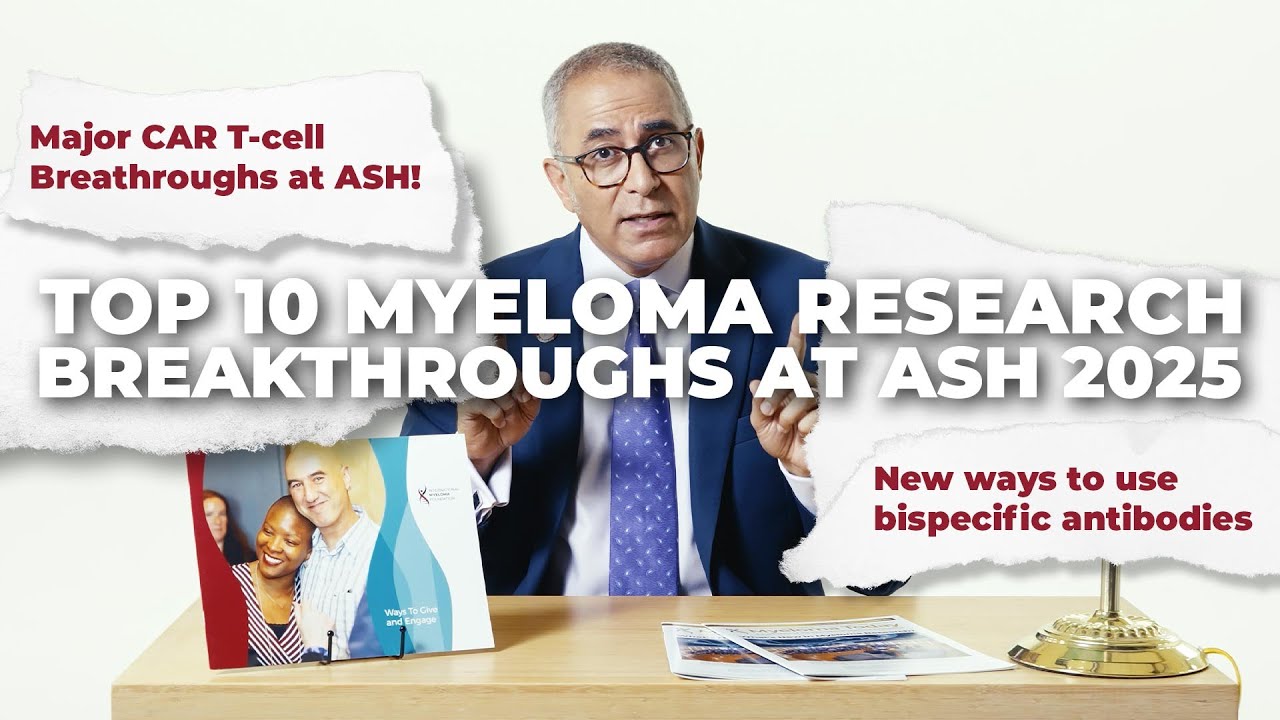
What if there was a major breakthrough in multiple myeloma presented and you missed it? Every year, thousands of researchers in hematology gather for the annual meeting of the American Society of Hematology or ASH. One of the big focuses of this meeting is multiple myeloma. And in fact, this year, over a thousand abstracts were presented in multiple myeloma at ASH. That's over a thousand ideas, projects, concepts that can improve the quantity and quality of life of patients. Today, Dr. Joe is going to give you his top 10, and you're not going to want to miss it. Now, today I'm just giving you the highlights of those top 10, but don't forget to subscribe to our YouTube channel where you'll be able to get a deep dive into all 10 of these abstracts. Hi everybody. Dr. Joseph Mikhael here, Chief Medical Officer of the International Myeloma Foundation, where we are committed to improving the quality of life of patients as we seek prevention and a cure.
The ASH meeting or the American Society of Hematology annual meeting was an incredible gathering of researchers and scientists and doctors and patients, as we thought about how we can improve the lives of patients with multiple myeloma. Over a thousand abstracts were presented in myeloma, but today I'm going to quickly give you my top 10? And I've divided them into two categories, so we can follow along. The first category is CAR T-cell therapy, the second category are bispecific antibodies. In the CAR T-cell category, the first abstract, which is what we call a late breaking abstract, because it was like, \This just in,\ related to a whole new way of giving CAR T-cell therapy, called in vivo CAR-T. What does that mean? Right now, when we do CAR T-cell therapy, we take T-cells out of a patient, we engineer those T-cells so that they can attack a patient's myeloma, and then we give them back to a patient.
That takes time, we have to do the collection, we have to do the manufacturing. Even before we give the cells back to a patient, we give them a bit of chemotherapy. What if we could just give patients a drug that went into their system and converted some of their own T-cells to become CAR T-cells? That's what in vivo CAR-T means, and that's what was presented. Granted, it was only the first three patients treated this way, but amazingly all three patients in the first month of treatment achieved the deepest level of response by becoming MRD-negative. I think this is critical, because in the future, we're going to be able to deliver CAR T-cell therapy more effectively and more safely. The second abstract I want to tell you about was the long-term follow-up of Cilta-Cel or Carvykti in standard risk patients.
We've been using Carvykti now for a few years. Sometimes we use it in earlier relapse when patients have only had one to three prior lines of therapy, or we use it very late in relapse after patients have had over four lines of therapy. And they showed to us that in the long-term follow-up of these patients who had standard risk myeloma, not high-risk myeloma, that those patients did extremely well. At two and a half years, for example, 80% of patients were still in remission in that early relapse, and 60% in that late relapse. These are really unprecedented outcomes, and speak to the value of CAR T-cell therapy. Abstract number three. How can we deliver CAR T-cell therapy more safely? One of our colleagues in myeloma looked at a large group of patients to try and see who is it that is developing some of those unusual, rare, but serious side effects of neurotoxicity. Meaning, after a CAR T-cell therapy, someone develops Parkinson's or a cranial nerve problem, or maybe even Guillain-Barré syndrome.
Thankfully, that happens in a small percentage of patients, but we learned that the risk is higher if we don't give good bridging therapy. And bridging therapy is what we give to a patient after we've collected their T-cells before we give their CAR T-cells back. We give them a little bit of bridging therapy to bridge those two events with myeloma therapy. When we give effective bridging, we reduce that risk of Parkinson's. Abstract number four was bringing CAR T-cell therapy to frontline therapy. There is a new kind of CAR T that we've not used yet, which works in a very interesting way, it's called a dual targeting CAR T. So instead of having just one target on the myeloma cell that these cells grab onto, they actually have two targets, which makes it perhaps even more precise to grab onto those myeloma cells.
This therapy was given frontline. Granted, the numbers are a little bit early, but 100% of patients responded to this, and we actually saw fewer side effects than what we see in other CAR T-cell therapies. Very promising for the future. The last CAR T-cell clinical trial that was presented, was with a new CAR-T called anito-cel, and this was given to patients who had many prior lines of therapy. What was fascinating about this study, was, one, we saw 96% response rate, and two, we didn't see any of those delayed neurotoxicities. None of the Parkinson's and other conditions like that, which I think is going to be very important in the future, and help us to deliver CAR T-cell therapy more safely. Those were the first five, let's talk about the next five, all of which relate to bispecific antibodies. Before I continue, you may be asking yourself, how do I participate in a clinical trial?
Can I be involved in some of this research that is being presented at meetings like ASH? The IMF has made it easy for you to search clinical trials. We've partnered with SparkCures and you can find it on our website at myeloma.org/sparkcures, which is a beautiful search engine to help you find clinical trials that are relevant to you and even close to you. You can absolutely participate in clinical trials, and very often they can help you now, not just for the greater myeloma community. We encourage you to be an active partner in your care. That may include clinical trials, that includes asking the right questions of your healthcare team. The IMF is here for you, and we want to empower you to ask these right questions, to search the right clinical trials, as we seek together to cure multiple myeloma. Myeloma this year at ASH actually had two abstracts in the late breaking session, and the other late breaking abstract was the combination of teclistamab, a bispecific antibody that we already use in later phases of myeloma, with daratumumab together.
This combination of teclistamab and daratumumab was given to patients with one to three prior lines of therapy, and we genuinely saw unprecedented responses. In fact, at three years, 85% of these patients remained in remission. We've not seen that kind of remission before in early relapse, and I think it's going to speak to the importance of combining bispecific antibodies with other therapies. In fact, the second abstract in our bispecific category was the same combination, teclistamab and daratumumab, but now given in frontline therapy in patients who are not going to autologous stem cell transplant. Again, the numbers were relatively small, but almost every patient had a response to this combination, and it can speak to our ability to give these therapies earlier on when patients' T-cells are less beaten down by the treatments we give in multiple myeloma. Thirdly, we saw a fascinating study that gave patients their usual frontline therapy, but then gave them a short course of a bispecific antibody called Linvoseltamab if they had not achieved MRD negativity.
We know that depth of response matters in myeloma, and this was one of the very first trials to say, if patients didn't achieve that depth of response, let's give them a short course of a bispecific antibody to achieve that MRD negativity. I think we are going to see more use of bispecific antibodies in the future like this, because we know the deeper response, the more likely it will remain durable. Another fascinating design was a clinical trial that said, when patients receive their CAR T-cell therapy, whether it was ide-cel or cilta-cel in standard practice, let's also give them a bispecific antibody, but this time they used cevostamab, which is a bispecific antibody not yet approved, but uses a completely different target on the myeloma cell, something called FCRH5. Sorry, they all sound like license plates, but it targets FCRH5, something that the previous therapy would not have done, to further reduce someone's multiple myeloma, to keep them in remission for longer.
I think we're seeing these novel combinations in ways that we've not used before, that are going to better the use of the drugs that we have. And lastly, abstract number five for bispecific antibodies, and my 10th abstract overall, was the combination of teclistamab again, but this time with talquetamab, in patients with extramedullary disease. That means patients have a very aggressive form of myeloma that doesn't just live in the bone marrow, but lives outside the bone marrow. This is a tough type of disease to treat, where typically patients don't respond and don't respond very well, but here we saw remarkably nearly 80% of patients responded to this combination. And there you have it, Dr. Joe's top 10 abstracts from ASH 2025. But please subscribe to our YouTube channel, so that you can dive deep with me as we go into more detail of all of these 10 abstracts. When you subscribe to that YouTube channel, you'll be notified when those deep dives come out. You're not going to want to miss learning more about cutting edge research in multiple myeloma.