

Read Dr. Joe's blog about these research updates.
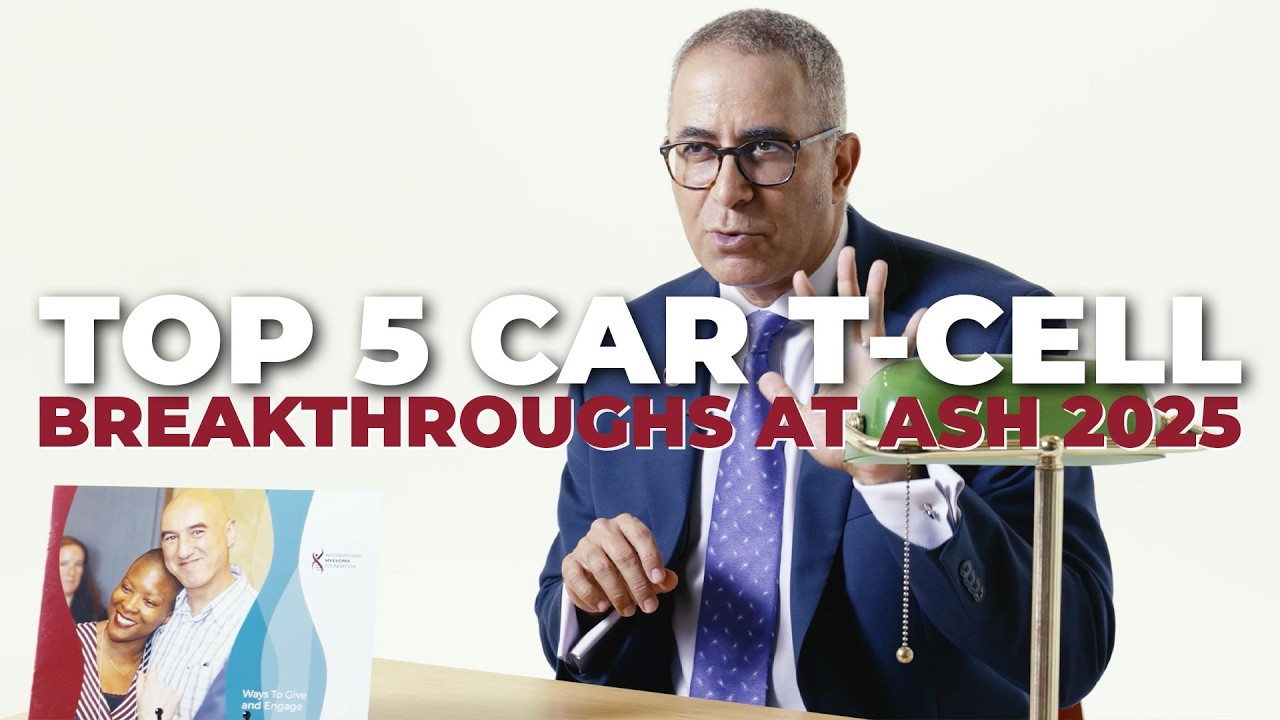
Is CAR T-cell Therapy Getting Safer and More Effective? What ASH 2025 Means for Myeloma Patients
CAR T-cell therapy has transformed multiple myeloma treatment and new research from ASH 2025 may make it safer, more effective, and more accessible.
In this video, Dr. Joseph Mikhael, Chief Medical Office of the International Myeloma Foundation, reviews the top five CAR T-cell therapy updates presented at the American Society of Hematology, including in vivo CAR T manufacturing, long-term Carvykti (cilta-cel) results, improved safety through bridging therapy, dual-target CAR T, and Abecma's (anito-cel) 96% response rate.
If you or a loved one is exploring CAR T for multiple myeloma, this research could shape the future of treatment.
Topics Covered in this Video:
- 0:00 - CAR T-cell therapy overview in multiple myeloma
- 0:46 - In vivo CAR T: Manufacturing CAR-T cells inside the body
- 1:41 - Long-term Carvykti (cilta-cel) remission data in standard-risk myeloma
- 2:23 - Safety: Bridging therapy & reducing delayed neurotoxicity risk
- 3:08 - Go deeper into the science with the IMWG Conference Series
- 3:38 - Dual-target CAR T (AZD0120) in frontline therapy
- 4:31 - Abecma (anito-cel): 96% response rate & safety findings
Have a question that needs more personalized support? Call us! We’re here for you. The IMF’s InfoLine is available to answer your myeloma-related questions and concerns. Call us at 1-818-487-7455, email us at [email protected], or schedule your call at a time that works best for you at: https://www.myeloma.org/infoline
View the Transcript:
Dr. Joseph Mikhael:
CAR T-cell therapy has revolutionized the way we treat multiple myeloma. But what if we could give it more safely? What if we could give it more effectively? What if we could manufacture CAR T's inside a patient's body? These are the kinds of questions that are being answered by the research presented at the American Society of Hematology.
Hi, everybody. Dr. Joseph Mikhael here, chief medical officer of the International Myeloma Foundation. I presented to you Dr. Joe's top 10 abstracts in multiple myeloma presented at the annual meeting of the American Society of Hematology. Well, now it's time to take a deeper dive into the five abstracts related to CAR T-cell therapy. Let's dive in.
The first abstract I presented to you was the very first in vivo CAR T, where instead of making CAR T's out of a patient in a lab, they actually made CAR T's inside a patient. Well, what does this mean for patients? Well, of course it's still early. Only a few patients have been treated, but to me this is revolutionary. One of the greatest challenges we face with CAR T-cell therapy is making it accessible to people because it's hard for people to get to a CAR T center, to go through the collection process, to wait for the manufacturing, to receive the T cells back with all of the challenges that comes with. In a disease that has so much health inequities across the world, this is heralding to us the opportunity to bring CAR T-cell therapy to more patients, to bring it more safely and more effectively. So I'm very excited to see what comes in the future of in vivo CAR T.
The second abstract we discussed was the long-term follow-up of cilta-cel patients who have standard risk multiple myeloma. We saw amazing outcomes that we hadn't really seen before in patients with multiple myeloma, whether they had early relapse or late relapse, meaning if there were one to three prior lines of therapy or more prior lines of therapy. This is particularly important because for a long time we've been thinking that CAR T-cell therapy may be best for high-risk patients, but the results here with standard-risk patients is genuinely remarkable, and I believe we'll be using CAR T-cell therapy in more patients because of this research.
Abstract number three, related to the safety of delivering CAR T-cell therapy, and specifically Carvykti, and how we can reduce the risk of delayed neurotoxicities, things like Parkinson's. What we learned from the study and why it's so important is the value of bridging therapy, that myeloma treatment we give someone after we've already collected their T cells and before we give their T cells back. We learned that if that bridging therapy was not effective, the risk of Parkinson's was 12 times higher. We want to reduce that risk and so now we are going to be very vigilant to ensure that a patient receives bridging therapy between their T-cell collection and reinfusion so that their myeloma is better controlled.
Let me pause here for a moment. If you want to dive even deeper into this great research that was presented at ASH, I hosted an in-depth education webinar where we went into a lot more detail of these abstracts and more. And make sure you subscribe to our newsletter at subscribe.myeloma.org so you can be up-to-date in the most cutting edge research in multiple myeloma. All right, let's get back to those abstracts.
The fourth abstract was introducing CAR T cell therapy into front line with a brand new CAR T called AZD0120 that is a dual-targeting CAR T, meaning instead of hooking onto one thing on the myeloma cell, which all of our CAR T's do now, it actually has two targets to hook onto. And I think this is important because it's teaching us that there are more ways to do CAR T-cell therapy and we might be able to even more effectively bind the myeloma cell so that other cells don't get bound. We believe that some of the side effects that people experience is because some of those wayward CAR T's may go after other. But if we can have them more particularly hook onto the myeloma cell, that will mean more efficacy and, indeed, more safety.
The last CAR T-cell therapy abstract we spoke about was another novel CAR T called anito-cel that was given in patients with very heavily pretreated myeloma, with remarkable response rate of over 96%, and a durable response at that. I think this is particularly important because none of those patients experienced the delayed neurotoxicities, none of those patients experienced some of those things now that really concern us about the use of CAR T-cell therapy, and this may be a way to deliver CAR T cell more safely.
And there you have it, five amazing abstracts that don't only influence how we treat myeloma patients today to make CAR T more safe and more effective, but look to the future of new ways of incorporating CAR T, new CAR T molecules that will almost definitely allow us to give it to more patients, and, indeed, to give it more safely. Thank you for joining us as we've reviewed the top five CAR T-cell abstracts from ASH 2025. And make sure you subscribe to our YouTube channel, because in my next video I'll go over the top five abstracts in bispecific antibodies, another form of therapy that is changing the way we treat multiple myeloma.
Tag #AsktheIMF to Ask Your Questions on Social Media!
Facebook: @myeloma | Instagram: @IMFmyeloma | Twitter/X: @IMFmyeloma
See all of our social media channels at linktr.ee/myeloma
Joseph Mikhael, MD, MEd, FRCPC, FACP, FASCO
International Myeloma Foundation Medical Advisor
TGen, City of Hope Cancer Center—Phoenix, AZ, USA
Dr Mikhael is a Professor in the Clinical Genomics and Therapeutics Division at the Translational Genomics Research Institute (TGen), an affiliate of City of Hope Cancer Center. He is also the Director of Myeloma research at the HonorHealth Research Institute in Scottsdale, Arizona. Dr Mikhael specializes clinically in plasma cell disorders, namely multiple myeloma, amyloidosis, and Waldenstrom’s macroglobulinemia. He is the PI of many clinical trials, primarily in relapsed multiple myeloma, and his other clinical research interests include pharmaco-economics, communication skills, and media relations.
Dr. Mikhael recently served as the Chief Medical Officer of the International Myeloma Foundation (IMF) from 2018 to 2026 – he now serves as Medical Advisor to the IMF to provide guidance and strategic input in areas such as patient education, health disparities, collaboration with partners, international research, and publications.
Dr Mikhael has published over 200 peer-reviewed articles in these fields and lectures internationally on a regular basis. Dr. Mikhael is deeply committed to health disparities in myeloma and is the chair of the Diversity, Equity and Inclusion Council at TGen. Dr. Mikhael is heavily involved in training future researchers and mentors junior faculty worldwide. Dr. Mikhael is an active member of the International Myeloma Working Group (IMWG) and recently led the ASCO guidelines in myeloma. Dr. Mikhael also serves as the Treasurer on the executive of the American Society of Hematology.
Dr. Mikhael did his medical training in Canada, including a fellowship in Multiple Myeloma at the Princess Margaret Hospital in Toronto. He also obtained his master’s degree in education from the University of Toronto. He then worked at the Mayo Clinic Arizona as a Hematologist from 2008-2018.