This week's "Ask Dr. Durie" comes from a caregiver, an anxious caregiver who wants to know: What is the role of a caregiver for a patient who's receiving CAR T therapy? And this is a very, very important question. CAR T therapy is one of the new immune therapies. Kind of a complicated therapy. The T cells are harvested from the blood of the patient and then they're sent off for processing, for engineering, so that the T-cells will attack the surface of the myeloma.
Usually, an antigen called BCMA. That process of engineering takes about three or four weeks and bridging therapy is required to keep the myeloma under control during that period. And then the cells come back and are infused into the patient. There can be some significant reactions to that. The most important is something called CRS or cytokine release syndrome.
And so it's very, very reasonable for a caregiver to ask; you know, what is involved with this whole process? Because after many therapies that patients have gone through to get to this relapsed/refractory state, the prospect of new toxicities, new challenges, a lot of different logistics, coordinating therapy while the cells are being processed, a lot of different things to be considered.
And so, it's extremely important for the caregiver, along with the patient, to talk in detail with the medical team, including the myeloma experts, the infusion teams, the nurses, and all of the other personnel who will be involved with this whole process. And so, that there can be an understanding of what's going to happen over several weeks with a little bit of waiting and then some time in the hospital and then some recovery time out of the hospital.
The very, very good news is that the results with CAR T therapy have been extremely positive, very promising. In one study, the responses with deep responses were around 75%. In another study, 98% of the patients responded, with many of them having deep responses. So, the good news is that if things go well, the response can be excellent and can be sustained without the need for ongoing therapy.
So, the positives are striking and important. The BOTTOM LINE, though, is that for the caregiver, extremely important to meet with the medical team to review things and to be prepared for what could be an emotional roller coaster, because it will take a lot of effort, a lot of planning, and it just takes time to work through and try to achieve the very, very best outcome.



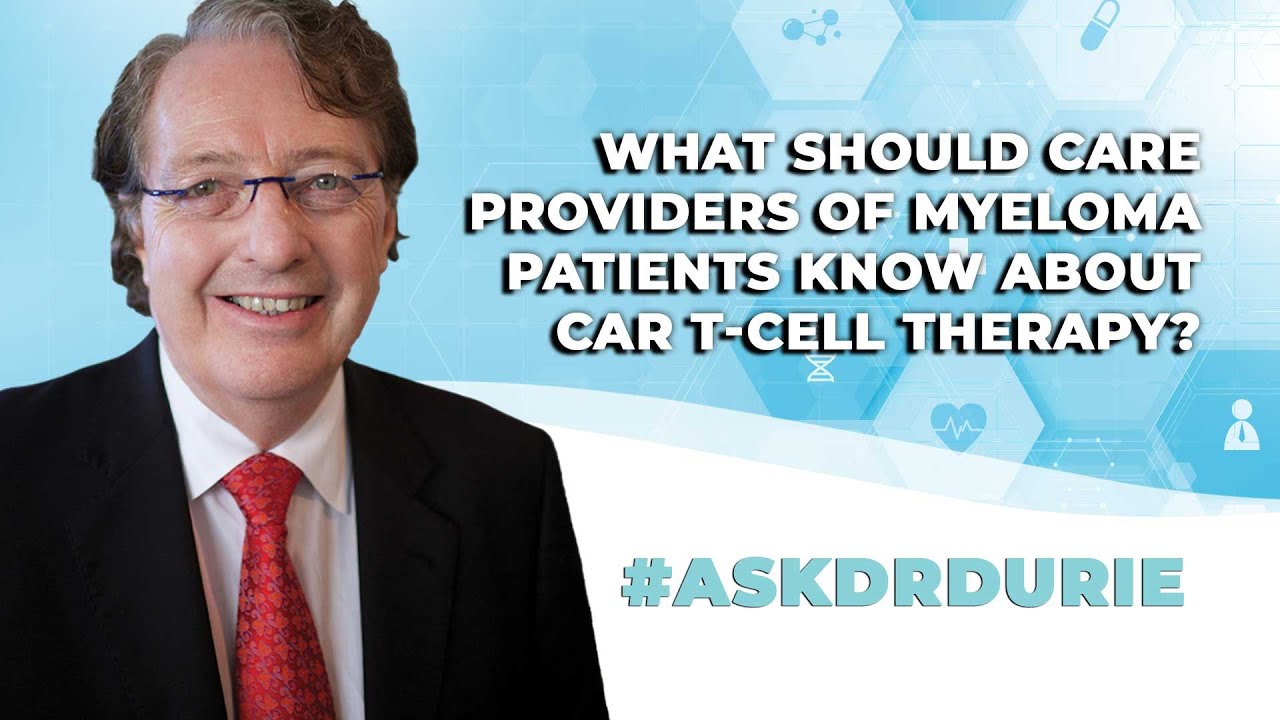
 Dr. Brian G.M. Durie (1942-2025) was the co-founder of the IMF. He was a Professor of Medicine, Hematologist/Oncologist, and Honoree MD at the University of Brussels.