


Beth Faiman:
Hi, everyone, can you hear me? I'm Beth Faiman. I don't know if you can hear me or not. I think we're having some audio-technical difficulties. MY name is Beth Faiman and I'm calling from my home. I'm on the nurse leadership board. We are having some technical difficulties. Dori, I see you. Is it thumbs up or down? Can you hear me?
Hi, everybody. This is Beth Faiman calling. I don't think you can hear me on this feed here. I was looking forward to join you on the Facebook Live and I unfortunately am not sure that this is going to work out due the audio-technical difficulties, but I'm going to try to call Houston and maybe Houston can help us because we have a problem. Yes, you can hear me? Perfect. Okay. Thank you so much. Wow, I thought I was so prepared for this afternoon.
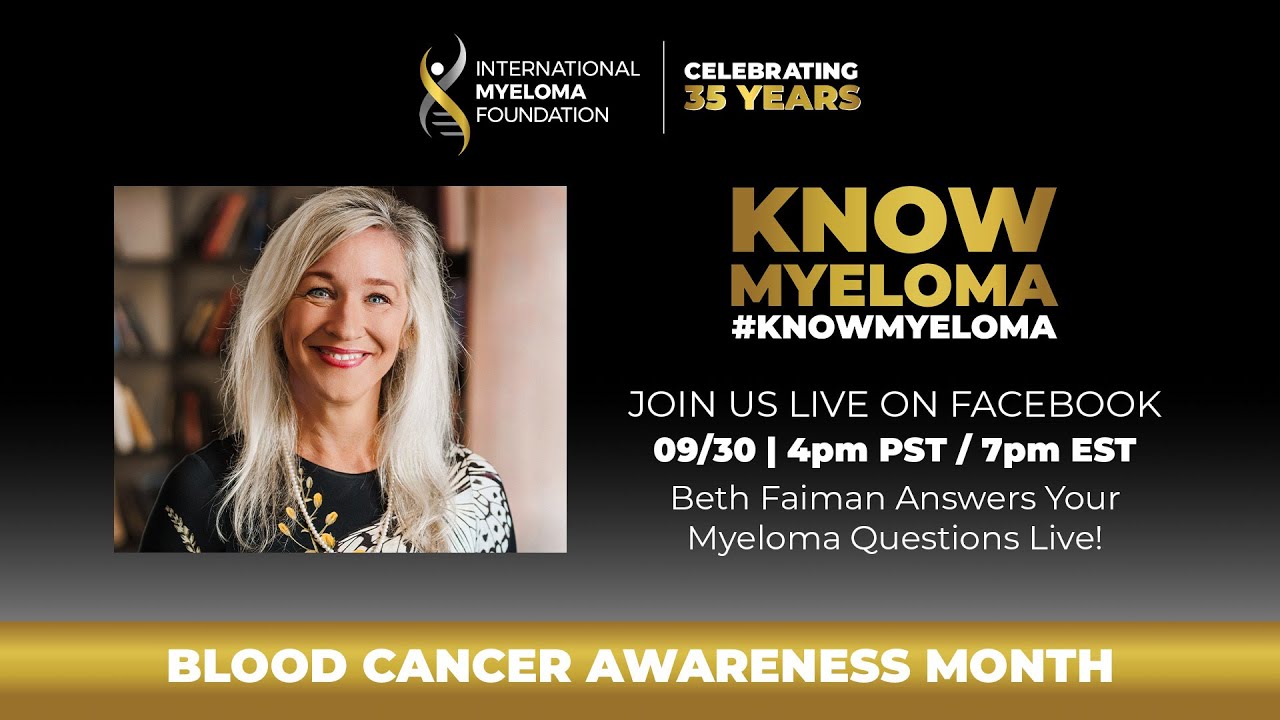
Yeah. We are here for the Facebook Live. September is Blood Cancer Awareness Month. Every September we shed light on blood cancers, and a part of this month, I'd like you to ask you anything you can about multiple myeloma and hopefully this will encourage you to raise awareness for others. I'm also going to be sharing some insights from our recent International Myeloma Society meeting that took place in Toronto, Canada, September 17th to the 20th. So if anything is exciting to you or if you hear of anything or have any questions regarding that, then absolutely please let me know.
Okay. So let's just give it another minute. We did start a little bit late so I really appreciate your patience here. I joined in a little bit earlier because I didn't want any technical difficulties, but this is what happened. So, looking for some comments. I don't hear any comments. Let me see if I click over here and view some insights. Okay. I'm going to go to my phone here and see if I can go on my live Facebook feed here and see if I can find anything. There's a lot that goes on in these Facebook Lives. Oh, gosh, I'm going to be able to do this. You have a lot going on here.
There's some comments going on here. Where's my feed? Where's my chat? So I'm looking for my feed. Okay. Just bear with me for one moment. Let me change and X this out. Perfect. I see some familiar faces here, some familiar names. There you are. Great. All right. Oh, I'm so excited. So, this is working. There's my chat. It's like this is the first time I've done this, right? All right. Thank you so much for saying we can hear you and then I couldn't hear myself.
Okay. Let's just get started about talking about updates from the International Myeloma Society meeting. I was so thrilled to have the opportunity to join again. I was the founder of our first nursing and allied health meeting in 2013 Kyoto, and we ran our ninth meeting in the nursing and this was the 22nd meeting. It used to be every other year, but now it's every year. It's so hard to find practice changing papers that really can influence what we do every day as myeloma clinicians, but I'm so excited to see all of the updates with the bispecifics and the CAR T-cell therapies.
The CAR T-cell therapies are now moving into the front line with newly diagnosed patients. There was a really exciting paper that I liked. There's a drug called cevostamab. It's an FcRH5 bispecific antibody, different from the BCMA CAR Ts, different from the BCMA bispecific antibodies we already have. I was really excited to see some early data that showed that when patients got the CAR T-cell therapy, then you can stay in remission called consolidations. So they gave the CAR T and then they chased it with this bispecific antibody with a different target. What they're seeing early on in this trial is that there's no new safety signals and patients are getting really, really deep responses that MRD negative response that we're looking for where you can find one in a million plasma cells. So, stay tuned for that. That was one of the very exciting things that I saw coming up.
Let's go to the chat for just a few moments and see if we can see anything in there. Okay. Oh, we have Julie from Kansas. Hi, Julie. Gloria is in a partial remission. Does it usually last long? Well, hopefully, I'll tell you that some people can have really amazing responses to drugs and it takes a lot of consideration. So when we say, "Is this remission going to last?" we take into consideration what kind of medicines did you get to get you into this remission? What is the risk of the myeloma? Do you have this high-risk status or low-risk status?
There was a new definition that was just presented in June of this year for high-risk myeloma. Now, fortunately, most people have "standard myeloma," so you should respond to a lot of the drugs that we have available. But for those of you that are high-risk myeloma, you can still have good responses. Again, newly diagnosed, relapsed and other health conditions all factor into how long this remission will last, but I would just talk with your doctor, your healthcare team to learn more about the disease biology. Track your labs, and then of course, going to the International Myeloma Foundation is really important as well.
Hi, Nick from Melbourne, Australia. I was there a few years ago and I'd love to come back and you'd have to say hi to me if I make it all the way over there. What a great trip. Laurie says, "I have six bone lesions. The bone marrow biopsy indicates only 8% myeloma. Does this happen frequently?" I think, yes. So the answer is that bone marrow is patchy and so sometimes you don't have a lot of bad cells in the bone marrow, but those myeloma cells that are there want to latch onto the bone, and so you want to make sure that these bone lesions are actually for myeloma, especially if there's only 8% in the bone marrow. So again, talking with your doctor about how they diagnose and are you sure these bone lesions are from myeloma just because you have a protein in your blood and make sure that you feel comfortable with the discussions you're having, whether you just started treatment or you're embarking on treatment.
Again, try to be an active member of your healthcare team and ask them questions. I do have quite a few people with a small percentage of plasma cells and sometimes it's because bone marrows are patchy, right? Proteins are sticky and they congregate together. So sometimes where the needle went, you might have just a small population, but if you go next door to where those plasma cells where you might have 20 to 30%. So it's different for everybody. Years ago, we would sometimes do bilateral bone marrow biopsies where you go one on each side to look for how many plasma cells are there. We don't do that anymore because it's too painful and it didn't make a big difference into how we treated patients. But again, talk with your doctor and see what they have to say about that.
Diane says, "My husband had a severe reaction to Revlimid and Pomalyst and said he has other drugs, but those seem to be the best. What can we look forward to?" Well, drugs like the immunomodulatory drugs such as Revlimid and Pomalyst are very effective at treating myeloma cells, but now we have newer ones coming out. At the meeting that I was just at, we had some updates on some of the drugs. There's iberdomide as newer classic drugs. It's called a cereblon inhibitor. It's a pill still, and it works very similarly, but a little bit differently than the Revlimid and the Pomalyst and the old one thalidomide. So, stay tuned. That one and mezigdomide are some newer ones that are coming out. Will he have a rash from that? Sometimes I have to give it very slow, low dose, every other day and with some prednisone and then eventually that rash goes away. But working really closely with your doctor and your healthcare team might get him to tolerate that medicine. But again, there are some other good medicines that are available.
"I am in remission and I trust my oncologist." That's wonderful news. I see Darius from Florida. "How are things in Cleveland?" Well, we lost the baseball game today to the Detroit Tigers, but other than that, things are great in Cleveland, so thank you for asking. We are in the playoffs. Let's see what else here. "Do you provide algorithm, secure myeloma patients in remission with MRD negative over two or five years or 10 years longer?" Oh, that's a great question. So we have some really mature studies that are becoming more mature. There's a PERSEUS study with newly diagnosed myeloma patients with daratumumab or bortezomib, lenalidomide and dexamethasone, four drugs. Those patients got transplanted and then we looked at MRD status. Then there's another one called the CEPHEUS study, which were patients that couldn't have transplant. There's also anti-CD38 combinations with drugs like isatuximab, which is a different cousin to the daratumumab.
What we're learning through research is that it's this sustained MRD negative status that is important. Yes, it's nice to get MRD negative where you have one in a million plasma cells or 10 of the minus five, 10 of the minus six is what we look at in research, depending on your country, because UK and Europe, they go to 10 of the minus five. Usually, we go to 10 of the minus six. But at any rate, we're learning that if you can keep that MRD negative status and hopefully over time we might be able to change therapy. Right now, it's just still investigational. So when I think you're asking about the algorithms, is it predicting with a model or a calculator if we can stop treatment or change treatment? The answer is not. Right now, outside of a clinical trial, we're just collecting the information, but hopefully we're going to see that patients are staying in this minimal residual disease, very few percentage of plasma cells and then maybe we can stop treatment.
Another question about lenalidomide rash. This has been a hot topic in this Facebook chat. So again, the lenalidomide rash is a real thing. I've been fortunate. Since 2002 and 2003 I've been using lenalidomide in clinical trials, so I have over... What is that? 23 years of experience in patients with lenalidomide, and especially earlier on, we didn't really understand how important it was to control the rash and it can be very severe and itchy and annoying. I use a lot of antihistamines in patients non-sedating like loratadine or Claritin. Then also, we have to balance with a little bit of prednisone, not the dexamethasone that you would use for your weekly treatments, but in between you have to do five or 10 milligrams. Low-dose prednisone is what I do in my practice and sensitize a person, and I've had some really good successes.
There's only been a handful of people in my 25-plus years of working with these types of drugs, the lenalidomide is first and then lenalidomide or Revlimid, I only have a handful of patients that actually could not take it, really Benadryl, creatine, antihistamines, low doses of prednisone or Medrol dose packs, and then over time your body gets kind of sensitized to it. Sometimes people still have an itchy scalp, but usually most people can do it. So work with your treating oncology team. Okay. Oh, so many great questions in here. I don't even know where to start. Yes, the replay will be here later. "Is hair loss come on Pomalyst?" It is not a very common side effect of Pomalyst. We have drugs like cyclophosphamide or Cytoxan, melphalan, those classes of drugs with chemo drugs, but I do see a lot of hair thinning with some of the anti-myeloma therapies.
Now, that can be hormone related too. So I always make sure that I check people's thyroid hormones if they're having some hair loss. I also make sure that they're on good B vitamins. Biotin is for hair, skin, and nails. So talk to your provider about whether or not that's safe for you to take. It's generally safe and doesn't interact with a lot of different medications. So biotin, hair, skin and nails is over the counter. You can get it at Amazon in bulk. Over time, it can really help thicken your hair and stop the thinning as long as we rule out other reasons why your hair is thinning. I've also seen patients go to the dermatologist because there's other reasons why people have hair thinning.
Let's see here. "My platelets are always low due to lenalidomide." I'm so sorry to hear that they're running low, but usually if they're a little low, that's okay. We want them to be 50 to 100,000 or higher if we can, but we just have to check their blood counts regularly. Other medications can cause the platelets to go low as well, but this is called thrombocytopenia and it's a very common side effect of medications. I always in my practice will look at the dose of lenalidomide because you don't have to be on a high dose of lenalidomide in maintenance if this is a maintenance phase.
10 to 15 milligrams is fine, but I have people that are on five milligrams or even 2.5 milligrams a day that are able to control the myeloma and not have really, really low platelets. But if your platelets are still going low, then your doctor might want to do additional testing to figure out why they're so low if they are between that 50 and 100,000 range. If you've had a transplant, sometimes people after a transplant, we gave a high dose of chemo called melphalan and then sometimes that recovery can take a while. So there's a lot of different reasons why you might have that.
Okay. I was going to talk about some updates. I shared with you my cevostamab, that was really exciting, but there's just so many questions. Oh, the trispecific antibodies, that was a really exciting topic of discussion at the International Myeloma Society meeting in Toronto. So we have BCMA, which is our bispecific antibody that's currently available and CD38 which is a different kind of an antibody, as well as the CD3. So we're seeing really impressive response rates, not a lot of side effects or toxicities. So this is hopefully going to be something in clinical trials near you that might be right for you down the road or a loved one.
Okay. Let's see. "Is it possible to have acupunctures to prevent neuropathy weekly?" The answer is I really like acupuncture for neuropathy, not only prevention but treatment. MD Anderson actually 20 years or so ago had quite a few studies in neuropathy. We used drugs like bortezomib or Velcade in higher doses and twice weekly in IV and we used thalidomide. Before we had all these effective treatments, we really did a disservice. I hate to say that to our patients. We had these great drugs and we didn't know the right way of using it. Now, we know weekly bortezomib or Velcade is the way to go. We don't use thalidomide any more except for short term and in certain situations. But acupuncture has been shown to help stimulate the nerve endings and treat neuropathy in a bunch of different causes.
I also like to maximize and know what the B vitamins are, nerve protective vitamins. So you might be low on B vitamins. Thyroid problems might be a reason why you're having neuropathy. And then the other thing is diabetes. So the steroids that we give you to treat the myeloma so effectively, it blocks this chemical called IL6 that the myeloma cells need to grow. So we give you these steroids to help the treatment work better. But unfortunately, it can raise your blood sugar levels, and in raising the blood sugar levels, it can cause some neuropathy symptoms. So yes, you can use it to prevent the neuropathy, but there isn't a lot of research. It says it absolutely works, but it's not going to hurt you.
"My oncologist told me to get a COVID shot and we'll get flu shot in November." Kathy, that's a great recommendation. I think immunizations are a tough topic. I will be doing a living well webinar in October with Dr. Shahid from Memorial Sloan Kettering. She's an infectious disease specialist and she has an expertise in multiple myeloma. She and I are going to be talking all about infection prevention, how to protect yourself. I am recommending October and November In Cleveland because that's where the flu season starts and then also the COVID vaccine once a year.
"Is there a thyroid myeloma connection?" Barbara, that's a great question because we don't know that there's a thyroid myeloma connection, but we do see that Revlimid in some cases and in earlier trials we had to check the thyroid every three months. There could be some thyroid dysfunction with Revlimid. So I screen my patients that don't have primary care providers regularly with thyroid testing if they have fatigue or waking or just not feeling well. Sometimes I'll throw in a thyroid screen or make sure that they've had a thyroid screen with a serum T, blood TSH level. At least annually it's recommended, and that brings up another good important topic.
We had a lot of discussions at our Myeloma Society meeting in Toronto last month, or actually this month, earlier this month, about the importance of survivorship. Survivorship starts a diagnosis. Once you're diagnosed with Myeloma, we're giving you all these treatments that could put you at an increased risk for second cancers or other conditions, high blood pressure, high blood sugars, and that's perfect for the primary care provider to help us monitor and manage. So if you don't have a primary care provider that you know and trust that can do those other health screenings, maybe you should try to seek one out that can partner with your oncology team. I do a lot of this on myeloma, but I really encourage them to partner because not only are the oncologists going to be able to work with the internal medicine or primary care providers, but you'll be helping them out because they'll know more about myeloma as well.
Oh, hi, Helen from Canada. I'm so excited to see that you're just started on selinexor and bortezomib. This is a great regimen. Selinexor is a pill. The selinexor pill used to be in higher doses before, but it's very effective and we think that selinexor can enhance T-cell activity. One of the things we worry about with these bispecific antibody, T-cell engagers in the CAR T-cell therapies, they're engaging your T-cell to be fighters, but sometimes they get tired. So selinexor, there's some research that it can strengthen your T-cell. I'm happy to see, Helen, that you started the selinexor. If you have any stomach upset, taking it with food is good. It's just once a week usually. You should be able to tolerate it quite well with the bortezomib or Velcade.
Going back to dara is a tough question. Depending on where you are and what province, there's certain recommendations for what's funded on the health system. So you might be able to get access to it down the road, but for right now, you have to follow that algorithm and what's funded in your province. So, I would talk to your provider, but yes, there are certain situations where you would be able to go back to dexamethasone. Oh, Kathy says that her shampoo conditioner, her hair's like straw. Just trying to do less often hair washing and deep conditioning once a week I think is something that a lot of people will try. Definitely, ask for a dermatology consult too, if you had wanted to in your special situation, access a dermatologist in many areas you might have that available to you.
"What is your experience with Xpovio?" Cathleen, that's also called selinexor and we just talked about it. It sounds like your son was recently put on this and don't care much about it's used. Again, it's an under-appreciated drug in my opinion. I use it quite a bit as a bridge to CAR T or a bridge to bispecific antibodies, but it's also very good in combination with bortezomib. It's FDA approved in the US with, but we have some studies with pomalidomide and bortezomib as well, but it can be very effective at treating the myeloma and keeping things quiet.
So, let's see what else? Oh, my gosh, it's going so bad. I was just telling the IMF people how fast this goes. I could be on here for literally three hours, so they should do a three-hour Facebook Live next time with me. One more thing, one more question and then we can always put things in the chat. How often is it recommended to have a PET, CT or MRI during maintenance? It depends on your provider and what they think. The International Myeloma Working Group guidelines on the management of bone disease tend to recommend every one to two years whole bone imaging and it's either with a PET, CT or a whole body low-dose CT scan, and some people can access MRI. A lot of it is insurance driven.Then the other thing is the bone neurobiopsy is really dependent on the centers. Now, we are learning so much more about MRD negative status. A lot of the centers are looking for serial MRD negativity with monthly, not monthly, annual, every year MRD testing and looking at the bone neuro microenvironment looking for bad changes, new changes, and all these changes that we can address.
Oh, my gosh, it's 7:29. I think I'm supposed to close it now. Oh, I have so many more comments I want to get to. I do want to take a moment though to thank our Blood Cancer Awareness Month supporters, Adaptive Biotechnology, Bristol Myers Squibb, GSK, Johnson and Johnson, Karyopharm Therapeutics, Pfizer, The Binding Site, Regeneron and Sanofi, and here's your call to action, right? So, thank you so much for joining this Facebook Live and thank you for spending this time with me. You could do anything in the world and you came here and so I really appreciate you to come to get some answers to your questions.
But during the month of September and today's the last day, so before you log off of Facebook, raise awareness. Do a #knowmyeloma. It's the hashtag K-N-O-W myeloma and tag the International Myeloma Foundation. Raise awareness about blood cancers and maybe more people will be aware of the back and bone pain and fatigue and common symptoms that lead to the diagnosis. So again, before you go, go to the IMF Facebook page, share one of our facts and stats or educational videos to your feed and then hopefully you're going to increase the knowledge so somebody can be more educated on the other end.
With that, it's 7:30 Eastern Time and I had a great time with you. So please reach out if you have any questions or concerns they have. The info line is there for you. Go to myeloma.org. Don't forget about Myelo. He's a chatbot that responds to you in any language, anything you want, and it's valuable information and it's valid information from the IMF website. With that, I wish you all a good day, good evening, wherever you are. Thank you.

