

Relapsed Multiple Myeloma Treatment: Long-Term Insights from GMMG Phase III Trial Comparing Salvage Autologous Transplant and Lenalidomide Maintenance to Continuous Lenalidomide/Dexamethasone
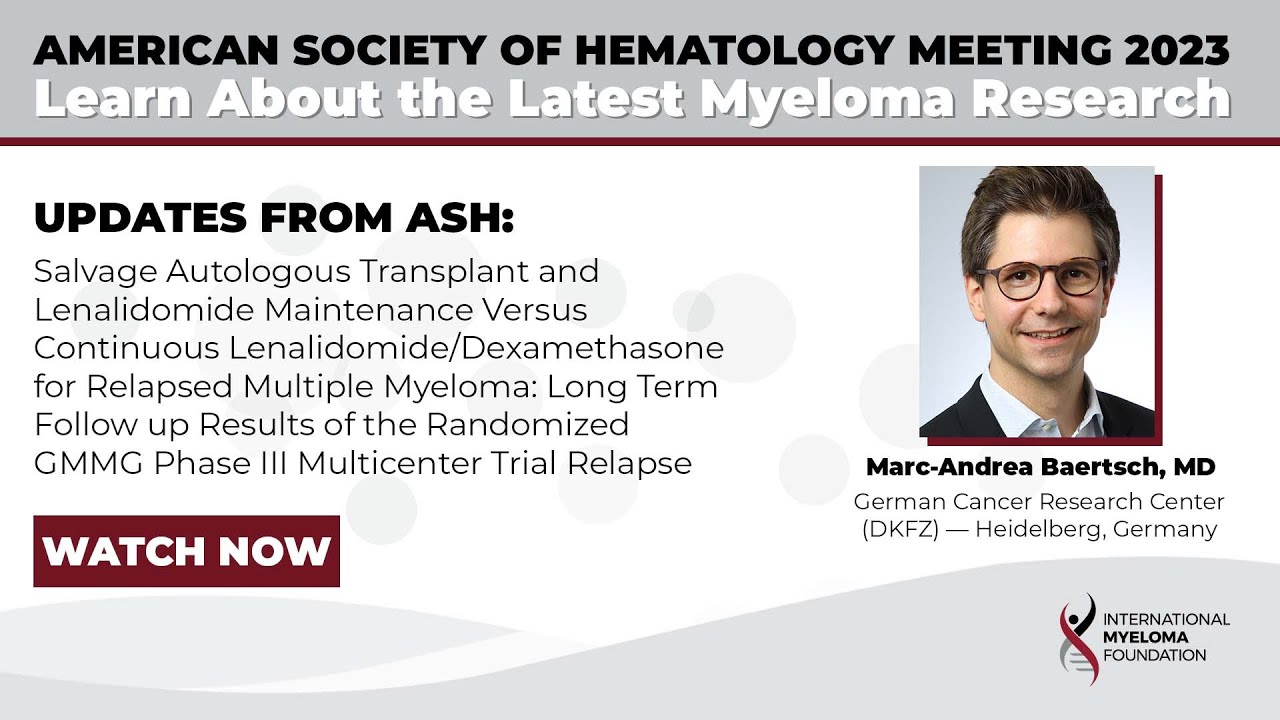
Dr. Marc-Andrea Baertsch reports on long-term, follow-up results from the GMMG ReLApsE trial.
Abstract Title:
Salvage Autologous Transplant and Lenalidomide Maintenance Versus Continuous Lenalidomide/Dexamethasone for Relapsed Multiple Myeloma: Long Term Follow up Results of the Randomized GMMG Phase III Multicenter Trial Relapse
What is the purpose of this trial?
This trial, known as the GMMG ReLApsE trial, aimed to evaluate different treatment strategies for individuals with relapsed multiple myeloma. Specifically, the study compared the effectiveness of two approaches: continuous Revlimid (lenalidomide) and dexamethasone (Rd) treatment and a combination of lenalidomide re-induction, salvage high-dose chemotherapy, autologous stem cell transplantation (HDCT/ASCT), and lenalidomide maintenance (R). The primary analysis did not show a significant survival benefit. However, further examination through landmark analyses, especially in patients who underwent salvage HDCT/ASCT, suggested a potential survival advantage.
This report presents the long-term follow-up results of the GMMG ReLApsE trial, shedding light on the outcomes of these treatment strategies over an extended period. The aim is to provide valuable insights into the effectiveness and impact on survival, particularly for those who underwent salvage HDCT/ASCT, contributing to the ongoing understanding of optimal approaches for managing relapsed multiple myeloma.
In this video:
Marc-Andrea Baertsch, MD, (Heidelberg University — Heidelberg, Germany) reports on long-term, follow-up results from the GMMG ReLApsE trial.
Conclusion:
The GMMG ReLApsE trial, the sole randomized and controlled study comparing salvage HDCT/ASCT with ongoing novel agent treatment, reveals, upon extended follow-up, an absence of significant differences in progression-free survival (PFS) or overall survival (OS) within the entire trial cohort. Notably, the previously noted survival advantage observed in patients who underwent salvage HDCT/ASCT is not validated.
Despite time to progression after frontline HDCT/ASCT being a common parameter for stratifying salvage HDCT/ASCT in clinical practice and serving as a general prognostic factor for PFS, it did not show itself to be a reliable predictor of the benefit derived from salvage HDCT/ASCT versus continuous Rd treatment. Consequently, the findings from the GMMG ReLApsE trial do not endorse the use of salvage HDCT/ASCT as a beneficial approach for individuals with relapsed or refractory multiple myeloma.
Trial Information: Abstract #782
Doctor Bio:
Marc Andrea Baertsch, MD, is an academic researcher from Heidelberg University in Heidelberg, Germany.