



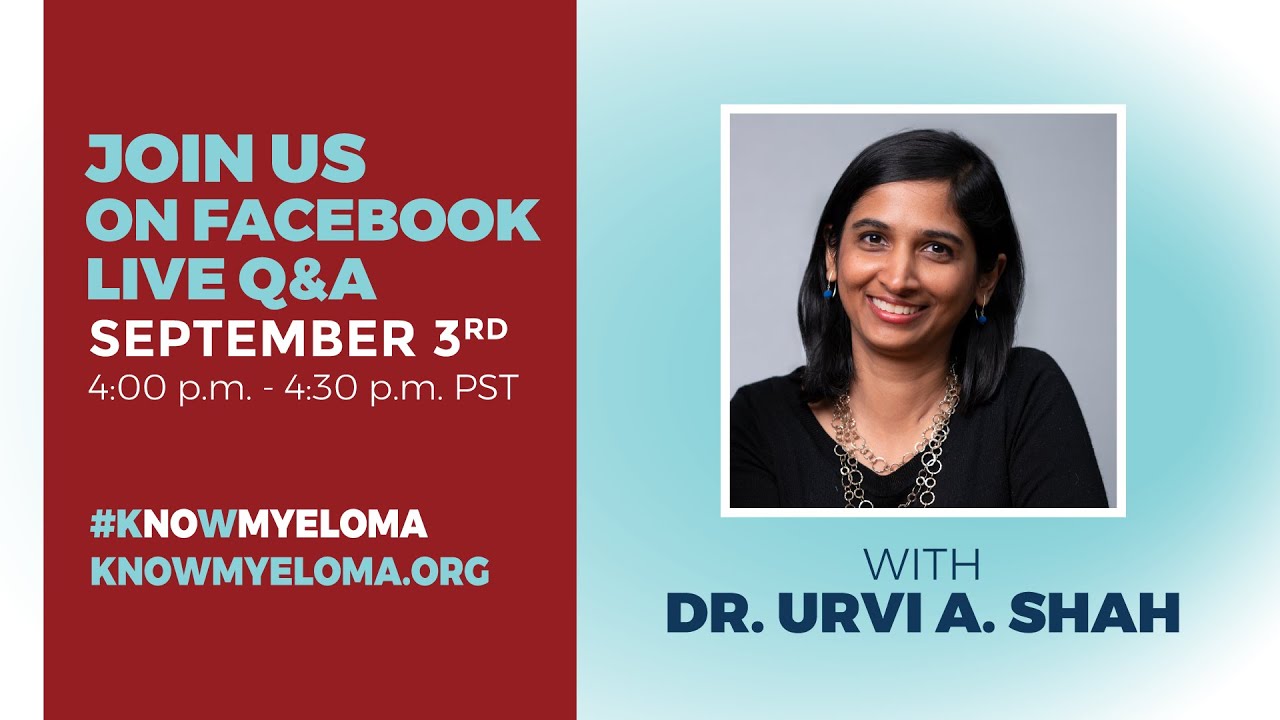
Dr. Urvi A. Shah:
Hi, everyone. Good afternoon to some and good evening to others. This September is Blood Cancer Awareness Month. Do you know myeloma for Blood Cancer Awareness Month 2024, the IMF goal is to put a spotlight on myeloma, the second most common blood cancer in the world and bring awareness to this through the social awareness campaign?
It's great to see some of you joining. Why don't you post where you're coming from and your name, and maybe one health food that you would like? It's great to see you all. Again, I know we had done one a few months ago in March and it's nice to be doing this again with you all.
So, every September we urge you to raise awareness about myeloma by sharing posts from the IMF and bringing awareness to this disease, given that a lot of people don't really know about myeloma. They know about lymphoma, they know about leukemia. But myeloma is one that somehow, people don't know until they've heard of it where somebody's got diagnosed. And you can use the hashtag #knowmyeloma KNOWMYELOMA to share more about it.
Today I'll be answering questions, both about myeloma and nutrition. And put your comments into the chat. It's great to see, I see Lynn from Georgia.
Use the #knowmyeloma to share more about. Put your comments into the chat. It is great to see Lynn...
Not sure what happened there, but I think we're sorted.
So, I am a hematologist oncologist. I work at Memorial Sloan Kettering Cancer Center. I have a focus on my research and nutrition and other modifiable risk factors, and how these affect cancer, especially myeloma. We're doing a lot of dietary interventional trials to understand this.
I see quite a few of you joining. I see Mindy, I see Long from Maryland and Maria from Denver. Maybe also could you add what's one of the health foods you like? I see Sandra said various greens. That's amazing. Recently, I started thinking about also greens and thinking, "How do I ensure that I'm getting enough leafy greens a day?" Because sometimes you may not have time to make a salad. And I figured sometimes just blending a lot of greens into a smoothie can very quickly get you the greens you need with not needing to spend that time chewing all of it too. So, I think that's one good way to think about greens.
One of my favorite health foods I would say is tofu. And that's probably because one is, it's high in fiber. Two, it's high in protein, rich in flavonoids too. It's a bean, so I think that's great.
I see kombucha from Mindy. That's amazing. That's a fermented food, so we really like that too. I also see grilled asparagus from Jason. Asparagus is really, really one of the health foods too. And when you think about cruciferous vegetables like broccoli and cauliflower, Brussels sprouts, these are considered to have sulforaphane which have anti-cancer effects. So, they are really considered very important and good to get regularly in your diet.
I also have a couple of other things to just let you know, is that throughout this time we will answer questions based on what you bring up and you ask me in the chat. So, feel free to start asking questions as well.
Almonds are great. And I love that you said raw and organic, Gene. Because often people will have almonds which are either salted or sugar-coated. And then that loses the benefit when you're having so much sugar with it too. But if you're getting nuts and seeds daily, they are longevity foods. Lots of studies have shown that people who eat a quarter cup of nuts or a small amount of nuts daily tend to be living longer as well. And they're good sources of unsaturated fats and minerals and things like that too.
I see we have lentils and squash. That's amazing too. Lentils are great for a good source of protein and fiber. Sometimes people feel like they might be challenging to digest. And I think that's something you have to just soak overnight, if you feel like that's an issue. Sometimes sprouting lentils can help with digestion better too, figuring out how to sprout them.
I like that Peter said salad with many colors because that's another thing where you want the variety. Remember in some of the talks I've talked about, studies have shown more than 30 types of plant foods per week are associated with better microbiome composition. So if you get a salad in with many different colors, you're already halfway there, if you have five or 10 vegetables in that salad.
Another question was organic popcorn made with olive oil. That's amazing. So people don't think about this, but organic popcorn is technically a whole grain, so whether organic or not, but popcorn is a whole grain. And so when you're eating popcorn, the bad part of it is the butter and the salt and the sugar we add. But if you're just eating it lightly salted or with some spices and herbs, it's actually a very healthy food. So, that's amazing.
I also see wild-caught salmon, sweet potatoes. That's great. Sweet potatoes also is another food that has a lot of beta-carotene and is really healthy in terms of blood sugar control and things too, which people don't think about. But getting sweet potatoes is another thing. And actually sweet potatoes are not really my favorite, but I've tried to start incorporating them more regularly and buy them, otherwise I would generally avoid them. But I think it is a good food to eat, and I'm glad some of you are thinking about it.
So, why don't we go ahead with some questions? If you all have, please share them in the chat. And in the meantime, maybe I'll start with talking a little bit about fiber and what we know about it. I think that's a good topic.
And before that, I see a question about microgreens, kale, and broccoli. I think microgreens are excellent. When you think about sprouting or the baby greens, they often have more of the nutrients because they are the small shoots. And I think that it is a good thing to eat. So if you can sprout or get those greens regularly in, that's really good.
In terms of fasting, I see a question. Sandra asked, "Do you see value in fasting along with a fabulous diet?" I fast two times a month for 36 hours. I understand autophagy controls occurs after 18 hours. My response to [inaudible 00:07:27] therapy has been very good. Don't know if fasting played a part."
There have been studies, one study recently looked at something called a fasting-mimicking diet. And in that study with every cycle of chemotherapy... And this was not in myeloma, these were solid tumors, so like breast cancer and prostate cancer and other cancers. And for every cycle of chemotherapy for five days, they would do something called a fasting-mimicking diet, meaning it was a very low-calorie plant-based diet. But very low, like 500 calories and less for five days. And the rest of the days they would eat whatever they wanted. But those five days they would eat very little. They did see that there was a boost in the immune system for those patients. However, because the study's not large enough and it was more heterogeneous in terms of the group of sample, it's hard to tell whether it really helped with improving response in that study.
So, I think that fasting may have benefits in some of these situations, but it has to be thought of in a very well-planned manner. Because while you're going through chemotherapy, it's also important to get enough calories and nutrients, and not lead to more weight loss or things like that. Where it's unintentional, weight loss is also an issue.
I see a question from Ahkila about, "What are your thoughts about kefir?" And I think kefir is fermented, so it is healthy and it's good. There's a study looking at about 18 individuals were asked to have fermented foods about five to six servings a day. And then they looked at microbiome and immune changes. And they saw that actually the microbiome had more diversity and the immune system was less inflamed or anti-inflammatory, suggesting that fermented foods are good for you.
Kefir can be for dairy, but it can also be non-dairy based. You can get coconut milk kefir as well. And then there are, I think maybe in the chat, if some of you can post, what are fermented foods you like to eat? So, I think sauerkraut is one that's really good. Kimchi is another one. Miso, nattō. These are ones that people don't think about. When we think about fermented, we're always thinking yogurt.
I see a lot of questions about seafood. And I think in general when you think about diet, you're always thinking about, what are you replacing it with and what are you eating it with? And this is what Dr. Christopher Gardner usually talks about. He's a nutrition scientist at Stanford. So what you're eating it with, meaning, like we talked about popcorn, are you having the popcorn with lots of butter or are you having it lightly salted? And what you are eating it instead of is always like what you're replacing it with. So if you're replacing red meat with salmon, that's very healthy and much better. But maybe if you're only eating salmon all the time and not eating the fiber rich foods because fish doesn't have any fiber, then it's less healthy.
So, I think it comes in the context of that. A few times a week is probably good or fine. It does have the omega-3 fats and the vitamin D. The only challenge is the microplastic contamination. So the wild caught has the benefit of omega-3, but it also has the microplastic issue and risk. And the ones that are farmed often are with lots of antibiotic exposure and things like that. So, that's the challenge. So, I would say few times a week is something that probably is healthy. But all the time, then you're probably not getting enough fiber in your diet too.
Tempeh is great. That's another good fermented food, if you can enjoy it or like it. I know it's an acquired taste for some, but it is a healthy fermented food.
Stacy says, "I find it hard to get really balanced healthy foods when my treatment side effects cause stomach upset. Any recommendations for more healthy options that won't make it worse? I'm sensitive to dairy."
So you're not alone in being sensitive to dairy. I've said this before, actually almost 70% of the population is lactose intolerant. And as we grow older, it gets worse sometimes. And also, it is something that probably with chemotherapy and things, we probably make it worse too. There are a lot of alternatives in terms of dairy like soy milk, which has enough protein. And many of them are fortified as well with calcium. So I think there are good options, if you are sensitive to dairy. And I think they're probably healthier options than dairy too.
And when you think about if your stomach's upset, thinking about one thing is, if you're not able to get enough calories and thinking about a smoothie with... What I like to do with smoothies is often blend in silken tofu, half a slab or a full slab, depending on how much I'm making. That silken tofu adds the fiber, it adds some protein, and it gives the creaminess to it. So I don't really need to add any milk to it because the tofu that you blend in the silken tofu kind of adds the milk part to it. And then you can do lots of greens and vegetables like beets, carrots, things like that too, if you like them. I love putting mint in there too, ginger as well. Those are two of my favorite things to add to a smoothie. I think everyone's different, but those are some things. And when you do that, then even if your stomach's not able to handle maybe eating too much this way, you can get in enough calories. So, that's one option.
Another thing is seeing what works for you. Fermented foods seem to help quite a bit with digestion. So if you want to think about fermented foods where when you are feeling that way you try having a little bit of sauerkraut with every meal or five, six times a day, a spoon of it. You can see if that helps your digestion too.
I think that there's another thing about fermented foods is when you buy them, you want to look at the label and see that they have live and active cultures. Because sometimes we think like, "Oh, pickles are fermented.", but they might just be in vinegar water and there's no fermentation in there. So, one thing is fermented foods usually will be in the refrigerated section of the grocery store. You're not going to find them in the room temperature section because these bacteria need to live. So, some of those things are important to look at when you're buying it.
Peter is asking, "What's a good way to start the day with food? I usually try to start with oatmeal and berries. Is that a good thing to kick off the day?" I think that's excellent. Oatmeal is good in fiber. It also has some protein. When you have that with berries, you're getting the fruit and the antioxidants. Another thing you can add is nuts and seeds. Nuts and seeds like pumpkin seeds, walnuts, flax seeds, chia seeds, all of those things. And it's sometimes easy to make because you can make it for a few days, if you soak overnight. And then you have that ready and you don't have to plan each day as well. So, that can sometimes work.
When I'm going to work and I know I have a busy day at work, I'll often make a bowl of oats with chia seeds or fruit, depending on what I have available. And then I take that to work. So, it's easy for me to just eat while I'm there because it's ready to go.
Other things I think is monk fruit or for sugar supplements. Again, it's hard because these artificial sweeteners, there is mixed data around them. Some people switching from sugar if they're addicted to sugar and having sugary drinks and beverages and switching to artificially sweetened may actually find that they lose weight and they feel better on it. But I think that they're still got some... Some studies show that people don't really lose as much weight. Or there are maybe potential risk for slight increased risk of cancer with some of these artificially sweetened.
So in general, I would say it's best to avoid it. And if you can use naturally sweetened things, like if you're making something put dates or put dried fruits or things like that, that could be things that you could add to it. And if you want to bake a cake or something, maybe use half the sugar that the recipe requires. Or maybe put in a banana if you think that it's a banana bread or something like that. So, those kinds of ways could have you reduce the amount of sugar that you're taking in.
The average person in the U.S. takes in about 17 to 19 teaspoons of added sugar a day. And many don't even know that they're doing it because it all comes in hidden form in terms of a drink that they're having, or it's in the cereal you are having or the bread you are buying. So if you just keep an eye on looking at added sugar, one teaspoon of sugar is about four grams of sugar. So if you see a label with saying one serving has eight grams, that's two teaspoons already. So if you want to stay at least below nine teaspoons per day if you can, that's probably best.
And I see a question about turmeric. Remember that turmeric is an herb or spice which people use in cooking. And curcumin is the active ingredient in turmeric. So, they're very different things when you're thinking about it. One is the actual natural root, the turmeric root. You can actually buy, the same way as you buy ginger, you can buy turmeric root. And sometimes I even cut pieces of turmeric and put that into a smoothie when I'm blending it. Because that way you're getting some of the natural root and these herbs and spices.
People cook with it. In Indian cooking, a lot of turmeric is used. But when we talk about in the studies that we're doing and many myeloma patients or smoldering myeloma take it because of the little bit of data that's there, that's curcumin. And curcumin is the active ingredient in turmeric and it's taken at much higher doses. So, it's the active ingredient. It doesn't have all the other things like oxalates and things which would be in the turmeric. But it's not in the curcumin, which is a purified form of the active ingredient.
Also, turmeric gets absorbed better with black pepper. So if you are cooking with black pepper and turmeric together, that's a good combination for absorption. However, turmeric is herb that doesn't get absorbed that well. So maybe some of its effects could be through the microbiome. And it's not just getting absorbed, but it could be right there that some of the effects are there. Whereas curcumin, because the doses are much higher and curcumin is often sold with BioPerine or black pepper in it, and that combination leads to better absorption, so you don't need to take as high doses.
Stacey's asking about probiotics and whether they would help with stomach issues. In general, I would say that if somebody has digestion issues, GI upset, or they've had recent antibiotics or their bacterial overgrowth or some medical condition that's leading to having chronic diarrhea and you try a probiotic and it helps you, then you could potentially take it for short periods during that period when you are having that transition.
The data with probiotics is very mixed. Some studies have shown that it is healthy in terms of it improves microbiome, but in others it maybe reduces diversity. And I think the reason is, one is that every probiotic has only very few strains. A probiotic will have five or 10 or 20 strains of bacteria. And maybe those bacteria are the ones that are missing from one person, person A, who it helps them. But person B tries that probiotic and it does nothing for them. So I think probiotics, sometimes you might need to see which one works for you because different ones have different strains of bacteria. But at the same time, I don't recommend probiotics across the board, because I don't think about it as a healthy supplement for everybody all the time. But if you have digestion issues and you feel like that's helping you have regular bowel movements, then that's a different issue. And maybe you consider it.
And I was just making slides for our talk I'm giving at the American College of Lifestyle Medicine and Society of Immunotherapy for Cancer. And I was looking up this study in skin cancer called melanoma, not myeloma. And they did a study with patients who are getting immune checkpoint blockers. Now we don't use those drugs in myeloma much, but with those drugs what they showed is those who had sufficient dietary fiber, meaning they were getting enough dietary fiber. They had the best progression-free survival. But if they were getting sufficient dietary fiber and also taking probiotics, actually their survival was worse and similar to those who are not getting enough fiber, similar to the insufficient fiber.
And then they looked at mouse models and they did this study in the mouse models too. And what they found was that actually the mice who got the probiotics had less microbiome diversity and less robust immune system to fight the cancer. So, the tumors grew faster in those mice. But this was for skin cancer and this was with checkpoint inhibitors. So it's only in that specific situation, but we don't have studies like that in myeloma that have looked at it specifically. So, it's hard for me to tell you.
But that's why I think I don't think we should just take it across the board because we think it's supposed to be healthy. But we should take it if we feel like we need it at that time. And I think better than that is, that's why taking foods that have written probiotics, that's probably much healthier. Because it comes with the fiber, the prebiotics, and all of that.
And another thing about probiotics, and this is if you are not eating a healthy diet, even if you're getting enough of these probiotics supplements, it is just going to go through as a passage through the bowels. It's not really going to stay around, for the most part, these probiotics. So unless you're taking them regularly, it's not like it's going to stick around. Because what is needed for the microbiome to change or stay is the change in what you're doing on a daily basis or the dietary changes.
The dose of curcumin, again, I don't recommend that patients take curcumin daily because we don't have enough evidence to say that it works. There are some side effects for some people like indigestion or nausea. And it is expensive to take these high doses. We are studying a dose of a gram twice a day with BioPerine. So, it is 1000 milligrams twice a day, curcumin with BioPerine five milligrams. But again, we're still studying it and we'll have data in a few years. I think that there is some anti-cancer, anti-inflammatory potential. Some people find that curcumin helps for joint pains. And I've seen people use it for that and find benefit.
Sabrina is asking about fresh aloe. I think that would be fine. I don't see why that's wrong or a reason to avoid it.
So as we're thinking about other things, I was recently reading up a little bit about supplements and one of the places you can look for information on supplements is Memorial Sloan Kettering has an app and also a website called About Herbs. And on that website, About Herbs, you can type in any herb you want and it will show you what the data is for that one, like, what are the side effects, what are the contraindications, what are the drug interactions? So, you can know if that's something that would work.
In general, I don't recommend supplements across the board. There are certain supplements that individuals need based on if their levels are low or things like that. One of them, again, I don't recommend this for everybody, but magnesium has got quite a bit of attention recently. And I think when we look at the population, it's thought to be about 40 to 50% of the general population is low in magnesium. And the reason they are low in magnesium is because foods rich in magnesium are things like chia seeds, pumpkin seeds, green vegetables, fruits, things like that. And most people are not getting enough fiber or plant foods, so they're probably not getting enough magnesium too.
And magnesium is important in many biochemical reactions, hundreds of them in our body. So, it is an important nutrient that we want to get enough of. So, I would recommend that people obviously get magnesium through their diet. But some people find that a magnesium supplement helps with sleep or with anxiety or with muscle cramps as well. And remember though, that if you have kidney failure, that's a supplement you would not take or you have to discuss with your doctor. Also, the interactions with other things.
Magnesium is also very important for bone health. I know we talk about calcium and we talk about if strength training are important and vitamin D. But magnesium is also important, because if we don't have enough magnesium, the body, to keep the levels in the blood okay, it's going to take it from the bones. And magnesium levels aren't a great predictor of actual body magnesium levels because our body is equilibrating or keeping the magnesium in the blood at a steady state. So unless there's a severe deficiency, the levels are often within the normal range. But if they're mild to moderate deficiencies, you're not going to see that in the blood.
What kind of magnesium is best to take for constipation? So yes, magnesium can help people have bowel movements or go because one of its side effects is diarrhea. In general, there are two types of magnesium salts that you would buy. It's organic or inorganic. The inorganic ones are things like magnesium oxide, magnesium sulfate. These tend to have less absorption and more risk of diarrhea. So, maybe they help a little more for constipation. I'm not sure. But the ones that are better absorbed and less discomfort on the GI tract are usually the inorganic ones. So, things like magnesium glycinate.
Kim is asking about CBD and THC for pain and inflammation. And what I'd say with that is that everybody's different. I found that some people find it really helps them and other people it does not, and they actually have side effects to these. So if you are somebody who tries it and you find that it helps you, then I think that that's something you can consider.
Another thing about magnesium is that deficiency for magnesium, it's more likely in people who have diabetes, in people who aren't eating enough fiber rich foods, in people who have diarrhea or chronic GI issues. So, those are situations in which you might. People who have frequent muscle cramps, that could be one cause of it too. So, things to think about. But again, if you're taking that, I would start at a very low dose because you don't want interaction. And you should discuss it with your doctor and see if it benefits you. If it doesn't, then maybe you would stop as well.
Another thing we can talk about is fiber. And oh, before we talk about fiber, actually I see Rosalind asked about how to begin eating vegetables for those who dislike them. It's a great question. I think starting small and gradually. I am a firm believer that our taste buds change with time. And often, we've grown up with a diet that our parents or somebody give us a lot of fast food or things to eat. So, our taste buds are used to that. And then it's very hard to suddenly now want to start eating healthy because you haven't grown up with it. And that's what happens because we have the kids' menu in most restaurants. And if you look at the kids' menu in the U.S. it's always pizza, chicken wings, and fries. So, we're not really helping children's taste buds or palette diversify and enjoy other foods. And that's a challenge when then people grow up and then they're used to certain foods.
So, I think starting small on the things you like. And remember since taste buds do change, it might be that the first week that you do it, you're like, "Oh, I'm not really enjoying it, but let me stick with it." And then you find that you slowly start craving those foods. I've seen people who hated beans and said they would never eat beans, and then started eating them. Initially was like, "Okay, this is okay.", and now crave them and want to eat them every week or almost every other day, or things like that. So, I've seen that.
From my own experience, if you asked me many years ago, "Would you ever eat celery or would you ever eat ginger?", I would've said probably no. I actually now would really enjoy the taste of ginger in many foods. But when I was younger, I did not. But I think that's come with an acquired taste over time. And I think that that comes for most food that way.
So it's hard for me to tell you which thing to start with, but I think you could think about what are the foods you really like or enjoy. And even if you don't like them, maybe take simpler foods, one or two, and then start adding on that a little bit. And another thing is spicing them or making them similar to what you anyways do enjoy. So if you like a certain chicken with a certain curry or sauce, then make that same thing with veggies instead. So, you start enjoying and making these slight changes over time.
Kim's asking about best plants and veggies to juice. And she makes daily kale, apple, cucumber, celery, carrots, spinach, blueberries. That sounds great. What I would say is that kale is a really great green leafy vegetable because it's high in calcium and many other nutrients. Spinach is also good. Just mixing it up is always nice when you get different greens. So making a smoothie with a base of a lot of greens, thinking about maybe tofu, which I talked about like silken tofu, soy milk so you're getting some of those beans and protein. Thinking about things like flaxseed, omega, chia seed, hemp seeds that will give you the omega-3s. So, you can put a few scoops of that in. And then you pick whichever vegetables, fruits you want to add in to get that slight sweetness.
And again, when somebody's starting out making it for the first time, you might be putting more fruits because you're not used to drinking a less smoothie or juice. But as your taste buds change, you might change to wanting it less sweet. And that's what's happened for me. When I would make these before, I would put very little greens and a lot of fruit many years ago. Now I put much more greens and less fruit, and it's just changed with time.
Beth's asking, "How many fruits and veggies a day would you suggest?" And I think that that's a tough question to say. I would say the more the merrier, as many as you can eat without stressing yourself out. I think that sometimes if you're just making things with diversity, you wouldn't even realize how many are getting.
Often, I'll have leftovers and things and put it together. So today morning for lunch, I kind of made tortillas. And I had beans, which from a can that I had opened, then I had guacamole left over. I had some boiled beets, I had some sautéed kale, and then some sliced tomatoes. I put that all into the tortilla and made like a wrap. So now that in itself, if you look already had five to six different Veggies. And then I also had bought those microgreens and I put that in as well. So easily, that one meal had six to seven different plant foods. And so it's very like, if you just have these different things ready in your refrigerator, it's a bit easier because you just pick them out and you put them together. And a lot of it is just putting things together as what's available in your fridge.
"I've been told it's always best to eat in season when possible." Yes, that is because usually that produces fresh, it's going to be cheaper, it's local, all of those reasons. If it's possible, that's great. Of course, it's sometimes hard. Remember also, frozen fruits and vegetables are equally nutritious if not more than fresh. So if you are somebody again, who only likes berries as fruit and won't eat what's in season like the stone fruit, it's fine. Get the berries. At least you're eating those and then you can blend them in or make something with that.
Sandra's asking what's the healthiest green in my opinion. And I think it's hard for me to pick one, but I think kale would be probably on the top of the list. Dandelion greens are supposed to have quite a bit of prebiotic fibers, so that would be good too.
Susan says, "Do pickles count as vegetables?" Yes, they do. And again, pickles can be a fermented food or they cannot be fermented food, depending on how you buy them. So if you buy pickles which are with live active cultures, then that's a fermented food. So, you'll get the added benefit of that too. If the pickles are just in vinegar and a pickled, then that would not.
Kombucha, Akhila is asking about kombucha. I think kombucha daily is fine. You just want to look at the sugar content of the kombucha you're drinking because many kombuchas are made with quite a bit of sugar. You want to, like I said, keep the sugar content low and reduce that. So while the fermentation part of kombucha is great and some people make it at home, I've never managed to do that yet. I've not had the time. But if you can get kombucha with less sugar, then that's definitely something good.
So with that, I think we're at the top of our time. And a few things I just wanted to mention. I want to thank you all for really staying and asking all these questions and participating. It's always fun to do this when people are interested in knowing.
One last question I'll take. Two questions I see here. One is from Davey who's asking, "What is the best diet for myeloma patients? Is it plant-based?" And when we talk about a healthy diet, whether it's myeloma or we talk about anybody without myeloma too, most healthy diets are plant-forward or plant-based, meaning that there are majority of calories coming from plant foods. The question is whether it's a hundred percent or whether they're doing 90% or 80%. But 80% and greater is where the majority of healthy diets are.
So whether it's for cardiovascular disease, whether it's for diabetes, whether it's for obesity, whether it's for cancer, the risk reduction for longevity, all of these consistently show the same dietary pattern. That's good news. You don't have to eat a different diet for one thing versus the other. But then maybe some things we need to tweak and individualize four different diseases and things. But I think overall, generally getting majority of your calories from unprocessed plant foods is going to be healthy, whatever your diagnosis is.
And I think so that's it. And with that, I'd like to just take a final moment to thank this year's Blood Cancer Awareness sponsors, Binding Site, Bristol Myers Squibb, GSK, Johnson & Johnson, Karyopharm, Pfizer, Regeneron, Sanofi, and Sebia.
I do post a bit on Instagram, LinkedIn, Facebook and Twitter. You can follow my #UrviShahMD. Also, definitely follow IMF. I've done a lot of talks for the IMF. I think they would've placed some of those talks in the chat, but I had done one last year. And then more recently for the Patient and Family seminar in LA where we talked about our latest results on the new intervention trial and also what we are currently doing in terms of research.
Of course, all of this is very, dietary research is hard to do for many reasons. And it's really not possible without funding and support. So I really thank you all for listening, and I'm happy to do more of these studies. It's just the limiting factor is getting funding to do them and having patients involved as well. So, hopefully we'll be able to do more in the future. And thank you all for listening and participating.

