


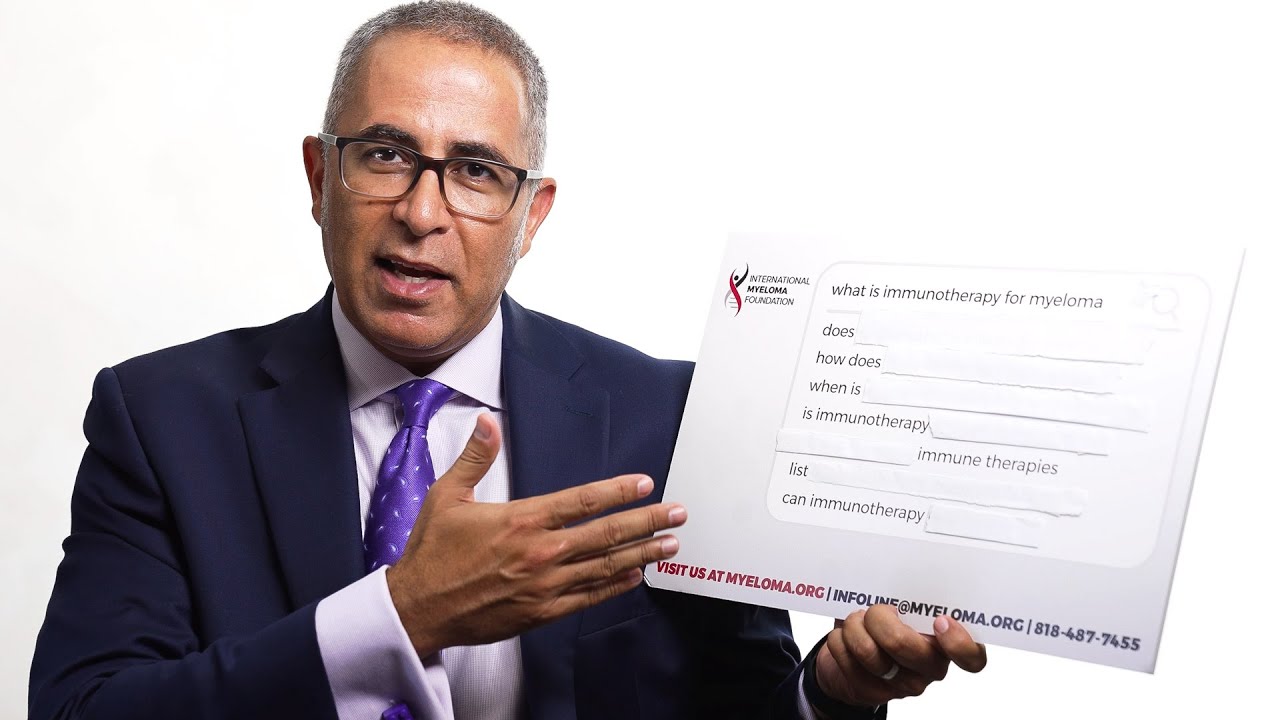
Dr. Joseph Mikhael: Peel this baby off. What is immunotherapy for myeloma?
Today we're going to talk about the most searched questions in myeloma and specifically the most searched questions about immunotherapy. The first question is, well, "Does immunotherapy work for myeloma?" Yes. Next question. I guess I should give a bit more detail. All right, so it does. To remind ourselves, immunotherapy is the concept of us employing a patient's own immune system to fight their myeloma. Now this is a little bit of irony in myeloma because remember myeloma is a cancer of the immune system, but the whole immune system is not affected by myeloma. Parts of it remain intact. The intact parts are what we use to help fight myeloma. This, as we've learned, is much better than just using external drugs as it were, or other treatments because your immune system is an incredible device and works in incredible ways. We know it's reliable because it's in you and this way it can attack myeloma.
So next one here. It says, "Well, how does immunotherapy fight cancer?" Well, this is where we started using immunotherapy in cancer, and now as I describe, I think myeloma's a perfect example of how we can use it. You can think of it this way. We harness the strength of the immune system now to attack someone's cancer so that the machinery that's built to attack, let's say an infection that you might get or some kind of insult to your body, your immune system is designed to fight it and to protect you. That's what the immune system concept is. So, now we can turn the tables a little bit and use it to fight that part of you that we don't like, which is cancer. That's how we started in the field of immunotherapy, starting with cancer and of course working in multiple cancers including multiple myeloma.
All right, next question is, "When is immune therapy used for myeloma?" Well, I've been around the block long enough to remember the days when we treated myeloma with old school chemotherapy, the bald and barf unfortunately kind of chemotherapy where we just gave big doses of chemo to patients. But now that has really evolved in what we're doing. Now we use forms of immunotherapy right from the very first time we treat someone with myeloma throughout their whole myeloma treatments and their whole myeloma career as it were. Immunotherapy is not just a boutique little area that's used once or twice. We use it throughout the whole spectrum of myeloma.
All right, next question. "Is immunotherapy covered by insurance?" Hopefully it's covered as much as this tape, but it is covered because the immunotherapies we use are now part of the natural treatments of multiple myeloma. Sometimes of course, like with all insurance coverage, we need to get special authorization and pre-authorization and those kinds of things. But in general, those immunotherapies that are now approved by the FDA, of which we have many, are indeed covered so people can have access to them.
"What are the types of immune therapies?" There is a lot of complexity here but let me simplify it and say there are really three major categories of immune therapies. Number one, what we call monoclonal antibodies, so these are drugs that mimic our own antibodies that we make. If I get a flu shot, I make antibodies to the flu to protect me. Well now we give someone an antibody that hooks onto the myeloma and triggers the immune system to destroy it. Number two is what we call CAR-T-cell therapy or chimeric antigen receptor T-cell therapy. I know it's a mouthful, but the bottom line here is now we take from a patient what are called T-cells. These are like soldier cells, they're part of our immune cells. We take them out of the patient, and we manufacture them and manipulate them in such a way that they're going to recognize a patient's tumor, a patient's cancer. We multiply them in the lab and then we give them back to patients to attack their myeloma. That's called CAR-T-cell therapy.
Then the third type is what we call bispecific antibodies. Bispecific antibodies are drugs, kind of like their name says, bi meaning they have two arms. One arm hook onto the myeloma, the other arm hooks onto a local T-cell and engages that T-cell or activates it to immediately attack the multiple myeloma. This sounds like a Star Trek movie, but this is what we're doing for patients with multiple myeloma.
All right, we got two questions left. "List immunotherapy drugs available." Well, there are lots of them, as I said, in those three categories. So for monoclonal antibodies, Darzalex, also known as daratumumab, Sarclisa, also known as isatuximab, and elotuzumab, also known as Empliciti. Right now, we have two CAR-T-cell therapies approved in multiple myeloma. One is called Ide-cel or Abecma, and one is called cilta-cel or Carvykti.
We have three types of bispecific antibodies. One's called teclistumab or Tecvayli. One's called talquetamab or Talvey. The third one is elranatamab or Elrexfio.
All right, we're coming up to the last one here. Drum roll please. "Can immunotherapy cure cancer?" Well, that's what we all want. That's the ultimate goal. I think we have moved closer to curing multiple cancers, including myeloma, with immunotherapy than we ever did with our other treatments. This looks to the future of what we're doing. I talked about monoclonal antibodies and CAR-T-cell therapy and bispecific antibodies. Well, we're making newer and better forms of those, and I'm excited about what we're able to do with immunotherapy.
Hopefully this has been helpful to you as we think a little bit about immunotherapy. I think I have another board somewhere. Oh, Sapna. Thank you, thank you, thank you.
If this has been helpful to you, but you want to ask more questions, in lots of different ways. You can call the phone number at the IMF. You can email the info line. You can follow us on social media, I do a lot of Facebook Lives. You can follow us on Instagram, on X. You can use the hashtag #AsktheIMF and we'll make sure we get an answer from you. Of course, there's a time to be in person. Join us at our events. If you're helped by these things and you want to help others, feel free of course to support us as well. Well, that's it for me. Thanks so much for joining me today.

