



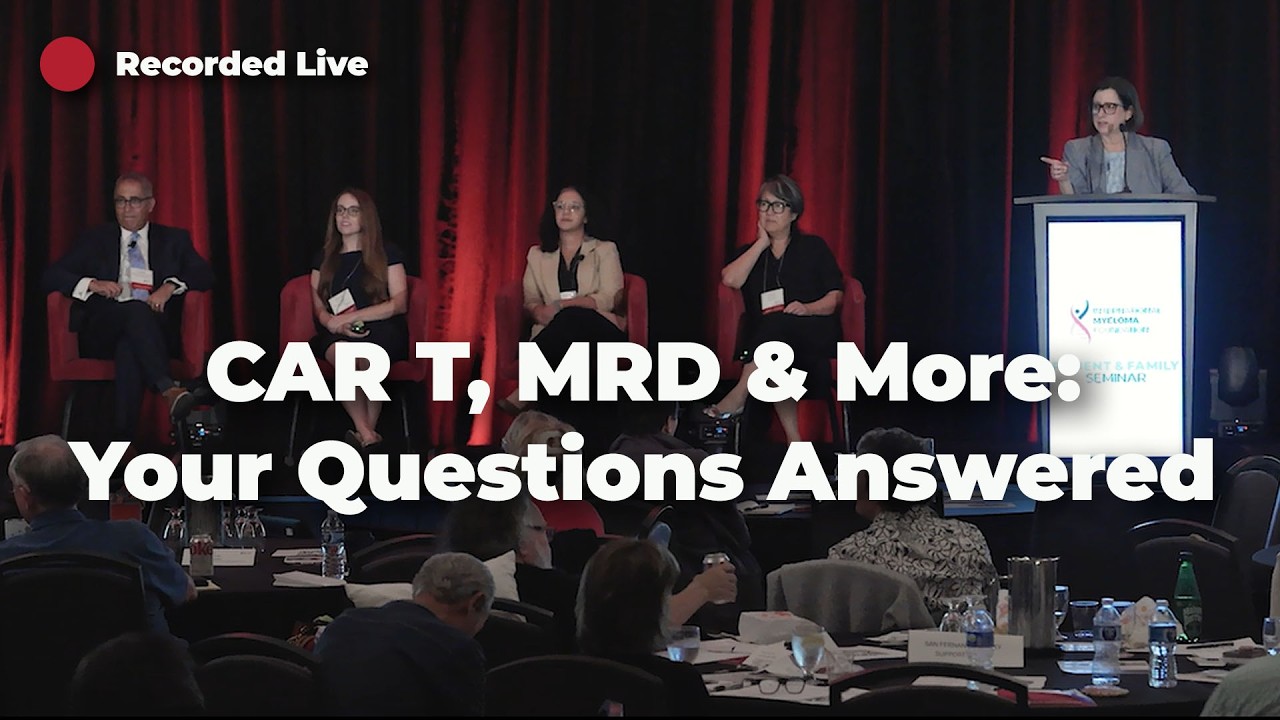
Heather:
... we'll start here with Jennifer because she got there first. We'll come here next.
Jennifer:
Hi. I think this question would be addressed to Dr. Joe. And I'm wondering at what level of an elevated serum viscosity would you consider treatment for multiple myeloma if the other factors that you normally consider don't quite meet the standard of smoldering myeloma?
Dr. Joe:
Did you say viscosity?
Jennifer:
Yes.
Dr. Joe:
Okay, so we didn't talk a lot about viscosity, but the way to think about myeloma, remember we said how myeloma produces those antibodies that are Y shaped? So typically when someone has IgG myeloma, it can accumulate in the blood and you can get so much of this protein in the blood that the blood becomes thicker or what we think of as viscous. There's some other forms of myeloma and cousins to myeloma. So when someone has IgA myeloma, it's like a double Y. When someone has IgM myeloma, it's like five Ys stuck together. And whether it's myeloma or the cousin disease Waldenstrom's, when that protein builds up in the blood, often there can be viscosity issues. So we can actually do a test that looks at someone's overall viscosity of the blood. There isn't an absolute cutoff. We get a little bit nervous when someone's viscosity is more than four, but it really depends on multiple other factors.
If someone even with a lower level of viscosity, if they're experiencing some of the symptoms that we believe can be attributed to blood being thick, which can sometimes mean burning in the fingers, certain kinds of headaches, certain kinds of visual changes, that may cause us to treat more. We were purposeful to not include viscosity in the CRAB criteria because it's not as easy to define and everybody has to be looked at uniquely. But it is an important thing to raise because sometimes peoples' blood levels can be so high, it's similar to when people's light chain levels are so high that it kind of gets clogged up in the kidney. This is where the proteins in the blood kind of get clogged up in the blood vessels. And so sometimes a higher viscosity, especially if someone's having symptoms, may cause us to treat even if the other classic criteria aren't there. But usually the other criteria are there when that happens.
Heather:
So we have over here.
Speaker 4:
I just want to thank you all for all your work, first of all. Thank you. And another question for Dr. Joe. I've been through a bunch of treatment. I did the stem cell transplant and I'm on bispecific right now as a bridge treatment to CAR-T. All of that from November until now, so kind of like whirlwind. My cells that came back or that are being processed, they told me it had a 75% specificity, I think that was the word they used. And I guess for the FDA, it has to be 76% or above. And if not, it has to be considered a trial for CAR-T. So I'm wondering if you could explain that a little bit. Does that mean the cells are like C if you think of A, B, and C, or what does that percentage mean?
Dr. Joe:
Yeah, so a lot of complexity here, I'll keep it simple. When we collect T cells for CAR-T, we test their viability, how effective they appear to be. Not dissimilar to what we do with stem cell transplant. If someone had their stem cells frozen for several years, when we thaw them, we test them for so-called viability to make sure they're working. For the products of both cilta-cel and ide-cel, the government has set appropriately, the FDA when they were developed, a certain threshold, you must meet a certain threshold. And sometimes our product is just below it, what we call out of spec.
And many of our centers will have a clinical trial to say, "Okay, well, we can't, by technicality as it were, give you this 75% when it has to be 76%," but we actually have a clinical trial for out of spec patients because we've learned that very often that bar, although very appropriately set by the government, is maybe a bit higher than it needs to be. Sometimes if it's so low out of spec, we'll have to say, "Look, we have to go again," or we have to dispense with that product. So that's what it means to be out of spec. But more often not if someone's close, we can still provide them those T-cells.
Heather:
And I'll just jump in and say a really important reason for the companies to continue doing clinical trials in that range is because these are all really new immune therapies. And so the government is setting thresholds appropriately. If you're that close, the companies may actually be looking at collecting additional real world data kind of post-approval that allows them to then go back and potentially change the label if they collect enough data. And so that may be one of the intentions and one of the reasons to consider joining this clinical trial, if that's what your provider is recommending, because that may help it be more accessible on insurance down the line for other people. Okay, so Nicky, I saw over here. I can't see your number, Nicky, but I guess the mic team can, the AV team can.
Nicky:
Hello. As a complete hypothetical and not asking for a particular diagnosis, if you do have a kappa lambda ratio above two and one of the CRAB criteria is anemia, would a anemia that is a iron deficiency anemia be something that would apply as a qualifying factor or is it completely separate?
Dr. Joe:
Yeah. The fine print under CRAB is that they all have to be attributable to the myeloma. So if someone has iron deficiency anemia or anemia from other cause or kidney dysfunction for another cause or high calcium for another cause or a bone disease of another cause, that other cause has to either be corrected or understood before we would attribute it. So for example, we've all had cases like this. I had a very traumatic case a few years ago of a young woman who had a really, really high M spike and was terribly anemic and they said this must be myeloma, but she just had very severe iron deficiency anemia. We corrected her iron deficiency and her anemia disappeared.
So if there's a reversible cause like that, we will have to attribute it to it. So we sort of glibly say CRAB, but the CRAB really has to be attributable to the multiple myeloma. That's one of the reasons why when we first diagnose someone or in the diagnostic time that we're working them up, we look for any other causes. And sometimes we really struggle with this, especially with the kidney dysfunction because people may have diabetes, they may have other causes. Sometimes we even have to do a kidney biopsy to prove that the kidney issue is not related to multiple myeloma. In this case here, I would absolutely work on finding the cause and reversing the iron deficiency anemia before claiming that that's CRAB criteria.
Heather:
Okay. At the back, I see Ralphie's got a question.
Ralphie:
Yeah, good afternoon. Thank you very much, excellent presentation so far. I have a forced relapse because I had a bad case of septus, so they put me on a new drug regime to cover the relapse. And because of my 11;14 dislocation or however it's called, the treating oncologist put me on one of the drugs to be, a drug called Venclexta, if I'm pronouncing it correctly. It was prescribed at that time off label because it's a leukemia drug, but it's been highly, highly effective in my case. And I was wondering, I think I noticed in Myeloma Minute that there were a couple of clinical trials using that. Are there any results from that trials that might make it a more mainstream drug and reduce the cost of it because it's very expensive?
Dr. Joe:
Thank you for that question. Sometimes I say multiple myelomas, multiple myeloma for a reason. The multiple part mean there are all sorts of different kinds of biology, if you will, around multiple myeloma. One form of myeloma that seems to, if you will, behave a bit differently, is when patients have this thing called Translocation t(11;14). Remember, I briefly explained what a translocation was earlier. That's when one piece of chromosome that's supposed to live one place, another piece of chromosome is supposed to live somewhere else, come together. In this case, it's a piece of 11, it's a piece of 14 come together. And when those two fuse together, it actually, what we call, up-regulates a pathway or excites a pathway in the cell that allows that cell to live longer, something called the BCL-2 pathway, something that we see in leukemia and in forms of lymphoma.
And so it's a kind of myeloma that has sometimes, if you will, features of a lymphoma or a leukemia. There is a drug that you made reference to, Venclexta or venetoclax, that has been approved in lymphoma leukemia, was not approved in myeloma for various reasons that I'll leave out for now, but has been tested in multiple clinical trials in myeloma and by our NCCN guidelines and our IMWG and other guidelines, can be used in patients that have that translocation, because with that drug is it sort of reverses that BCL-2 pathway.
There are at least two other drugs in that class that are being tested and ongoing in clinical trials. One's called Sonrotoclax, there's other. They all seem to end with the word clax. None of them are FDA approved yet, they're undergoing clinical trial, but we have found many patients with Translocation t(11;14) can actually do very well with that drug. And those drugs typically are pills that are generally well tolerated. There are some that increase infection that we have to be careful with. But if you have Translocation t(11;14), that's something to discuss with your doctor about whether or not it may be worthwhile pursuing one of the drugs in that other class.
Heather:
Or pursuing one of those clinical trials.
Dr. Joe:
Correct.
Heather:
Becky up here, number three.
Becky:
Thank you so much for your expertise and guidance, all of you. I do have a question for Dr. Joe. My question is, I wanted to see your thoughts about using a bispecific with the BCMA target on new or early diagnosis. I was diagnosed in January and I'm considering doing IMMUNOPLANT trial or something like the MajesTEC-5 with the BCMA target. My concern is for that to affect the effectiveness of a later CAR-T, which would also need the BCMA target, so I wanted to know what your thoughts are on that.
Heather:
Good question.
Dr. Joe:
Throw me the easy questions, right? I love it. Okay, so this is an area that the myeloma community is challenged a little bit with. Remember how I told you about how CAR-T works and how bispecifics work? Right now, most of the bispecifics and the CAR-Ts target BCMA. BCMA, thankfully, and to give you the quick answer to your question, BCMA is a very resilient target. We have often treated someone with a bispecific and later been able to do a CAR-T. Our IMWG guidelines a couple years ago said when we were really only in the later relapse setting, we said, "Well, if you have a choice of both, we might favor the CAR-T first because it engages the BCMA target, but then you're off treatment and it sort of lets that target rest before you would do it again with a bispecific where you're constantly engaging it."
If you do the reverse, then you're constantly engaging the target. And then when the disease grows again, you can't immediately do a CAR-T. It's hard to collect T-cells from someone who's just had a T-cell engager. However, moving forward in a lot of our clinical trials and as we move it to the earlier lines, a lot of these bispecific trials are actually giving a fixed duration period of time on the bispecific, or at minimum is so reducing the frequency of its use that it's not as exhausting to the T-cells or as exhausting to the B-cell target.
Lastly, our general approach is always don't save the best for last in myeloma, use the best therapy upfront. And with the responses we're seeing with these bispecific antibodies, it's challenging that early thinking of, "CAR-T is better than bispecific, so use CAR-T first." I think it really is an individual decision. I think it's really that six of one, half a dozen of the other that patients... I just try to reassure patients that you are not burning a bridge with all the new treatments we have. With the ability to give people T-cell and target rest in between, there is an opportunity to come to those treatments later. And if the treatment plan that is in that trial is appealing to you, I wouldn't worry about the next line, I would worry, focus more on what can be best given in this line.
Heather:
Okay. Nikki, number one. And the numbers are so our AV team knows which mic to turn on.
Nikki:
Oh, okay. Well, you guys all did great and my brain's just so full, so any of you can answer me, whoever has the answer. I had a stem cell transplant in September, will be my 10th birthday. And then I was on Revlimid for almost six years, along with Dex and all that good stuff. Then I have lambda light chain, a myeloma IgG Lambda light chain. And so my kappa lambda free ratio was doing great, so my doctor took me off everything. So for three years I went drug free, which was so lovely.
Last year I had a relapse, but hallelujah, you guys have so many new things. I started, it's Sarclisa, but it was a different name and I had that for infusions for eight months, but within two months it knocked it all the way back down to normal, but he kept me on it. And now I'm on Faspro and I'm only on Faspro. And I have no homogenous band or spike seen, it's just gone. I've never had that. It's always been quantifiable, or not quantifiable, but it's gone. So my question is, would the MRD be the next thing I should do to see if I'm free?
Dr. Joe:
You actually ask a really great question because I've been talking a lot positively about MRD, which is true, but at the same time, we always have to ask ourself a question, "How is a test going to change our management?" And we're in a phase right now where we are, and based on the ENDURANCE trial that I shared earlier, we're trying to figure out how long people should be treated. Because in this case, and again, it's hard for me to comment, detail in your specific case without knowing absolutely everything, but just in general, when someone tells me, "I'm on treatment, doc, should I get an MRD test," the question might be, "Is it to stop treatment, to deescalate treatment, to add to treatment?" So those are legitimate questions. The reality is we don't really know. If I just magically knew right now that you were MRD positive or negative, I'm not sure it would change what we do, right?
The other aspect to it to always think of is if things are working now and by the measures that are there, they're down, if it ain't broke, don't fix it in the sense that, "Am I experiencing any side effects from what I'm on?" One of the things that happened in the ENDURANCE trials when people are on that extended treatment of lenalidomide or Revlimid, some people had no trouble with it, but some people did have trouble with it. So it allows us to think, "Okay, we need to have this conversation to say, 'Look, you really shouldn't be having this diarrhea. We've tried all the ways to stop it.'" So I think in this situation, getting an MRD test has to be discussed about whether or not is this going to change it?
Sometimes what we often do in this situation is say, "Okay, let's check a bone marrow with an MRD test once every year or once every two years to just have more points on the curve to see where your myeloma is at and not necessarily change the intervention immediately, but it may influence a decision down the line when we have more information that we're trying to gain, as Heather mentioned, from real world studies and from clinical trials that say, "Oh, someone in this kind of situation who's been on Darzalex for X period of time can come off if they have A, B and C." So I know that's a very generic kind of answer because it's hard to be specific, but always ask yourself, "Is the test going to change my management? How am I tolerating my treatment? And by what measures is the disease under control right now?"
Nikki:
And would a clinical trial be beneficial in any way?
Dr. Joe:
Most clinical trials, of course, are going to enroll patients who have an active disease that's measurable to show a benefit.
Nikki:
Okay.
Dr. Joe:
However, there are some trials that will take people that are already even achieving MRD negativity to see how long they keep them there. So it varies, but most clinical trials where we're doing an intervention, there has to be a starting point that we want to improve for sake of the trial. It's usually depth. Sometimes it's duration, but it's usually depth.
Nikki:
Okay, thank you.
Heather:
Okay. In the center of the room over here, I can't see that number, but...
Dr. Joe:
There are three other people on the stage with me, too. Let me just-
Heather:
Yes, I know. And all our speakers are wonderful. And also in addition to Dr. Joe, we have other experts joining our expert, Dr. Joe, tomorrow. So if you don't get your very specific question answered today, know that there will also be opportunity tomorrow. Go ahead, please.
Speaker 9:
For a patient that had a bone marrow biopsy with MGUS that showed a high risk mutation, such as a translocation, and then was tested again with a bone marrow biopsy with no treatment and had enough of the bone marrow biopsy showing irregular cells over 10%, and then there's no cytogenetic mutations, no translocations or anything, whether it's FISH or kerotyping or anything, do you see that often where a mutation goes away by its own without any treatment? And would you consider that person to have a high risk mutation even though their latest bone marrow biopsy does not show that, but a previous bone marrow biopsy did?
Dr. Joe:
Wow, yeah. So, lots of complexity there. One, we don't really fully understand the significance of cytogenetic abnormalities in MGUS or even smoldering myeloma for that matter. We understand them more when someone has active myeloma because we have more data and more understanding. I mean, I have patients who've had a very significant mutation with MGUS or smoldering, who I followed for 20 years. So that's one of the reasons why those features have not typically triggered us to treat. Secondly, you asked, can someone have it and it goes away? It depends on the mutation and the type of mutation.
Some mutations are never going to go away. Typically, translocations should not be acquired. So sometimes if it goes away, maybe there just weren't enough cells to find it. And typically with MGUS, there aren't a lot of cells to test on. And when you're doing the test on fewer cells, the quality of the test may be reduced. So I don't want to create false sense of hope like, "Oh, it's gone now, so it's not there." But I'm also not as anxious about the cytogenic abnormality in MGUS. I'm a little bit more concerned in smoldering, a little less in MGUS. What matters more at that stage, of course, is the sheer amount of the plasma cells.
Heather:
We're going to go over to number two, and then we'll come to number three.
Speaker 10:
Okay, this is a two-part question, and it's for Susan and Danielle. I'm on employer-based insurance that runs on the calendar year, January to December. In May, I got a letter from my insurance company saying, "As of July 1st, we are no longer going to be covering this medical network that you are currently on," my Independent Physicians Association. It was followed by another letter saying, "We are in negotiations," and that's what was going on with the IPA. "We are in negotiations with the UC Health System, too, and as of July 1st, you may not have access to your cancer doctor." Now, I'm in remission almost seven years and not on anything, but I'm worried about whether something else would happen.
So I immediately start looking into continuity of care and what kinds of hoops do I have to jump through to keep my doctors? I did not want to make changes based on the fact that the insurance company could not figure out how to negotiate with the providers. My question for Susan is if I had been denied continuity of care by the insurance company, would Triage Cancer be able to help me fight that? And my question for Danielle really is, I'm not the first person I've ever seen go through this with insurance companies playing roulette with patients in the middle of the year before open enrollment. Is there anything the IMF can do to advocate for insurance companies not to play with us that way?
Danielle:
You go first.
Susan:
Okay, so we do find this happening a lot, and we actually do get quite a few calls, and it seems to happen a lot with the UC system, so it's not something that's unfamiliar to us. And not that it's super reassuring, but honestly, it does seem to get resolved and it might take a little bit of time. So it's good that you've done your research on continuity of care and trying to continue seeing your providers. And again, not that that's reassuring, but this does happen a lot.
And unfortunately, you don't have a whole bunch of recourse other than asking for that continuity of care and maybe appealing that decision. And at triage, unfortunately, other than talking about the situation, we don't really provide any sort of direct representation or advocacy on your behalf in that particular situation. So again, what we do is provide education and information and different resources, and maybe we could find somebody to help you through the process, but we ourselves do not, unfortunately.
Danielle:
I'm happy to share the advocacy perspective on this. This is not necessarily a federal advocacy reform, but I know that this happened at the center where my dad was being treated and his insurance company, and there was actually a patient that started a petition and that was sent to both the center and the provider, saying... And it was just a story about how much it would disrupt folks. And I just want to plug our masterclass again because those will help folks get the skills they need to be able to do advocacy like that.
Heather:
And I'll just quickly add that I've been seeing this happen in the healthcare setting for the last several years, as Susan was saying, and it's like a negotiation ploy. And it's really, really offensive. And so I'm sorry if anybody here works for an insurance company, but it's basically they're trying to scare patients into getting their doctors or the doctor network to perhaps go easy on negotiations, where it really shouldn't be up to the patients. Patients shouldn't be part of those negotiations. We should all just be able to maintain our insurance, especially if it's something that employer paid. So I agree with what Danielle is saying.
First of all, Susan's right, you already are ahead of the game in knowing what your options are, but I think I've been seeing this in California a lot, I don't know about other states, but insurance companies operate on a state by state basis. And since we're in Los Angeles, in California, this is like a California advocacy opportunity here for, to think about how we might actually convene other advocates that might be impacted and see if there's something that we can do at the state level. It's a hard thing because it's not a regulatory issue, it's a contract issue, so it's a challenge. Number three here. Hi, Malcolm.
Malcolm:
Yeah, hi, and thank you all for today's presentations. I actually have several questions, but let me start with this one for Dr. Joe. On a four drug trial, you must obviously get into the amount of each drug that goes along with the four drugs. What do you do when there is a reaction? Do you change the amounts, do you stop it? With four drugs and the amount of each drug being potentially different, how do you figure that out?
Dr. Joe:
Yeah, that's a great question, Malcolm. And for those who haven't seen, Malcolm and Sally are movie stars now, so make sure you watch their videos.
Heather:
They're all over social media.
Dr. Joe:
Yeah, it's awesome. Over the years, we've come to appreciate the kinds of reactions that typically happen with each of the four drugs. There is some overlap between them, no doubt, but more often than not with the quadruplets that we're using, someone gets a rash, I'm pretty sure I know what that's from. Someone has this kind of infusional reaction. Well, I'm pretty sure I know what that comes from. Someone has a neuropathy or diarrhea or whatever it might be. So again, it speaks to, I think, the healthcare team having experience with myeloma, that more often than not, we tend to know, "Ooh, I think that's because of the Revlimid," or, "That's because of the bortezomib, the Velcade," whatever it might be.
And then in that situation, we'll typically either hold or reduce that one and often still continue the other. Sometimes we have to stop everything if it's very severe, someone's in the hospital or something, but that's the art of medicine, of figuring that out. And that's one of the reasons why we spend a lot of time trying to help educate our community oncology team to ensure that they can understand what those side effects are to know when to intervene, because sometimes everything gets stopped. I saw a patient not that long ago where everything was stopped. I think really, it's only drug number two out of the four that's the issue, so let's hold or reduce two and keep one, three, and four going, and that's typically how we approach it.
Heather:
Okay, final question over here.
Speaker 14:
Ah, great. Thanks so much to the whole panel, I really appreciate all the great information. This is a question for, I think, Danielle and Dr. Joe. I mean, it's really great, all the new options that are coming, and I think more and more myeloma is going to become a chronic disease, and I think there are a lot of questions that are unanswered. There was recently the trial on lenalidomide and when you can stop treatment. And I was wondering if IMF is looking into or supporting more trials that would deal with chronic disease and advocate to the government to provide funding? Because there can be real gaps in terms of who will sponsor certain types of clinical trials and what kinds of questions get asked, not just what the efficacy of the next line of treatment is.
Heather:
You want me to take this from a strategy perspective of... So Dr. Joe can talk to you a little bit about the whole field and what they're looking at, and if you want to know about the whole field, then I can toss this back to Dr. Joe. I can tell you that the IMF strategy as we're looking into talking about doing more in clinical trials is about being very specific with the type of clinical trials we might engage with in terms of them being trials that will really improve clinical practice. Improving clinical practice means people's lives are better. So it's everything from, "Can we stop drugs? Can we stop treatments to allow people to recover?" So, limited duration.
But it's also about, "What are the novel therapies that we might be able to explore that actually lead to not just durable remission, but can we then also be a part of helping to understand, are we or are some combination of therapies actually able to cure some number of patients, some percentage of patients?" So from an IMF perspective, yeah, we're looking at, again, not just some of the more academic questions or early stage, "Are these therapies safe?" We're looking at, "What are the opportunities to really impact clinical practice and make sure that wherever we're able to actually participate, that we're actually bringing forward new therapies as quickly as possible so that we can really, again, improve clinical practice?" And then another thing we're really interested in doing is ensuring equity, not just with clinical trials, but also in standard of care.
Because we're a big country and we can talk about access all day. Danielle's got all kinds of information and opportunities to advocate around access, but there are still parts of our country, parts of our community locally that do not receive standard of care. And that's problematic that people don't have, even though some of these therapies are approved, people don't have access, they're not being recommended by their providers. And so that's another area that we're also interested in expanding some of our participation and doing more. And I'm going to talk a little bit more. I don't know, Dr. Joe, if you want to-
Dr. Joe:
No, I mean, you've covered it well. I think as a field, we're coming to understand that people are living longer with myeloma. So it's now become standard in so many of these studies that we are actually capturing what we often call PROs or patient reported outcomes. So it's not just progression-free survival and overall survival, it really is the symptoms they're experiencing, the quality of life they're experiencing.
I'll let Danielle speak to the advocacy portion, but even as we saw from the ENDURANCE trial, we're now even doing more trials looking at, "Can we stop therapy? Can we give limited duration treatments instead of just giving continuous treatment forever?" Especially now because people are living longer. I don't want to tell my 42-year-old patient, "You expect to be on drugs for 40 years." I mean, that's not what the goal is anymore, right? So I really do think that move from incurable to chronic to curable, we're in the process of doing that already.
Danielle:
And from a patient advocacy perspective, we are looking at reforming something called anti-kickback laws. So what those are, are essentially laws that say that trial sponsors can't provide certain services to patients, funds to patients. That includes things like paying for their travel or paying for housing, paying for childcare. And we as an organization and the advocacy community have pointed out that's a barrier for a lot of people. Rural patients often have to travel quite a long ways. Patients that maybe are lower income don't have the means to do this, so we are really looking at a lot of different areas to modernize the system. That's just one of them. As Richard mentioned, the Clinical Trials Modernization Act addresses a lot of those barriers, both in underserved communities and people who maybe just live too far away.
Heather:
That's going to bring us to a close for today's Q&A session. But as I said, tomorrow there's lots of opportunity. Also, Dr. Joe, you sticking around for the reception? Awesome.
Dr. Joe:
Absolutely.
Heather:
Thank you.
Dr. Joe:
Of course.
Heather:
So we're going to wrap up today. Now, nobody gets to leave the room, not even for a bathroom break, until you do your evaluations. Come on, get out your phones. I can see you. I mean, I might be a little bit blinded, but I can see that... This is so important to us. And by the way, if one of the things that you would like to tell us is that you would rather have a paper evaluation than doing it on your phone, you can put that in your comments. We actually are interested in understanding how people prefer. We really love the idea of doing it digitally because then we don't have to have somebody type in, enter all of your responses. And sometimes your writing, it's not you, I'm not talking to you specifically, but the writing of many people, it's illegible and it's very hard for our team to then figure out what your comments were and how we might be able to enter them.
So if you'd like that glass of rose, write away. All right, but while you're doing that, could we please also thank today's sponsors? Dr. Joe, of course, who will be back tomorrow. Danielle, Yara, I want to give a shout-out for the four square, I don't remember what you call it, breathing. Oh my God, that thing clears my brain. Do it, do it. Susan, I almost called you Sharon. My apologies. Susan, thank you so much and please give our appreciation and our best to the whole team at Triage Cancer. We're very grateful for our partnership with you. Thank you for all the work that you do for the myeloma community and the entire oncology community. So, thanks to all of our speakers.

