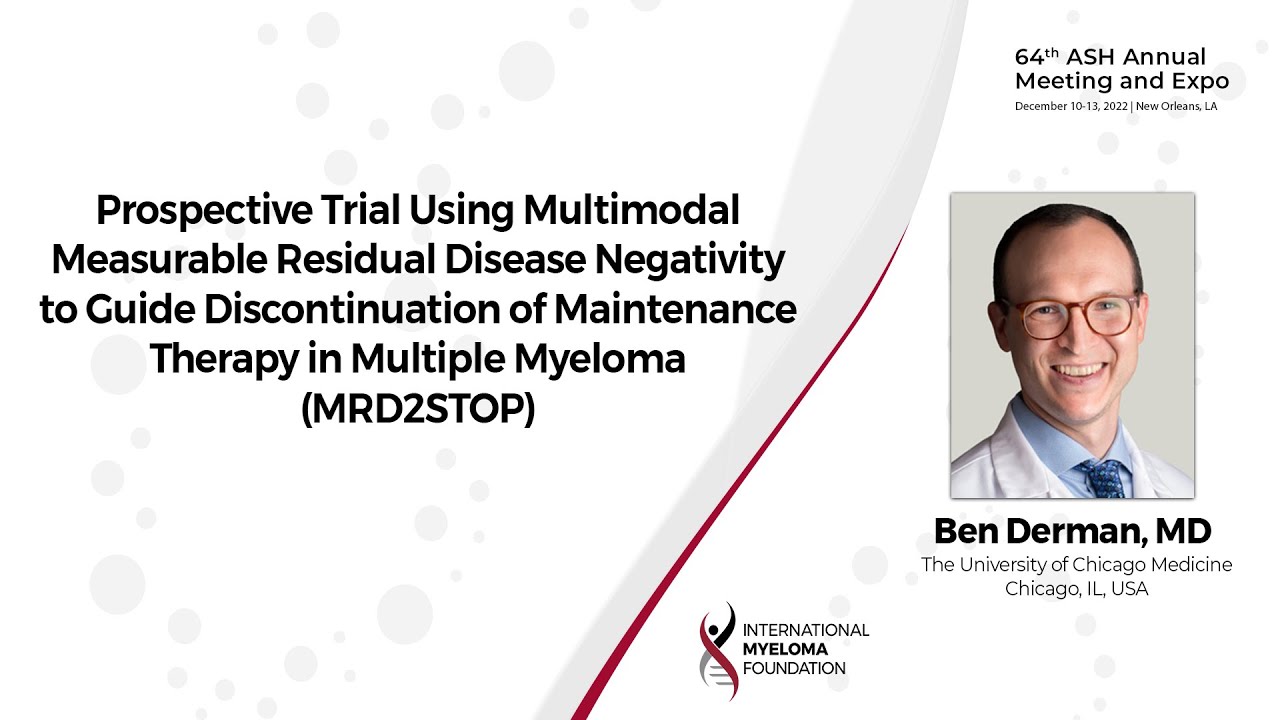
MRD2STOP: Impact of Multimodal MRD Negativity on Discontinuation of Maintenance Treatment Presented at ASH 2022
Dr. Ben Derman discusses the MRD2STOP study on the impact of multimodal MRD negativity allowing for the discontinuation of myeloma maintenance treatment
Dr. Ben Derman of the University of Chicago presents a report on the prospective MRD2STOP study investigating sustained multimodal MRD-negativity in patients who discontinue maintenance therapy after meeting per-protocol eligibility criteria for the absence of residual disease.
Abstract title:
Prospective Trial Using Multimodal Measurable Residual Disease Negativity to Guide Discontinuation of Maintenance Therapy in Multiple Myeloma (MRD2STOP)
Purpose of the trial:
Measurable residual disease or minimal residual disease (MRD) status is an important prognostic marker in multiple myeloma (MM). Despite an increase in MRD-adapted de-escalation and intensification strategies under investigation, the role of MRD in decision-making remains unproven. With an increasing number of patients experiencing durable and deep responses while on indefinite maintenance, MRD-negativity has emerged as a potential marker for the absence of any residual disease, which could be used for cessation of therapy in a subset of patients. The prospective MRD2STOP study (NCT04108624) is investigating sustained multimodal MRD-negativity in patients who discontinue maintenance therapy after meeting per-protocol eligibility criteria for the absence of residual disease.
Video summary:
Minimal residual disease (MRD) negativity in patients is strongly associated with an improved multiple myeloma prognosis. Since maintenance therapy (lenalidomide) has disadvantages including no established end date, side effects, an association with second cancers, and immense financial strain, this study investigates sustained MRD activity is patients who discontinue maintenance therapy. Participants could not have any positive disease for at least a year leading up to the study. An estimated $19,126,000 was saved in healthcare dollars as a result of stopping lenalidomide with a median follow up of 15 months. Limitations include a limited follow up of only 15 months and a higher number of screen failures than anticipated, mostly due to old or unavailable archived samples. In the future, the study aims to collect quality of life surveys, conduct formal cost savings calculations, and demonstrate the study of serial mass spectrometry from peripheral blood.
Conclusions:
Discontinuation of maintenance therapy among patients with MM and multimodal MRD-negativity results in a high rate of sustained MRD-negativity and lack of disease progression 1 and 2 years later, with longer follow-up in progress. The results to date indicate that MRD assessed using the clonoSEQ assay with CD138-enrichment may help to identify patients who can discontinue therapy.
Trial information:
ASH 2022: Abstract #870
Authors:
Ben A. Derman, MD, Ajay Major, MD, MBA, Sarah Major, PA-C, MMS, MPH, Brittany D. Wolfe, MMS, PA-C, Martha Gorski, MSN, APN, FNP-C, Jennifer H. Cooperrider, MD, Evangelia Andreatos, BS, Ken Jiang, Karson Buckley, Amanda McIver, Andrew Stefka, MS and Andrzej Jakubowiak, MD, PhD