Interim Phase 1b Study Results on Isatuximab and Pd Subcutaneous Administration in RRMM Patients Presented at ASCO 2022
Abstract Title:
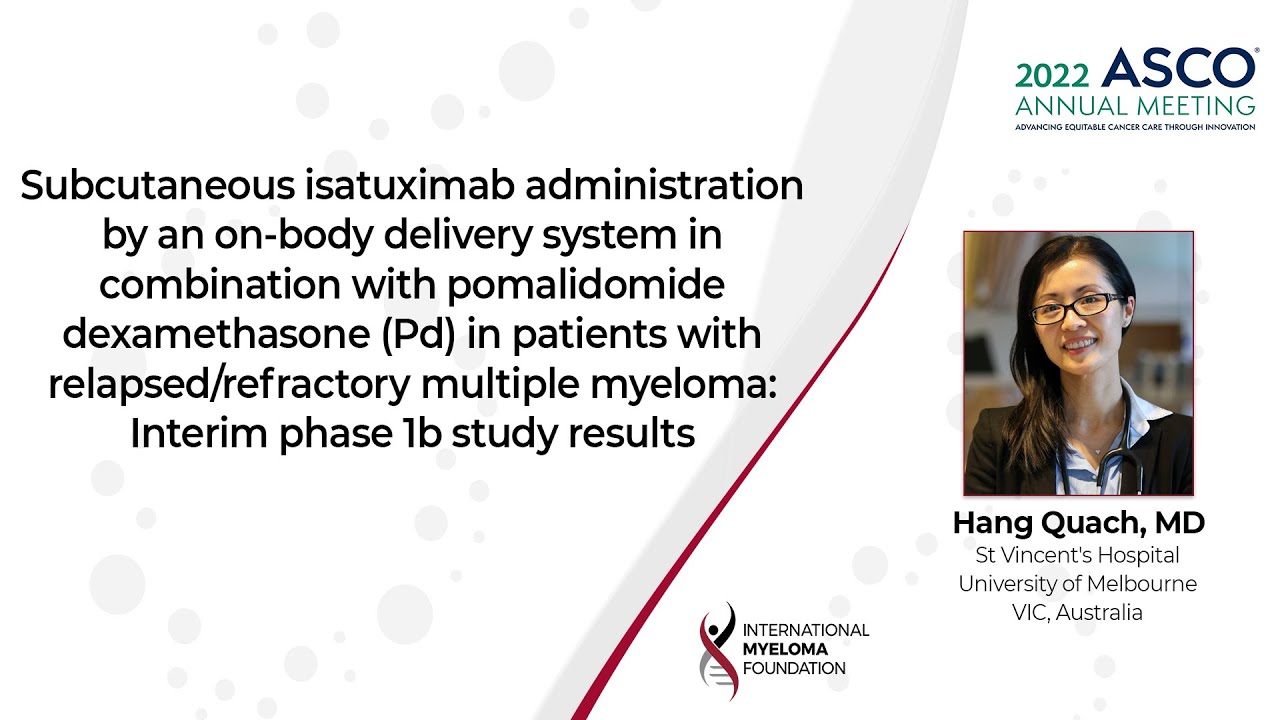
Subcutaneous (SC) isatuximab administration by an on-body delivery system (OBDS) in combination with pomalidomide-dexamethasone (Pd) in patients with relapsed/refractory multiple myeloma (RRMM): Interim phase 1b study results.
What is the purpose of this trial?
Intravenous (IV) isatuximab (Isa) + Pd is approved for the treatment of RRMM patients. Subcutaneous (SC) delivery would optimize convenience of administration. Prior results showed that SC Isa administered by syringe pump has efficacy and safety profiles comparable to IV Isa; the recommended Phase 2 dose (RP2D) was 1400 mg (IMW21 P-207). Primary endpoints (EPs) were safety, including injection site reactions (ISRs), and pharmacokinetics (PK). Main secondary EPs were overall response rate (ORR) and progression-free survival (PFS).
In this video:
Prof. Hang Quach (St. Vincent’s Hospital, University of Melbourne—Melbourne, VIC, Australia) discusses Interim phase 1b study results on subcutaneous administration by an on-body delivery system (OBDS) of isatuximab (Isa) in combination with pomalidomide-dexamethasone (Pd) in relapsed/refractory multiple myeloma (RRMM) patients.
Conclusion:
Subcutaneous (SC) Isa administered by on-body delivery system (OBDS) shows a safety profile consistent with intravenous (IV) administration with no infusion reactions (IRs) and excellent local tolerability. Efficacy in the SC cohorts was comparable to the Phase 3 ICARIA results. Isa SC administration by OBDS is well tolerated, requires a short duration of injection and provides a convenient hands-free option.
Doctor Bio:
Prof. Hang Quach MBBS(Hons), SpecCertOC, FRAC, FRCPA, MD is a consultant clinical and laboratory hematologist at St.Vincent’s Hospital, University of Melbourne in Melbourne, VIC, Australia. She is also the Director of Haematology Clinical Trials at St.Vincent’s with a portfolio of over 60 clinical studies mainly in multiple myeloma and lymphoma. Prof. Quach is currently the co-chair of the Myeloma Disease Group Committee of the ALLG (Australian Lymphoma and Leukaemia Group). She also serves as a councilor of the Specialist Medical Review Council on multiple myeloma, to the Australian Minister of Veterans' Affairs and leads the development and update of the Australian National Treatment Guideline for Multiple Myeloma as part of her role on the Myeloma Scientific Advisory Group (MSAG) for Myeloma Australia.
with support from:
Bristol Myers Squibb, Janssen, and Takeda Oncology