

What is the purpose of this study?
In this analysis, we aimed at confirming the applicability and validity of DS criteria to define PET/CT CMR and showing their impact on patient’s outcomes in the multicenter phase II randomized FORTE trial for Newly Diagnosed Transplant Eligible Multiple Myeloma (NDTEMM) patients. We also looked at the complementarity with BM techniques, especially MFC.
In this video:
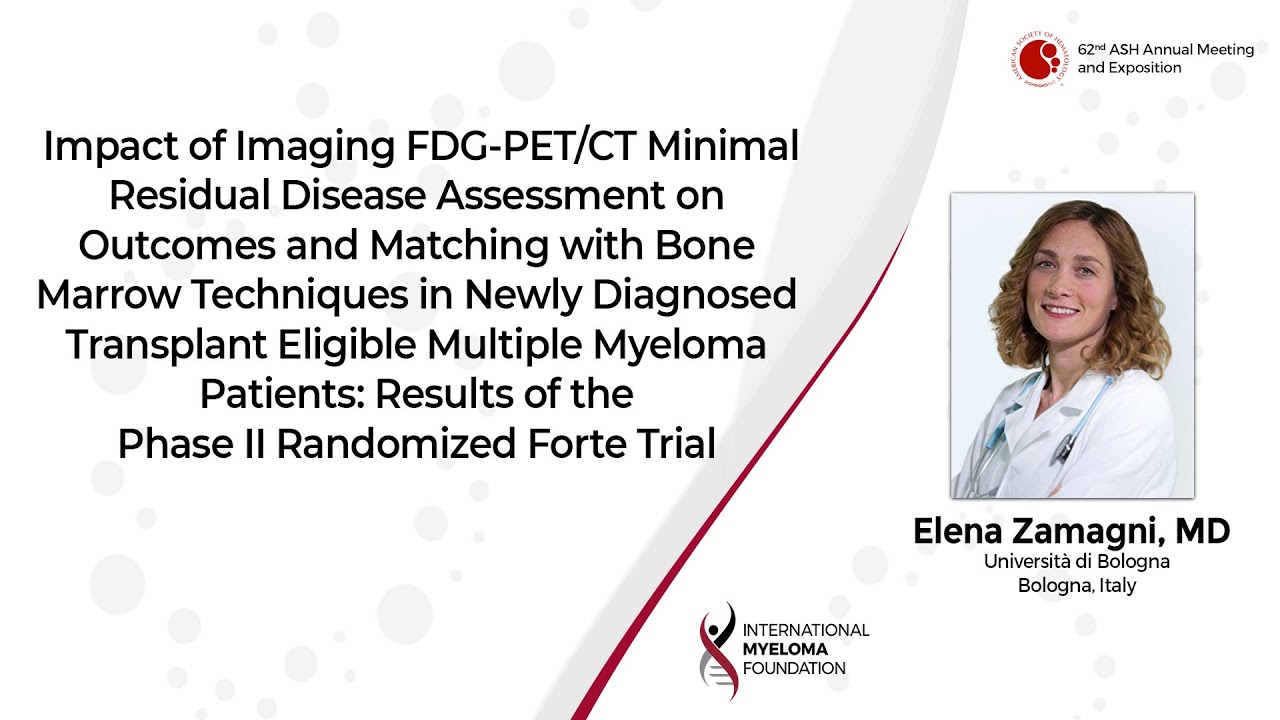
Dr. Elena Zamagni presented an update on the FORTE trial regarding the impact of FDG-PET/CT on MRD .
Results:
There was an 83% overall response rate in the most recent evaluable group and an overall 26% response rate for all combined dose levels. Interestingly, one patient on the study relapsing after 13 lines of therapy including a stem transplant as bridging therapy to this study responded with a stringent complete response for over 26 months. Six out of seven patients tested for MRD were MRD negative.
Conclusion:
In conclusion, the present analysis confirms the applicability and validity of DS criteria to define PET/CT CMR in an independent prospective series of NDTEMM patients. CMR significantly and independently correlated in uni- and multivariable analysis with patient’s outcomes in terms of PFS and OS and was complementary to the MFC MRD negativity.
ASH 2020: Abstract 3326
Elena Zamagni MD, PhD
Dr. Zamagni is an Assistant Professor of Hematology at the University of Bologna, Italy. She received her medical degree from the University of Bologna. She has published over 90 papers in peer-reviewed journals, mainly in the field of plasma cell dyscrasia.