


Dr. Joe Mikhael:
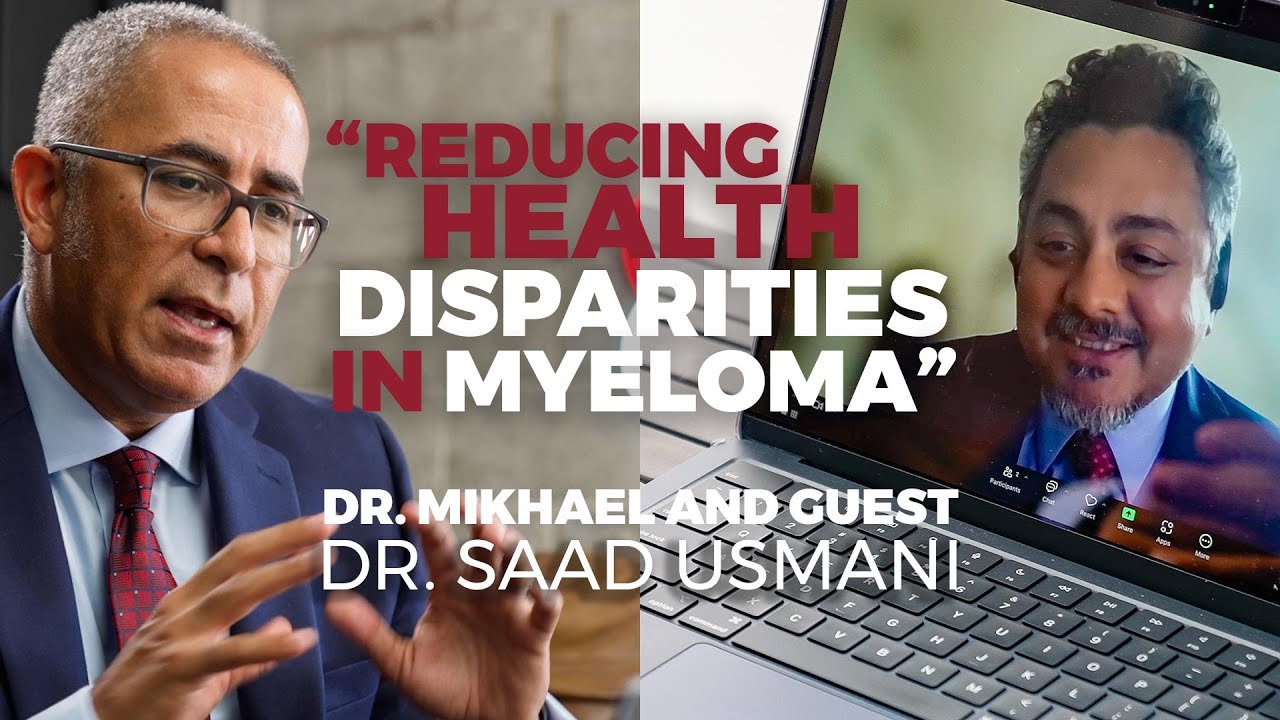
Can we reduce health disparities in multiple myeloma? Multiple myeloma is the most disparate cancer within the African-American community. What that means is that a black man or a black woman diagnosed today with myeloma is expected to live half as long as the same-aged white man or white woman. That's clearly unacceptable, and the IMF is working very hard towards reducing that disparity. We've created the M-Power program, which is designed to improve the short and long-term outcomes of populations that have historically been underrepresented and have had health disparities in multiple myeloma. Part of that strategy has been a program for medical students called the Medical Student Scholars for Health Equity in multiple Myeloma. The IMF has partnered with the NMA, the National Medical Association and its research arm, the Cobb Institute, to create this program where we pair 12 medical students, many from historical black colleges and universities with a myeloma expert to do a project in health disparities. And we all gather together at the annual meeting of the NMA, the National Medical Association, and the medical students present these projects as posters.
It's been a tremendous program. And I'm absolutely delighted today to be able to chat about this program with one of the mentors and a leading expert in multiple myeloma, Dr. Saad Usmani. Dr. Usmani is the Chief of the Multiple Myeloma Service at the Memorial Sloan Kettering Cancer Center in New York City. Hi, Saad. It's always good to see you, my friend.
Dr. Saad Usmani:
It's a pleasure to be here, Joe, and look forward to chatting with you.
Dr. Joe Mikhael:
Well, Saad, you know this program particularly well because you've been a mentor in this program for the first two years that we've run it. And before we dive into the exact project that you and Yasmine Griffiths did together, just tell me a little bit about the importance of mentorship in this kind of program as we seek to promote within the medical community, minority and African-American medical students who, no matter what they ultimately do, of course we all want them to become myeloma doctors, but whatever they do, that they can understand a bit more of myeloma and its impact in their community.
Dr. Saad Usmani:
I think one of the most important facets of creating an equitable society and healthcare system is to empower folks from all backgrounds. We take care of patients with very diverse backgrounds, whether it has to do with race, gender, socio-economic status and the ability to conversate with patients, keeping in mind all those different elements is extremely important. This is also the reason why a diverse workforce and the significance of a diverse force comes into play because you need to have within the healthcare physicians, nurses from different backgrounds and the patients can relate better to them. So I think this initiative that the IMF has taken is so important on so many levels, not just for our own mission of trying to cure the disease, but I think this is so important for the societal goals in general.
Dr. Joe Mikhael:
Well, thanks, Saad. No, I completely agree with you. I mean, the M-Power project was designed to try and affect all of those that are affected from this disparity. We engage the community, we educate the primary care provider to ensure that the diagnosis is timely, but we also want to enhance the care of the patient. And we think part of that has to do with, as you said, the workforce. We think of about 20% of all patients in this country are African-American. If we look at the population, about 14% of the population is African-American, and yet only 6% of us as physicians are of African descent. And in fact, it's about 3% when we look at oncology. So I totally agree with you. We want to not only do it for the numbers sake, but to make sure that our patients feel comfortable with it.
And you and I know being the old guys now in the myeloma world, that mentorship means so much as we traverse our medical threshold and through our whole medical careers. So tell me a little bit about the mentorship side of it with you and Yasmine. I want to talk about the project in a minute, but first just tell me about the interaction you had because we paired you in this virtual world that we live in for about five or six months. So tell me about how that interaction went.
Dr. Saad Usmani:
Yeah. IMF did a great job in pairing up the medical students with their mentors. As a mentor, one of the things that I'm looking for is to get a good sense of what the mentee is trying to get out of the relationship and try to prioritize that and find ways in which you help them achieve that goal. As a mentor, however, you also want to influence their thought process towards asking key critical questions and really challenge them to think of things in a little different way. So it's kind of like a balancing act and how much you can push them, how much do you let them be in their own comfort zone? And the virtual world makes that whole process a little bit different. It's very different when you're having a face-to-face conversation, appreciating cues and body language compared to the virtual world. It's a different experience, but it's very doable as you can see with the success of this particular program.
Dr. Joe Mikhael:
Oh, I mean, I was amazed. I mean, these 12 students created some of the most amazing posters. The projects that they were working on was, I was literally flabbergasted when I got to see all of them. Well, tell us a little bit more about the project. Tell us first of all about the medical students you worked with and then what were those questions that you were trying to answer?
Dr. Saad Usmani:
Yasmine is a very bright young medical student who wants to pursue a career in research. And for her it was important to actually hone in those research skills and then also wanted to work in this healthcare equity field. So for me, I was looking at where the field is headed and how I can introduce the idea of how immune therapies are really shaping up, not just myeloma, but cancer research in general. So we had these conversations and I thought that it would be a nice way of pairing, helping her read up on the immune therapies, bispecific, CARs in the context of CAR T-cell therapy or myeloma therapy, but cancer in general.
And then see if we can come up with a nice clinical research project where she can actually see the impact of those therapies across race and ethnicity and try to answer those questions because we keep on thinking from our experience in the past, that these therapies are not available to all patients in an equitable fashion, but when they do become available, the impact on survivor outcomes are startling different. So these were some of the conversations we had. And I would give Yasmine homework each time to look up literature and then provide her with some references and papers to look at, but then challenge her a little bit to do her own work in the background and then catch up about it later.
Dr. Joe Mikhael:
Awesome. Of course, not surprising, you're like the ideal mentor where you want to help a little bit, but not too much. So tell us then more specifically about the project and what did you find in this project? Trying to understand a bit more about immune therapies and outcomes based by race and ethnicity.
Dr. Saad Usmani:
So if you look at the historic clinical trial accruals in multiple myeloma, cancer in general as well, the proportion of patients with minorities has always been low. That trend actually has been changing in myeloma because many of us have recognized this and are pushing to create, kind of level the playing field in a matter of saying. What I wanted Yasmine to look at was we've treated a significant number of patients with novel therapies under the FDA approved indications, both with CAR T-cell therapies and the bispecific antibodies in patients who have had a lot of previous therapies, they're what we call triple class exposed or refractory. And I wanted her to see if we see any changes in outcomes, are we seeing any differences in the way that they're responding to treatment, if there are any differences in their safety profile or side effects they're having from therapies? And what Yasmine found was that the response to treatments is the same, in some subsets may be a little better. The safety profile consistently is looking no different in our minority patients.
So going along with the theme, that if you level the playing field and you give patients the right treatments, that you should expect really good outcomes for those patients. So she showed no differences in overall response rates, depth of response in Caucasian, black myeloma patients or Hispanic versus non-Hispanic patients. And I honestly thought that we might see some differences there because intuitively we've learned about some data, that there might be biologic differences between myeloma that we see in the Caucasian population versus minorities. But it was actually really good to actually have this tangible data that yes, they are going to have good responses and they're going to have good durable responses. And I can talk about what she's thinking about as next steps to this research as well a bit later.
Dr. Joe Mikhael:
Yeah, let's come to the next steps in a minute. But I mean, you're emphasizing something that's just so important, right, that we've learned in the history of myeloma is that I started our conversation by reminding us that unfortunately, outcomes are inferior within the African-American and also in the Latino-American populations where we see less improvement in survival, then all these great improvements we talk about in myeloma, but it's not affected all communities in the same way. But when given access to the therapy, we know patients do better. Right. You and I both know that we've looked at this in the VA where at least theoretically independent of race and ethnicity, everybody gets the same access to the diagnostic and therapeutic regimens. And sure enough, African-American patients do just as well, if not better.
So I think your study is kind of showing us the same principle, isn't it? That when given equal access, it was terrible. The very first set of CAR-T trials, we saw 1% representation within the African-American community. I mean, that's just not acceptable. So I hope this kind of study that you've done not only gives us the results that we should be able to introduce immune therapies to all patients in [inaudible 00:12:30] race, ethnicity, but I hope it's raising awareness around the importance of inclusion in clinical trials when we develop these therapies early because we need to know that these drugs are just as safe and just as effective in every patient that we treat, which I know is a huge deal, not just in New York City really, but right across the country as we care for our patients.
So let me ask, before we look at the future directions of the study, let me just ask from a logistical standpoint, how did it go working with her? Was there a lot of phone calls or a lot of emails back and forth as you were sort of creating the poster? I mean, the poster looked amazing. I saw it, but how did, we learned, for example, saw that about two thirds to 70% of these medical students had never done a research project before. So it's really extraordinary opportunity for them. So tell us a little bit about that logistic part of it.
Dr. Saad Usmani:
Yeah, I mean, that was an interesting experience for me. We went through this exercise last year as well, so I had learned some lessons. And since we were going to have this focused research question very early on, I had Yasmine meet with our biostatistics team members. I also had her meet with our database folks at MSK. And it's always a little bit challenging trying to get folks credentialed, access to EMR and all of that. So I wanted to make sure that she goes through that exercise to appreciate, okay, what are the steps that you really have to go through when you're thinking about a research question? And then, okay, I have access to the charts. Now what do I do? How do I find this information that is missing from the existing database? So going through that whole exercise, I think doing this in a suffice fashion was important.
And there were other team members from the myeloma service who actually also played an important role in this. You know Dr. Carlyn Tan. She's a young attending in my service, but highly motivated working in this bispecific space. Dr. Mylan Cody, who's working on the CAR T space. So all of these folks made time to meet with Yasmine separately and go over the nuances of databases from their perspective. So I yeah, I think she had, so she met not just with me, with other people to kind of alleviate her concern. Oh my gosh, how am I going to do this? And she got very comfortable with it. And yeah, in the end it worked out really nicely.
Dr. Joe Mikhael:
That's fantastic, man. I mean, that's why the bromance between us continues, man. I mean, you are like the quintessential mentor. Right. To not only provide her with a great concept and idea, but to make sure that all of the facilities were available to her, but also to teach her from the very start, like research takes a village. Right. None of us have done research projects by ourselves ever, right? It's always a team effort. So I just think that's fantastic that you've done that, and that's what we're hoping these medical students experience, that they get kind of the excitement of working with different groups and talking to the biostatistician and getting the layout correctly so it fits on the poster properly. And I just think that's fantastic. In the last couple of minutes that we have here, Saad, we're running out of time. Of course, you and I could chat about this all day long, but what is the next step for Yasmine? What is the next step for this project?
Dr. Saad Usmani:
One thing, she was so excited after the poster presentation. She sent me an email the very next day saying, "Dr. Usmani, I got such and such feedback. Can we get on a call and talk about these particular ideas? I think we can do a little bit more with a little bit longer follow up. Maybe look at the patterns of infection over time between patients." So she came up with these ideas on her own. And so again, I connected her with our transplant ID folks to see what kind of projects and questions they're looking at and provide her some feedback ahead of our call. And so as we think about trying to put a manuscript together for her, we might make it a little bit focused about the long-term, sequel eye of the safety profile between these therapies. So that's just one thing that she really wanted to look into. So hopefully we can put that together in that paper.
Dr. Joe Mikhael:
Well, that's fantastic, Saad. Actually, we found in the first year of the program, several of our students were able to present these abstracts at large meetings. Some of them won abstract awards, achievement awards, and indeed have gone on to manuscripts. And that's really our hope, right? That these medical students don't just have a six-month experience, that this becomes a long-term strategy. And I know with the great mentorship that you provide, that you'll likely stay in very close touch with her. And we have wanted to create a community of those who have been alumni, as it were, of this program to work together. So Saad, let me just, again, thank you for joining me today, my friend. It's always good to see you. It's always good to know that you're involved in helping us reduce these health disparities through the medical student program, and I just appreciate you very much.
Dr. Saad Usmani:
Thank you so much, Joe.
Dr. Joe Mikhael:
You heard it here. One of the ways that we can help reduce health disparities is by engaging the new generation of physicians that are coming and have them appreciate the magnitude of the disparity in health in general, but specifically in multiple myeloma and how we can overcome it. Please give us your feedback. Let us know about what you thought about today's program, questions that you might have, areas that were particularly impactful. And also make sure that you follow us on all channels. And if you have specific questions, you can always use the hashtag ask the IMF, or indeed, you can use our newly generated chatbot or AI chatbot Myelo and go to myeloma.org and you'll learn more about Myelo and he'll be able to answer your questions. Thanks so much for joining us today.
Dr. Saad Usmani:
And oh, Joe, let's not forget to ask our audience to subscribe to the IMF YouTube channel.
Dr. Joe Mikhael:
Absolutely. Of course we will. So please don't forget to subscribe to the IMF's YouTube channel.

