

Beth Faiman:
What happens to your immune system after CAR T-cell therapy?
Dr. Joseph Mikhael:
How do patients keep track of all their lab results, medications, and treatment changes?
Hi, everybody. Dr. Joe here from the International Myeloma Foundation.
Beth Faiman:
And I'm Beth Faiman, I'm also from the International Myeloma Foundation's Nurse Leadership Board, and I'm thrilled to be here today.
Dr. Joseph Mikhael:
Beth and I are here with you today to answer the huge number of questions that come in across our social media channels, on X, on Facebook, on Instagram, and on YouTube. So here we go, let's dive into these questions that you've sent in.
Jonathan asks, "What hidden costs come with clinical trials that patients might not expect?"
Beth Faiman:
So Jonathan, hidden costs might be involved in clinical trials, mostly from transportation, right? So you might have to travel more often to that treatment center, it might be a greater distance. So we're looking at hotel costs, gas, and so on. So your insurance will cover for that drug, of course, because it's not an approved therapy, but it's that extra cost. Fortunately, many of the clinical trials that are well-designed, looking at safety and efficacy, will provide reimbursement programs for you so that you do not incur those out of-pocket costs. So, talk to your healthcare team and then hopefully the hidden costs won't be anything that prevents you from starting the clinical trial or completing the clinical trial.
Let's go to the next question. "Will the treatment decisions I make now limit my options later? Why treat myeloma if it's just going to come back more aggressively?"
Dr. Joseph Mikhael:
Wow, that is a challenging but important question. The short answer is that we are not limiting options later by the treatments we take now. Typically, we don't so-call, save the best for last in myeloma. When we give patients the best option now, that gives the opportunity to have the longest remission before the disease wakes up. Yes, it may wake up and sometimes it wakes up more aggressively, but by then we'll have even more options for patients later. So, having this discussion with your healthcare team is so important to look at what all options are available to you and what is the best option to control the disease here and now.
Beth Faiman:
Absolutely.
Dr. Joseph Mikhael:
So, here's a great question from Patty, who asks, "My myeloma has come back." I'm sorry to hear that, of course, Patty. "I've asked for CAR T, but they won't give it to me until it gets worse. Why can't I get CAR T now?"
Beth Faiman:
So Patty, that's a very interesting question. It might be that CAR T might not be right for you. There are certain indications and recommendations and when patients are candidates for CAR T-cell therapy, and we have to adhere to those. So talk with your doctor and your healthcare team and ask them, "Why am I not able to get into CAR T-cell therapy right now?" It might be that you didn't get the right drugs that are according to the FDA indication and it's not right for you at this time. There might be a better treatment for you as well. What would you have to say, Dr. Joe?
Dr. Joseph Mikhael:
Well, I agree. I think the discussion around CAR T is really important. We know that CAR T has changed so much of how we treat myeloma. We want patients to have access to this at the right time. And this may involve a conversation with an expert in the field, to join that conversation to decide, what is the best therapy for you, at the right time.
Beth Faiman:
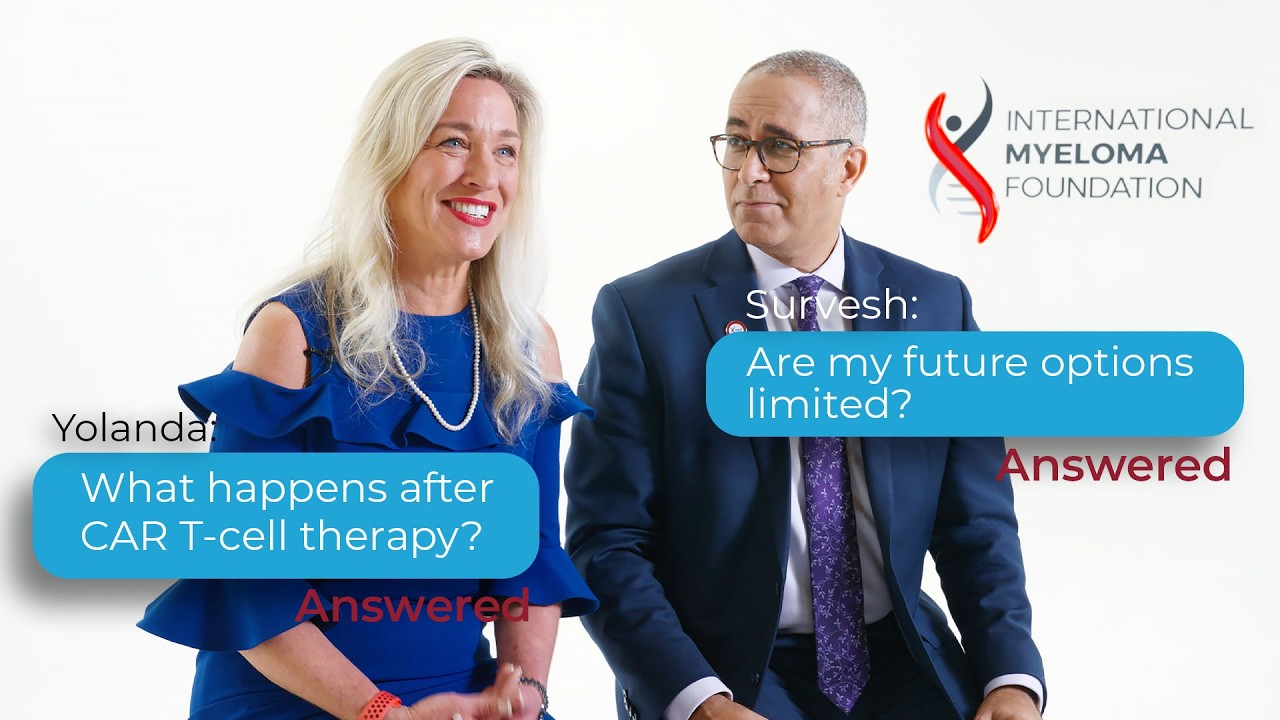
We have another question from Yolanda. "What happens to your immune system after CAR T-cell therapy?"
Dr. Joseph Mikhael:
Great question, Yolanda. The immune system after CAR T-cell therapy goes through a period of time where it's a little bit weakened, as it were, but then it comes back over time. Remember that CAR T-cell therapy is where we actually use your immune system to attack your multiple myeloma. We take T-cells out of you, which are part of your immune system, like soldier cells. We train them to fight your myeloma. We give them back to you, and they take down your multiple myeloma. In that process, the general parts of the immune system can be weakened for a while, which is why we know that patients are at risk of getting infection after CAR T-cell therapy, and so we monitor them very closely for infection. We supplement them with what's called IVIG, or intravenous immunoglobulin, to help keep their immune system strong. And in some cases we may have to give certain antibiotics and antiviral drugs to prevent those kinds of infections.
That being said, over time we know that the immune system reconstitutes itself. It gets stronger again as the myeloma is put to sleep, and so people's immune systems can come back to normal.
All right, let's move on to our next question that comes to us from Kathy, and I want to give a special shout out to Kathy.
Beth Faiman:
Hi, Kathy.
Dr. Joseph Mikhael:
Kathy is a support group leader and has been just an incredible patient advocate. And by the way, if you're interested in finding a support group, you can go to support.myeloma.org and find one that is near you.
Kathy asks us this question. "I've been on lenalidomide maintenance for nearly three years and I'm struggling with side effects. How long can you safely stay on it?"
Beth Faiman:
Kathy, I'm sorry to hear about your side effects. Well, first of all, congratulations for being on lenalidomide maintenance for three years, that's actually a good success story. We in prior years would keep you on forever, but controlling the side effects is so important, making sure that your doctor knows about the side effects and what they are. We have things such as diarrhea, which can be managed by a drug called cholestyramine, but I still see some of the community providers aren't aware of this. We also have side effects such as neuropathy, which can be rare, and then low blood count. So, finding out about your side effects and sharing them with your doctor is the one important part, but then we have the discussion of how long should you be on lenalidomide maintenance.
Dr. Joseph Mikhael:
This is a hot topic in myeloma now, because we want patients to get the benefit of maintenance therapy to maintain a remission for a long period of time, but we don't want them to have to stay on drugs forever. And a lot of studies are now being done looking at discontinuing lenalidomide, sometimes at two years, sometimes at three years, maybe even at four years, based on getting a nice deep response often with MRD or minimal residual disease negativity where we can't measure the disease at all, that allows a patient to be able to come off treatment. So again, discuss this with your healthcare team, because whereas in the past we used to say it was lenalidomide forever and yes, we'll try to manage the side effects, but the longer you stay on it, the better it is. Now we've learned that actually, we can often stop it and allow people to go off treatment.
Beth Faiman:
Exactly.
So, let's go to the next question. The next question is from Donna. "How important is the FISH test for smoldering myeloma? Mine was done with unenriched bone marrow, so I'm not sure I trust the results. Should I push for another test?"
Dr. Joseph Mikhael:
Great question, Donna. And I think the quick answer is, I wouldn't necessarily test again right now. So Donna's asking about FISH testing, which is when we look at the specific chromosomes, the genetics of the cancer cells or of the plasma cells in smoldering multiple myeloma, to see if that gives us a hint as to whether or not smoldering myeloma will become active myeloma. We have all sorts of different scoring systems to help predict, nothing is perfect. If someone who has smoldering myeloma, which typically is what we do not treat, we just wait and watch, although there is a form that we can treat sometimes, we wait and watch to see if it becomes active myeloma. We've learned that looking at the genetics through the FISH testing can help a little bit.
And I understand, Donna, that you may be concerned that the accuracy of that FISH testing may not be complete, but I would wait until such time as there is a change in the other parameters, because typically that FISH testing is not the biggest influencer in those scoring systems along the way. Most importantly, it's critical that your disease continue to be monitored closely with you and your healthcare team because we don't want to treat too early, but we also don't wait too late to have the disease grow where we could have caught it earlier.
Beth Faiman:
I agree, 100%. I think it's really important to know what the FISH test looks like. And she had mentioned unenriched bone marrow and that's just a different way of looking under the microscope. But as Dr. Joe mentioned, it's not necessarily what we would consider in that scoring system as to whether or not she needs treatment. I typically follow my patients with smoldering myeloma, whether or not they're high risk, about every three months with blood and urine testing. And we treat the people not numbers, we take that into consideration when we're watching folks with the smoldering myeloma, but having that discussion with your healthcare team and sometimes this might be a good time for an expert opinion to make sure that you feel comfortable with your treatment team and the goals of care that you want to embark on.
Dr. Joseph Mikhael:
All right, let's come to another question that comes to us here from Pauline. Pauline asks, "How do patients keep track of all their lab results, medications, and treatment changes?"
Beth Faiman:
Pauline, you know firsthand, it sounds like, that there are a lot of labs to keep into consideration and the treatments. And so, this is something that's called survivorship. So survivorship is something that starts at diagnosis and it was only considered for patients with breast cancer, prostate and other tumor types. But keeping track of labs can be challenging, and I encourage patients to look at their EMR, the electronic medical record, there's portals all out there. Maybe you keep track of records on your own by an Excel spreadsheet or some other spreadsheet mechanism. But each time you go in and see your provider, make sure they're going over what type of myeloma you have, where's your myeloma landing right now, and have that discussion of, does anything change on here? So keeping track can be a big effort, but engaging your healthcare team and taking your own advocacy might be right for you.
Dr. Joseph Mikhael:
And I would just add that when patients understand their labs and know what's being followed, they're empowered throughout their experience with multiple myeloma, and the IMF is here to help you through that. We have a patient handbook that outlines all the different testing that can be done. Of course, you can always reach out to us through the info line or through our chatbot to ask specific questions so that we can help you as you follow that, because myeloma can be complicated to follow. It's typically not just one number or one x-ray that we follow, and we want to be able to help you do that so that you can have the best experience possible.
Well, unfortunately, that's all the time we have for today. Thank you again, Beth, for joining me for this Q&A session. Do you have more questions that we didn't get to today? Lots of ways you can have your questions answered. One way is right at the bottom of this video, there's a comments section and if you start your question with the number sign or hashtag, Ask the IMF, and then add your question, we will get that question and we'll do our best to answer it as quickly as possible. But of course, come to us at myeloma.org and learn about all the different other places that you can ask questions, not just on social media, but at our live events, at our virtual events. We're here for you and we want to be able to answer the questions that we know are important to you.
Beth Faiman:
And if you like these videos, hit subscribe and follow the International Myeloma Foundation to learn about more content and more opportunities for education.