This week's "Ask Dr. Durie" poses an age-old question, which I'm happy to answer once again: Do we still use dexamethasone as part of our myeloma therapies? The answer is yes.
Dexamethasone is a steroid that we have used for many years. It enhances the impact of virtually all myeloma therapies that we still incorporate into most of our regimens. We use what is called a low-dose schedule, meaning one day a week, which is lower compared to what used to be four days in a row or high dose. The starting dose is 40 milligrams, which is significant for frail patients.
The key thing to be alert about is that there are quite a few side effects. Some immediate side effects could be noticeable, where patients immediately feel great, lively, and active on the day they take it. As they come off, there is a real mood swing effect from taking the dexamethasone, which is not comfortable.
Moreover, patients may have difficulty sleeping while on the drug. Longer-term side effects include an increase in blood sugar, even the development of sugar diabetes, the development of cataracts in the eyes, and effects on bones with weakening of the bones with osteoporosis or even particular damage to the head of the hip bones. So really, in the long term, many side effects are best avoided.
The key thing about dexamethasone is that in the first few months of therapy, it really does improve the benefit of therapy, achieving a response in more patients and deeper response. However, over time, the main goal is to reduce the dose of dexamethasone from 40 to 20 to ten and even to lower doses, and eventually to plan to get off it entirely to reduce the risk of longer-term side effects.
So, yes, we use it upfront, but we try to get off it in the long term. The BOTTOM LINE is that dexamethasone is definitely still a useful drug. The side effects are difficult, so talk to your doctor about the dosing and scheduling because there are quite a number of possibilities. The goal should be to reduce the dose and to get off dexamethasone as soon as the value has been achieved.




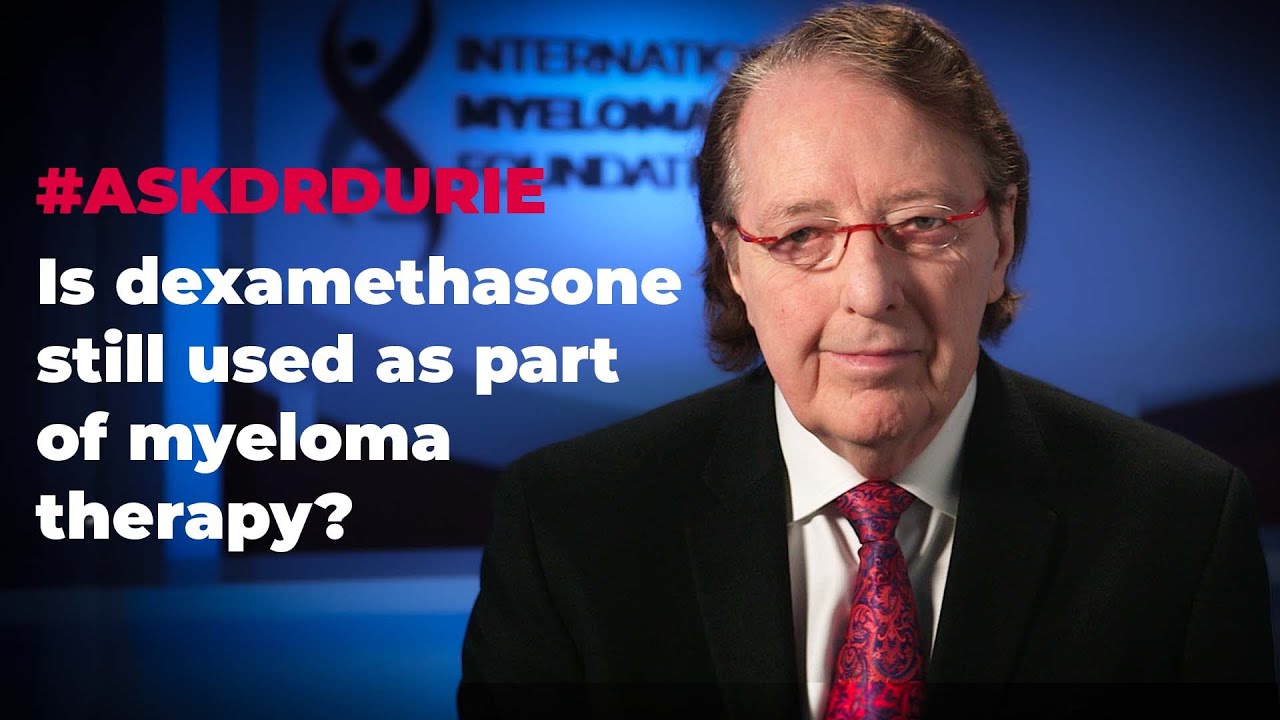
 Dr. Brian G.M. Durie (1942-2025) was the co-founder of the IMF. He was a Professor of Medicine, Hematologist/Oncologist, and Honoree MD at the University of Brussels.
