

Joseph Mikhael:
Have we moved on from Covid-19? Do myeloma patients still need to learn about the risks of the disease and take precautions because of it?
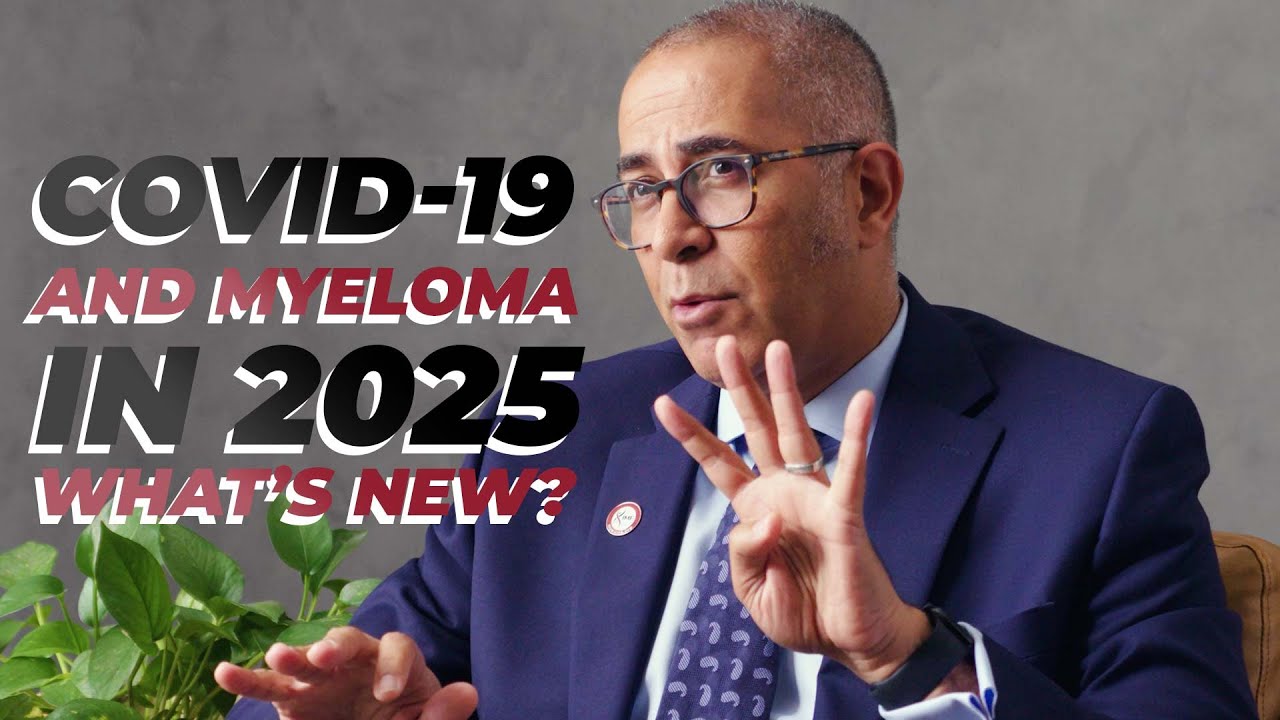
Hi everybody. Dr. Joseph Mikhael here, Chief Medical Officer of the International Myeloma Foundation, an organization committed to the quality of life of patients as we seek prevention and a cure. There are so many hot topics in myeloma, and one of the questions that comes up a lot is what is happening with Covid-19? And I hope to address that in this with you today.
But also know that the IMF is here for you in every way possible. Please subscribe to our YouTube channel where you can keep updated with topics like this. But no, we have support groups and an info line. We have educational programs both in person and virtual, and we want to help you through this journey, whether it's you or a loved one with multiple myeloma.
All right, let's start talking about Covid-19. So much to be said here. I'm going to simplify it with four simple take home messages. Take home message number one, Covid-19 is still with us. It has not disappeared. Thankfully, it tends to affect fewer numbers of patients, and when it does tends to be less dramatic than it was before. Some of the very severe side effects we used to see like change in taste and requiring hospitalization, has really gone down. But there are still different communities where we see a lot more of Covid-19 and it's fluctuating all the time, which is always a reminder to us to stay informed with what's happening.
So the disease has not gone away, but thankfully it tends to be milder, and a lot of patients may experience Covid-19 and not know it, because it is a lot like the regular flu. Which brings me to point number two.
Something that actually has never really changed is that myeloma patients are at risk of infections. We have to remember that myeloma is a disease of the immune system. It's a cancer of the plasma cell, the very cell that makes antibodies. Antibodies are what we make when we get a vaccination. So if you get a vaccination for the flu or for Covid or for tetanus, it sends a message to your plasma cells to make antibodies to protect you against it. So we do have to remember that myeloma patients are at greater risk of infection.
However, I want to balance that with what we learned during the pandemic, during the Covid-19 pandemic, that myeloma patients, although they are at increased risk, that risk is not dramatic. It tends to be highest when the myeloma is active, or if someone has just recently had a stem cell transplant, or if someone has recently had a CAR T cell therapy or is on a bi-specific antibody.
But in general, I don't want myeloma patients to be frightful day and night that they might get Covid-19, or any infection, because that risk, although it is present, is not extremely high.
Which brings me to important point number three, precautions still work. Vaccines still work, even in a myeloma patient where we might argue that the ability to respond to a vaccine may be slightly blunted, it clearly still helps our patients. And so it is fundamental that our patients continue their regular vaccinations, which includes vaccination for Covid-19.
Similarly, isolating keeping distance from individuals wearing masks. Although those things we're not routinely using every day, we know that they can help, especially in higher risk situations. And so it's important for us to remember those precautions and take them at the right time. People should not be going to work or going out when they're sick, and so we want to limit the risks.
Which brings me to maybe the most important point, point number four. This has to be individualized and communicated with your healthcare team. Some people over these last several years have really isolated themselves. Others have really not and have not taken any precautions at all. We want to find the right balance based on your situation, with your own care provider, to know what is best for you. In fact, the IMF vision is that all myeloma patients can live life to the fullest, unburdened by the disease.
And so we don't want people to artificially have to completely isolate themselves from life. We want our patients to be able to go out to dinner and to travel and even go to concerts. One of my patients loves going to concerts, so we try to mitigate that risk, but we want them to enjoy the things that they can.
There'll be times in your myeloma career, as it were, where you'll be at higher risk, and other times at lower risk, and we want to make sure that's communicated so that we can do the best to keep healthy and general and indeed to keep away from the risks of Covid-19.
I hope this has been helpful to you, but feel free to comment or ask more questions on this topic and others through all of our social media channels at the IMF. You can use the hashtag, "#asktheIMF," and we'll do our very best to answer your questions. And remember, the IMF is here for you. Whether it's you or a loved one with myeloma, we want to support you through your journey. Visit us at myeloma.org.