


Dr. Joseph Mikhael:
Do myeloma patients really need maintenance therapy forever? That's a question we are often asked. How long is too long? How long is too short? What is the best way to give maintenance therapy? A recent clinical trial, the ENDURANCE trial was published and is starting to challenge some of the ways we think about maintenance therapy.
To help us understand this more, I'm going to talk you through three areas of maintenance therapy. Number one, what is maintenance therapy? Number two, what was the ENDURANCE trial and its results? And lastly, what does that mean for you, the patient? We are rethinking the way we deliver maintenance therapy because of the ENDURANCE trial. Let's hear more about it.
Hi, everyone. Dr. Joe here from the International Myeloma Foundation, committed to improving the lives of patients and accelerating the cure for multiple myeloma. Today, we're talking about a very important topic, maintenance therapy. One of the greatest questions we have in maintenance therapy is how long should someone be on treatment? Many patients have their initial treatment, sometimes we call that induction therapy and then, it's followed by maintenance to maintain that response that they've already had, but we don't know how long that should go on. For most patients, this includes Revlimid, also known as lenalidomide. Recently, the ENDURANCE clinical trial evaluated how long someone should be on maintenance. It's complicated, lots of nuance, so let's dive in together and think about maintenance therapy and how long someone should be treated.
Before we begin, let me encourage you to subscribe to the International Myeloma Foundation's YouTube channel. The science of myeloma is so rapidly evolving. You don't want to miss out on the latest and greatest, and here you'll learn about myeloma and all the things that are changing as we care for our patients with this disease.
Now let's get started. What is maintenance therapy? Maintenance therapy, by the word, is the concept of maintaining a response that someone has already achieved. So typically when someone gets first treated for their multiple myeloma, we call that treatment induction treatment. The idea is to induce a remission or to get the disease down. Sometimes when I think of the way we treat multiple myeloma, I like to think of the two Ds, depth and duration. Whatever measures we have of the multiple myeloma, we want to see them come down. We want to eliminate the disease, bring it down to as low as possible, but of course we want to keep it there, we want it to be durable. We want it to remain low.
Maintenance therapy is about that second part. It's about the duration. So someone has typically been treated with initial therapy. Sometimes that's three drugs, sometimes it's four drugs, sometimes it may involve an autologous stem cell transplant, and then they go into a maintenance phase where typically we're giving less drugs, we're giving it less intently, but the intent is to give it for longer so that patients can stay in remission for longer. So when we talk about maintenance therapy, we talk about that treatment that someone is receiving after they've already had their initial therapy. Historically, this is really centered upon the drug Revlimid, also known as lenalidomide. More recently, there have been some studies looking at adding a second drug to lenalidomide, sometimes a drug called Velcade, sometimes a drug called Kyprolis, and more recently a drug called Darzalex. Either way, the point is to maintain someone's response to keep them in remission for longer before, as we know, unfortunately, the disease comes back again in the future.
When we give maintenance therapy, we have to ask ourselves, what are we actually doing? And I'm going to suggest we're doing two things. Number one, we're continuing to give a patient a deeper response. Even though we think of maintenance as maintaining a response, most patients actually still have a little bit more to go down and that maintenance therapy helps get the disease down a little bit lower. The second thing we do is we sort of stimulate the immune system to stay awake and to not allow the disease to come back. So in summary, maintenance therapy is what we give after someone's initial or induction therapy to maintain a remission over a long period of time. It tends to be less aggressive so that people can go on with their lives and the goal is to keep the disease down for long periods of time.
Could two years of maintenance really be enough? The results of the ENDURANCE trial were just published in the New England Journal of Medicine. This is a critical trial in maintenance therapy. It was led by some of the key members of the leadership at the International Myeloma Foundation, including Dr. Shaji Kumar on our scientific advisory board, Dr. Vincent Rajkumar, the Chair of the board, and Dr. Sagar Lonial, Vice Chair of the board. They, along with others, wanted to study how long we really should be giving maintenance therapy. After patients had had initial therapy, they were randomized to either receive two years of Revlimid, also known as lenalidomide, or indefinite Revlimid, which means until their disease relapsed. The results were quite striking, even though it took a long time to get the results, hence the word ENDURANCE trial.
After 13 years of this trial, they evaluated whether or not patients lived longer if they had two years of maintenance or indefinite maintenance. And in fact, they showed there was no difference in overall survival between these two groups. Furthermore, those patients that were on the indefinite Revlimid ended up having more side effects, more secondary cancers, and more likely to come off the study because of those side effects. So this has really questioned whether or not we really need to think about indefinite maintenance therapy in many of our patients.
The study did not include high-risk patients, so that is a separate discussion, but for our standard-risk patients, this is now beginning to have us think that perhaps we could give maintenance therapy for shorter periods of time. Two years may be the sweet spot. We know that maintenance therapy does contribute to further deepening response and most of that happens in the first two years. And it also triggers the immune system to keep vigilant to make sure that the disease doesn't come back, and most of that immune system is restored in the two years of maintenance therapy. But in summary of the ENDURANCE trial, this study in non-high risk patients randomized two years versus indefinite maintenance Revlimid and showed that those two groups had no difference in overall survival, but there was more side effects and more discontinuations in the long-term group.
So can I stop my maintenance therapy? What do the results of the ENDURANCE trial mean for patients today? Well, we want to be careful that every time we make important decisions in medicine, this has to be a conversation with you and your healthcare team. And even though the results of the ENDURANCE trial are quite striking in demonstrating that shorter periods of Revlimid maintenance may be just as effective as longer periods on Revlimid maintenance, this has to be discussed with your healthcare team to determine if that's right for you.
That being said, I want to emphasize the point that this has really challenged us to think about how long we treat patients with maintenance therapy. Especially when patients don't have high-risk multiple myeloma, we know with the great therapies that we have upfront with quadruplets and sometimes stem cell transplant, patients do really get a deep response and very often we don't need to keep them on therapy in the long term. Patients really do like coming off therapy. I say it all the time, 'I love giving nothing. It's my favorite prescription, nada. I love writing that prescription." I say that a little bit jokingly, but it really is serious. It's wonderful to be able to take patients off treatment because every treatment comes, of course, with some kind of risk.
So as we evaluate how the ENDURANCE trial is going to affect our treatment with maintenance therapy, I'm going to suggest that we're going to see many patients who had been on two, three or four years of maintenance Revlimid with standard-risk myeloma have a conversation with their doctors about potentially stopping it. I'm also very encouraged by the fact that we have so many options for patients later that we can give periods of time off of all treatment for our patients with multiple myeloma.
So in summary, the ENDURANCE trial is changing the way we think about maintenance therapy in standard-risk patients, and there are many patients now who are going to be able to come off maintenance therapy because of the results of this important clinical trial. If you're interested in discussing this more with your healthcare team, here are a few key questions you can ask. Do I have standard-risk or high-risk multiple myeloma? How long have I been on maintenance therapy? Is there a possibility of me stopping maintenance therapy? And very importantly, am I experiencing any of the side effects that could be worsened by continuing maintenance therapy? With these and other questions in hand, you can have an empowered conversation with your healthcare team to decide what's best for you.
So that sums up much of maintenance therapy and the recently published ENDURANCE trial. We've discussed together what is maintenance therapy, what was the ENDURANCE trial, and what does this mean for patients? These are exciting times and we may be able to treat patients for shorter periods of time, but of course this doesn't necessarily mean that you're going to stop treatment. Please discuss this with your healthcare team and you can decide together what is best for you.
On the subject of questions, we love questions at the IMF and we encourage you to bring us your questions so we can help answer them with you. Please use the hashtag asktheimf on any of our social media channels and we would love to feature your questions and answer them. You can always reach out to us directly at myeloma.org. And of course, many of these questions can even be answered by Myelo, our chatbot that you can find at myeloma.org where we have a host of information to help you in your journey with multiple myeloma.
By the way, if you found this video interesting, I'm going to encourage you to watch another one. It's the replay of a webinar that I did with a group of patients trying to break down the results of some of the most incredible myeloma research of the year that was presented at some of our big meetings, namely ASCO or the American Society of Clinical Oncology and EHA, the European Hematology Association. There was one segment in there called This Just In that you're not going to want to miss. You can watch the replay linked here.
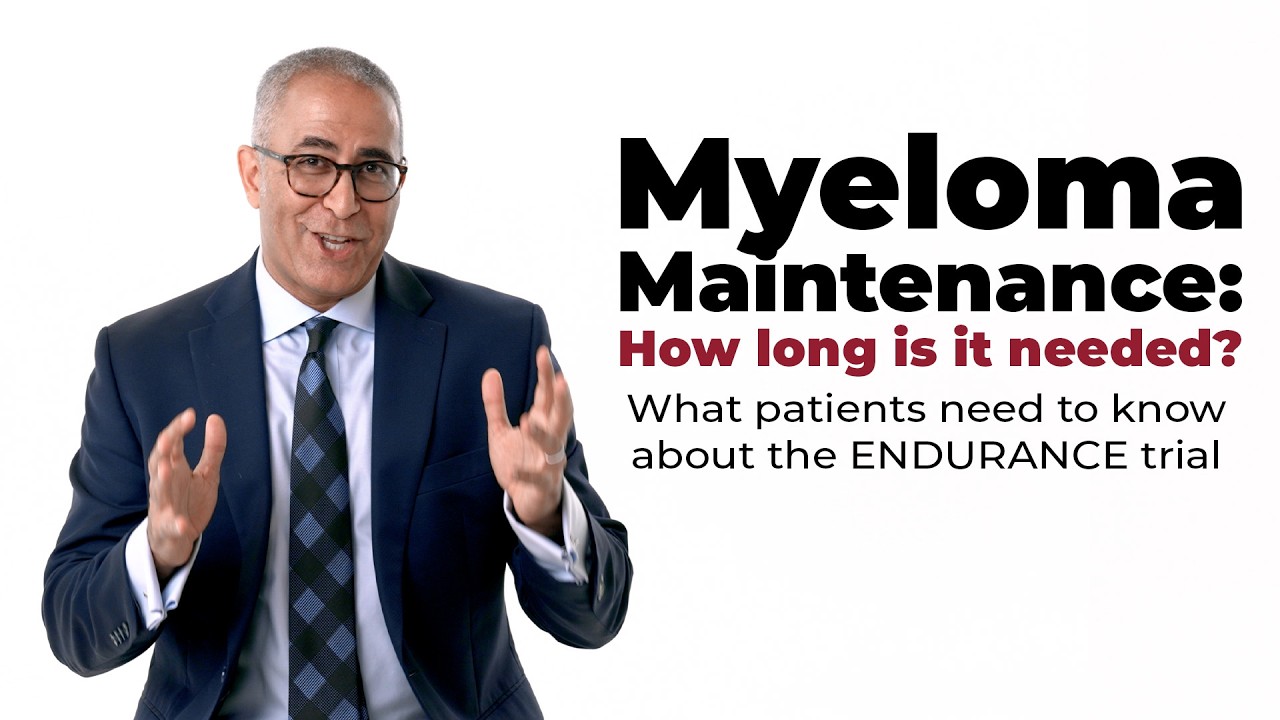
Could Two Years of Myeloma Maintenance Be Enough? What the ENDURANCE Clinical Trial Found
Do you need multiple myeloma maintenance therapy forever? Dr. Joseph Mikhael of the International Myeloma Foundation explains the ENDURANCE clinical trial and what its findings may mean for patients taking Revlimid (lenalidomide) after initial treatment.
Maintenance therapy helps patients maintain their response to initial treatment and stay in remission for longer. In this video, learn how the ENDURANCE trial compared two years of Revlimid maintenance with indefinite treatment, what the study found about overall survival, and why patients who continued treatment indefinitely experienced more side effects and were more likely to stop treatment because of those side effects.
Dr. Mikhael explains why the results are prompting new conversations about the length of maintenance therapy, particularly for patients with standard-risk multiple myeloma. He also discusses treatment side effects, the importance of understanding your risk level, and questions to ask your healthcare team about whether stopping maintenance could be an option for you.
If you or someone you love is living with multiple myeloma, this video can help you better understand maintenance therapy and prepare for an informed conversation with your healthcare team. The ENDURANCE trial did not include patients with high-risk myeloma, and its results do not mean everyone should stop treatment.
Explore trusted multiple myeloma education, treatment information, clinical trial resources, and patient support from the International Myeloma Foundation at myeloma.org.
Have a question that needs more personalized support? Call us! We're here for you. The IMF's InfoLine is available to answer your myeloma-related questions and concerns. Call us at 1-818-487-7455, email us at [email protected], or schedule your call at a time that works for you at: myeloma.org/infoline.
Workshop chapters Topics Covered in This Workshop
Joseph Mikhael, MD, MEd, FRCPC, FACP, FASCO
International Myeloma Foundation Medical Advisor
TGen, City of Hope Cancer Center—Phoenix, AZ, USA
Dr Mikhael is a Professor in the Clinical Genomics and Therapeutics Division at the Translational Genomics Research Institute (TGen), an affiliate of City of Hope Cancer Center. He is also the Director of Myeloma research at the HonorHealth Research Institute in Scottsdale, Arizona. Dr Mikhael specializes clinically in plasma cell disorders, namely multiple myeloma, amyloidosis, and Waldenstrom’s macroglobulinemia. He is the PI of many clinical trials, primarily in relapsed multiple myeloma, and his other clinical research interests include pharmaco-economics, communication skills, and media relations.
Dr. Mikhael recently served as the Chief Medical Officer of the International Myeloma Foundation (IMF) from 2018 to 2026 – he now serves as Medical Advisor to the IMF to provide guidance and strategic input in areas such as patient education, health disparities, collaboration with partners, international research, and publications.
Dr Mikhael has published over 200 peer-reviewed articles in these fields and lectures internationally on a regular basis. Dr. Mikhael is deeply committed to health disparities in myeloma and is the chair of the Diversity, Equity and Inclusion Council at TGen. Dr. Mikhael is heavily involved in training future researchers and mentors junior faculty worldwide. Dr. Mikhael is an active member of the International Myeloma Working Group (IMWG) and recently led the ASCO guidelines in myeloma. Dr. Mikhael also serves as the Treasurer on the executive of the American Society of Hematology.
Dr. Mikhael did his medical training in Canada, including a fellowship in Multiple Myeloma at the Princess Margaret Hospital in Toronto. He also obtained his master’s degree in education from the University of Toronto. He then worked at the Mayo Clinic Arizona as a Hematologist from 2008-2018.
Tag #AsktheIMF to Ask Your Questions on Social Media!
Facebook: @myeloma | Instagram: @IMFmyeloma | Twitter/X: @IMFmyeloma
See all of our social media channels at linktr.ee/myeloma
