


Dr. Joseph Mikhael:
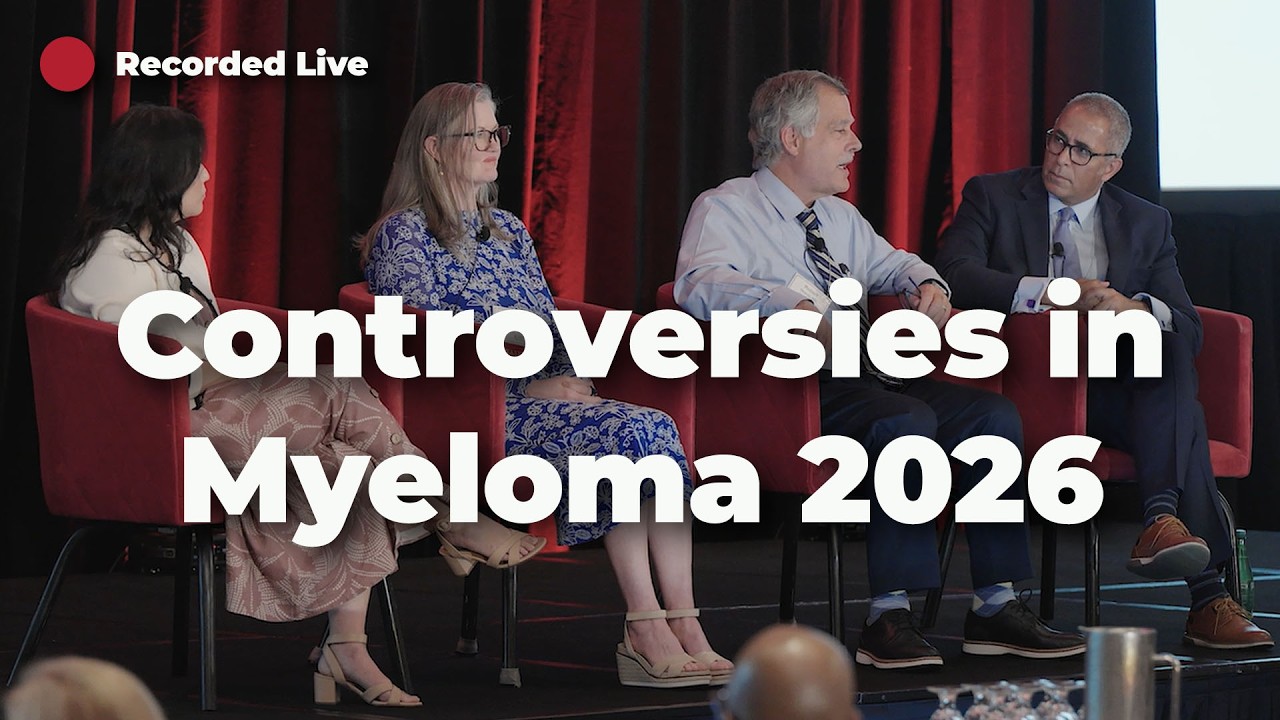
This is the session that we've entitled Controversies in Myeloma. This is not a WWE sponsored event. There's no wrestling or fighting involved because we do things so gently and sweetly here. But sometimes it scares people a little bit when we say we have Controversies, but hopefully you've heard over the last couple of days that myeloma is complicated. It's not always easy to understand. It's not always, of course, easy to treat. And there are differing opinions in different areas. And so what we try to do at this session is highlight some of those key areas that can be a little bit challenging, and then we'll lead into a Q&A. And I'm going to come and sit with my friends here so that we can have more of a warm, comfortable conversation.
So, we had the fireside chat with Dr. Gregory earlier, and we covered lots of topics. There will be some overlap to what we've discussed before, but I have sort of four particular areas that I'd like to quickly cover before we get into our Q&A. And the first of those is arguably sometimes the most controversial topic we have right now in myeloma. I always say, if I want to get varying opinions, put 10 myeloma doctors in the room, ask them about smoldering myeloma, and I'll have 12 opinions. So, there's always a little bit of a difference. So, the quick background to this first topic is that as we shared yesterday in the Myeloma 101, we know that pretty much everybody with multiple myeloma, before they get myeloma, go through the phases. Some, it takes many, many years. Sometimes it's very quick, but people go through the phases of MGUS or monoclonal gammopathy of undetermined significance, just means they have a little bit of the protein in their blood, but it's not causing any harm and doesn't seem to be pending to cause harm.
Then we have smoldering multiple myeloma, then we have active myeloma. As of this past year, we now have an approval to treat patients with high risk smoldering. So if you think of that middle section, it also has a division between lower risk and higher risk situations where people are getting closer to becoming myeloma. One of the things I'm sure will come out in the conversation is even though we draw definitions, we love making little boxes in medicine, but biologically we're not built that way. So, we draw lines between them. We know those lines are a little bit fuzzy, but nonetheless, for that high risk group, we now have an opportunity to treat them, to treat them with single agent Daratumumab or Darzalex for three years because of a clinical trial that showed when we did that in that high risk group, it allowed patients to have a delay in their becoming active myeloma.
Some never develop multiple myeloma, and there's even evidence that it might prolong life and give people longer overall survival. That being said, there's a lot of controversy around it. Some people believe in that, some people don't. Some people feel that, although the trial was particularly well-designed and well carried out, that it doesn't always apply to every patient. They'd rather watch patients for a bit longer. So, I'd like to get our panel's take on smoldering, but that you understand the bigger picture is that there has been a strong move in cancer in general, understandably. You just heard me talk earlier about health disparities, about trying to catch the disease earlier. I would rather catch all my patients with myeloma before they've broken the bone, before they've damaged their kidneys and so on. But myeloma is such a strange disease that so many people have the precursor. Remember I said yesterday, one in 20 individuals over the age of 40 have MGUS.
So, if I go through LA here, imagine the thousands of people that are going to have MGUS. We clearly aren't going to treat all of those individuals because most of them will never develop myeloma. So, when do we wait too long? When do we not wait long enough? When do we under treat? When do we over treat? So, it is a natural area of challenge. But I'll start down on the far end, Sarah, and maybe just start with you and say in your high risk smoldering population, are you routinely giving single agent Daratumumab and yes or no?
Sarah:
So, not routinely-
Dr. Joseph Mikhael:
And why?
Sarah:
... I like you said routinely because if it's routinely, no. Am I giving it? Yes to some people. I'm assuming by the end of this whole debate and the takeaway will be shared decision making because I think there's so much nuance-
Dr. Joseph Mikhael:
Okay, next topic. Let's move on. Sorry.
Sarah:
Because there's so much nuance, but I think when the study first came out and we had this new option, anytime we have an option to be able to treat a different population of patients, we're always happy to have more tools in our tool chest. So, we're certainly happy to have that as an option. It's a drug that we're very familiar with, toxicity profile, very familiar with and how to manage that. And I think for certain patients, having an option where they can do something that may delay the onset of myeloma from happening is a very big piece of mind and feels like they're doing something and they're willing to take on whatever risk that is. I think the thing that I still, I think I've kind of tempered my reaction to it now and since then. And so really with each patient we have a conversation, but it's important to remember in smoldering, it's not a cancer yet. You're largely asymptomatic. You're not having any symptoms. You maybe are coming into the doctor's office every three months for lab work and it may not become a problem.
So, if you're introducing a treatment, we might cause side effects, you might get infections, you're going to be coming in weekly at first and then the pace at which you're coming in and the monitoring is going to be a lot more. And so you are potentially accepting some risk. Nothing that we have unfortunately is still free of that. So, I think that there's still some things to think about. I think also now knowing how good our quad therapy is, I worry about using one of these medicines first and are you potentially going to lessen the effect of that as using it in smoldering if you're going to need it in your frontline? And what do we do about that? Especially if you're progressing on Dara as a smoldering patient.
Dr. Joseph Mikhael:
At the time.
Sarah:
Yeah.
Dr. Joseph Mikhael:
So, Tara, can you think of a cadre of patients within the pool of everybody having high risk smoldering myeloma that you would particularly recommend that they receive the single agent Daratumumab?
Tara:
I think my practice is a lot like Sarah's. It's a shared decision making. I have quite a few smolders and in this study, the diagnosis of a high risk smolderer was very generous. There's not a smolderer I have that didn't fit high risk. So, I don't know that they were really that high risk. The two patients that I have on Dara are only because they were chomping at the bit to get something and I didn't think it was time to really pull the big trigger of away we go because at the time away we go was quads, transplants, we're going to hit it. So, I didn't think that that was appropriate for them, but they really wanted something. And I haven't been overwhelmed with their responses, but again, it's a small number of patients.
Dr. Joseph Mikhael:
Again, you're bringing that same point of a patient preference because there's some patients that just say, "I want to be treated." Some people are, "Let's wait and watch. Are they really wanting..." Bob, what do you think? What has your approach been?
Bob:
I've been a little more comfortable with the treatment, but it is very much a patient decision. I think when the study was done, it's hard to design a study for one of the other tools that we have, which is to watch a patient's disease to see if it's progressively growing and you can add it progressively growing at a rapid rate. And for those, I get nervous to just watch it grow at a progressive rate without doing something, especially a drug that's very well tolerated. But for others that totally meet the criteria and they're fine and I've had somebody who smoldered for many, many, many years, his point to me was, "Well, what's so different today compared to three months ago, compared to a year ago, compared to two years ago?" So, I think it has to be very individualized. There is the whole thing about if you use a very good drug early, maybe are you burning a bridge? I don't know. You have less disease to deal with and hopefully it works and you can find out eventually how well it's going to work. So, patients tolerate the drug pretty well.
Dr. Joseph Mikhael:
Yeah. So, I think in summary, we have a great option, in particular patients who are keen to be treated. Based on your patients out of first remember, no one could enter the AQUILA trial if they had smoldering myeloma for more than three years. So, I do think there is a part that those numbers don't catch. Go back to the analogy I gave yesterday that it's like I'm running towards a cliff. You want to catch me before I fall off the cliff. What matters really are two things. One, how far am I away from the cliff? And most of our measures are kind of like measuring how far away someone is from the cliff. What's their M spike level? We define high risk as usually two out of three things. Either an M spikes over two, a free light chain ratio is over 20 or they have more than 20% plasma cells.
Those are kind of measuring, if you will, how far it is from the cliff. It's not a perfect analogy. But the other thing that matters is how fast they're running. And so we have some patients like your patient, Bob, who's... I think of a patient who I've been following for 18 years with smoldering myeloma, right? Just because the trial came out, I'm not obviously going to treat them. But by contrast, sadly, we have some people that are smoldering this month and then the next month they're pretty much active myeloma. And so it's helping us. I think with time, as we have better ways to measure myeloma and if you will, the rate of which someone's myeloma is growing. There's a really fascinating paper that was published by Roberto Mina who looked at a big group of smoldering patients and he said, actually, genetically speaking, really half of them essentially look like MGUS and half of them really look like myeloma.
So, that may help us do more sophisticated testing to say, You're in the group that is really low risk of ever getting to the cliff. Let's just leave you alone. You're in a higher risk group, so maybe we should consider some kind of intervention. And Daratumumab, of course, was the first clinical trial. There's so many clinical trials now going on with more. So, if you're here and you have smoldering myeloma, a lot of it is what your own risk tolerance is, what you prefer, how you feel about treatment, shared decision making, of course, rules the day as Sarah predicted from the start. All right. All right. That's just a warm up. Let's now get the... What is it? Motion is lotion. Let's get moving here.
So, topic number two is to transplant or not to transplant. We have some centers in the country now that are almost doing away with transplant. There are others who are saying, no, no, no, transplant. This very fit 97 year old is still a candidate for transplant. I'm not ageist, but we don't make decisions by age, but we have to be careful too. So I'll go in the reverse order this time. Bob, you've been around the block a couple of times here in LA. Has your thinking about transplant changed a lot in the last couple of years or are you still primarily sending the majority of standard or high risk patients who are eligible for a transplant?
Bob:
I'm sending less. I still do it. I still think the Perseus trial is still our best outcome where people had the transplant, but when patients are doing well, they went into remission, they're tolerating the treatment, it's a big event. It's an annoying event to go through a transplant. CAR-T, if you just were to line them up head to head, I know there's a trial comparing the two. We'll know eventually. I think everybody's pretty confident CAR-T is going to kill more myeloma. So, again, I think it has to be very individualized. Probably today, if I had myeloma, I'd still do a transplant on myself, but I can see that may not be for long now.
Dr. Joseph Mikhael:
I'll help myself-
Bob:
And then I-
Dr. Joseph Mikhael:
... to a transplant myself.
Bob:
I've been around a long time, so I have those people that are 10, 15, 20 year survivors. I have a guy just did a CAR-T. His transplant was in 2007. I don't know if it would've made a difference if he didn't do the transplant, but I kind of feel like it might've made a difference and that's why he's around long enough to have the CAR-T. I'm still in the transplant group, but I don't know that I'll be there long.
Dr. Joseph Mikhael:
You're so reasonable, Bob.
Bob:
Well, I don't know if that's reasonable because I have a feeling people will be in the other side already.
Dr. Joseph Mikhael:
Oh, we'll see. Tara, thoughts?
Tara:
Largely in our practice, we transplant. That is our default. Our real default is can we get them on a study? We are super motivated to get my partner, Dr. Shada, on the podium for faster. So, we are enrolling like gangbusters on that one and that's a randomization of transplant versus a bispecific with limited therapy. So, that's really exciting. But if the patient can't do the study because they live too far away, they don't want to come to us for continued therapy, then we're recommending transplant if they can. That being said, to my earlier comment, if I have somebody who's older and I don't feel like I have to use every single tool, like you mentioned, then I'm not going to... I mean, I used to work really hard to get people who didn't want a transplant to transplant and now I'm like, "Well, you have good options if you don't want to do it." So, I don't work so hard to get the people who don't want one to do one.
Dr. Joseph Mikhael:
Sarah, what do you say? I mean, City of Hope has been a bastion of stem cell transplantation from the earliest of days. And you've actually even spent some time at Fred Hutchinson, which is where the very first transplant occurred. So, if anyone's been drinking the transplant Kool-Aid, it's you. What do you think?
Sarah:
Yeah. I'll add to what Tara was saying. I think I try not to find reasons not to transplant somebody, but the default is to transplant. So, I'd say I think we all think CAR-T and immunotherapy is going to take over and even we talk about quad now. I think eventually frontline's going to include a bispecific and that's going to change the paradigm even more. But I think with the current data that we have, I agree Perseus is really very good outcomes with the quad in transplant and maintenance. And again, especially if you're younger, less than 70, and you are looking for 20, 30, 40 more years, it's about using all your tools and kind of maximizing each thing. And so if you can tolerate the transplant, we can get you through it and that gives you five, seven, eight years. We might have by then, CAR-T in vivo CAR-T that works, that's going to be the cure.
You showed in the last that our remission curves get shorter and the shorter, but it's not the case anymore. After your first line therapy, which we thought was going to be your longest, best shot, that's not the case. We have people in their 12th line who are now five years out with the cure we're talking about these days. So, that paradigm's going to be shifted all over the place. I think certainly now in the right setting, a transplant is still, for most patients, I would say what we're trying to do. If there's a reason to avoid it, I try to look for that reason and we can justify that. But there are certainly certain patients who I also really encourage it for. If you're high risk, if you're young, it's keeping that foot on the gas pedal is still, I think, really important.
Dr. Joseph Mikhael:
You're all so balanced and also, so much for controversies. But anyway, no, but I think one of the things-
Sarah:
He want us to fight.
Dr. Joseph Mikhael:
... that pushes me is that although in general we see that benefit, I think it is really important to look at those extra variables. If I have someone with high risk myeloma, I may push a little bit more towards transplant. I got to say the best evidence we have for transplant, and I'm the last person to be ageist because I don't think we make major determinations by age. We should do it by people's fitness in general and how well they are and their frailty. But the vast majority of our evidence for transplant are people 65 years and younger. So, my kind of approach is if you're 65 years and younger, I'm looking for a reason to not transplant you. Otherwise, that should be the default. But in someone between 65 and 75, we know there's going to be more, in general, toxicity and morbidity.
We try to do our transplants at my center entirely as an outpatient. We look back on our last five years to determine who stayed outpatient versus who had to come inpatient. By far, the most predictive feature was age, age over 62, actually. But of course everybody is different and that's just an average, but I do think I find myself giving people a lot of permission to not go to transplant. And then the last piece that I'll add because of our French colleagues did this fascinating study called the MIDA study, and I know we need longer term follow up, but what they did is they treated everybody with a quadruplet, and then if they got to MRD negativity versus MRD positivity, they then made a decision. If you are MRD negative, they randomize people to getting a transplant or just continuing more of the quad. And believe it or not, there's no difference between those two groups.
So, patients who get that really deep response with induction therapy and they're perhaps not high risk, that's another reason for me to say no to transplant. By the way, for those who are MRD positive, they randomize them to getting a transplant versus getting two transplants, which most of us don't do in the US. Very few place... Hackensack. Other than that, there's very few places that will do that. Our next patient family seminar is in Short Hills. So yeah, we'll be talking about that.
Sarah:
I trained there too, actually.
Dr. Joseph Mikhael:
There was also no difference between those two groups. So, I don't think we really should be doing a lot of double transplants anymore. So, I think that also factors in. So, it's a conversation with your healthcare team. As always, we said shared decision making, partly your preference, partly the biology of your disease, either it's high risk, standard risk or the depth of response you've achieved before. All right, controversy number three. Tara, we'll start with you. We already talked a little bit about it is for a long time, there has been a sense in the US in particular, maybe a little bit different than our European colleagues, that really we should be giving maintenance therapy for the long term, right?
That people stay in remission longer if they're tolerating their Revlimid, which is the typical maintenance therapy, then we should just continue it for long term.As opposed to now with the Endurance study coming out saying maybe it's not any better than just going two years. Have we come to the end of, as one of my colleagues built a license plate that said "Rev forever," does he have to take that license plate down now and are we really now just moving towards two years of maintenance? Frankly, whether or not someone's had a transplant or not, you talked about the transplant element of it earlier, but do you think long-term maintenance is going away?
Tara:
I do. I think even before the study came out, there's a nice meta-analysis that took four big studies about maintenance Revlimid out and looked at how many years on treatment and how much bang for your buck are you getting. And one year is really great and two years is better than one, and three years is a little bit better than two, and four years is a little bit better than three. And then by five years, you're kind of starting to just plateau-
Dr. Joseph Mikhael:
Your voice is going to keep going up each time. Higher octave. Yeah.
Tara:
Yeah. At that point, I was using that to discuss with patients, if I could get you to... Before the endurance study came out, "If I could get you to three, that would be amazing." Let's see if we can dial in the side effect profile, taper drugs, that sort of thing, because I think a lot of patients just will not suffer the side effects, and I think that's totally appropriate. I shared earlier that we are adopting limiting maintenance to patients and starting to have that conversation at the two-year mark to peel off. So, I do think that maintenance therapy is going to start to limit.
Dr. Joseph Mikhael:
Sarah, do you agree?
Sarah:
Yeah, I think offering it more-
Tara:
Oh, sorry. Well, in the standard risk patients.
Sarah:
Yeah.
Dr. Joseph Mikhael:
Okay. Yeah.
Tara:
Yeah.
Sarah:
Yeah. I think we're having that discussion, offering it more. I think it's something that, I'll be honest, I have to get comfortable with as much as patients. When I talk to a patient, I say, "We can stop maintenance." There's a little bit of like... Because it's a little bit of a security blanket to feel like you're on something. We talk about it, we train our patients to think in this mentality, it's always going to come back. So, this is keeping things under control. And so I think we really have to be comfortable in falling back in the data that we have to say that in standard risk patients, if you had that really good response, we can do that. And then again, being comfortable with what we have now in our arsenal to back us up if we need to and if disease comes back.
Dr. Joseph Mikhael:
Bob, what do you think?
Bob:
Well, I'll put my glove on for this one.
Dr. Joseph Mikhael:
Finally.
Bob:
Yeah. I think it depends on how the drug is bothering a person. Patients often do relapse and even if we're MRD negative, as you are MRD negative for longer, okay, at some point it's probably very unlikely to relapse, but it's got to be a balance of what the drug is, what harm is the drug doing? How is it affecting a person? If you have a treatment that's been working and they're having no side effects and there's a disease that some of us in the room have seen grow back, I'm not one to change too readily if there's no reason to change. I'm not one to have people take lesser of it when there's no problem with the dose they're taking. And many do have a lot of side effects from Revlimid. I don't think that's the best drug. It was just the drug that was designed first.
I think for high risk patients, Revlimid alone is not the drug. Bortezomib, and there's definitely better CAR-T bispecifics that'll show that they're going to be better. But if somebody's been doing well for a long time and they're swallowing a pill and they really don't have side effects, I'm okay and I think it is appropriate for them to continue taking it. I know it can cause secondary malignancies and the main one is leukemia, which is absolutely terrible. So, I watch patients for signs of that and if they show signs of that, then that's a reason, even if they feel well, to stop the drug and look elsewhere. But again, I've been doing a long time, so I got the people that are 10 years into it and they're fine and they were told they weren't going to be fine when they first got diagnosed. So, it's kind of hard to just say, okay, today we're going to stop.
Dr. Joseph Mikhael:
Yeah. I think it speaks to how we have to interpret evidence, right? I mean, we had a British clinical trial that seemed to show that four years was better than three. I'm not minimizing the results of the endurance study. I think the endurance study is helping us realize that there isn't a cookie cutter here and everybody gets the same thing, that there is rationale. I always try to think, what are we doing with maintenance? What is actually happening? I think it's primarily two things. One, you're continuing to reduce the burden of the disease. There's some people that after their induction and transplant, if they've had it, there's still a little bit of disease left. Remember I said yesterday, sometimes Rambo is the last soldier to be killed and it takes longer to get rid of that last little bit.
I think there's that element that by the two or three year mark, you're pretty much done that. I mean, you're not going to get much more out of Revlimid. But I also think the second thing it does is it sort of tickles, as it were, or touches the immune system to keep it active that if there are... Remember I showed you yesterday that slide about elimination, how the immune system can be empowered to see that a cell is going towards malignancy and eliminate that tendency. I kind of oversimplified it, but I think that, because remember Revlimid is also, you called it revving up the immune system. I made the joke yesterday about Todd looking out the window and not listening and the teacher is watching Todd. It's kind of like caffeine for the teacher, right? It keeps the teacher alert.
And so they're looking around, I've been revved up and I'm looking saying, oh, wait a minute, there could be a problem here. And I do think for some patients, they need that in the long term. I think there are some patients who after a couple years of this, their own immune system is strong enough again. It doesn't need the caffeine anymore. It can do it by itself. I wish we had a test to determine that. But I think the great news for patients out of this result is that it is a valid approach to say we can stop maintenance therapy in many patients. And absolutely, if someone is having side effects, we really have to have that conversation because it's very different even when we talk about transplant. We say, look, we're going to make you sick for a few months. That's one thing.
To say you're going to be sick for years is unacceptable. We really, really can't allow that. I know sometimes there's this feeling like, oh, but I want to stay on it, Dr. Joe, because I want to keep the disease away. As we heard stories even today around, oh, well, the person doesn't leave the house anymore. They've got to take all these drugs just to get to Costco. You got to go to Costco, for one hour. It's just not right. All right, last topic in our last few minutes. I'll phrase it this way. We've talked about all these great new therapies, in particular CAR-T, bispecific antibodies and antibody drug conjugates. Is it fair to say that just about every patient at first relapse should get a BCMA driven therapy if they've not had one before? Meaning if someone at their first relapse, should they get either a CAR-T or a bispecific or an antibody drug conjugate? What do you say, Sarah?
Sarah:
Yeah, they should.
Dr. Joseph Mikhael:
Wow.
Bob:
Wow.
Dr. Joseph Mikhael:
I love how you commit.
Sarah:
I'm going to commit to this one.
Tara:
Commit.
Sarah:
Yeah. I think when we look at the way it works, I think when we look at the way it's given, I think even toxicity profile compared to things that we have already available, I think our immunotherapy and BCMA directed therapies really are proving to be better than what we had. And so I think that's really the direction we need to go to. Now, there's always the caveat, but I think by and large, that's the direction that I would try to go to. I will say I had a recent opportunity to hear a lot from different colleagues throughout the country, but particularly in rural areas where patients really have a lot of trouble accessing care and getting a bispecific still not necessarily in the community. And I love that people are trying to get it out into the community and trying to do that, but they still can't get those treatments.
I think that's why I'm so excited that IVR now is approved and that we're starting to get these cell mods because these are going to be treatments that maybe for those patients, it's going to be a better option than what we have available now, maybe more effective and be able to do something where they can in where they are in their community beyond something that's still better than that we've had available so far.
Dr. Joseph Mikhael:
Tara, I know I'm channeling my inner Jeff Mattis when I say, I know your answer is going to be every patient should be on a clinical trial, but outside of a clinical trial, do you think everyone should have or the vast majority should get a BCMA directed strategy?
Tara:
I think yes, I'll agree. And some of my patients, it's a little bit more of a road that we have plotted out together. You did talk about Anito-cel's coming and it looks like we have a PDUFA date for December 23rd. And that product does look like it's going to be better than cilta-cel. It has less toxicity. I know, Bob, you said that you haven't had a lot of the weird neurotox stuff, but we have. We had a patient who expanded and we're really tight about making sure patients are going into their CAR-T with zero disease. We're really strict about that. And this guy had an ALC expansion to 36,000 within a few days, and we're still dealing with his neurotox. A month later, I have another patient who I thought I just totally had this perfectly set up. He got Parkinsonianism on me, so I just shut that down with chemo.
We're seeing that stuff, and I think... I have another patient who's a primary care doctor and he's got a facial droop now, and so we're just letting it roll a little bit because he's like, "Well, I can't puff out my cheek on one side. That's fine. I don't want a bunch of steroids." So, I think that stuff happens. And so patients can be very savvy and they know I want to wait for anito-cel because A, it looks like I'll probably get a better response and B, less toxicity along with that. But when that product gets approved, it's not going to be approved for the early line that we talked about. It's going to be for the late because we always do things late and then we bring it forward. But one thing that myeloma doctors are really, really good at is we can make it look like you've had as many lines of therapy as we want to.
I can reorganize your note and you can have eight, you can have two. I got that dialed in. So, with those patients, if they are relapsing and we know they're really trying to get to anito-cel, I'll figure something else out with a plan that it's probably not going to hold me, but our goal is to get to that. So, we're really thinking, really projecting with our patients.
Dr. Joseph Mikhael:
Thoughts, Bob?
Bob:
Well, I think what you just stated is it puts it out there. I think that there are patients who need it. They need treatment now and trying something that may not work very well, you might lose your chance. But I think there are those that have a very slowly progressing disease and CAR-Ts are improving in efficacy and side effect profiles. And so they have the advantage of trying something that shouldn't hurt them. And as long as you can watch what's happening, you can hopefully kick the can down the road until there's better options out there for people. And there's a fair number of people that fit into that category. So, I don't think everyone should be straight to a CAR-T. It's going to get better in the future.
Dr. Joseph Mikhael:
Yeah. And I think you're all very balanced. I absolutely agree. I think the beauty of it is we have choice as was said, but I think there's one thing we've learned through all these trials with the CAR-T, with the biopsy antibody drug conjugates, that very often the triplets we've been historically using are not as good as what we have now. So, I think that just the default of always saying let's go back to a triplet is perhaps not always the way we should go. We really should think about these new treatments. All right, with that, I'm going to thank the panel, but you're going to stay. And Heather, I believe is going to come up.

