


Enhancing Survival in Multiple Myeloma: A Breakdown of Frontline Treatments DRd vs. VRd for Transplant-Ineligible Patients
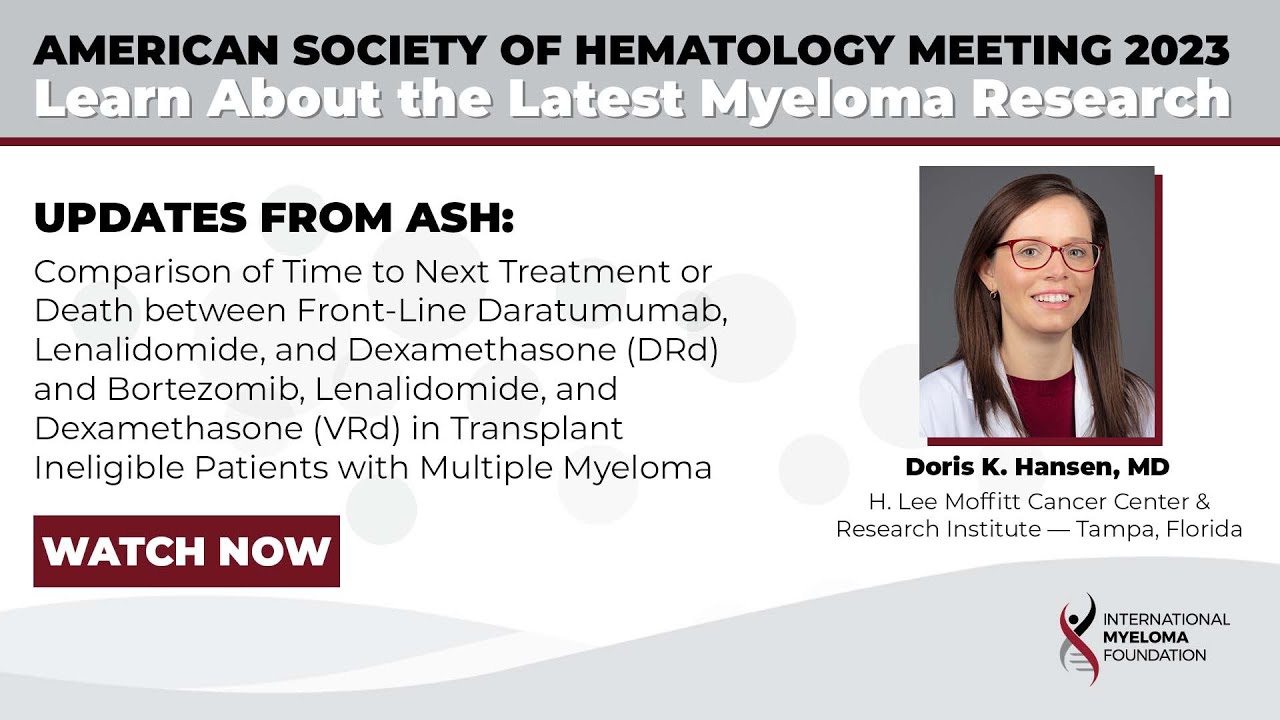
Dr. Doris K. Hansen discusses a study that compares real-world time-to-next-treatment (TTNT) or death between newly diagnosed multiple myeloma (NDMM), transplant-ineligible (TIE) patients treated with frontline (FL) Darzalex (daratumumab), Revlimid (lenalidomide), and dexamethasone (DRd) or Velcade (bortezomib) and Revlimid (VR).
Abstract Title:
Comparison of Time to Next Treatment or Death between Front-Line Daratumumab, Lenalidomide, and Dexamethasone (DRd) and Bortezomib, Lenalidomide, and Dexamethasone (VRd) in Transplant Ineligible Patients with Multiple Myeloma Presented at ASH 2023
What is the purpose of this trial?
The purpose of this trial is to investigate and compare the real-world effectiveness of two commonly preferred treatment regimens: Darzalex (daratumumab), Revlimid (lenalidomide), and dexamethasone (DRd); and Velcade (bortezomib), Revlimid (lenalidomide), and dexamethasone (VRd), in newly diagnosed multiple myeloma (NDMM) patients who are ineligible for transplantation. Despite both being recommended by the National Comprehensive Cancer Network (NCCN), a lack of direct head-to-head studies are being conducted to assess their clinical outcomes in this specific patient population.
This study seeks to address this gap by focusing on the critical endpoint of time-to-next-treatment (TTNT) or death. By examining real-world data, the research aims to provide valuable insights into the comparative effectiveness of DRd and VRd in NDMM patients ineligible for transplantation. Building upon the findings of the indirect comparison in the PEGASUS study, which indicated a lower risk of disease progression or death with DRd compared to VRd and Rd, this trial aims to contribute essential information to guide treatment decisions and improve outcomes for this patient cohort.
In this video:
Doris K. Hansen, MD, (Moffitt Cancer Center — Tampa, FL) discusses a study that compares real-world time-to-next-treatment (TTNT) or death between newly diagnosed multiple myeloma (NDMM), transplant-ineligible (TIE) patients treated with frontline (FL) Darzalex (daratumumab), Revlimid (lenalidomide), and dexamethasone (DRd) or Velcade (bortezomib) and Revlimid (VR).
Conclusion:
In this retrospective cohort study using EMR data, TIE NDMM patients who initiated DRd had a significantly longer time to next treatment or death than patients who initiated VRd. Results from this real-world study fills an unmet data gap by providing information on the comparative effectiveness evidence for DRd versus VRd among TIE NDMM patients. These findings support the use of DRd as an effective treatment option in the TIE NDMM patient population.
Trial Information: Abstract #543
Doctor Bio:
Dr. Hansen is an Assistant Member in the Department of Blood and Marrow Transplant and Cellular Immunotherapy and a practicing hematologist integrated in the Immune Cell Therapy (ICE-T) Program. Her clinical and research interests include using autologous transplantation and cellular immunotherapies to treat and improve outcomes in patients with multiple myeloma. In particular, Dr. Hansen is characterizing both clinical and patient-reported outcomes among patients with multiple myeloma receiving immunotherapies and identifying predictors of adverse outcomes among this patient population. Dr. Hansen founded and co-leads the U.S. Multiple Myeloma Immunotherapy Consortium, a collaborative of ≥ 18 institutions in the U.S. treating patients with multiple myeloma using immunotherapies. The ultimate goal of this consortium is to contribute to a better understanding of the efficacy and safety of novel immunotherapies.

