


DR. JOE MIKHAEL:
Hi everybody. Dr. Joe here from the International Myeloma Foundation. And it's such a pleasure today to have with me my dear friend and colleague, Beth Faiman, to help answer all the great questions that you send to us on a regular basis.
DR. BETH FAIMAN:
And as you heard, I'm Beth Faiman. I am a member of the Nurse Leadership Board of the International Myeloma Foundation. And I'm so excited to be here to answer all of your questions.
But before we dive into today's questions, I want to remind you that the International Myeloma Foundation hosts many in person and online educational seminars. We are here for you to answer all your clinical questions so you have all the knowledge you need to help with your care.
DR. JOE MIKHAEL:
And if you have more specific questions that you want to speak to someone about, please reach out to our info line and one of our coordinators will work with you. Or if you have that question in the middle of the night and you want to ask an AI chatbot, please come meet Myelo at myeloma.org and Myelo will also answer your questions.
All right, let's dive into some more questions. So here we have a great question from Tim who asks, "Why are patients choosing not to do stem cell transplant?"
DR. BETH FAIMAN:
So stem cell transplant has been considered a standard of care among newly-diagnosed patients with multiple myeloma who are able to undergo the procedure. But latest evidence shows that you might not need to undergo a stem cell transplant. The goal of therapy is the deepest and most durable response and some patients can achieve that just with induction therapy. So now we have evidence that maybe if you're achieving MRD or minimal residual disease, you can delay transplant and just stay on that effective therapy that got you into remission. But talk to your healthcare team and your provider and ask what they think is best for you for recommendations.
Why not replace transplant entirely with CAR T-cell therapy or bispecifics? Tell us.
DR. JOE MIKHAEL:
I love this question because someone is trying to predict the future. And I think as myeloma doctors, we all believe that CAR T-cell therapy and bispecific antibodies are going to make their way into frontline therapy. And they may someday replace autologous stem cell transplant. But the old adage is true, you're the champ until someone knocks you out. And so now we're doing the trials to compare CAR-T with transplant or bispecific antibodies with transplant. But we need that confirming evidence to prove unequivocally that these new treatments can do better than what we did with transplant and then perhaps we'll be using less transplant.
But it's just, to me, a very exciting time in multiple myeloma. We are increasing the options that we have for patients and introducing therapies that are going to be easier on the patient, but still tougher on their multiple myeloma.
Let's come to another question here for you, Beth, where someone says, "Does doing bispecific therapy before CAR-T make CAR T-cell therapy less effective?"
DR. BETH FAIMAN:
That is such a great question because we don't know 100% what the right sequencing is. So for example, we know that four drug induction is generally recommended for newly-diagnosed patients. And we know that we are moving CAR T-cell earlier into the treatment paradigm after one prior line of therapy. So generally based on that information, if patients are fit for CAR T-cell therapy procedure, it uses a BCMA target, we generally recommend, as does the International Myeloma Working Group, to go to the CAR T-cell therapy before the bispecific antibody therapy.
James asks, "What percentage of CAR T-cell patients remain cancer-free at five years?"
DR. JOE MIKHAEL:
I love this question, James, because this is a really special circumstance that we're now starting to discover with CAR T-cell therapy, that there are a fraction of patients who, after five years, are still remaining completely free of disease, after having had only that one infusion of CAR T-cell therapy five years before. That percentage is approximately 33% in patients that were treated with Cilta-cel or with CARVYKTI.
Now, interestingly, those were patients who had had multiple lines of therapy before, so it was quite surprising, and a good surprise at that, to see that fraction, that large a fraction of patients to stay in remission for that long.
We're hoping that as we introduce CAR T-cell therapy even earlier into the disease course, that that fraction may even be higher. And please, of course, follow us at the IMF and at myeloma.org as we share the newest research results as we're introducing even newer CAR T-cell therapies that we hope will even further increase the fraction of patients who will have that deep and durable response.
Beth, I've got a great question for you here that comes to us asking about this new CAR T-cell therapy that was just presented, the in vivo CAR-T. And someone says, "Will the new in vivo CAR-T carry a Parkinson's risk?"
DR. BETH FAIMAN:
So the in vivo CAR-T is an innovative product that we still don't have very many patients that have enrolled in the clinical trial. We just don't have enough information long-term and enough patients to say that it'll contain the same risk. Right now, there's not a worrisome signal. But again, even though it's deep and durable responses have been seen, we still have to have more time and research to show whether or not this is going to be a risk as well.
Gilbert asked, "Does family Parkinson's history increase the CAR-T risk of developing it as a side effect?"
DR. JOE MIKHAEL:
Thanks for this excellent question. We know that despite the fact that CAR T-cell therapy is so incredibly effective, with over 90% of patients responding, there is a small fraction of patients, perhaps around 1%, who will experience what we call a delayed neurotoxicity, where they may have a more serious side effect typically weeks or months after the CAR-T, of which one of those side effects is Parkinson's disease or a Parkinson's-like syndrome. Thankfully, we're studying this more, we're learning to understand who is at high risk, and maybe even how we can reduce that risk.
What we don't know is really what in the patient puts them at risk of developing that. And we've not determined that if someone has a family history or someone in their family with Parkinson's, that it puts them at higher risk. And so at present, if I have a patient in clinic who has a family history of Parkinson's, it would not necessarily be a reason to not proceed with CAR T-cell therapy.
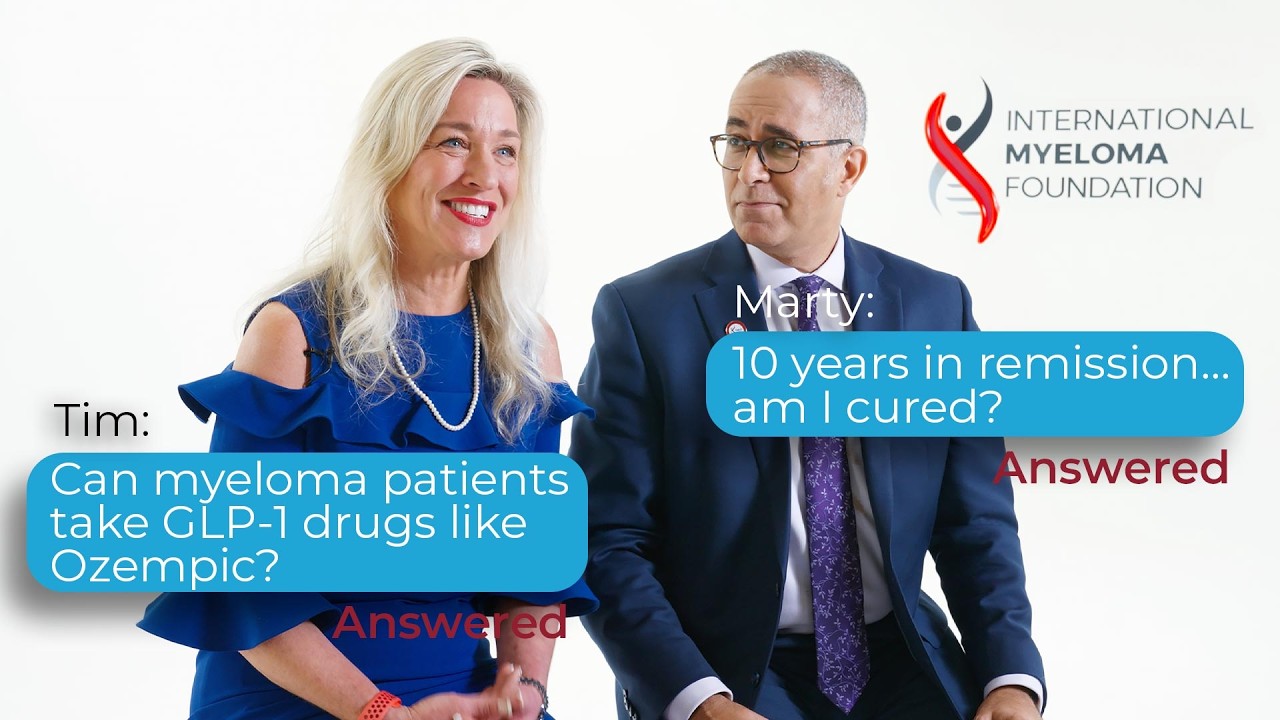
Tim asks, "Can myeloma patients use GLP-1 drugs for weight loss?"
DR. BETH FAIMAN:
That is a very relevant question. So GLP-1 drugs are for weight loss and for diabetes management, and they're all in the news these days. And so I get this question asked frequently as to whether or not it's safe for myeloma. Interestingly, there have been an explosion of studies lately about the safety in different blood cancers, including myeloma. Some patients with monoclonal gammopathy have a decreased risk of progression to myeloma. And in the myeloma patient studies, we've shown that there's a lesser chance of bad side effects that occur. So in my opinion, it's always better to discuss with your healthcare provider this question, but I think it's safe to use GLP-1 drugs in myeloma, and I haven't seen any studies to show any harmful side effects.
Oh, I have a question for you. So Marty asks, "I've been in remission for 10 years. Does that mean I'm cured?" Congratulations, Marty, by the way.
DR. JOE MIKHAEL:
Marty, I am thrilled to hear that you've been in remission for 10 years. And in many respects, people would think of that as a cure, that you've been in remission for such a long period of time. But of course, we know that, sadly, there are some patients that can still have a relapse that long after, although the risk goes considerably down after someone has been in remission for five years.
The exciting element of this is that really for the first time in the myeloma community, we are talking about what is cure in myeloma. When Beth and I started in myeloma over 25 years ago, we were really not using the word cure at all or maybe in a tiny fraction of patients. We all see and know that a larger fraction of patients are going into long-term remissions. And as a myeloma community, we're now coming together to define cure more meticulously so we can be using the same terminology together so that we can truly determine what fraction of our patients are being cured.
But I'm very excited about the future of multiple myeloma and believe that the fraction of patients who are going to be cured will continue to rise over time.

