This week's "Ask Dr. Durie" comes from a gentleman who wants to know what MRD is. MRD stands for minimal residual disease, which is a level of disease achieved as part of deep responses. The level of MRD is very low and is measured on bone marrow samples using new technology, either genetic testing called next-generation sequencing, or flow technology where the bone marrow sample is passed through a flow machine to detect any passing myeloma cells. This is called next-generation flow. With this technology, there is a high level of sensitivity in detecting one out of 100,000 cells, or even one out of a million cells, or even more. This ten to the minus five or ten to the minus six sensitivity, as it is called, is extremely helpful in documenting that deep response has been achieved.
The value of this methodology is that one can tell if modern therapies are producing better results. If therapy produces a ten to the minus six MRD level, this could be better than other older therapies where this is not achieved. So, the BOTTOM LINE is that MRD is an important new technology primarily used within trials to document if one therapy is better than another.
This is important because if documented early on, for example, within the first six months to a year to show that one therapy is better than another, it can speed up the approval process for new drugs, therapies, and combinations. This is tremendously helpful for pharmaceutical companies in the drug development process, but also for patients in accessing these new therapies.




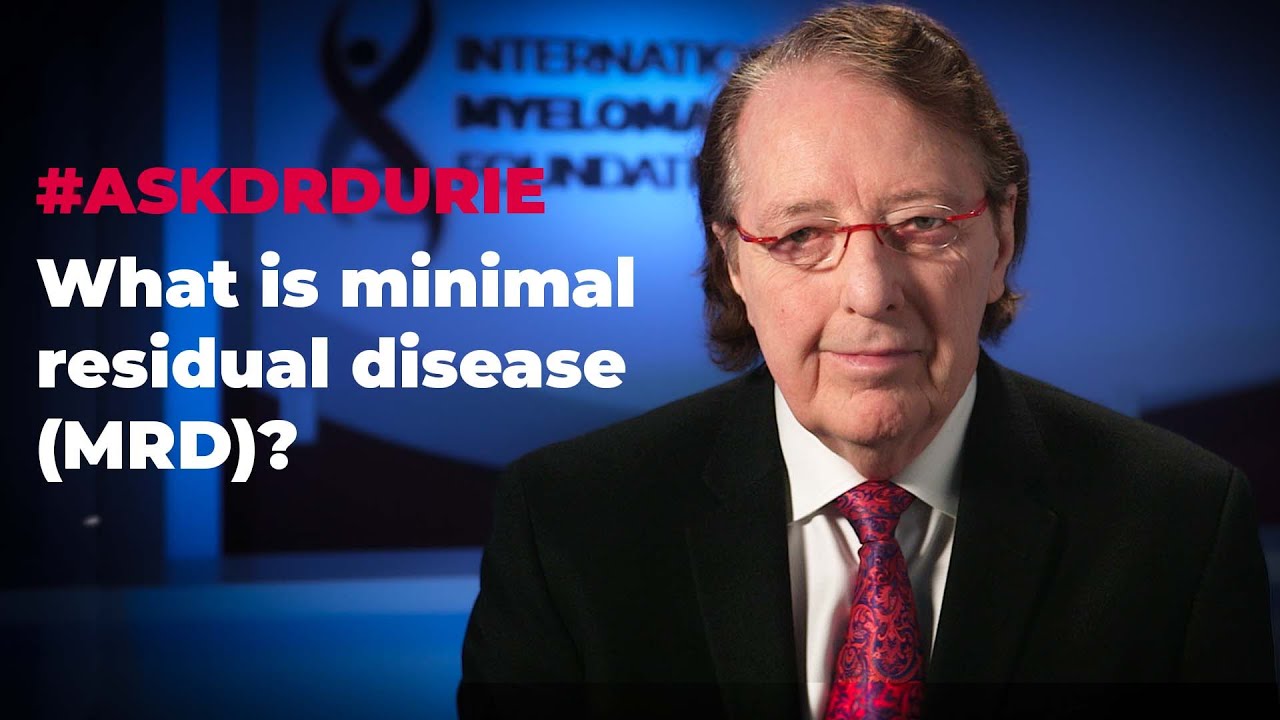
 Dr. Brian G.M. Durie (1942-2025) was the co-founder of the IMF. He was a Professor of Medicine, Hematologist/Oncologist, and Honoree MD at the University of Brussels.