


'BDN Research Grants have been shaping the future of myeloma research and transforming patients’ outlook for 30 years,' says IMF Interim CEO and SVP of Strategic Planning Diane Moran
The Brian D. Novis Grants Reception and Dinner took place on Saturday, August 16, at the Hilton Los Angeles/Universal City in Los Angeles, CA.
At the culmination of the Patient and Family Seminar (PFS) in Los Angeles, the IMF held its annual Brian D. Novis (BDN) Research Grant 2025 Reception and Dinner to award this year’s junior and senior grant recipients.
The BDN Research Grants were established in 1995 to honor the memory of IMF co-founder Brian D. Novis. The grant program promotes research into all myeloma areas to improve patient outcomes, with the grants awarded annually to deserving senior and junior investigators in the field of myeloma.
“The Brian D. Novis Research Grants, awarded by the IMF, recognize exceptional scientists dedicated to improving outcomes in myeloma. These grants are made possible by the generosity of our donors, whose support drives the innovative research transforming patient care today and bringing us closer to a cure tomorrow,” said IMF Chairperson of the Board Dr. S. Vincent Rajkumar.
During the awards and reception dinner, IMF Interim CEO and Senior VP of Strategic Planning Diane Moran, RN, MA, EdM highlighted the 30th anniversary of the BDN Research Grant Awards — “a program that has helped shape the future of myeloma research for three decades.”
“Over the past 30 years, the IMF has awarded nearly 160 grants to both junior and senior investigators, helping to fuel bold, high-impact research across the globe. Their research is part of a collective global effort that has transformed the outlook for myeloma patients. Thanks to work like theirs, survival has dramatically improved, over 20 therapies have reached patients, and—perhaps for the first time—we are beginning to see a clear path toward a cure. Tonight, we proudly recognize the 2025 Brian D. Novis Grant recipients, each of whom carries forward this legacy of progress,” said Diane, as she introduced this year’s BDN grant recipients.
“To our recipients: your work is not only advancing science—it’s reshaping the future for patients and families worldwide. And to our donors and partners, thank you. Your generosity helps move research from idea to impact.”
“As we honor our 2025 grant recipients, let us remember the power of research to change lives—and the importance of continuing this vital work. Together, we are advancing science, supporting innovation, and most importantly, standing beside every patient who’s counting on us,” stated Diane in closing.
IMF Executive VP of Research and Operations Lisa Paik spoke about the history of the program, as well as the overall peer review committee process:
“From the very beginning of the IMF, our founder, Brian D. Novis, a patient himself, had the vision and determination to raise money for myeloma research. His dream was simple yet profound: to ensure that scientists could continue advancing discovery, and that patients and families would benefit from that progress. In 1995, the very first Brian D. Novis Grant was awarded to a researcher at the Dana-Farber Cancer Institute. Since then, this program has been a cornerstone of the IMF’s mission.”
“In the past 30 years, the IMF has invested millions of dollars into innovative myeloma research across the globe. Each grant awarded has gone through a rigorous review process, ensuring that only the most promising and impactful science is funded.”
“We are honored to recognize our 2025 award recipients. We admire the excellence of your study aims and look forward to the discoveries your work will bring to the myeloma community. Congratulations on this well-deserved recognition.”
“Of course, none of this would be possible without our donors, their families, and their communities. Your generosity fuels the next generation of discoveries and gives hope to countless patients worldwide. On behalf of the IMF, thank you for believing in this mission,” Lisa expressed further.
Awardees and Donors
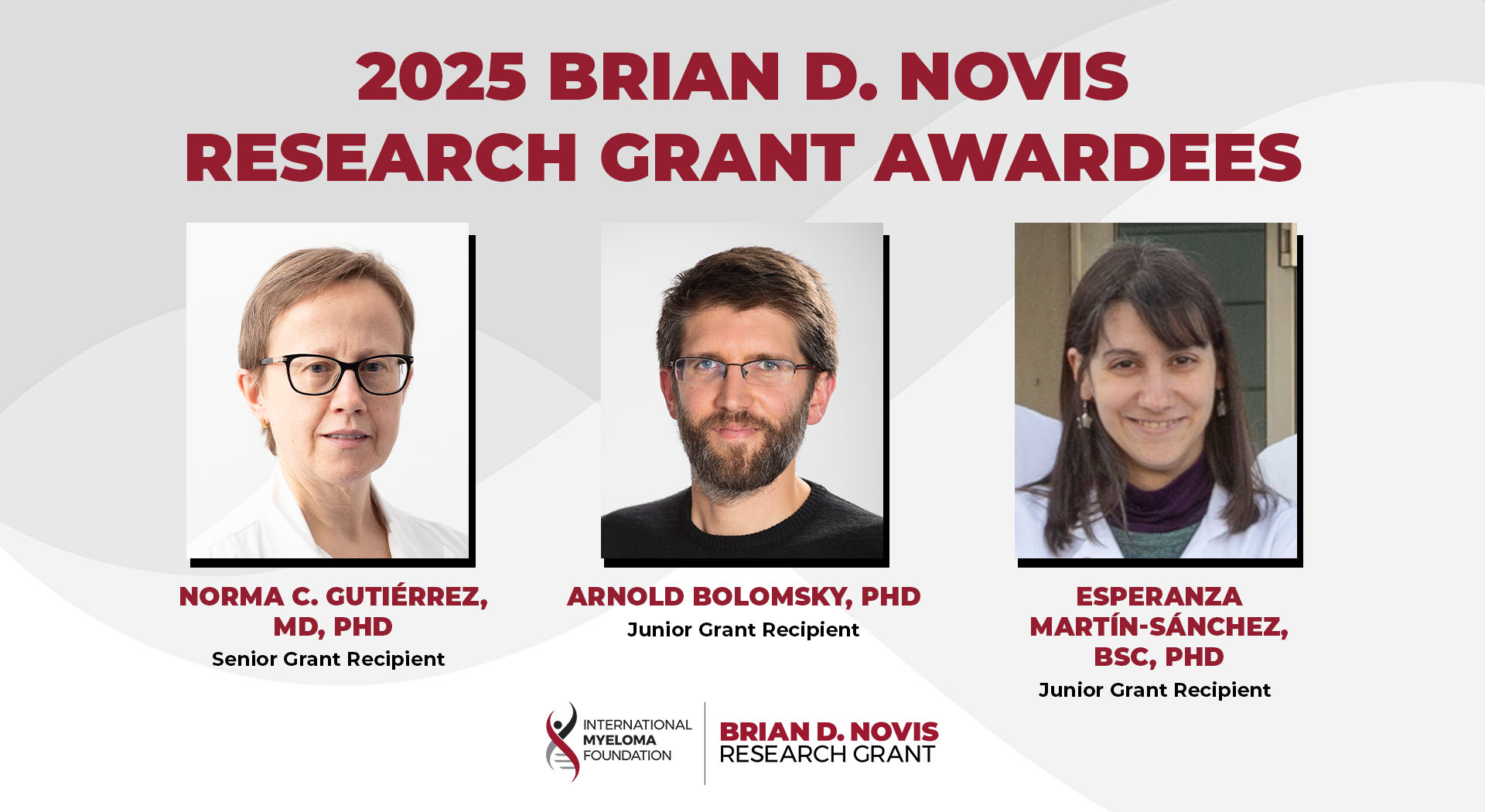
This year’s BDN junior grant recipients (amounting to $50,000 each) are:
Arnold Bolomsky, PhD
Lymphoid Malignancies Branch, National Institutes of Health
Organizer: Debbie Beatty and Family
Junior Grant Donor: Mission for Matt
Dr. Arnold Bolomsky began his myeloma research career as an undergraduate student in the laboratory of Heinz Ludwig in Vienna, Austria. More recently, he joined the Lymphoid Malignancies Branch at the National Institutes of Health, where he leverages multi-omics screening technologies to decipher novel myeloma-specific dependencies, with a special focus on targeting the key myeloma transcription factor IRF4. His research has been published in top-tier journals and both supported and awarded by multiple independent funding agencies.
Bolomsky’s project, “Targeting Novel Regulators of IRF4: Examination of RNA binding proteins regulating IRF4 expression as targetable vulnerability in multiple myeloma,” aims to define how the identified RNA binding proteins (1) control IRF4 expression, (2) regulate oncogenic transcription, (3) are involved in drug resistance to standard-of-care agents, and (4) determine whether they represent a plasma cell specific dependency in vivo. Targeting of IRF4 has curative potential and this study elucidates novel strategies on how to halt its activity in myeloma.
“Multiple myeloma is driven by a tightly regulated transcription program organized by IRF4. We recently confirmed IRF4 as the prime target in myeloma. Our detailed proteogenomic investigation of IRF4 biology revealed that specific RNA binding proteins regulate endogenous IRF4 expression,” said Dr. Bolomsky about his study.
“Tremendous progress has been achieved in the field of multiple myeloma, including significant changes in the treatment landscape. This made long-term disease control a realistic therapy goal for many patients. However, the requirement for continuous treatment to maintain disease control compromises quality of life and highlights the need for curative approaches. We believe that new drug classes specifically targeting plasma cell specific dependencies are key to achieve a myeloma cure. This study investigates novel approaches to target IRF4, the most essential myeloma gene and highly specific oncogenic driver of myeloma,” he further added.
Esperanza Martín-Sánchez, BSc, PhD
Cancer Center Clínica Universidad de Navarra — Pamplona, Spain
Organizer: Craig Czerkies
Junior Grant Donor: Czerkies Memorial Golf Outing
Dr. Esperanza Martín-Sánchez earned her PhD in Molecular Biology and Biomedicine from the Spanish National Cancer Research Centre (CNIO, Madrid, Spain), where she developed her thesis with the Lymphoma Group, focusing her research on the identification of new potential therapeutic targets in chemoresistant lymphomas.
Dr. Martín-Sánchez also became a part of the Translational Immunomics in Hematological Malignancies at the Center for Applied Medical Research (CIMA, Universidad de Navarra — Pamplona, Spain) to investigate on the preclinical evaluation of drugs in acute myeloid leukemia and multiple myeloma.
During the pandemic, Dr. Martín-Sánchez explored COVID-19 immunopathobiology and vaccine effectiveness to identify high-risk immune biomarkers, particularly in myeloma patients. Shortly after, she was granted by the Spanish Association Against Cancer to develop minimally-invasive methods to detect early myeloma.
For more than 15 years, Dr. Martín-Sánchez’s participation in 20 research projects has provided her with a wide expertise and knowledge in the molecular biology of cancer — reflected in 22 publications and over 30 peer-reviews in scientific journals.
Dr. Martín-Sánchez’s project, “Defining the pathogenesis of multiple myeloma by integrative next-generation flow and sequencing analyses of CTCs and MRD clones,” aims to elucidate the biological significance and genomic characteristics of multiple myeloma (MM) circulating tumor cells (CTCs) and minimal residual disease (MRD) cells using next-generation flow cytometry and sequencing technologies. CTCs, present in a significant portion of MM patients, may represent a metastatic subclone with unique genomic features.
“Additionally, we aim to characterize the genomic signature of ultra-chemoresistant MRD cells. These studies seek to identify novel therapeutic targets to prevent relapse and improve treatment outcomes in MM,” further stated Dr. Martín-Sánchez.
Her study “aims to understand how certain blood cancer cells in multiple myeloma (MM) spread and resist treatment. Rare cancer cells in the bloodstream and bone marrow are examined for their unique features and genetic makeup.”
By focusing on these cells, Dr. Martín-Sánchez “hopes to discover why some patients experience relapse even after intensive therapy and identify potential new treatments to prevent the cancer from coming back. Ultimately, her research seeks to improve outcomes for MM patients by targeting the most stubborn cancer cells responsible for disease spread and recurrence.”
The BDN Senior Grant (amounting to $80,000) was awarded to:
Norma C. Gutiérrez, MD, PhD
Institute for Biomedical Research of Salamanca (IBSAL)
University Hospital of Salamanca —Salamanca, Spain
Organizers: Ron and Sheree Pask
Senior Grant Donor: Miracles for Myeloma 5K Run/Walk
Dr. Norma C. Gutiérrez is an attending physician of Hematology at the University Hospital of Salamanca, Spain, and an associate professor in the Department of Medicine.
She is the principal investigator of “Molecular and Cellular Biology of Hemopathies” at the Institute for Biomedical Research of Salamanca (IBSAL), which comprises 30 researchers, including post-doctoral fellows, pre-doctoral students, and technicians.
Her primary research focuses on understanding the genetic basis of multiple myeloma and other monoclonal gammopathies using high-throughput genomic technologies and functional assays.
Additionally, Dr. Gutiérrez coordinates the cytogenetic studies for the Spanish Myeloma Group. To date, she has published over 200 peer-reviewed original papers in international journals.
Dr. Gutiérrez’s project, “RUVBLl as a synthetic lethality approach for MYC overexpressing Multiple Myeloma,” aims to validate RUVBL1 as a synthetic lethal gene for MYC and evaluate its inhibition, as a new therapeutic approach for MYC-overexpressing myeloma patients.
According to Dr. Gutiérrez, “Multiple myeloma (MM) is characterized by malignant plasma cell accumulation in the bone marrow. The MYC oncogene is altered in 40-50% of MM cases, and its overexpression is linked to increased tumor growth and disease progression. Directly targeting MYC is challenging due to its complex structure and involvement in numerous cellular processes. One strategy that could help to overcome the difficulties in the development of direct inhibitors is to exploit the concept of synthetic lethality.”
Her study “investigates the gene RUVBL1 as a potential target to selectively eliminate multiple myeloma (MM) cells overexpressing MYC and to evaluate a specific RUVBL1 inhibitor as a new potential treatment for this subset of MM patients. These efforts aim to improve survival and quality of life of MM patients by exploring innovative treatment approaches.”
“Multiple myeloma is a type of blood cancer where abnormal plasma cells accumulate uncontrollably in the bone marrow. The MYC gene is commonly altered in MM, accelerating tumor growth and disease progression,” stated Dr. Gutiérrez.
In his closing remarks at the awards and reception dinner, IMF Chief Medical Officer Dr. Joseph Mikhael emphasized two things that are vital to advancing myeloma care: research and the people behind it.
“The IMF has been a trusted resource for the myeloma community as well as a critical convener of research worldwide. When the IMF conducts research it does so with the CCC model – Creative, Collaborative and Comprehensive. Creative in that we seek novel and unique ways to understand, measure and attack myeloma – there isn’t only one way to conquer this cancer, it takes a multifaceted approach. Collaborative in that we bring together the world of myeloma – academic institutions, patients, industry, regulators – all in one place, to find solutions that individually they could not discover. Comprehensive in that we approach myeloma from the bench to the bedside, from its precursors to its most aggressive forms – we cover the whole spectrum of the disease and all who are affected by it worldwide,” explained Dr. Mikhael.
“This is why funding is the lifeblood of the IMF’s research initiatives,” states IMF VP of Development Sylvia Dsouza. “Science requires funding, with research needing unrestricted dollars to search for a cure. The IMF is grateful to all its donors for sustaining the BDN Research Grants for the past 30 years. We hope you’ll continue to support the IMF’s initiatives and play a vital role in our fight against myeloma,” said Sylvia.
To know more about the Brian D. Novis Research Grants and past BDN grant recipients, visit myeloma.org/brian-d-novis-research-grants.
Make an Impact on Myeloma Research and Finding a Cure
IMF Vice President of Development Sylvia Dsouza invites you to join the International Myeloma Foundation in its efforts to help fund and further myeloma research. If you are interested in supporting the Brian D. Novis Research Grants program, please reach out to Sylvia by emailing [email protected] or by calling (310) 947-4126 to start a conversation.