


The Brian D. Novis Grants Reception and Dinner took place on Saturday, August 17, at the Sheraton Universal Los Angeles in North Hollywood.
At the culmination of the Patient and Family Seminar (PFS) in Los Angeles, the IMF held its annual Brian D. Novis (BDN) Research Grant 2024 Reception and Dinner to award this year’s junior and senior grant recipients.
The BDN Research Grants were established in 1995 to honor the memory of IMF co-founder Brian D. Novis. The grant program promotes research into all myeloma areas to improve patient outcomes, with the grants awarded annually to deserving senior and junior investigators in the field of myeloma.
IMF Vice President of Development Sylvia Dsouza was the evening’s gracious host and emcee, welcoming donors, awardees, and special guests as they enjoyed their cocktails and dinner.
IMF President & CEO and 28-year myeloma patient Yelak Biru kicked off the evening with his opening remarks.
“Tonight, we gather to honor the legacy of Brian D. Novis, the co-founder of the International Myeloma Foundation, and to celebrate exceptional individuals whose groundbreaking research is paving the way for a brighter future. Brian's story resonates deeply with all of us. Diagnosed with myeloma at a young age, Brian was not content to accept the status quo, as you are also not accepting of the status quo.”
“These efforts are accelerating progress towards earlier detection, more effective therapies, and improving patient outcomes on a global scale. Tonight, we are here to honor, not only the recipients of the 2024 Brian D. Novis Research grants, but also the transformative power of research itself.”
“It is through your tireless efforts that we inch closer to a world where myeloma is no longer a life-threatening diagnosis. The impact of your work extends far beyond the laboratory, and it brings hope to patients and their families who yearn for better treatment options and a brighter future. As we recognize the achievements of these outstanding researchers, we must also pay tribute to the broader research community and the countless individuals who dedicate their lives to unlocking the mysteries of myeloma.”
“To our donors, your generosity is truly commendable. By investing in the Brian D. Novis Research Grants, you are paving the way for groundbreaking discoveries and innovative therapies in multiple myeloma. You are providing researchers with the resources they need to push the boundaries of scientific knowledge and to accelerate the development of lifesaving treatments for all myeloma patients globally. Your dedication to advancing myeloma research is a beacon of hope. And tonight, we celebrate not only the remarkable projects you have supported, but also the long-term impact of your contributions to myeloma research,” stated Yelak.
Awardees and Donors
IMF Vice President of Patient Support Robin Tuohy facilitated the awards segment and introduced the BDN junior and senior grant recipients, as well as their respective donors.
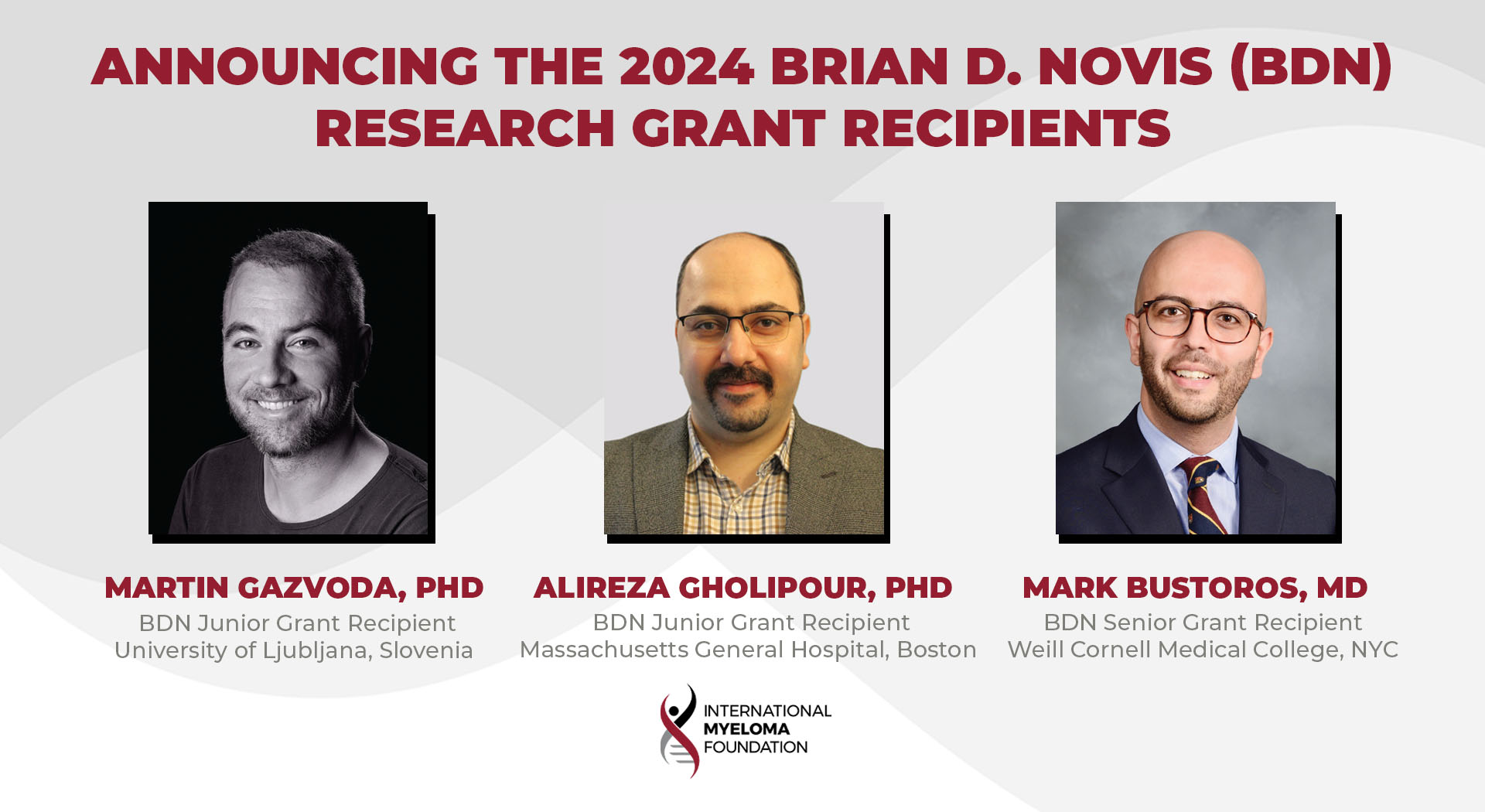
This year’s BDN junior grant recipients (amounting to $50,000 each) are:
Martin Gazvoda, Ph.D.
University of Ljubljana, Slovenia
Organizer: Kent Oliver
Junior Grant Donor: Laughs for Life
Martin Gazvoda received his PhD in chemical sciences from the University of Ljubljana in 2013. After a postdoctoral stay at the Chemical Development of Sandoz GmbH (Novartis) in Kundl, he started working as a research associate at the University of Ljubljana in 2014 and became an assistant professor of organic chemistry at the Faculty of Chemistry and Chemical Technology, University of Ljubljana in 2018.
In 2020, he received a Fulbright Grant under the Fulbright Visiting Scholar Program to conduct research at the Massachusetts Institute of Technology.
Dr. Gazvoda's research interests lie in the interface between organic chemistry, physical chemistry, and chemical biology. He is working on the development of synthetic methodologies for the selective modification of complex biomolecules, such as proteins, with the aim of improving (modifying) their stability, catalytic activity, and binding to target antigens.
While boron neutron capture therapy (BNCT) has been described as an almost ideal treatment for cancer, it is not accepted as a treatment option in the clinic.
“Despite tremendous efforts, the major challenge to date has been to selectively deliver boron to target cells. Building on our proof of principle that proteins can be selectively enriched with boron, we aim to enable targeted BNCT for the treatment of multiple myeloma by preparing boron-rich antibodies. The synergistic effect of demonstrated therapeutic profile of antibodies combined with localized lethal alpha radiation at myeloma sites could overcome the treatment challenges, e.g., solid malignancies,” said Dr. Gazvoda about his project, "Boron-rich antibodies for synergistic targeted therapy with boron neutron capture therapy (BNCT) in multiple myeloma data.”
Alireza Gholipour, PhD
Massachusetts General Hospital, Boston
Organizer: Ron and Sheree Pask
Junior Grant Donor: Miracles for Myeloma 5K Run/Walk
As a distinguished academic and biomechanical simulation expert, Dr. Gholipour currently leads research efforts at Massachusetts General Hospital (MGH) and Harvard Medical School (HMS), focusing specifically on advancing spinal stability in patients with multiple myeloma.
Dr. Gholipour integrates computational biomechanics, medical imaging, and artificial intelligence to pioneer predictive biomechanical models aimed at enhancing the understanding and treatment of spinal complications.
His project is centered on developing a novel patient-specific predictive simulation approach, designed to revolutionize the care of spinal instability in multiple myeloma by leveraging patient-specific data for greater diagnostic accuracy and therapeutic effectiveness. Dr. Gholipour is committed to merging advanced simulation technologies with clinical insights, striving to fill a critical void in personalized medicine for multiple myeloma.
“With a solid foundation in engineering and a specialized interest in spine biomechanics, my research includes creating automated biomechanical detection systems for spinal instability and utilizing AI for clinical decision support,”” said Dr. Gholipour about his proposal, demonstrating his dedication to improving multiple myeloma patient care and to pushing the boundaries of patient-specific predictive medicine in diagnosing, treating, and screening complex spinal disorders.
His project, "Advancing spinal stability in multiple myeloma: a predictive biomechanical simulation approach,” aims to develop a patient-specific predictive biomechanical simulation model for spinal stability in multiple myeloma patients.
The objectives of the study are: (1) to investigate biomechanical factors contributing to spinal instability in multiple myeloma using advanced simulation techniques; (2) to develop a patient-specific predictive model incorporating disease-related factors, identifying patients at higher risk of spinal instability; (3) to validate and refine the predictive model through clinical evaluation, comparing predictions with actual outcomes.
The BDN Senior Grant (amounting to $80,000) was awarded to:
Mark Bustoros, MD
Weill Cornell Medical College, New York City
Organizer: Pam Poliakoff and the International Myeloma Foundation
Senior Grant Donors: Inland Empire Virtual/In-Person Walk for Myeloma Miracles and Miles for Myeloma 5K Run/Walk
Dr. Mark Bustoros is an Assistant Professor and physician-scientist in the Hematology & Medical Oncology division at Weill Cornell Medicine in New York City.
After completing his medical training in Hematology, Dr. Bustoros did his postdoctoral training at Dana-Farber Cancer Institute in Boston, where he studied the mechanisms and biomarkers of progression of multiple myeloma from its precursor conditions.
He became an instructor of Medicine at Harvard Medical School and continued conducting his research in myeloma and Waldenström’s macroglobulinemia. As a physician-scientist, he also focuses on studying the biological and environmental factors associated with racial disparities in myeloma.
Dr. Bustoros is involved in novel therapeutic targets, epigenetic alterations, and mechanisms of resistance and relapse to immunotherapies in myeloma, combining experimental and computational work to study potential targets and different myeloma subgroups and presentations.
His project, “Characterizing the Role and Targeting of the histone methyltransferase SETD2 in Multiple Myeloma,” studies the epigenetic protein SETD2 in myeloma to understand its role and how targeting it causes tumor cell death. The overall goal is to determine the role of SETD2 in myeloma pathogenesis and the effects of targeting this human gene to cell survival and proliferation.
“Our central hypothesis is that SETD2 is an essential gene for myeloma pathogenesis through maintaining genomic stability and transcription of essential genes in tumor cells and has a synthetic lethal effect in the t(4;14) subtype. This is based on our preliminary data showing that SETD2 is frequently overexpressed and mutated in newly diagnosed and asymptomatic MM patients, and genetic and chemical perturbation of SETD2 is cytotoxic to myeloma cells and their proliferation,” states the proposal.
In his closing remarks, IMF Chief Medical Officer Dr. Joseph Mikhael spoke about the future of myeloma research and related initiatives at the IMF and beyond. Here are some excerpts:
“When we think about research, you know, it is meticulous, challenging, time-consuming in the lab or in the clinic. It feels like you are not making a whole lot of progress at any given moment.”
“But sometimes, it is important for us to step back and look at the big picture and realize that every single piece, every single hour, every single test — everything that we do, ultimately has an impact. And it's a privilege at the IMF to be a big part of that. And as I was thinking about how we put it together, some of you heard me say before, that the IMF has a lot of different superpowers for which I'm very grateful to be a part of.”
"When it comes to research, I think of what I call the three CS of the IMF: collaborative, creative, and comprehensive.”
“[The IMF] brings together everyone and we bring together the right people in the right context, in the right way to achieve results.”
“When you support the IMF, you are supporting myeloma patients, not just in your own community, but across the whole planet, comprehensively. You see that the IMF is a trusted partner in the way we do research collaboratively, creatively, and comprehensively that will hopefully change the whole face of multiple myeloma. We have already seen that change and we have seen people. There are people here tonight who are with us because of that kind of research,” stated Dr. Mikhael.
“I am beyond thrilled to have hosted this event in Los Angeles, where the IMF is headquartered, and to bring IMF’s long-time friends, supporters, and awardees together to celebrate innovation and cutting-edge research that will bring us closer to finding a cure for myeloma. The IMF cannot accelerate its mission alone, we need all who have the passion, dedication, commitment, and resources to help us reach our goals and fulfill our aspirations.”
“Science requires funding, with research needing unrestricted dollars to help find answers to key questions related to myeloma and to search for a cure. I am grateful to all donors—past, present, and future—who helped us get this far. I also want to thank in advance those who are willing to play a vital role in the IMF’s fight against myeloma. I strongly encourage you to join us,” said IMF Vice President of Development Sylvia Dsouza.
To date, the IMF has funded over 100 of the most promising projects by senior and junior investigators in multiple myeloma. Important research supported by the IMF has made contributions that bring us closer to fulfilling the IMF’s mission – finding a cure for myeloma.
The IMF warmly congratulates this year’s BDN Research Grant Recipients and looks forward to next year’s junior and senior grant recipients. We also wish to thank all the organizers and donors of this year’s junior and senior grants.
To know more about the Brian D. Novis Research Grants and past BDN grant recipients, visit myeloma.org/brian-d-novis-research-grants.