

ASH 2025 Myeloma Satellite Symposium: SMM, Quad Therapy & SDM
By Jessie Daw, PhD
I was up and at’em for my first session, which began at 6:30AM Central time. This session, Steady Progress in Multiple Myeloma: Applying New Data and Updated Guidelines Throughout Treatment, looked at the spectrum of myeloma. My interest was in the precursor state of smoldering multiple myeloma (SMM), which was covered first. The presenters, Carol Ann Huff, Thomas G. Martin, and Adriana Rossi, reviewed the aims of ongoing clinical trials in smoldering multiple myeloma (SMM). They highlighted that trials have essentially one of two approaches: (1) Some trials are testing modest interventions designed to slow the progression of the disease, while (2) others are exploring more aggressive treatments intended to completely prevent development of active myeloma.
They provided an overview of many of the completed and on-going trials, and how they aligned with the two approaches. They acknowledged that the field is evolving rapidly. In addition to the trials, they also indicated that T-cell engagement therapies are emerging as an exciting frontier, offering a potentially powerful new way to treat SMM before full-blown myeloma develops.
Although my focus is on SMM, I also took part in a satellite symposium on therapy for newly diagnosed multiple myeloma (NDMM)—a stage we hope to avoid but may someday face if SMM progresses. The presentation, titled “Four” Every Patient: Maximizing Outcomes in Newly Diagnosed Multiple Myeloma, argued convincingly that a four-drug (“quad”) combination as first-line therapy is becoming the norm. In fact, the speakers suggested flipping the standard question: instead of asking “Who is a candidate for a quad upfront?”, we should consider instead “Who isn’t?”
They emphasized that key factors now guiding treatment decisions include not only patient health and myeloma characteristics, but also any prior therapy history. Importantly, some patients classified as NDMM may already have received treatment — such as daratumumab — if they participated in a prior clinical trial or were treated with daratumumab while smoldering. This will reshape how clinicians choose initial therapy upon progression to active myeloma.
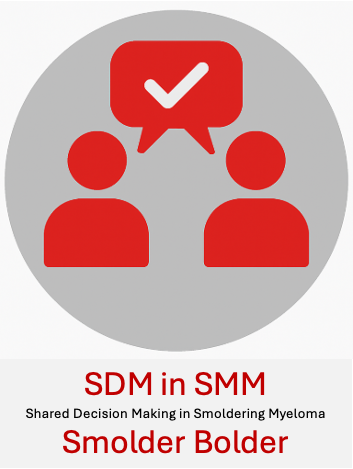
The session, led by Caitlin Costello and Paul G. Richardson, also stressed the importance of shared decision-making (SDM) As they indicated, the era of paternalistic medicine is fading; now patients and their physicians must engage in a true dialogue to pick the best course of action. As the landscape changes rapidly in the SMM space, SDM will only become more important. So important that I decided to develop an icon for this concept:
It was a good first day! These sessions kicked off the pre-conference programming — the formal research presentations start tomorrow. I’m looking forward to diving deeper into the latest data, and I’ll continue to share what I learn!
Jessie Daw
THIS BLOG IS HOSTED BY THE INTERNATIONAL MYELOMA FOUNDATION (“IMF”) FOR MULTIPLE MYELOMA SUPPORT GROUPS. THE CONTENT APPEARING ON THIS WEBPAGE IS NOT CONTROLLED OR PROVIDED BY IMF, AND IMF NEITHER WARRANTS NOR GUARANTEES THE ACCURACY OF SUCH CONTENT. THE FOREGOING NOTWITHSTANDING, THE CONTENT IS NOT A SUBSTITUTE FOR ADVICE AND SERVICE PROVIDED BY QUALIFIED AND LICENSED MEDICAL PROFESSIONALS, AND SHOULD NOT BE RELIED ON WITH RESPECT TO ANY HEALTH MATTERS. ANY HEALTH-RELATED INFORMATION FOUND HEREIN IS ONLY MADE AVAILABLE AS PART OF A GENERAL EDUCATIONAL SERVICE.
Published on December 5, 2025.