Dr. Brian G.M. Durie (1942-2025) was the co-founder of the IMF. He was a Professor of Medicine, Hematologist/Oncologist, and Honoree MD at the University of Brussels.




With new information emerging from ASH 2022 and more recently, from ASCO 2023, the 2023 IMWG Summit and EHA 2023 annual meetings, this question comes to mind: How has myeloma care changed?
The answer may surprise you, as we review the impact on recommended testing and the approaches to treatment decision making.
“Knowledge is Power” has been and continues to be the mantra of the International Myeloma Foundation, thanks to its founder, Susie Novis Durie.
It is still the key guiding light for myeloma patients—to gather as much information as possible and to discuss them with their respective doctors.
While sources of information have evolved over time, Susie and the IMF still prioritized the power of in-person learning by creating the Patient and Family Seminar (PFS).
The Patient and Family Seminar was structured to allow patients time to be able to directly ask myeloma experts questions of greatest concern. The seminar also presents the opportunity for them to meet other patients and caregivers in person to discuss their unique experiences of myeloma and to learn from one another. In-depth questions and answers were discussed among the breakout groups.
Over the years, the Patient and Family Seminar has been the most successful IMF program—expanding to countries all over the world and being held on a regular basis.
This focus on “Knowledge is Power” became a global phenomenon and has expanded to include other diseases, while using the same model.
Inspired by the success of the Patient and Family Seminars, the IMF created the Regional Community Workshop (RCW) —a condensed version of the PFS which focuses on serving smaller, underserved communities across the United States.
And while this was all happening, the formation of local support groups also began to thrive—providing huge support to myeloma communities through structured regular meetings and the annual Support Group Leader Summit (SGLS).
Tireless efforts being made by IMF support groups help coordinate, innovate, and enhance patient and care provider programs and activities thus, improving patient outcomes while promoting self-care for care providers.
“New knowledge” continues to bring new innovations to myeloma research. The hope is that as testing continues to evolve and become more sophisticated and precise in its findings, it will pave the way for myeloma patients and their healthcare team to choose the best treatment options and possibly, even find a cure in the not-so-distant future.
The majority of tests used to diagnose and monitor myeloma have been in place for almost three decades now, with baseline staging existing even longer.
Routine blood tests, chemistry panel, Serum Protein Electrophoresis (SPEP) plus immunofixation, FREELITE, and of course, routine bone marrow aspiration and biopsy are still being used to assess myeloma cell percentage. Flourescence in situ hybridization (FiSH) is also conducted to map genetic material (including specific genes or portions of genes) to determine risk status.
Imaging of bone and soft tissue is well-established, using X-rays, Computerized Tomography (CT), Magnetic Resonance Imaging (MRI), as well as CT-PET scanning.
To search for myeloma-related bone lesions more accurately, whole-body low-dose CT scanning is being used as the main innovation at baseline and monitoring, as opposed to routine X-rays.
The introduction of better therapies that frequently produce very deep response has necessitated reliable monitoring at low levels of the disease, even beyond traditional complete response (CR). Two types of testing have been introduced to detect myeloma at these low levels of disease.
These are cellular tests that look for low levels of myeloma cells in the bone marrow and blood. This is called minimal residual disease (MRD) testing.
Next Generation Flow (NGF) will become commercially available for this assessment in 2024 in the U.S. NGF is used to determine the number of myeloma cells using a flow cytometry approach.
This method plus a related method called Next Generation Sequencing (NGS)—a method that detects the specific gene sequence of myeloma cells the specific gene sequence of myeloma cells—have been used in the clinical trial setting for several years now.
These tests are clearly valuable for the documentation of very deep response and in indicating that one treatment is better than the other in producing such deep responses (MRD undetected).
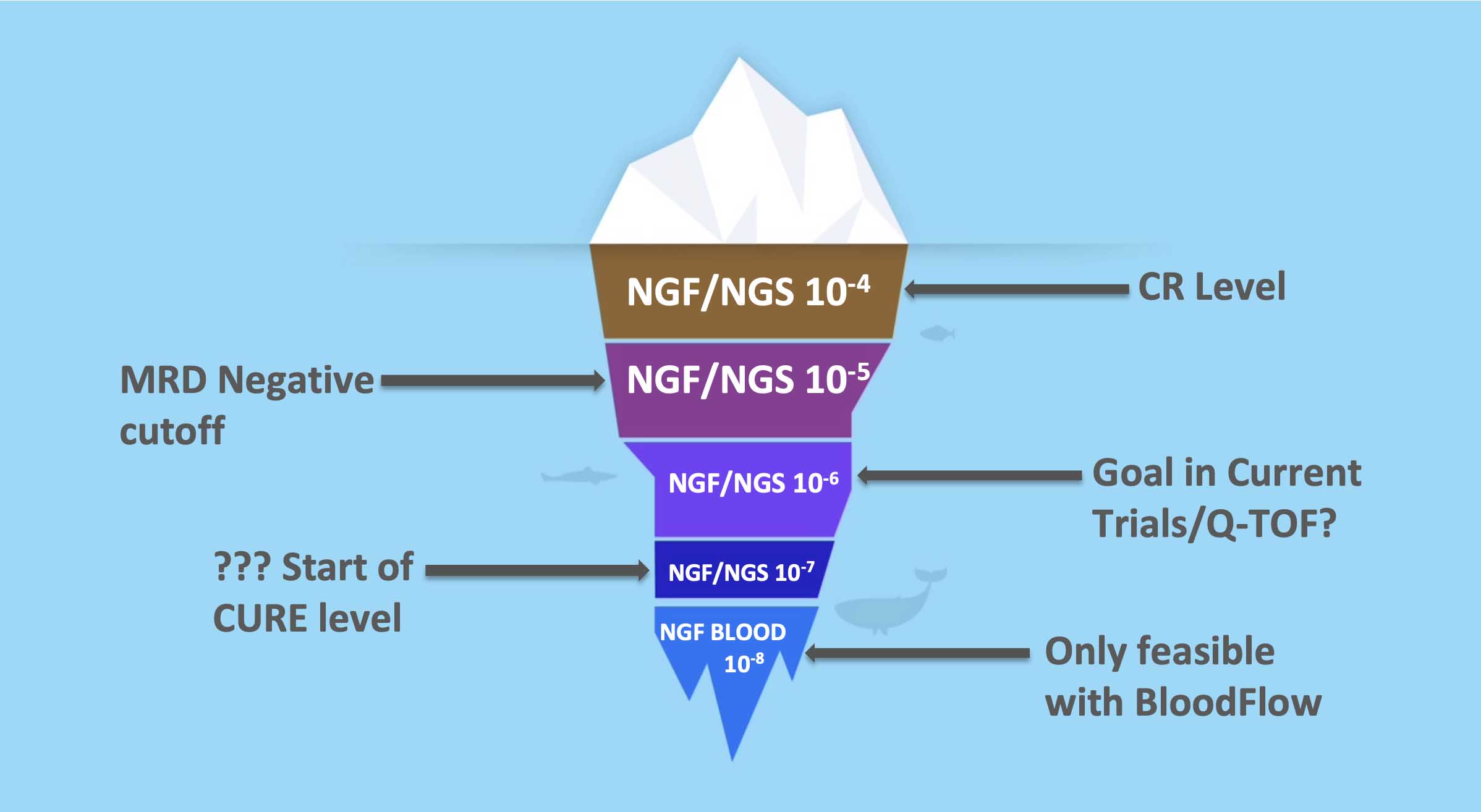
Mass spectrometry is a type of protein testing which uses very sensitive methodology to detect very low levels of myeloma protein in blood and urine.
Mass spectrometry has also been used in clinical trials for several years to assess response. When the mass spectrometry test (Maldi-TOF method) indicates a negative result, this correlates with a response that is somewhat better than CR using traditional SPEP and IFE testing.
The Maldi-TOF method will become commercially available in the U.S. in 2024, with the trade name, EXENT method.
A more sensitive method called Maldi-Q gives information similar to MRD testing and will become available in the future.
Next Generation testing is almost here! However, standardization and guidelines are required to for doctors and patients to be able to interpret test results.
NGF guidelines need to be put in place to standardize the collection of samples for testing (sample acquisition) as well as all aspects of processing and reporting of results.
Fortunately, there is a software program which automates details of sample processing (called cell gating). However, right now there is no safeguard against the reporting of “no myeloma detected” which may be due to a poor-quality sample.
Guidelines for mass spectrometry are likewise required for doctors and patients to be able to compare what the advantages of mass spectrometry (EXENT method) are over traditional testing. Assessment of real-world and clinical trial data is required for best guidance.
As previously noted, in-person learning remains to be the most important central tool. Over the years, it has become clear that nothing beats meeting and interacting with patients who have been experiencing similar issues and concerns.
On top of that, the opportunity to ask a panel of experts at a PFS or RCW meeting to ask key questions is the best means to get unique advice tailored to a patient’s needs. Another benefit to in-person learning is being able to openly ask questions and talk about one’s experiences in a supportive setting.

With so much new information going around, how can doctors and patients keep up?
So many questions involving new guidelines and treatment options. For example, what is the new Standard of Care (SOC)? Is that new immune therapy you heard about good for you? Where is it available?
While information can be acquired through in-person meetings and the IMF InfoLine, there are also new information tools that doctors and patients can utilize.
Of course, I would recommend exploring the IMF website first and foremost for the latest information on myeloma.
Other reliable information tools include Wikipedia, UpToDate, PubMed, Humata.AI, and ChatGPT (plus direct sourcing and magic prompts).
ChatGPT-4 has been getting a lot of buzz lately—it is truly an incredible resource. HOWEVER, it must be directed to only use trusted resources, as emphasized by Brian Chen of the NY Times in his article, We’re Using A.I. Chatbots Wrong. Here’s How to Direct Them.
One general tip which I have mentioned before is to use “magic prompts” so as to have ChatGPT-4 act like a myeloma expert and to instruct it to use ONLY trusted sources which you would have to provide.
As noted by Gina Kolata of NY Times in her article, A Mystery in the E.R.? Ask Dr. Chatbot for A Diagnosis, ChatGPT-4 can be relied on “for help in reaching a diagnosis.”
However, caution is still definitely needed when using AI tools for this purpose.
The next generation is coming but is still NOT quite here.
Right now, all we can do is to STAY TUNED.
Dr. Brian G.M. Durie (1942-2025) was the co-founder of the IMF. He was a Professor of Medicine, Hematologist/Oncologist, and Honoree MD at the University of Brussels.