


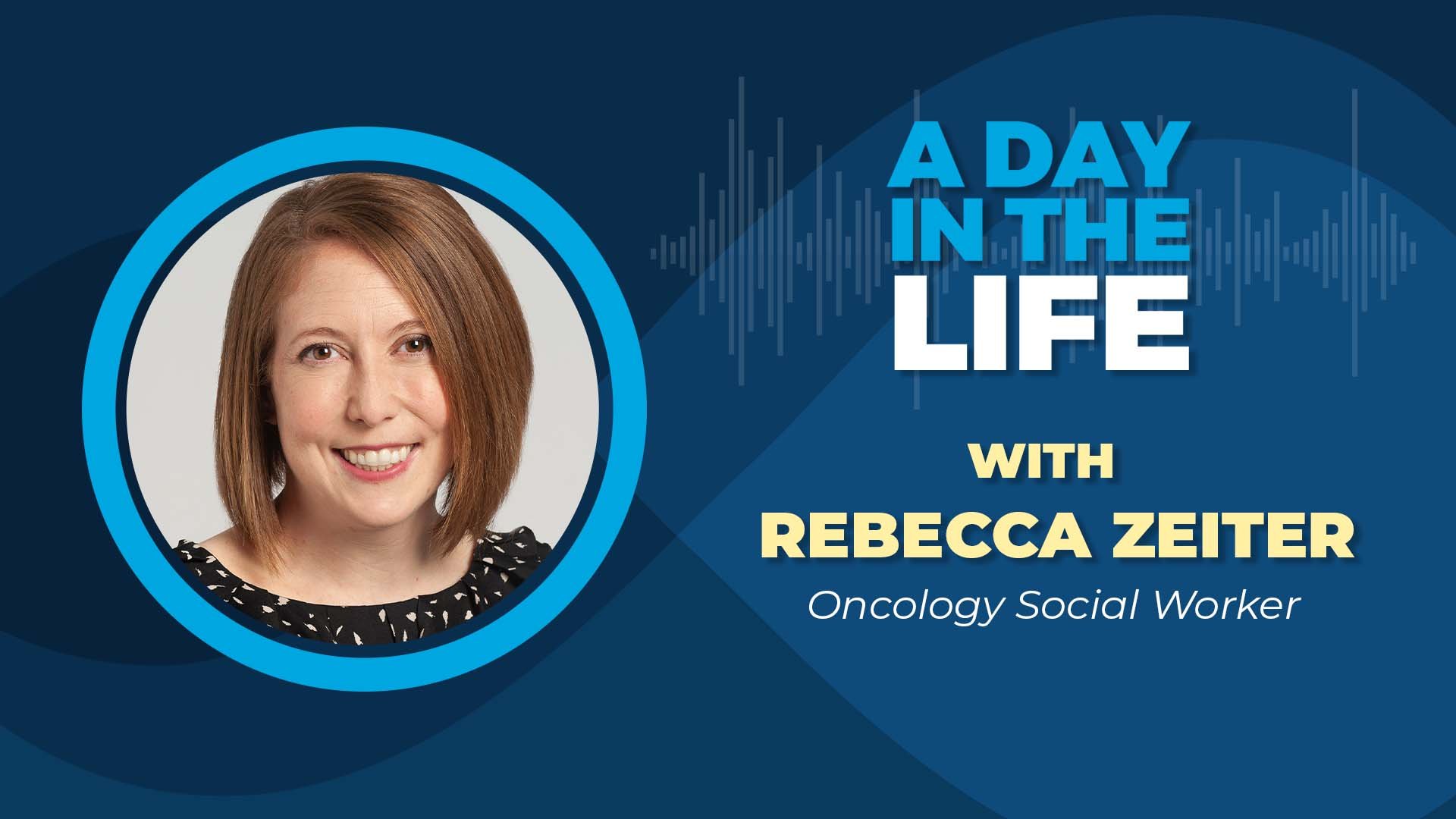
IMF Communications: Hello, everyone. You're watching a Day In The Life. We're bringing this to you as a video-cast today, rather than a podcast. Brought to you by the International Myeloma Foundation. We hope that this video today will provide messages of hope and resilience for those in the myeloma community and beyond. Today we are talking to Rebecca Zeiter, who holds a Master of Science in Social Administration and is a licensed social worker with the Cleveland Clinic Taussig Cancer Institute. Rebecca, thank you so much for being our guest today.
Rebecca Zeiter: Thank you. Nice to be here.
IMF Communications: Great. My first question for you is, as an oncology social worker, what role do you play for cancer patients and their care partners who are facing a diagnosis or undergoing treatment?
Rebecca Zeiter: Absolutely. The role of a social worker, we are an integrated part of the care team. So we look at it as, of course there's multiple levels of care. There's your oncologist, your hematologist, your nurse, and then the social worker, along with many other players as well. But we are an integrated part of that team from start until wherever that path goes.
IMF Communications: And what are some typical aspects of oncology social work? We all are familiar with social workers as far as like one-on-one therapy or in counseling, but when somebody is diagnosed with cancer, they might not be familiar with working with an oncology social worker. What are some things that you can inform patients or the general public what oncology social worker's role is in the process?
Rebecca Zeiter: Of course. So when I first meet with patients or families, the main thing, how I identify my role is really to help eliminate any barriers of care. So whether that is physically getting to those treatment appointments or appointments in general or if there's emotional barriers going on, they're human, everyone's human, there's a lot to process. So the role of the social worker is there to help either eliminate or help process through whatever barriers a person may be experiencing. We are there as an educational point when it comes to those psychosocial factors as well as general support and an ability for individuals to verbalize feelings and emotions.
IMF Communications: And one of the things you mentioned was getting to the appointments and so I was going to kind of go more into detail with that. Transportation needs, side effect management, a home care, being able to get meals at home. What kind of role does the oncology social worker play in that aspect?
Rebecca Zeiter: Absolutely. So transportation, you mentioned, absolutely, it can be one barrier to receiving treatment. So oncology social workers do look into options for patients and families to get to those appointments. So whether it is physically getting a transportation like a bus or taxi or Uber or arranging for family support to help provide that, looking into local resources. The other side is of course funding options. So whether there are grants available for gas cards, assistance with car maintenance, things like that, we definitely support. The getting two appointments. Also, time of appointments is a big one. Coordinating that with caregivers who might have full-time jobs. Communication between the healthcare team and the families and patients to make sure that those appointments are good for everyone, and really putting the person and the family at the forefront of this navigation and working through what works best for them, what resources are available and then the social worker works to match those two.
IMF Communications: Excellent. And what would you say are some typical stressors that caregivers or care partners face in their role?
Rebecca Zeiter: There's so many. I'm going to start in a smaller sense in the not so small, but the myeloma section of awareness of that diagnosis. I think when individuals do get diagnosed with myeloma, obviously, there's uncertainty surrounding that, but then also it's a diagnosis that maybe someone can actually be understood. There is a lot that goes into a myeloma diagnosis, a lot of points that a person has to go through in order to get to that. And I think once established it's going, okay, now what's going on is understood. Now it's a matter of the treatment and going through that. You mentioned stressors. So getting the diagnosis is one thing, the uncertainty that surrounds it and the distress that can come from that, social workers really help to provide support and navigation through that component alone. And then also we're looking at, as mentioned before, just the coordination.
So now we know what that path may look like as far as treatment and the steps needed to be taken, but the how, the how is that person going to get through it? And also as mentioned too, the side effects that can often come along and just ultimately that unknown. I think in life, were human and we're grounded by that sense of control. And when faced with a diagnosis such as this, that's completely gone. So the role of the social worker is to empower and advocate, but also making sure, okay, we don't have control over certain things, but what do we have control over? What does that person have control over? And really making sure one of those things can be the support that that person has and the social worker can play a part in being that support system.
IMF Communications: Excellent. Well, you mentioned of course uncertainty and things you focusing on, what you can control and what you can't control. What are some techniques people can use to cope with that kind of uncertainty?
Rebecca Zeiter: Absolutely. So in our field of social work, we really do work on various things. I mentioned empowerment, definitely the grounding mechanisms. I think prioritizing and helping individuals who are given this big picture, this big thing now full of emotion and all the challenges that can come with it, we need to bring it down and we need to really focus, I say not even 24 hours at a time, but let's look at five minutes at a time and just taking the one step and looking at like I mentioned, what can we control in that five minutes? And it can unravel rather quickly if a person even thinks of 24 hours. And that includes family members too. So really the grounding techniques, the empowerment tools that we use because a person's choice and abilities are still there. And I think a lot of times the medical jargon that can be thrown around can make a person feel like they're in a tornado. These are words by the way, used with other patients that I've worked with. They are not my own, tornado, chaos, however you want to define it.
So making sure from my point of view that I'm helping to my ability helping the patient and family understand what is being said by the medical team and then allowing that person to be empowered to ask the questions. That is one way to control. Asking the questions and making sure that their voice is heard, even if they feel that the answer might have been provided 15 different times, that's okay. We ask it a 16th time. So providing that control in that aspect and the person and the family, the grounding techniques. And then also just making sure they truly understand the members of their team, who's around them, both internal from the hospital or medical standpoint, but also external. So are there support groups available? Are there different communities that they can be connected to? And truly understanding who that person and that family unit is in order to connect them to the best resources that will help them.
IMF Communications: Excellent. And this is something we hear in the healthcare space, the phrase, shared decision making. For those who may not be familiar with it, could you define to us what shared decision making means?
Rebecca Zeiter: Absolutely. I will say from our realm, shared decision making is really putting the patient and family in the forefront and making sure that we see the person and family as a whole, as a unit and that they are part of the decision making moving forward. So when presented with any diagnosis, physicians, nurses, everyone, they're going to have that standardized process. The ones with the best research behind it, obviously that countless hours of research have been put into it, but that might not mean that it is the right decision for that patient or that family unit. So therefore when we talk about shared decision making, we look at bringing the whole together, meaning we have our medical opinions and then we have our personal opinions and our personal values. Respecting a person's dignity and putting that at the forefront of every decision, making sure that that is a shared decision.
IMF Communications: Excellent. And what role would you say the care partner plays in that type of decision making?
Rebecca Zeiter: The care partner can play a significant role in everything. And looking at myeloma specifically, if the path let's say is for transplant or various treatments, then the care partner needs to be there to help support that person. Whether it's through transportation, getting that individual to and from their treatment appointments. If it's transplant, then caring for that person following transplant, depending on of course the different aspects of that. But the care partner can also carry a lot of emotional, I don't want to say burden by any means, I want to say heaviness, emotional heaviness. So they're trying to understand the process just as much as the patient in hopes to best help their loved one.
So really, we look at not just the patient, but we look at the care partner or the care dynamic, seeing how that patient is supported. And that can mean various things to different people, whether it's immediate family, whether it's church or religious community, whatever that supportive unit is, and ultimately navigating making sure that that supportive unit has the strength to get through that next five minutes as well. And I think one of the biggest overlooks that can happen, doesn't mean that it does, is neglecting the care partner's view or the care partner's feelings because they are huge part in that unit.
IMF Communications: Exactly. And you mentioned the care dynamics of the different types of relationships. What do you see as certain issues that come up with different types of care dynamic relationships? For example, lots of times the care partner is the spouse, sometimes it's the child, which I was. In my case, my mom had myeloma, so both my sister and I were caregivers to our mother. And you've got the mother-daughter relationship to contend with and then you've also got the care partner relationship to contend with and then there's sibling relationships and sometimes friends or family. What kind of advice would you give to people in these different care dynamics, how to sort of separate what it is in their regular dynamic and in their care partner relationship?
Rebecca Zeiter: Absolutely. So I think first and foremost, looking at the care partner relationship, that can be defined various ways. So that can be defined as maybe someone doesn't have a strong care partnership with anyone. Maybe they've lived an isolated life, whether that is self chosen or not. So one of the roles the social worker can play is really connecting to resources for that person. Now the opposite end of the spectrum and something you hinted on is they have six different siblings all with various opinions, just trying to help and control the situation at hand. Navigating that. Ultimately, how do we work through that? I think first and foremost, the first step is to talk to the patient, gather the patient information, the patient's wishes and values. This can be very sensitive as well. And ultimately too, one thing to know is goals of care conversation just because of that uncertainty.
So pulling that patient out, getting to know who they are, how they feel what is best helpful to them. And then from that standpoint, making sure that they're advocating whether it's themselves that are advocating for their wishes or maybe they need the help of the care team such as the social worker, to help just communicate those different needs. And that can change. That is ever flexible, that is ever-changing throughout whatever that path may take.
But if we have different siblings who have various opinions, I think looking at it not from a malicious standpoint, I will say in all the work that I have done, maybe less than 1% of that has ever been malicious. Most of the time it is family simply just wanting to help care for and of course make sure that their loved one is best taken care of. And so if we can kind of filter that out and really get to the root of all those emotions and the conversation at hand and also just filter out that chaotic situation that can absolutely occur, it's a breakthrough for a lot of family caregiving units as far as what is our end goal here and ultimately how are we going to get there?
Our end goal is always to help and support and that's like I said, 99% of the family caregiving units that I've worked with. That is the number one thing that they're trying to do. And then working from that standpoint, it's a lot better than if we get the individual voices and everything else. I had mentioned kind of that tornado before as far as the medical jargon, but family dynamics caregiving unit can absolutely be chaotic if not dealt with appropriately and looked at as not from a malicious standpoint.
IMF Communications: Exactly. And you mentioned a kind of side note as you were talking about these different care partner teams, somebody who might be isolated. What would you do to help develop their care partner team for a person who doesn't have the social support?
Rebecca Zeiter: Absolutely. So when we're looking at individuals, I'll give you one example, but let's say someone's going to transplant and obviously there are different types of transplant and they all have different requirements and different care needs, but if we're looking at one with the most needed care need afterwards, one of the flags that our bone marrow transplant social workers do look for is that support system. So what if we get someone that doesn't have the strongest support system, but yet they still deserve and they still need this medical care? Then the role of the social worker is there to really piece it together. So we've got to really think outside the box in those situations, looking at whether or not nonmedical home care is a possibility is one example, church community or religious organization is one example. And a lot of times it's interesting because someone that might have self-isolated, that was their preference. Maybe they're an introvert and that's just who they've been their entire life.
Now this diagnosis is forcing them to become kind of asking for help. And as I always point out in an extrovert sort of way, that may be very uncomfortable to do so. Someone can oftentimes pull together someone that has had meaning in their life that they know they can reach out to, but oftentimes having to have those conversations, the asking for help and that aspect, kind of building that, I don't want to say confidence, but I want to say just empowerment to do so and to get that person the care that they deserve. So we're always looking for those options. But individuals have different stories and they come to us with various things and we mentioned the people with the six to eight siblings and then that's the strong family unit, sometimes too strong. But ultimately then we do have the people on the other end of the spectrum and that's okay. But then we have to really think creatively of how we're going to support them.
IMF Communications: And what would you say as a care partner are things that they should steer clear? What are the patient's domain and what are the taboos of things that they really shouldn't put their voice in or might feel like they kind of made the wrong move in that scenario?
Rebecca Zeiter: So I think I can speak for everyone, and this includes the oncologist, hematologist too. The Googling is the number one thing. The medical degree via Google is one of the hardest and most challenging and taboo things you can ever do. Once again, does it come from a place of maliciousness? Of course not. It's coming from a place of wanting to help, but a lot of times what we see is someone is diagnosed and then we have family members being like, "I saw on Google you do this. I saw on Google you do that. What about this? What about that?" And the diagnosis in itself is already overwhelming. Now the patient is trying to really listen to their hematologist as far as, or the medical team as far as what the next steps are, and then they're going to get kind of in this tug of war between wanting to please family and then kind of doing what the medical team is suggesting.
So care partners, one of the biggest things that we do, as I mentioned, we want to equally care and support the care dynamic, the patient and whatever care partner they have to fully understand everything. Also having them understand the reasons why this treatment is chosen, and that's obviously a conversation with the physician, but why this treatment is chosen versus this other treatment. So when looking at what's taboo from a care partner standpoint, I will say number one is Googling.
Number two is probably not putting their loved one in the forefront, meaning they're going to be tough conversations. And I can only speak so much on that by all means I'm an outsider, but what I have seen is that patients have to go through tough conversations. And I mentioned goals of care, I mentioned all those other things, that we really want to get the patients understanding and insightfulness and put that at the forefront of everything.
And if the patient, let's say this is an extreme case, but if they choose a more palliative route, for instance, of course the care partner might disagree with that, knowing that there are other treatment options. Oftentimes that's just one example of how opinions can really be against each other in a care dynamic. And we really need to put that patient first, understanding who they are and what they want.
And also the care partners I've seen, once again, not being malicious, might mention things like music therapy, art therapy, reiki, which are amazing services offered to our patients and families at the Cleveland Clinic, but is that what the patient wants? So really kind of going from there.
But as social workers, we recognize, where is that emotion coming from and how can we best serve that? Meaning, it seems like in some cases that emotion might be coming from what we may define, for lack of a better word, anxiety, and how can we help that care partner with their own, for lack of a better term, anxiety in that moment as well as of course help the patient and then bridge those two together. So really it's a matter of some just general understanding.
Also, validation goes a long way for both the patient and the care partner, validating those feelings, making sure that they're all heard and that they're validated, like I said, and empowered. Ultimately it can go a long way when you just recognize that this is really tough and that there's nothing... I always say to patients and families, they say, "I don't expect you skipping in here with rainbows and butterflies and everything else." We want to be transparent with one another. So if you're having a bad day, that's more than okay just to have that conversation about it.
IMF Communications: I think we've touched on all the questions that I... One question that I wanted to ask you is, in financial stressors for families, what kind of role does the oncology social worker play in that area?
Rebecca Zeiter: Absolutely, and man, oh man, if that is not a huge topic. So financial distress, that is absolutely one question that social workers assess for, I should say one factor that we assess for on a routine basis. So distress has many different parts, whether it's emotional, but financial is one of those. And a lot of times we're battling, to be quite frank about it, insurance coverage can be one big factor. Whether or not different medications are covered under that specific individual's medical formulary for their insurance. So working with their social worker for grant funding opportunities, thinking outside the box for rearranging some funding, whether that person might need help with their electrical bill to help offset the cost of a medical bill. Also empowering that individual to advocate for their medical needs with maybe the billing department of their hospital system. So that's one factor.
The other side is of course, bills. Treatment, diagnosis can absolutely impact an individual's ability to work. We see this whether it is short-term, long-term, whatever it might be, but ultimately if that person doesn't have any income coming in, how are they going to be able to afford their lifestyle? And that can be a very simple lifestyle, but it still costs money. So we're helping individuals seek funding options for bills, household bills, electrical, gas, food, looking at the local resources as well as the national resources. I know working with our patient population with myeloma, various foundations are significant in helping our patients and their families. So social workers really help to navigate and try as much as possible, although ever-changing, to be as much of an expert in the financial realm or at least understanding of the resources available to help support that person. And then translating that to the family and patient and the care unit.
IMF Communications: And also hand in hand with that, the legal issues. Once you're diagnosed with an illness, what kind of support do you offer in that area?
Rebecca Zeiter: Absolutely. So we look at it in advanced directives too. Looking at the healthcare power of attorney, the living will, social workers can absolutely help to facilitate that. So just to clarify, someone who's going to be a medical decision maker, if that person goes in for surgery and is under anesthesia and they can't speak for themselves, who do they want speaking for them? Something we advocate from a social work standpoint is everyone, anyone over the age of 18, I'm going to say, should be absolutely filling out their healthcare power of attorney and their living will. Unfortunately, those conversations don't take place all the time until there's a medical diagnosis or some change in a person's life. So social workers really help to facilitate that, help providing education between next of kin and the advanced directives. I generalize advanced directives to mean both healthcare power of attorney and living will.
So we do help someone facilitate that. A lot of times, a lot of questions that we get is, as far as estate planning goes, we refer to lawyers. We do have some referral sources that we use. We look in the local area, just helping people facilitate that. The other part is if a person's a veteran, now they want to establish with veteran services, how do you go about that? And making sure from a social work standpoint, we allow that person to know what resources are available to them. So from a legal and a financial standpoint, social work absolutely helps to navigate that and really just to make sure the patient and the care unit are aware of the resources available. Once again, we never force anyone to do anything. It's more so from an educational standpoint, putting the patient in the forefront and making sure they have the resources that will best help them in the long run.
IMF Communications: Excellent. And this is a bit of a curveball, what brought you into this field of work?
Rebecca Zeiter: Absolutely. So I've been in social work for well over a decade at this point. And interestingly enough, if you would've told me I'd be a social worker 20 years ago, I probably would've laughed. But I just found that to be my calling. I was thankful enough to get established at the Cleveland Clinic over six years ago. Five? Five years ago with the myeloma and amyloidosis team. And that opened my world to this diagnosis, this amazing group of individuals who are impacted with this diagnosis that I hope everyone understands when I say this, thankfully has become more well known, especially over the last decade with research and everything else. But here was a diagnosis that very few know about unless you are somehow connected to the world, whether you have a loved one diagnosed or you're part of the medical care team or whatever case might be. So that really took off my understanding, my appreciation for anyone impacted by this.
And then also just to see the growth that has really occurred, thankfully with the different treatment options and the different general options available to our patient population. So social work is kind of just who I am to be truthful about it. I do have a degree to speak on that, but my personality was kind of the magnet towards that degree. And then from there I was thankful enough to get in with the Cleveland Clinic and have my doors open to the Myeloma Foundation and ultimately the myeloma world.
IMF Communications: And would you suggest that people who are not maybe at a myeloma center, this is something they inquire about how to get contacted to a social worker, oncology social work in any type of cancer? Yeah.
Rebecca Zeiter: Absolutely.
IMF Communications: Because I think some of the centers that are not myeloma specific sometimes don't present that whole team.
Rebecca Zeiter: That's a very good point to make. First and foremost, every center is set up so differently. I can only speak from my experience. However, I will say that a social worker should be available, whether oncology, hematology specific or not, we all have the skills and knowledge to make sure that support is provided. But the other aspect is if for some reason a person finds themselves without that social work available to them, then I would highly recommend reaching out to whether it's the International Myeloma Foundation or other resources in their community, because oftentimes they have strong social work support available. So I know, and I can only speak for the Cleveland, Ohio area, but we do have our local cancer support centers that have social workers available too. But yes, I feel that oftentimes we introduce ourselves to families and patients right away where our aim and our goal is to get there when someone's first diagnosed to as close to that as possible.
I feel at times, because there are so many moving parts, especially in the initial phases of a diagnosis, we tend to give our card and then we follow up accordingly. Not all the time by any means, but my point is I do have families often coming back to be like, "Hey, I know a couple months ago you had introduced yourself. Now I have these questions," because sometimes we play the game of catch up, especially emotional catch up when we just don't know how else to process everything going on. So as social workers we're there every step of the way. I think that it brings, like I said, value, respect, and dignity to that person and really just that general sense of understanding and a little bit, and I say that very, very much so people are aware, a little bit of control in a very chaotic situation.
IMF Communications: That's excellent. And my final question for you is, is there anything that I haven't touched upon in your role with care partners or with patients that people should be aware of with oncology social work?
Rebecca Zeiter: I think just to make sure that if you are questioning whether or not, and if this is from a patient standpoint, a care partner standpoint, if you are questioning whether or not your voice is being heard, if you have questions that are lingering with your medical team, that you're sitting back a little afraid to ask because "you don't want to rock the boat or don't want to be a bother," I say make sure that you have the right people in your life to empower you to ask those questions. This is your care, this is your path that you're going through and you have every right to know all available options to you. And if you ever want to explore what is available or look into nationwide services, things like that, know that there is support available to help you navigate that.
IMF Communications: Well, thank you, Rebecca. We're very grateful for you and what you do for a living. And thank you for taking time out of your busy schedule to talk to us today. I'm sure your insights will be helpful to myeloma care partners, to the cancer community at large. So thank you again.
Rebecca Zeiter: Thank you very much for having me.
IMF Communications: You've been listening to A Day In the Life or watching a Day in The Life podcast today, brought to you by the International Myeloma Foundation. To learn more about IMF and Myeloma, visit us at myeloma.org.

