

Beth Faiman:
If we want to find myeloma earlier, why are MGUS and smoldering myeloma patients still told to watch and wait?
Sam Shenoy:
How do older myeloma patients decide what treatment is still worth pursuing?
Beth Faiman:
And how do patients cope with feeling like a burden? Hi everybody. It's Beth Faiman here with the International Myeloma Foundation's Nurse Leadership Board, and it is my absolute pleasure to have with me my good friend, Sam Shenoy.
Sam Shenoy:
Hi everyone. I'm Sam Shenoy with the International Myeloma Foundation's Nurse Leadership Board. Today we're answering your questions from all the International Myeloma Foundation's social media channels across Facebook, Instagram, YouTube, and X.
Beth Faiman:
Before we jump into today's questions, we have a small favor to ask.
Sam Shenoy:
Nearly 70% of people who regularly watch our videos aren't subscribed yet.
Beth Faiman:
If you could take a moment to hit the subscribe button, you'll help us reach many more people who may be searching for answers about multiple myeloma, and we promise we're listening. The questions you ask and the topics you care about shape everything we create on this channel.
Sam Shenoy:
We're here for you and we want to continue bringing you the information that matters most.
Beth Faiman:
Let's dive into some questions.
Sam Shenoy:
All right, so we have a great question from Cheryl. "If we want to find myeloma earlier, why are MGUS and smoldering myeloma patients told to watch and wait?"
Beth Faiman:
That's a great question, Cheryl. So MGUS stands for Monoclonal Gammopathy of Undetermined Significance. Most patients with MGUS don't have any symptoms. Smoldering myeloma patients have a little bit of extra protein in their blood of the urine. We do have data that some people with high-risk smoldering myeloma need to start treatment, but there's no evidence right now that MGUS patients will live longer if they get treated sooner. So close, watchful waiting and discuss with your healthcare provider any concerns about your monitoring.
Sam, we have a great question from Angie. "Menalidomide side effects are making me depressed, but my doctors want me to stay on it. Are there really no other maintenance options?"
Sam Shenoy:
Well, first of all, Angie, I just want to say that I'm sorry that you're experiencing these symptoms and I would want to know more about what the symptoms are because there may be other medications that can help you manage some of the symptoms such as cholestyramine for diarrhea can be really effective versus other agents. And secondly, there are other maintenance options, but I would talk to your healthcare provider about that.
All right, and this is a really important question from Sharon. "Dexamethasone feels impossible to live with. Why can this one drug cause such intense physical and emotional side effects?"
Beth Faiman:
Well, Sharon, dexamethasone is definitely a hard drug for many people to take. Dexamethasone has been FDA approved for over 50 years though, and we find it an effective component to not only lessen the side effects of treatments like pre-medications from CAR T and bispecifics, but also to help the myeloma cells feel better. If you are having intense side effects from dexamethasone, please discuss these side effects with your healthcare provider.
Betty asks the question, "I was diagnosed at 83 after multiple fractures and I'm exhausted. How do older myeloma patients decide what treatment is still worth pursuing?"
Sam Shenoy:
Betty, that's a really important question. We actually have a really wonderful tool that was developed by the nurse leadership board and it's on myeloma.org and it's called a decision-making tool. And that's something that goes through different aspects that can help you answer that question. So things like do you want to prioritize quality of life over quantity of life? Do you want something where you have fewer pills and what's most important to you at this point in your life? So I would check that out on the IMF website.
Our next question is from Dewey, "Please don't downplay neuropathy. When nerve damage changes your life, what treatments can actually help?"
Beth Faiman:
Peripheral neuropathy can be devastating to the individual. It can be a painful sensation. It can be a loss of sensation. Medications like bortezomib can make neuropathy worse. Medications like thalidomide can make neuropathy worse, but sometimes there's an underlying cause such as vitamin deficiency and other health conditions. If you are having neuropathy, please share this with your healthcare team. There have been medications such as duloxetine, pregabalin, and gabapentin that lessen the neuropathy symptoms. Newer techniques such as scrambler therapy can also be helpful. So the first thing that starts with the neuropathy is talking with your healthcare team and they can explore options that might be right for you.
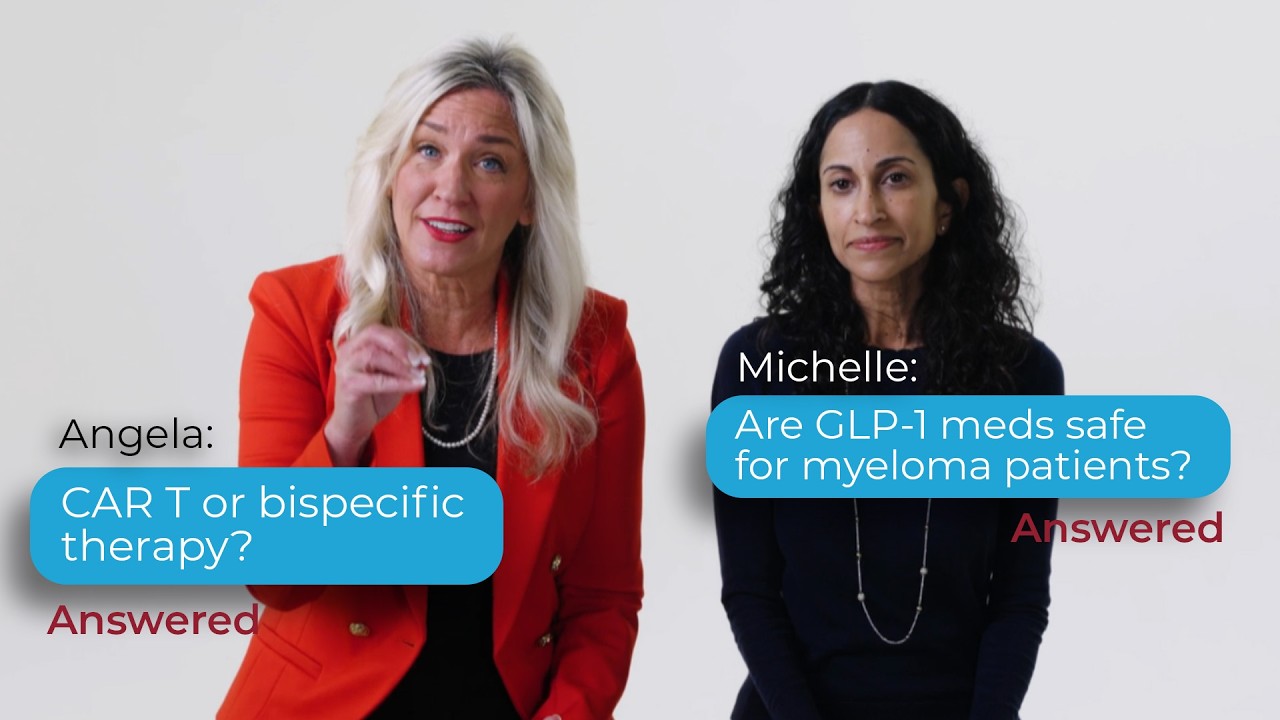
We have a question from Angela. Angela asked, "My husband is 71 and not in great health and has never reached remission. How do you choose between CAR T and bispecific therapy when CAR T feels too invasive?"
Sam Shenoy:
Well, first of all, Angela, I would really want to understand what it is about CAR T therapy that you feel is too invasive, and I encourage you to check out some of the resources we have on the IMF website that really walk you through CAR T and bispecific antibody therapy and what each of the treatments entail. In addition, I would talk to your healthcare provider about these different treatments and what the exact steps would be for each.
So this is a question from Sharon. "My grown children are my care partners and the guilt can feel overwhelming. How do patients cope with feeling like a burden?"
Beth Faiman:
Oh boy, that's a tough question. So there's a natural process when a parent has a child, they're supposed to be the caregiver, but now there's this role reversal that occurs as now the parent has special needs such as taking them to office appointments, making sure that the medications are in line and they're eating well. So that guilt can be overwhelming. Talk with your children about your feelings. Discuss your concerns with the social worker. If you have any more serious depression symptoms, talk to your healthcare team and make sure that they know how you feel because if they don't know how you feel, they can't help you.
Sam Shenoy:
All right, so this is a question from Jeff. "If myeloma can sometimes be found through blood testing, why don't we screen people?"
Beth Faiman:
The simple answer to that question is that there's no evidence that early screening for the whole population for MGUS will improve outcomes. We do know that individuals that have symptoms such as neuropathy or kidney disease or back pain may benefit. In order to screen the whole population, we need to pass a certain threshold like prostate cancer or breast cancer screening, which for a rare condition like MGUS or myeloma, we're not sure we're going to meet that threshold. So if you have concerns or symptoms, that's when we're going to screen you. But other than that, we can't screen the whole population just yet.
Brian asks, "If you stop Revlimid maintenance and your numbers rise, can you go back on it before it becomes a full relapse?"
Sam Shenoy:
Ryan, that's a great question and the answer is a little complicated, so I'm going to say yes and no, but I need a little bit more information. I would want to know, for example, why your Revlimid was stopped. Was it stopped for side effects? Was it stopped because you were maybe going on a longer vacation? I would talk to your provider about answering that question because the other thing to think about is that there's a lot of other great treatments that are out there right now, so you may not need to go back on Revlimid.
This is a great question from Anita. "If bispecific antibodies are used earlier, could they make CAR T less effective later?"
Beth Faiman:
Oh, Anita, that is one of the hottest questions in myeloma today. So you asked if bispecific antibodies are used before CAR T, if it makes the CAR T less effective. If you're using a BCMA-targeted CAR T or BCMA bispecific antibody, the science says when we're engaging those T-cells with that BCMA target, then you can make CAR T less effective. It is important that you get all the information available, talk with your healthcare team, and make the decision that's right for you.
Kenneth asks, "Can bispecific antibodies weaken the immune system and what can patients do to protect themselves from serious infections?"
Sam Shenoy:
Yeah, so Kenneth, bispecific antibodies, specifically those bispecific antibodies that target BCMA, do increase your risk of infection. You are at risk of infection also with bispecifics like Talquetamab that target GPRC-5D, but we do know that the BCMA-targeted bispecifics increase your risk of infection even more. So some of the things that you can do to help prevent infection, you should be on appropriate antimicrobial prophylaxis, and then also you can talk to your provider about IVIG, so intravenous immune globulin.
Okay, this next question is from Michelle. "Are GLP-1 weight loss medications safe for myeloma patients, especially those dealing with insulin resistance?"
Beth Faiman:
Michelle, that is an excellent question. The GLP-1 class of drugs have been used to treat not only diabetes, but also have been used to treat other conditions such as excessive weight in people that need weight loss or have insulin resistance. There have been numerous studies, including ones from the American Society of Hematology in 2025, that suggest that these drugs are safe for myeloma patients and may delay the onset of patients from getting MGUS2 myeloma. So stay tuned on the research, but the short answer is yes, that the GLP-1 drugs are safe for myeloma patients, and you should discuss all your concerns with your healthcare provider, of course.
So while GLP-1 type drugs are safe, and I know I keep saying this, but discuss with your healthcare provider, and especially in this situation, as you can get these drugs from numerous different outlets, make sure your healthcare team knows exactly what medications you're taking at all times.
Darrell asked, "Can bispecific therapies increase the risk of serious lung infections like pneumonia or bronchiectasis?"
Sam Shenoy:
Yes, Daryl, they definitely can, and it's really important because of the risk that bispecific antibodies do increase your risk of infection, as with many multiple myeloma therapies that you speak to your healthcare provider about the most appropriate prophylaxis and other things like intravenous immune globulin that can help prevent infection. It's also really important to report any signs or symptoms of infection so that we can catch any infection early and treat it appropriately.
And here's our last question for today from Tom, "Is multiple myeloma hereditary, environmental, or both?"
Beth Faiman:
That's an excellent question, Tom. So when we think about hereditary cancers, we think about breast cancer, for example, passed down from the mother to the child and that person will have a BRCA gene. We think about lung cancer where that's passed down from the parent to the child and there's a gene. We don't have a known gene in multiple myeloma. We think the environment causes changes to cells, which leads to the myeloma diagnosis, but we don't think of it as hereditary.
Do you have any questions that you'd like us to answer? Comment below with #asktheimf and join us in an online or in-person program. You can visit events.myeloma.org to find upcoming virtual and in-person seminars and workshops.
Sam Shenoy:
If you like these videos, please subscribe to the International Myeloma Foundation's YouTube channel. And to learn more about myeloma or how the International Myeloma Foundation can support you, visit us at myeloma.org.
Beth Faiman:
Are you looking to dive deeper and understand multiple myeloma from the ground up? We recorded a full Myeloma 101 presentation for you.
Sam Shenoy:
It's a 40-minute session designed for patients and families walking through what myeloma is, what causes it, how it's diagnosed, and the latest treatment options available today.
Beth Faiman:
We also cover important topics like risk factors, the difference between MGUS, smoldering, and active myeloma, and how we use tools like slim crab criteria to guide diagnosis and care.
Sam Shenoy:
So if you're newly diagnosed or just want a clear understanding, this is a great place to start.