

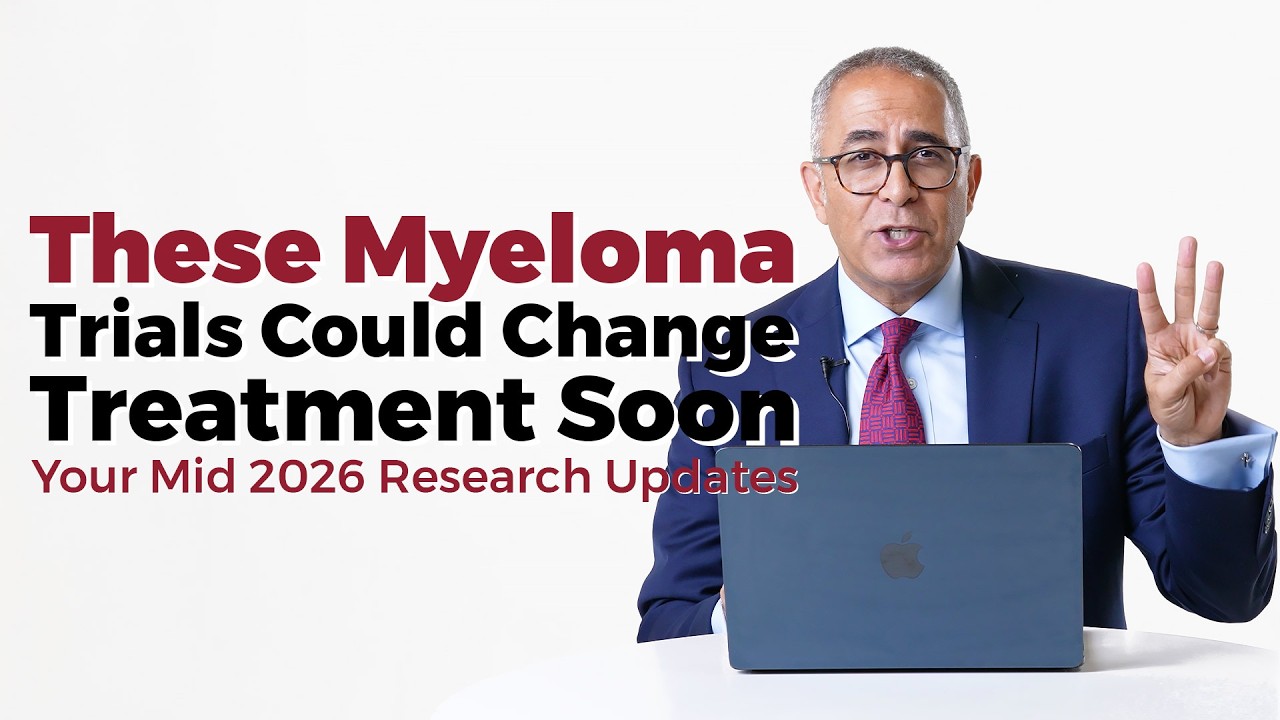
Myeloma research continues at an incredible pace. Questions are being asked, such as: Should we treat high-risk smoldering myeloma with new immunotherapies? What is the best frontline therapy for multiple myeloma? Can we use bispecific antibodies by themselves in early relapse? These and more are the questions that myeloma researchers are trying to answer—and are answering—and they have been a huge part of the recent major conferences of ASCO and EHA.
ASCO stands for the American Society of Clinical Oncology, and EHA is the European Hematology Association. In addition to that, we had our own International Myeloma Working Group Summit in Stockholm in June. I’m going to take the best of those meetings that relate to multiple myeloma and share them with you today, so that you and those you love can learn more about what’s happening at the cutting edge of research in multiple myeloma.
Hi, everybody. Dr. Joe here from the International Myeloma Foundation. It’s my privilege today to give you a quick review of the major updates that came to us from ASCO, EHA, and the IMWG Summit. Just before I start, let me remind you to subscribe to our YouTube channel. When you do that, you’ll be kept up to date, and you’ll help others stay up to date on the latest and greatest in multiple myeloma.
All right, let’s dive in. I’m going to start with three very important clinical trials. It’s easy to remember three trials because they were all phase 3 trials. You may remember that phase 3 clinical trials are really the highest form of evidence. This is when we compare a new strategy with the standard of care. Phase 3 trial number one was called MonumenTAL-3.
This was actually highlighted among the top abstracts of the meeting. This study brought in talquetamab, a bispecific antibody that we typically use in late-relapse disease, and moved it earlier in combination. Just as a quick review, bispecific antibodies are drugs that grab onto the myeloma cell and also onto a local T cell, engaging it to help destroy the multiple myeloma.
What’s unique about talquetamab is that it targets a unique target on the myeloma cell called GPRC5D. We can use it now as monotherapy, or by itself, in very late relapse after four prior lines of therapy. But in this MonumenTAL-3 study, they brought it into earlier relapse and combined it with daratumumab, plus or minus pomalidomide, and compared it with what we would typically do in early relapse: use a combination like DPd, or daratumumab, pomalidomide, and dexamethasone.
Well, the results were striking. Whether it was talquetamab plus daratumumab plus pomalidomide, or just talquetamab and daratumumab, both of those arms did so much better than the DPd arm. In fact, we saw that at the three-year time frame, over 80% of these patients were still in remission, compared with 30% of patients receiving the usual triplet.
I think this study is really important because we’re going to see a further move toward bringing bispecific antibodies not just into late relapse, but earlier into relapse. We’ll also bring them in combination so that we can get a deeper and more durable response. There were side effects, of course, that we’re still learning to minimize with the use of talquetamab, but we saw considerably fewer infections with this combination than we’ve seen before.
Phase 3 trial number two was also with a bispecific antibody and was also used in earlier relapse. It’s called the MajesTEC-9 trial. The MajesTEC-9 trial took teclistamab, another bispecific antibody that targets BCMA, and used it by itself, comparing it with the usual drugs that we use in early relapse. This is a follow-up to a study that you may have heard me talk about last year after our annual American Society of Hematology meeting, where teclistamab was partnered with daratumumab.
Some would say, “Well, by the time we get to relapse, some patients have already had their daratumumab.” So, they did this study to look at teclistamab alone. Again, the results were impressive. At 18 months, we saw that 70% of patients were still in remission—much, much better than the patients who received the triplet or doublet with which it was compared.
I think this will be particularly important. We anticipate that, just as I mentioned with the talquetamab study, these two drugs in these formats will likely be FDA-approved in the near future for us to use earlier in the disease course, so that we have more options for patients. We can bring the strength of these bispecific antibodies not only to late relapse, but also to early relapse.
The final phase 3 clinical trial also has a great name. I love these names: MonumenTAL, MajesTEC, and now SUCCESSOR-2. The SUCCESSOR-2 trial introduces a new drug that we do not yet have FDA-approved, from a new class of drugs that is also not yet FDA-approved, although we hope to see them this year.
They’re called CELMoDs. CELMoDs are pills. They’re oral drugs that are like the next generation of immunomodulatory drugs. The two drugs in the CELMoD class are called iberdomide and mezigdomide. Mezigdomide—if you’re a soccer fan, we sometimes call it “Mezi,” or “Messi,” for short—was the one studied in the SUCCESSOR-2 trial. Mezigdomide was combined with carfilzomib and dexamethasone and compared with carfilzomib and dexamethasone alone in relapsed multiple myeloma.
Most patients had received two or three prior lines of therapy, but some patients had received even more lines of therapy than that. The results were also very impressive. Patients who received this novel combination stayed in remission for an average of 18 months, whereas it was only eight months with carfilzomib and dexamethasone alone. This will almost definitely lead to an approval of these CELMoDs—mezigdomide in particular—quite likely late in 2026, and give us yet another option to treat patients, especially an option that is easily accessible because it is a pill and does not require people to come into the clinic so regularly.
Well, there you have it: an amazing set of phase 3 clinical trials that were truly the highlight of the myeloma abstracts at the American Society of Clinical Oncology and the European Hematology Association meetings. But don’t run away yet, because I’m going to fill you in on some of the other amazing abstracts that will very much change the course of multiple myeloma in the months and years to come.
Before I continue, I want to talk for a moment about clinical trials. I just shared with you three practice-changing phase 3 clinical trials, and the only reason we have these great drugs and can bring them into the clinic is because patients with multiple myeloma have participated in clinical trials. Sometimes we hear “clinical trials,” and it may scare some people. They may think, “Am I just going to be a guinea pig? Am I going to receive a placebo?”
That’s not how we do it in multiple myeloma. This is an opportunity to have access to therapies that could likely change the way we treat multiple myeloma. We encourage you to learn more about clinical trials, come to our IMF events where we discuss them, and search for clinical trials that could be available to you through the IMF’s clinical trial matching engine, powered by SparkCures. We have a search engine built into our website that can help you find clinical trials close to you. As we move closer and closer to a cure for multiple myeloma, clinical trials are going to be critical to providing that cure for our patients in the future.
Well, let’s get back to the science. In the introductory part of this review of ASCO and EHA, I shared with you three huge phase 3 clinical trials.
Now, let me tell you about some other very influential studies that are very likely going to change the way we think about and treat myeloma. Several trials are looking at smoldering myeloma—that phase of myeloma before it becomes true, active myeloma—using bispecific antibodies, particularly elranatamab and linvoseltamab. These drugs are being studied to see whether we can intervene early enough to catch this disease so that it never becomes active multiple myeloma.
Some of those preliminary studies are underway, and I think they will change the way we think about high-risk smoldering multiple myeloma. In the frontline setting, we saw several studies bringing drugs that we’ve historically used later in the disease course into the frontline. One in particular I’d like to highlight is belantamab mafodotin. You may remember that belantamab mafodotin, sometimes called “bela,” is an antibody-drug conjugate.
It’s a drug that hooks onto a myeloma cell, as antibodies do, but conjugated—or attached—to it is a toxin that it drops into the cell to help destroy it. It’s now approved in relapsed myeloma, but several studies were presented in which it was brought into the frontline, adding it to VRd—Velcade, Revlimid, and dexamethasone—or DRd—daratumumab, Revlimid, and dexamethasone—the combinations we often use.
We’re still sorting out the exact dosing of this drug, but I think it’s something we’re going to be able to offer patients in the frontline setting in the near future. Furthermore, looking to the future, I was very excited to see the number of novel ways of treating multiple myeloma that are being developed.
Let’s take CAR T, for example. CAR T-cell therapy has changed the way we treat myeloma, and many patients are living longer and better because of it. But can we make even better CAR T-cell therapy? One approach is to use a new target. Right now, the two CAR T-cell therapies we use target something on the outside of the myeloma cell called BCMA. But now we have a new target, GPRC5D, and we saw updates from a drug called arlocabtagene autoleucel, or arlo-cel, that is being developed to target that part of the myeloma cell.
We know CAR T-cell therapy is great, but most patients sadly still relapse later. Having another CAR T that can target the cell differently will be really important. Furthermore, we saw an update on so-called in vivo CAR T. What does that mean? Right now, when we do CAR T-cell therapy, we take T cells out of a patient.
We train them to know what their myeloma looks like, or we treat them so that they have a receptor on their surface that is specific to multiple myeloma. Then we give them back to the patient. That takes time. It takes manufacturing, and it requires some extra chemotherapy to be given to the patient before those T cells are given back.
In vivo CAR T means that we directly give patients a drug, and it goes to their own T cells and converts them into CAR T cells. Amazing. We saw this reported last year with only three patients. Now we have 18 patients reported. Incredibly, all 18 achieved MRD negativity in the first month. This is a remarkable therapy, not only because it is very effective—although the numbers are small and we need to validate this in larger numbers—but also because it was safer, in the sense that we saw fewer side effects than we often see with CAR T-cell therapy.
Not to mention, this could make the science of T-cell therapy even more accessible to patients in the future.
Then I’d like to highlight what’s new in bispecific antibodies. We already have four bispecific antibodies approved in multiple myeloma, and that’s wonderful, but there are more coming. One of them in particular is called etentamig. Etentamig is a little different from the other bispecific antibodies because, from the very start, it is given once every four weeks.
Most of our antibodies start weekly, and then maybe we taper them down to every other week or once a month. But here, it is given right off the bat once a month, and we see fewer of the early side effects that we typically see with bispecific antibodies, specifically cytokine release syndrome.
In fact, the study showed two interesting things. First, they could give this drug after someone had received CAR T-cell therapy, which gives us more options after CAR T. Interestingly, when they gave what we call prophylactic tocilizumab—that’s a mouthful, but it simply means giving a drug before the bispecific antibody to prevent a patient from developing CRS—0% of patients developed cytokine release syndrome.
This could make this drug much easier to administer in the community, rather than necessarily in an academic center where many of these treatments are being given now. This is something that is not yet FDA-approved, but I think it provides a little view into the future of what we’re going to be able to do in multiple myeloma.
There is so much more that I could say about other things coming in the future: novel bispecifics, new antibodies, new small molecules, and even something called allo CAR T, where we collect T cells from healthy donors to give to patients. All of these are part of the amazing research going on in multiple myeloma that will inevitably help our patients live longer with this disease, live better with the disease, and bring us closer to a cure.
These are exciting times in multiple myeloma, with so many things going on. Please feel free to reach out to us. Subscribe to the YouTube channel that you see below. If you want to speak to someone, call our InfoLine or come to one of our events, whether in person or virtual. You can learn more about them on our events page.
By the way, if you want to dive even deeper into what’s going on in myeloma research, you may want to check out a webinar that the IMF recently hosted. Three doctors on our board—Dr. Vincent Rajkumar, Dr. Sagar Lonial, and Dr. Nikhil Munshi—shared their thoughts about what was happening in multiple myeloma, moderated by our own Heather Cooper Ortner.
You can click the link here to check it out, and you’ll learn even more about what’s happening in multiple myeloma. I hope you enjoy it.