Phase 1 Clinical Study of the BCMA Nex T CAR T-Cell Therapy
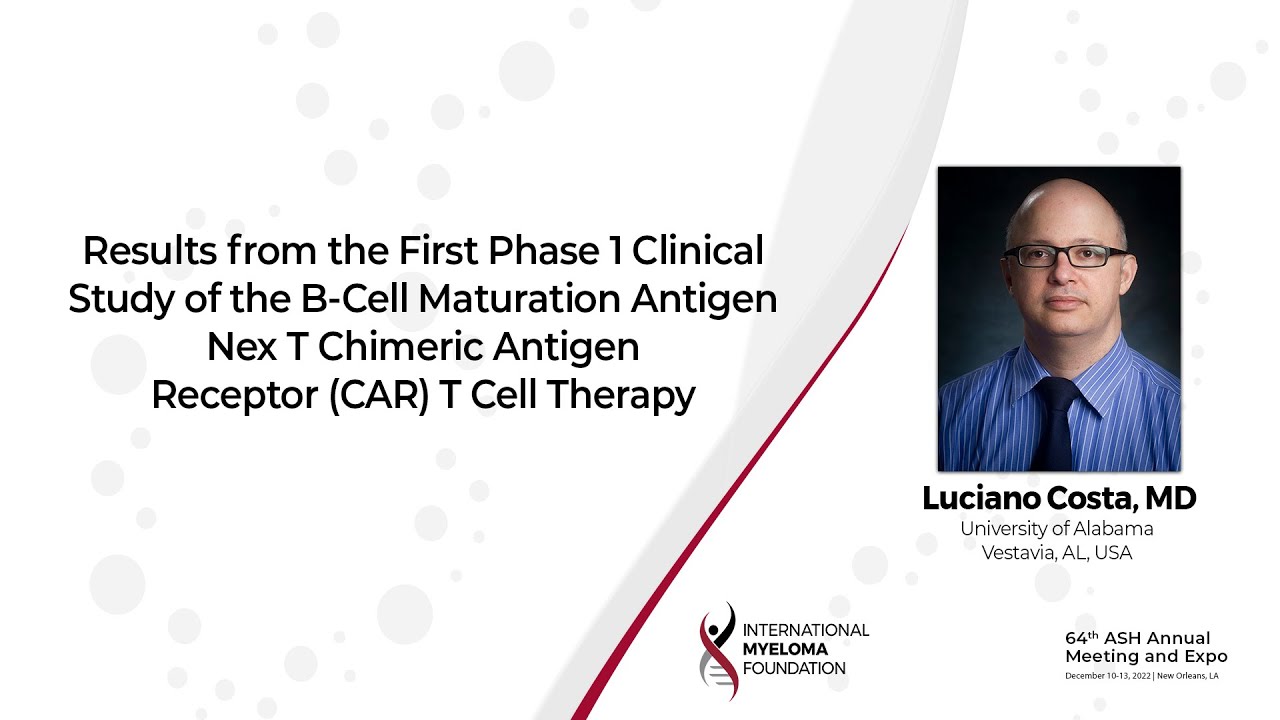
Dr. Luciano Costa presents the results of the first phase 1 clinical study of the B-Cell Maturation Antigen (BCMA) Nex T Chimeric Antigen Receptor (CAR) T Cell therapy CC-98633/BMS-986354 in patients with Relapsed/Refractory Multiple Myeloma (RRMM)
Abstract title:
Results from the First Phase 1 Clinical Study of the B-Cell Maturation Antigen (BCMA) Nex T Chimeric Antigen Receptor (CAR) T Cell Therapy CC-98633/BMS-986354 in Patients (pts) with Relapsed/Refractory Multiple Myeloma (RRMM)
Purpose of the trial:
CC‑98633/BMS-986354 is a next-generation CAR T-cell product that contains the same fully human BCMA-targeted CAR construct as orvacabtagene autoleucel (orva-cel; Harrington K et al. Blood. 2017) and is manufactured using the NEX-T process. The NEX-T process was designed to shorten manufacturing time and improve the potency and phenotypic attributes of the CAR T-cell drug product with the aim of enhancing depth and durability of response. In vivo studies have shown that BMS-986354 is a less differentiated CAR T-cell product with improved potency and tumor control vs orva-cel. Here, we present phase 1 clinical data from the ongoing CC-98633-MM-001 trial (NCT04394650).
Video summary:
This is a multicenter, phase 1 trial investigating BMS-986354 in pts with RRMM who received ≥ 3 prior regimens, including an autologous stem cell transplant, proteasome inhibitor, immunomodulatory drugs, and an anti-CD38 monoclonal antibody. Following leukapheresis, patient T cells were purified and engineered with reduced ex vivo expansion and manufacturing time of 5 or 6 days. Pts received a single BMS-986354 infusion 2–7 days after lymphodepleting chemotherapy (3 days fludarabine [30 mg/m2] and cyclophosphamide [300 mg/m2]).
Conclusions:
BMS-986354, a NEX-T investigational BCMA-targeted CAR T-cell product, is a less differentiated, more potent cellular drug product than orva-cel and can be manufactured with a more rapid processing time. At low doses, BMS-986354 demonstrated a favorable safety profile and promising efficacy, including deep and durable responses in pts with heavily pretreated RRMM. The study continues to enroll patients in the dose-expansion phase. Updated safety, efficacy, and translational data will be presented.
Trial information:
ASH 2022: Abstract #566
Authors:
Luciano J. Megala Costa, MD, PhD, Shaji K Kumar, MD, Shebli Atrash, MD, Michaela Liedtke, MD, Gurbakhash Kaur, MD, Benjamin A. Derman, MD, P. Leif Bergsagel, MD, Sham Mailankody, MBBS, Philip L. McCarthy, MD, Josiana Limones, Yanping Chen, PhD, Sharmila Das, Jerill Thorpe, BS, Jonathan Cacciatore, Garnet Navarro, Ashley K Koegel, Michael R. Burgess, MD, PhD, Kristen Hege, MD and Shambavi Richard, MD